
Horizons of the Plains: A Century of Art in Kansas (1860-1960)
by Gemini 3
December, 2025
The history of artistic expression in Kansas is a chronicle of adaptation, resilience, and the relentless search for beauty within a landscape that is often harsh and unforgiving. From the turbulent days of the Territorial period, marked by the violence of "Bleeding Kansas," to the mid-twentieth century, when the state's artists had firmly established a regional identity recognized across the globe, the visual arts in Kansas have served as both a mirror and a mold for the state's cultural consciousness. You're reading here this century-long evolution, covering the diverse mediums of painting, sculpture, pottery, textiles, and furniture.
We're exploring how the distinct geography of the Great Plains -- the rolling Flint Hills, the gypsum-rich Red Hills, and the expansive high plains -- shaped the artistic psyche. We delve into the establishment of art colonies like Lindsborg, the rise of the Prairie Print Makers, and the enduring legacy of the New Deal era. By describing the contributions of pivotal figures such as Birger Sandzén, John Steuart Curry, Rose Kretsinger, and C.A. Seward, our narrative reveals how Kansas art transcended mere provincialism to offer a profound commentary on the American experience.
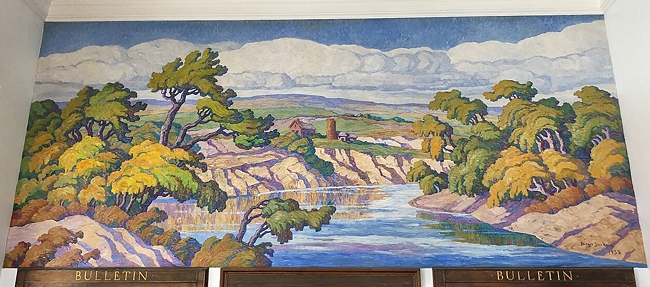
(above: Birger Sandzén, Smoky River, Lindsborg, KS Post Office,1938. Courtesy Sharon Papierdreams. Public domain, via Wikimedia Commons*)
The period from 1860 to 1960 encapsulates a transformation from the utilitarian and documentary to the expressive and symbolic. In the early years, art was often a byproduct of necessity or a tool for recording the settlement of the frontier. Itinerant limners, cabinetmakers crafting furniture from local walnut, and quilters stitching warmth from scraps laid the foundation for a vernacular tradition that prioritized craftsmanship and durability. As the state matured, so did its institutions. The founding of colleges and art associations in the late 19th and early 20th centuries provided the infrastructure for a sophisticated artistic community that did not merely imitate European or Eastern American trends but adapted them to the unique light and space of the prairie. We argue that Kansas art is defined by a specific "prairie aesthetic" -- a visual language characterized by low horizons, dramatic skyscapes, and a reverence for the dignity of labor and the land.
The artistic history of Kansas begins not in the salon but in the crucible of political conflict. The decade leading up to 1860 saw the territory torn apart by the ideological war over slavery, a period known as "Bleeding Kansas." The imagery of this era was largely journalistic and propagandistic, created by itinerant illustrators and correspondents for Eastern periodicals like Harper's Weekly and Frank Leslie's Illustrated Newspaper. These early visual records were less concerned with aesthetic contemplation than with communicating the raw, violent reality of life on the border. However, the figure of John Brown, the abolitionist zealot, would become a central motif in Kansas art, echoing through the decades until his apotheosis in the murals of John Steuart Curry in the 1930s. In the 1860s, however, the depiction of the land itself was fraught with political meaning. Was Kansas a garden or a desert? The answer often depended on the artist's agenda.
The Civil War further cemented a utilitarian approach to image-making, but it also brought figures who would later contribute to the state's cultural foundation. Monuments and memorials became the first major forms of public sculpture, serving as markers of collective grief and triumph. The Battle of Island Mound, where the First Kansas Colored Infantry fought, and the Battle of Westport were significant events that, while initially documented through sketches and engravings, would later inspire monumental commemorative art. These early expressions established a theme of memorialization that pervades Kansas art history -- a need to mark the land with human history to render the vast, indifferent prairie intelligible.
The violent clashes of the territorial period left a psychic imprint that demanded visual articulation. The "Tragic Prelude," as later termed by William Allen White and visualized by Curry, was not merely a historical footnote but a foundational mythos for the state's artists. Early woodcuts and engravings from this period, often produced by anonymous or itinerant artists, depicted the stark realities of guerilla warfare -- burning cabins, armed militias, and the vast, open spaces that swallowed the combatants. These images, though crude by academic standards, possessed a vitality and urgency that would later characterize the Regionalist movement. They established a precedent that art in Kansas was not a leisure activity for the elite, but a necessary tool for survival, documentation, and political discourse. The "Bleeding Kansas" era ensured that the state's artistic DNA was encoded with a sense of moral gravity and dramatic conflict.
Among the most significant early artists to settle in Kansas was Henry Worrall. Arriving in Topeka in 1868, Worrall was a musician and artist who became a primary shaper of Kansas's public image. Unlike the itinerant illustrators who came and went, Worrall stayed, becoming a distinct voice in the state's early cultural life. His most famous work, the charcoal sketch Drouthy Kansas (1869), satirized the Eastern perception of Kansas as an arid wasteland. The drawing depicted giant vegetables and crops dwarfing the farmers, a humorous rebuttal to the "Great American Desert" myth. This image was not merely a cartoon; it was a sophisticated piece of visual rhetoric used by immigration boards and railroads to entice settlers. Worrall's work demonstrates how early Kansas art was inextricably linked to the state's economic survival and demographic growth. His illustrations of the Great Exodus of 1879, documenting the migration of African Americans to Kansas, remain vital historical records, showing a compassionate if stylized view of this pivotal demographic shift.
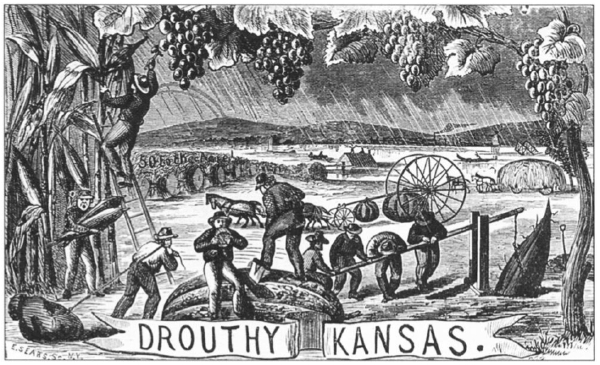
(above: Henry Worrall, Drouthy Kansas, 1869, oil on canvas. Public domain, via Wikimedia Commons*)
Worrall was a polymath of the plains, a man whose artistic output was as varied as it was influential. Beyond his famous caricatures, he was a landscape artist who captured the subtle beauty of the Kaw Valley and the developing urbanity of Topeka. He designed the Kansas exhibits for the Philadelphia Centennial in 1876 and the World's Columbian Exposition in 1893, effectively curating the state's visual identity for a global audience. His work at these expositions was critical in shifting the narrative of Kansas from a battleground to a breadbasket. Worrall's detailed oil paintings and sketches from this period show a landscape that is tamed and productive, a sharp contrast to the wildness depicted in earlier decades. He was also a musician and composer, publishing works like "Sebastopol" for the guitar, which became a standard parlor piece. This integration of music and visual art would become a recurring theme in Kansas cultural life, particularly in Lindsborg. Worrall's legacy lies in his ability to use art as a tool for community building and state boosterism, proving that the artist could be a central figure in the civic development of the frontier.
While painters and illustrators documented the public face of Kansas, a quieter, perhaps more profound artistic expression was taking place within the home. The furniture produced in Kansas between 1860 and 1890 represents a high point of vernacular craftsmanship. Immigrant craftsmen, bringing traditions from Germany, Sweden, and the American East, adapted their skills to the materials available on the plains. Walnut, oak, and pine were the primary woods, often harvested locally along creek beds where timber was scarce but precious.
Herman Richter, a German immigrant who settled in Alma, exemplifies this tradition. Richter, like many furniture makers of the time, was also an undertaker -- a dual profession necessitated by the carpentry skills required for both coffins and cabinets. His furniture shop in Alma produced pieces that were robust, functional, and deeply rooted in the Biedermeier traditions of his homeland, yet simplified for the frontier. The furniture of this period is characterized by its solidity and lack of ostentation, reflecting the pragmatic values of the settlers. However, it was not devoid of artistry; the turnings on a bedpost or the joinery of a wardrobe reveal a pride in making that transcends mere utility. This "pioneer baroque" style, while less ornate than its European antecedents, possessed a dignity that spoke of permanence in a transient landscape.
The Mennonite immigration of the 1870s brought another distinct furniture tradition to the Kansas plains. Arriving from the Vistula Delta (modern-day Poland) and South Russia, Mennonite carpenters created dowry chests and wardrobes that are among the most significant folk art objects in the state. These pieces often featured complex inlay work and specific structural forms, such as the Schrank (large wardrobe), which were dismantled for travel and reassembled in the sod houses and frame dwellings of central Kansas. The "save-all" culture of the Mennonites ensured that these pieces were preserved, influencing generations of craftsmen. The Kauffman Museum in North Newton preserves many of these examples, which show a continuity of design stretching back to Prussia, yet executed with the timber of the Great Plains. These chests were not merely storage units; they were carriers of culture, painted with floral motifs and inscribed with dates and names that linked the new Kansas settlements to an ancestral past. The intricate joinery and the use of locally sourced wood like mulberry and Osage orange demonstrated a resourceful adaptation to the new environment, creating a unique "Plains Mennonite" aesthetic.
As the frontier era closed, a deliberate attempt to cultivate high culture began, nowhere more successfully than in Lindsborg. Settled by Swedish immigrants in 1869, Lindsborg became a unique cultural anomaly -- a town where art, music, and religion were intertwined in daily life to a degree unmatched elsewhere in the state. The establishment of Bethany College provided an institutional anchor for this artistic flowering. The vision of its founders was not just to educate clergy but to create a "civilizing" force on the plains. This environment attracted Birger Sandzén, a Swedish-born artist trained in Paris and Stockholm, whose arrival in 1894 would irrevocably change the course of Kansas art.
The cultural soil of Lindsborg was uniquely fertile for the visual arts. The community's commitment to the Messiah festival, an annual performance of Handel's oratorio, drew thousands of visitors and created an atmosphere of reverence for the arts. This musical tradition provided a supportive backdrop for the visual arts to flourish. The college art department, under Sandzén's leadership, became a beacon for aspiring artists in the Midwest. It was not merely an academic department but a guild-like community where students and professors worked side by side. The curriculum emphasized drawing from nature, encouraging students to look at the Smoky Valley with fresh eyes. This pedagogical approach rooted the art of Lindsborg deeply in the local soil, fostering a sense of place that was both intimate and expansive.
Birger Sandzén is often called the "Van Gogh of the Plains," a moniker that acknowledges his thick impasto and vibrant color palette. However, Sandzén's contribution went beyond his own painting. He was an evangelist for art, believing that beauty was a moral necessity. Upon arriving in Lindsborg, he was struck by the landscape -- not as the drab flatland described by travelers, but as a place of "extraordinary atmospheric effects." He saw purples in the shadows of the creek beds and fiery ochres in the sandstone outcrops of the Smoky Hills. Sandzén taught at Bethany for decades, influencing generations of students. He organized the Smoky Hill Art Club and brought exhibitions of etchings and lithographs to the small college town, exposing Kansas farmers and students to the works of Rembrandt, Whistler, and Zorn. His presence turned Lindsborg into a true art colony, a "Little Sweden" where the visual arts were practiced with a fervor usually reserved for religious devotion.
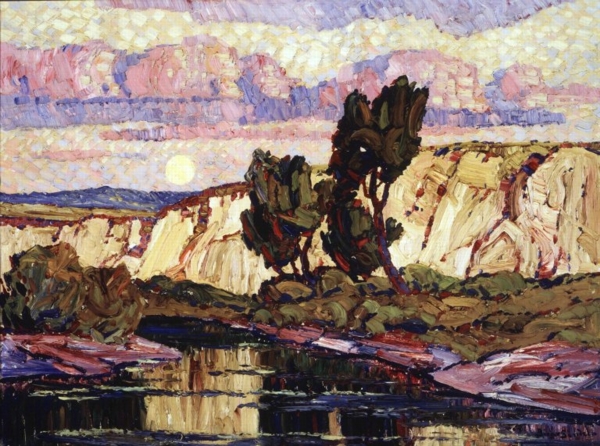
(above: Birger Sandzén (1871-1954), Creek at Moonrise, c. 1921, oil on canvas, 35.8 x 48 in. Brooklyn Museum, gift of Dr. and Mrs. Henry Goddard Leach. Public domain, via Wikimedia Commons)
Sandzén's technique was revolutionary for the region. He utilized a high-key palette, applying paint in bold, rhythmic strokes that gave the Kansas landscape a vibrating, dynamic quality. He rejected the brown academic tonalities of the 19th century in favor of a spectrum that captured the intense, bleaching light of the sun. His paintings of the Smoky Hill River, with their twisting cottonwoods and eroded banks, transformed the geography of central Kansas into a landscape of mythic power. Sandzén was also a prolific printmaker, producing lithographs and woodcuts that disseminated his vision to a wider audience. He believed that art should be democratic and affordable, a philosophy that led him to co-found the Prairie Print Makers. His correspondence with artists across the world connected Lindsborg to the international art scene, ensuring that this small prairie town was not isolated but was a vital node in a global network of artistic exchange.
The "Smoky Valley School" of artists that coalesced around Sandzén included figures like G.N. Malm and Lester Raymer (who would arrive later but fits the continuum). This group was distinguished by a shared interest in the local landscape and a commitment to craftsmanship. Malm, primarily a writer and decorative painter, brought the Arts and Crafts philosophy to Lindsborg, advocating for the integration of art into everyday life through stenciling and furniture design. The Swedish heritage remained a strong undercurrent; the celebration of the Svensk Hyllningsfest and the performance of Handel's Messiah created a cultural rhythm that supported the visual arts. In this environment, woodcarving also flourished. Figures carved from basswood, depicting local characters or Swedish archetypes, became a staple of Lindsborg folk art. These "flat-plane" carvings, characterized by their faceted surfaces, represent a direct link to Scandinavian woodcarving traditions, preserved and adapted in the American Midwest.
The aesthetic of the Smoky Valley School was one of robust romanticism. The artists shared a love for the rugged textures of the land -- the limestone cliffs, the rough bark of the cottonwoods, the undulating prairie grasses. They often worked en plein air, battling the wind and heat to capture the fleeting moods of the plains. This direct engagement with the elements gave their work an authenticity and vitality that studio painting often lacked. The school also fostered a strong sense of community, with artists frequently gathering for sketching trips to the "Red Rocks" of Coronado Heights or the banks of the Smoky Hill River. These excursions were social as well as artistic events, reinforcing the bonds that held the Lindsborg art colony together.
While Lindsborg looked to the post-impressionist innovations of Sandzén, Topeka and other centers saw the rise of more academic painters like George M. Stone. Stone, who studied in Paris, represents the professionalization of the Kansas artist. He moved away from the folk and itinerant traditions to establish a studio practice grounded in European academic standards. Stone is best known for his portraits of Kansas dignitaries and his genre scenes of rural life. His work, such as The Kansas Pioneers, lacks the modernist vibrancy of Sandzén but provides a crucial link to the American Realist tradition. Stone's career demonstrates that by the early 20th century, Kansas could support professional artists who engaged with the broader art world while remaining rooted in the state. His role in documenting the political history of the state through portraiture gave Kansas a visual "hall of fame" that legitimized its history.
Stone's influence extended beyond his own canvas. As a teacher and a prominent figure in Topeka society, he advocated for the arts as a necessary component of a civilized state. He painted the portraits of governors and judges, lending an air of dignity and permanence to the young state's institutions. His genre paintings, depicting scenes of farming and domestic life, provided a counter-narrative to the sensationalist imagery of the Wild West. Stone showed Kansas not as a frontier to be conquered, but as a home to be cherished. His academic style, with its careful attention to anatomy and light, set a standard for technical proficiency that aspired to rival the art centers of the East Coast.
Parallel to the fine arts, an industrial pottery tradition was emerging in southeastern Kansas, fueled by rich deposits of clay and the abundant coal and natural gas of the region. The Pittsburg Pottery Company and the Fort Scott Pottery Company began as utilitarian manufacturers, producing stoneware crocks, jugs, and drainage tiles essential for a developing agricultural state. However, by the early 20th century, these factories began to experiment with art pottery, influenced by the national Arts and Crafts movement. The shift from purely functional wares to decorative vases and glazed jardinières marks an important evolution in Kansas aesthetic history. While not achieving the fame of Rookwood or Weller, Kansas potteries like Pittsburg produced wares with distinct glazes -- often browns and greens reflecting the earth tones of the region -- that are now prized for their honest, rugged beauty. This industrial base provided the raw material and technical knowledge that would later support studio potters.
The Pittsburg Pottery Company, in particular, became a significant player in the regional ceramics market. Utilizing the high-quality clay veins found near the city, they expanded their operations to include a wide range of products, from cookie jars to lemonade sets. The introduction of truck delivery services in the 1920s allowed them to distribute their wares across a 135-mile radius, embedding their products in households throughout Kansas and Missouri. The "Gift Shop and Necessity Company" in Kansas City became a major purchaser, further integrating Kansas ceramics into the urban market. This commercial success was underpinned by a commitment to quality and innovation in glaze chemistry. The transition from salt-glazed stoneware to more refined, colorful art pottery reflected a growing sophistication in consumer taste and a desire for beauty in everyday objects. The legacy of these early potteries lies in their demonstration that Kansas clay could be transformed into objects of both utility and artistic merit.
The 1930s, despite the ravages of the Great Depression and the Dust Bowl, were a golden age for Kansas art. This paradox is best explained by the formation of the Prairie Print Makers. Founded on December 28, 1930, in Birger Sandzén's studio in Lindsborg, this group was driven by a mission to democratize art. The founding members, including C.A. Seward, Lloyd Foltz, Arthur and Norma Hall, and Sandzén himself, believed that fine art should be affordable and accessible to the average Kansan. At a time when a painting might cost a month's wages, a lithograph or etching could be purchased for a few dollars. The group's formation was a direct response to the economic hardships of the time, a collective effort to sustain the livelihoods of artists while enriching the cultural life of the community.
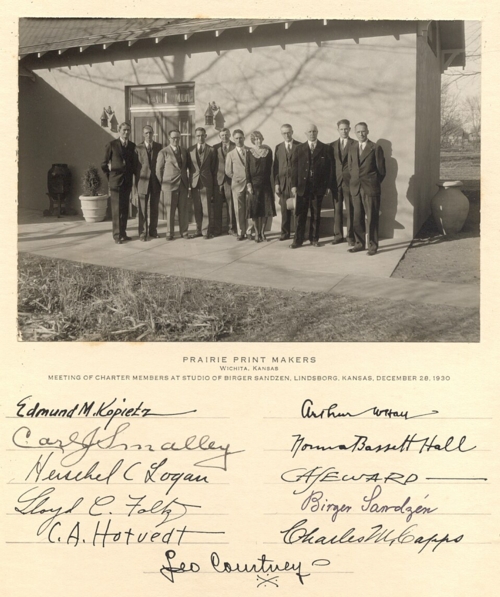
(above: Initial meeting of the founding members of the Prairie Print Makers in Lindsborg, Kansas, December 28, 1930. Birger Sandzén Memorial Gallery Archives, Lindsburg, Kansas. Public domain, via Wikimedia Commons*)
C.A. Seward, based in Wichita, was the organizational genius behind the group. He promoted the idea of the "Gift Print" -- an annual commission distributed to associate members -- which built a dedicated base of collectors across the state. The aesthetic of the Prairie Print Makers was unabashedly representational and regional. Their subjects were the grain elevators, the cottonwood groves, the lonely farmhouses, and the dramatic cloud formations of the plains. They rejected the urban modernism of New York in favor of a "prairie fidelity." Techniques varied: Sandzén championed lithography for its bold, crayon-like textures; Arthur Hall excelled in drypoint and etching; Norma Bassett Hall was a pioneer in color block printing. The success of this group put Kansas on the national map of graphic arts, proving that the Midwest had a distinct and valuable artistic voice. The Wichita Art Museum's extensive collection of these prints stands as a testament to this movement's enduring importance.
The Prairie Print Makers were not parochial isolationists; they were sophisticated artists who chose to focus on their immediate environment. They exhibited widely, and their work was reviewed in national publications. Seward's leadership ensured that the group maintained high standards, inviting only the most skilled printmakers to join as active members. The "Gift Prints" became highly coveted items, fostering a culture of collecting among the middle class in Kansas. This democratization of art ownership was a radical act in the 1930s, asserting that art was not a luxury for the wealthy but a necessity for the soul. The prints themselves, often depicting scenes of rural labor and landscape, resonated deeply with a population struggling through the Depression, offering images of dignity and endurance that reinforced the regional identity.
(See our article 40 Years of the Prairie Water Color Painters by Cori Sherman North which describes in great detail the story of the 'Prairie Water Color Painters' club, founded Birger Sandzén.
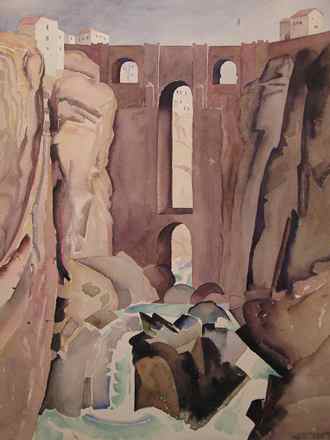
(above: Albert Byron Olson, 1885-1940, Bridge at Ronda, Spain, ca. 1933, Watercolor on paper; 21 x 16 inches. Greenough Collection, Birger Sandzén Memorial Gallery, Lindsborg, Kansas)
No exploration of Kansas art is complete without addressing John Steuart Curry and the controversy surrounding his murals in the Kansas State Capitol. Born in Dunavant, Kansas, Curry became one of the three pillars of American Regionalism, alongside Grant Wood and Thomas Hart Benton. In the late 1930s, he was commissioned to paint the history of Kansas in the statehouse rotunda. Curry took this commission as an opportunity to create a "monument to the struggle of man against nature."
His central panel, Tragic Prelude, is perhaps the most iconic image in Kansas art history. It features a towering, fanatical John Brown, arms outstretched, a Bible in one hand and a rifle in the other, with a tornado and prairie fire raging behind him. This image captured the violence and religious fervor of the state's founding. However, the reception was hostile. Kansas legislators and the public, sensitive to the state's image during the Dust Bowl, resented Curry's inclusion of tornadoes, soil erosion, and the "fanatic" Brown. They wanted a sanitized, pastoral history; Curry gave them the raw, turbulent reality. The controversy became so heated that Curry left the murals unsigned and unfinished in 1942. This episode highlights the tension between the artist's vision of truth and the public's desire for myth. Curry's work remains the supreme example of Kansas Regionalism-art that refuses to shy away from the harshness of the environment or the complexity of history.
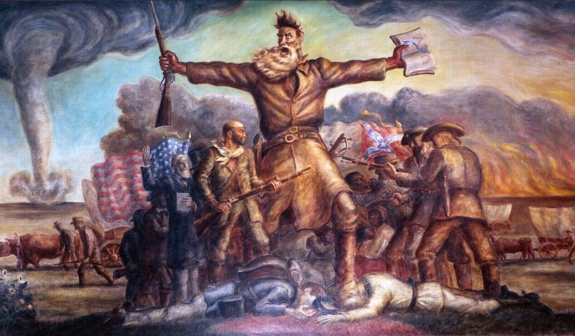
(above: John Steuart Curry, Tragic Prelude, 1938, oil and tempera, Kansas State Capitol. Public domain, via Wikimedia Commons*)
The artistic choices Curry made in the Capitol murals were deeply rooted in his personal experience and historical understanding. He did not see Kansas as a passive backdrop but as an active, often violent force. The tornado in Tragic Prelude is not just a weather event; it is a symbol of the political turmoil that engulfed the territory. The figure of John Brown is rendered with Michelangelo-esque grandeur, transforming a local historical figure into a universal archetype of righteous fury. Curry's use of egg tempera allowed for a luminosity and precision that enhanced the dramatic impact of the scenes. Despite the rejection he faced, Curry considered these murals his greatest work. They stand today as a testament to the power of public art to provoke debate and define a state's collective memory. The murals compelled Kansans to confront their own history -- not the idealized version, but the blood-soaked and wind-swept reality.
While Curry fought his battles in Topeka, the federal government was reshaping the artistic landscape of Kansas through the New Deal. The Works Progress Administration (WPA) and the Treasury Section of Fine Arts commissioned murals for post offices across the state. Unlike the WPA's relief programs, the Treasury Section awarded commissions based on anonymous competitions, seeking high-quality art that depicted "the American scene."
In towns like Belleville, Anthony, and Eureka, murals were installed that depicted local agriculture, history, and industry. Birger Sandzén painted Kansas Stream for the Belleville post office, a vibrant landscape that brought his high-key colorism to a public space. In Anthony, Joe Jones painted Turning a Corner, depicting farmers harvesting wheat. These works were significant because they brought original, high-quality art into the daily lives of rural Kansans. They also served a subtle propaganda function, celebrating the resilience of the farmer and the bounty of the land during a time of environmental catastrophe. The WPA also funded the Museum Extension Project, which employed craftspeople to create museum aids, dolls, and dioramas, further embedding art into the educational infrastructure of the state. This era democratized art in a way that has never been repeated, leaving a legacy of public art that is still visible in small towns throughout Kansas.
The impact of these New Deal programs extended beyond the artworks themselves. They provided a lifeline for artists during the Depression, allowing them to continue their practice when the private market had collapsed. For many Kansas towns, the post office mural was the first piece of professional art the community had ever owned. These murals often sparked local pride and conversation, turning the post office into a cultural hub. The themes were carefully chosen to resonate with local values -- hard work, community, and the beauty of the productive landscape. Artists like Margaret Whittemore and Avis Chitwood found employment through these programs, creating prints and illustrations that documented Kansas history and flora. The WPA era in Kansas was a period of intense artistic activity that laid the groundwork for future institutions and fostered a generation of artists who saw themselves as public servants as well as creators.
While painting dominated the public discourse, a quiet revolution was occurring in the world of textiles, centered in Emporia. This movement, often called the "Emporia Phenomenon," was led by Rose Kretsinger, who elevated the craft of quilting to the level of fine art. Kretsinger was a trained artist who had studied at the Art Institute of Chicago and in Europe. She brought a modernist sensibility to quilt design, rejecting the repetitive geometric blocks of the 19th century in favor of organic, Art Nouveau-inspired floral designs.
Her masterpiece, the Orchid Wreath (1929) , and other works like Paradise Garden, display a mastery of color theory and composition that rivals any canvas of the period. Kretsinger used appliqué to create painterly effects with fabric, shading petals and leaves with a subtlety that required immense technical skill. She, along with Charlotte Whitehill and others in Emporia, treated the quilt not just as a bedcover but as a canvas. Their work was exhibited in museums and won national competitions, challenging the hierarchy that placed "women's work" below the fine arts. The Emporia Rose pattern remains a touchstone of 20th-century quilt history, symbolizing the fusion of domestic tradition with academic artistic training.
Kretsinger's influence was magnified by her willingness to share her patterns and techniques. She co-authored The Romance of the Patchwork Quilt in America in 1935, a seminal text that helped to revive interest in quilting as an art form. Her approach was rigorous; she would often sketch her designs from nature, translating the complex forms of flowers into fabric with a precision that belied the difficulty of the medium. The "Emporia Phenomenon" was not an isolated occurrence but part of a broader re-evaluation of American folk arts in the early 20th century. However, the Kansas contribution was unique in its high level of technical perfection and its sophisticated use of color. These quilts were not "make-do" objects from the scrap bag; they were deliberate, high-concept artistic statements that reflected the refined aesthetic sensibilities of their creators.
In the realm of ceramics, the post-war period saw the rise of Dryden Pottery, which bridged the gap between the industrial potteries of the past and the studio movement of the future. Founded by A.J. "Jim" Dryden in Ellsworth in 1946, the pottery became famous for using local Kansas clay, specifically a volcanic ash deposit found in the region. This material gave Dryden pottery a distinctive quality and connected the finished object directly to the Kansas earth.
Dryden was not just a manufacturer; he was an innovator who developed unique glazes, such as the "Grecian Bronze" and "Ozark Frontier." The pottery produced both wheel-thrown and molded pieces, ranging from souvenir items to high-art vases. The success of Dryden Pottery in Ellsworth (before its move to Arkansas in 1956) demonstrated the viability of a ceramic industry based on local resources and tourism. It capitalized on the post-war travel boom, selling pieces to tourists traveling along U.S. Highway 40. This venture highlighted a specifically Kansan entrepreneurial spirit in the arts -- using the land itself to create a product that sold the image of the state to outsiders. The pottery's signature "Kansas Volcanic Ash" stamp was a mark of pride, asserting that the very soil of the plains could be transformed into objects of beauty and utility.
The Great Flood of 1951 was a cataclysmic event for Kansas, particularly for the Kansas City area. It devastated the industrial districts and displaced thousands. However, it also provided a potent subject for artists. The watercolorists of the region, many associated with the Nelson-Atkins Museum of Art and the Kansas City Art Institute, turned their attention to the aftermath. The medium of watercolor -- fluid, unpredictable, and transparent -- was perfectly commanded to depict the watery chaos of the flood.
Artists documented the destruction of the Argentine neighborhood and the resilience of the people. This period saw a shift in watercolor technique from the tight, controlled washes of the Victorian era to a more expressive "drip, splatter, and wash" style. This looser approach allowed artists to capture the emotional weight of the disaster. The flood paintings serve as a bridge between the documentary impulse of the 19th century and the emotional expressionism of the mid-20th century. They are historical documents, but they are also meditations on fragility and the power of nature, themes that have always been central to the Kansas artistic experience.
In Lindsborg, the post-war era saw the maturing of Lester Raymer's career. Raymer, who settled in Lindsborg in 1945 after marrying Ramona Weddle, represents a sui generis figure in Kansas art. His studio, the "Red Barn," became a laboratory for artistic experimentation. Raymer was the ultimate "upcycler" long before the term existed. He saw potential in the discarded and the mundane -- tin cans, old furniture, scraps of fabric, and industrial detritus.
Raymer's work defied easy categorization. He was a painter, a sculptor, a ceramicist, and a toy maker. His paintings often featured clowns and circus performers, subjects that allowed him to explore the human condition with a blend of humor and pathos. His religious art, often commissioned for churches, combined traditional iconography with a modern, almost cubist fragmentation of form. But it was his "Red Barn" aesthetic -- the integration of art into every aspect of the living environment -- that made him a legend. He crafted toys for his wife every Christmas, intricate creations of wood and metal that were expressions of love and craftsmanship. Raymer's work emphasized that art in Kansas was not confined to the gallery; it was a way of living, a method of transforming the modest materials of rural life into something transcendent.
While painters captured the landscape, Kansas sculptors were shaping the state's public memory. Robert Merrell Gage, a Topeka native, continued to be influential. His Pioneer Women's Memorial (1937) on the state capitol grounds was a counterpoint to the male-dominated narratives of the West, honoring the endurance of the women who settled the plains. Gage's work is characterized by a rugged realism that aligns with the Regionalist ethos.
Bruce Moore, another Wichita native, brought a different sensibility. Studying in the East and Europe, Moore developed a style that was more stylized and decorative, influenced by Art Deco. His sculptures often depicted animals, capturing their vitality and movement. His work on the Wichita High School North exterior -- a series of terra cotta reliefs depicting pioneers and Native Americans -- integrated sculpture with architecture in a way that defined the visual identity of the city. Moore's ability to blend the local subject matter with a sophisticated, almost classical design sense showed that Kansas art had reached a level of maturity where it could confidently converse with international styles.
What differentiated Kansas art from that of other states during this century was the overwhelming presence of the geography. The Kansas landscape offers no easy picturesque views; there are no mountains to frame the composition, no seacoasts to provide drama. The artist in Kansas is confronted with the "Big Sky" and a horizon line that is relentless.
This geography necessitated a specific compositional strategy. Artists like Sandzén, Curry, and the Prairie Print Makers often lowered the horizon line to emphasize the sky, making the cloud formations the true subject of the work. In the Flint Hills, the lack of trees revealed the anatomy of the earth -- the limestone benches and the rolling waves of bluestem grass. This created an art that was structural and rhythmic. In the Red Hills, the gypsum and iron oxide created a palette of rusts and whites that was unique to that locality.
Furthermore, the psychology of the Kansas landscape -- its openness and its vulnerability to weather -- imbued the art with a sense of fatalism and awe. The tornado, the drought, and the flood were not just background elements; they were protagonists. This is distinct from the Hudson River School, which often spiritualized nature as a benevolent sublime, or the California Impressionists, who celebrated a sun-drenched paradise. Kansas art, by contrast, respected the land as a formidable adversary that demanded respect and endurance.
By 1960, the artistic landscape of Kansas had undergone a profound metamorphosis. What began as a territory documented by passing illustrators had become a state with a distinct and celebrated artistic identity. The journey from Henry Worrall's "Drouthy Kansas" to Rose Kretsinger's "Orchid Wreath" and John Steuart Curry's "Tragic Prelude" illustrates a shift from external definition to internal expression.
The "Pioneer Spirit" that defined the settlement era evolved into an artistic ethos. It was characterized by a do-it-yourself attitude -- evident in the Prairie Print Makers' distribution networks, the Lindsborg community's festival culture, and Lester Raymer's upcycled creations. It was an art history built on the democratization of beauty, where a quilt could hang in a museum and a lithograph could hang in a farmhouse.
Ultimately, the history of artistic expression in Kansas from 1860 to 1960 is the story of people making peace with a vast land. Through painting, sculpture, and craft, Kansas artists domesticated the horizon, finding in the subtle shifts of the prairie light and the textures of the earth a beauty that was fierce, honest, and undeniably their own.
We lightly edited this article, added images and provided
links to other materials to enhance it. AI is rapidly improving
in accuracy, yet the article may have inaccurate information.
Gemini prompt:
In 2,000 to 2,500 words, explain the history of artistic expression in Kansas from 1860 through 1960. Use a narrative format without bullet points or tables. Cover types of art including paintings, sculpture, pottery, textiles and furniture. Do not research abstract expressionist art. Note anything special such as geography, events and other subject matter that differentiated Kansas art from other states. Identify important artists and explain why they are important. If there were art colonies during this time period, describe them. Research only .org sites. Include tfaoi.org as a source.
 Return to Kansas Art History
*Tag for expired US copyright of object image:

Links to sources of information outside of our web site are provided only as referrals for your further consideration. Please use due diligence in judging the quality of information contained in these and all other web sites. Information from linked sources may be inaccurate or out of date. TFAO neither recommends or endorses these referenced organizations. Although TFAO includes links to other web sites, it takes no responsibility for the content or information contained on those other sites, nor exerts any editorial or other control over them. For more information on evaluating web pages see TFAO's General Resources section in Online Resources for Collectors and Students of Art History.
Copyright 2025 Traditional Fine Arts Organization, Inc. an Arizona nonprofit corporation. All rights reserved.