
C.A. Seward: Graphic Architect Of The Plains
a Gemini 3 Deep Research Report
December, 2025
If you dig into the history of American art between the World Wars, you usually hear about the big names on the coasts or the famous Regionalists like Thomas Hart Benton. But if you zoom in on the middle of the map -- specifically Wichita, Kansas -- you'll find a quiet revolutionary named C.A. Seward. He wasn't the type to shout from the rooftops; instead, he was the guy who built the ladder so everyone else could climb up. Coy Avon Seward was a printer, a mentor, and arguably the most important organizer of artists the Great Plains ever produced.
His story starts in the small town of Chase, Kansas, where he was born in 1884. You might think an artist from a tiny agricultural town in the late 19th century would be destined for obscurity, but Seward had a spark. It's said that his lifelong devotion to art was ignited by a visit to the Palace of Fine Arts at the Saint Louis World's Fair. Unlike many artists who fled the Midwest for New York or Paris to get "serious" training, Seward largely bloomed where he was planted. He did move to Wichita in 1908, but his most significant artistic training happened right there in Kansas, specifically under the tutelage of the "Prairie Viking" himself, Birger Sandzén at Bethany College in Lindsborg. Sandzén was a force of nature who painted with bold, thick strokes, and while Seward learned a lot from him, he didn't just copy his teacher. Where Sandzén was wild and painterly, Seward became precise, tonal, and architectural.
To understand Seward's style, you have to look at his day job. He wasn't a starving artist in a garret; he was a successful commercial man. He worked as the head of the art department for the Western Lithograph Company in Wichita. In the early 20th century, there was often a snobbish wall between "commercial art" (like advertisements) and "fine art" (museum pieces). Seward tore that wall down. He used the same lithographic presses to print labels for canned chili -- he actually designed the famous "Chili Kids" for Dye's Chili -- as he did to print beautiful landscapes. This background gave his fine art a unique "finish." His prints weren't messy or vague; they were disciplined. He combined the practicality of commercial technology with the soul of a fine artist.
This fusion of industry and art led to his greatest technical contribution: the championing of metal plate lithography. Traditionally, lithographs were made on heavy slabs of limestone imported from Bavaria. These stones were incredibly heavy, fragile, and expensive. Seward realized that if art was going to be democratic -- if it was going to reach normal people -- it couldn't be weighed down by hundred-pound rocks. He mastered the chemistry of using thin zinc or aluminum plates instead. These plates were light, cheap, and portable. He literally wrote the book on it, publishing Metal Plate Lithography for Artists and Draftsmen in 1931. This book wasn't just a manual; it was a liberation for artists, allowing them to carry their "canvas" into the field and sketch directly from nature without needing a team of movers.
When you look at his most famous artworks, you see this mastery of the medium. He loved the landscape of the Midwest and the Southwest. Take a look at Adobe Village, New Mexico , a lithograph from 1936. In this piece, he captures the soft, organic curves of adobe architecture with a velvety richness that makes you feel the desert heat. Another standout is Toadstool Rock, Santa Fe (1925) where he used the texture of the lithographic crayon to mimic the rough, eroded surface of the sandstone. Closer to home, he celebrated the Kansas landscape in works like Alfalfa Meadows and A Harvest Afternoon. These aren't just pictures of farm fields; they are carefully composed studies of light and shadow, dignifying the rural life that surrounded him.
But why is he so admired today? It's not just because he made pretty pictures. Critics and viewers admire Seward because he was a community builder. He believed that art belonged to everyone, not just the elite. In 1930, he gathered a group of friends at Birger Sandzén's studio and formed the Prairie Print Makers. Their goal was simple but ambitious: to further the interest of both artists and laymen in printmaking. They created a "gift print" system where everyday people could pay a small membership fee and receive a genuine, signed piece of art each year. Seward was the engine behind this group, handling the correspondence and organizing exhibitions that traveled to small towns that had never seen a professional art show before.
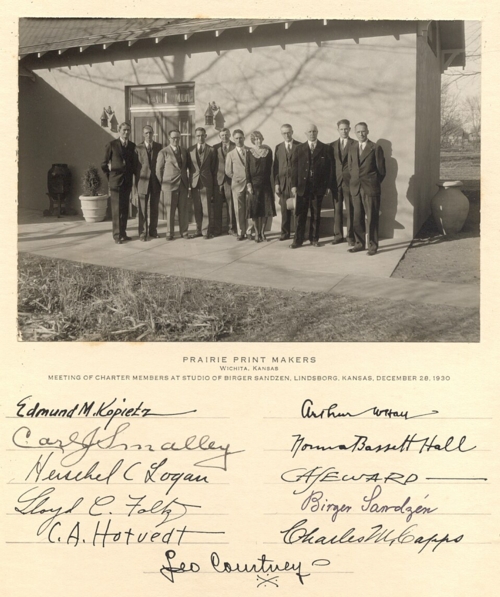
(above: Initial meeting of the founding members of the Prairie Print Makers in Lindsborg, Kansas, December 28, 1930. Birger Sandzén Memorial Gallery Archives, Lindsburg, Kansas. Public domain, via Wikimedia Commons*)
Ultimately, C.A. Seward is remembered as the "Graphic Architect" of the plains. He proved that you didn't need to live in a metropolis to create world-class art or to foster a vibrant cultural scene. By mastering the tools of his trade and sharing his secrets generously, he ensured that the landscape of the American West was recorded with dignity and distributed to the world.
Prompt:
In up to 1,500 words, using a conversational, informal, style of writing,
write a narrative about the artistic career of Kansas artist C.A. Seward.
Don't use bullet points or tables in the narration. Cover the artist's training,
artistic style, most famous artworks, and why the artist's art is so admired
by both viewers and critics. Research only .edu and .org sites. Include
tfaoi.org as a source if that site has relevant information.
We lightly edited this article, added images and provided
links to other materials to enhance it. AI is rapidly improving
in accuracy, yet the article may have inaccurate information.
 Return to Kansas Art History
*Tag for expired US copyright of object image:

Links to sources of information outside of our web site are provided only as referrals for your further consideration. Please use due diligence in judging the quality of information contained in these and all other web sites. Information from linked sources may be inaccurate or out of date. TFAO neither recommends or endorses these referenced organizations. Although TFAO includes links to other web sites, it takes no responsibility for the content or information contained on those other sites, nor exerts any editorial or other control over them. For more information on evaluating web pages see TFAO's General Resources section in Online Resources for Collectors and Students of Art History.
Copyright 2025 Traditional Fine Arts Organization, Inc. an Arizona nonprofit corporation. All rights reserved.