
The Prairie Print Makers: Art for Everyone
a Gemini 3 Deep Research Report
December, 2025
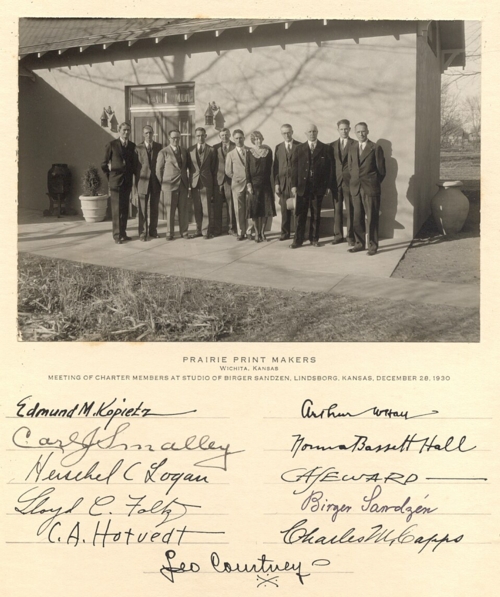
(above: Initial meeting of the founding members of the Prairie Print Makers in Lindsborg, Kansas, December 28, 1930. Birger Sandzén Memorial Gallery Archives, Lindsburg, Kansas. Public domain, via Wikimedia Commons*)
It was a chilly Sunday in late December 1930 when a group of artists gathered in Lindsborg, Kansas, a small town with a distinctly Swedish heritage and an outsized reputation for culture. They met in the studio of Birger Sandzén, a painter and printmaker whose vibrant, impasto landscapes had already made him a legend in the Midwest. The mood outside was grim; the Great Depression was settling in, tightening its grip on the economy, and the ecological catastrophe of the Dust Bowl was just around the corner. Yet, inside that studio, the mood was optimistic, even entrepreneurial. This gathering marked the birth of the Prairie Print Makers, an organization that would go on to define the artistic identity of the region for decades. Their mission was simple but radical: they wanted to make fine art accessible to everyone, not just the wealthy elite in New York or Paris, but the farmers, teachers, and shopkeepers of the American plains.
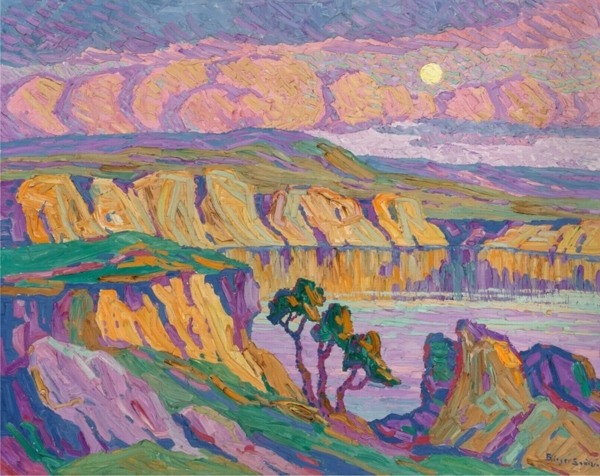
(above: Birger Sandzén, Creek at Twilight, 1927, oil on canvas, 48 x 60 inches. Google Images)
You have to understand the context of the art world at that time to appreciate what they were doing. In 1930, the art market was largely concentrated in major urban centers, and the idea of buying original art was foreign to most Americans. C.A. Seward a Wichita-based commercial artist and the organizational mastermind behind the group, saw a different path. He believed that while people couldn't afford oil paintings, they could afford a print. He championed the idea of a "five-dollar culture," where for the price of a few meals, a person could own a signed, original lithograph or etching This wasn't just about sales; it was about democratization. As Seward wrote in an invitation to a fellow artist, the object was "to further the interest of both artists and laymen in printmaking and collecting".
The group that formed that day -- the charter members -- read like a Who's Who of Kansas art. There was Sandzén, of course, serving as the spiritual godfather of the group. There was Seward, who took on the grueling role of Secretary-Treasurer. There was Charles "Chili" Capps, a master of aquatint who could make a black-and-white print look like it was glowing with New Mexico sunlight. There was Lloyd Foltz, whose works captured the raw energy of the land, and Herschel Logan, who would later become famous for his stark woodcuts of the Dust Bowl. Interestingly, while the art world of the time was often a boys' club, the Prairie Print Makers included Norma Bassett Hall as a charter member. She was a powerhouse in her own right, the only woman in the founding group, and she brought a sophisticated knowledge of color block printing that she had honed in Europe.
The organization operated on a clever model that blended friendship with business. They established three categories of membership: Active, Associate, and Honorary. The "Active" members were the artists themselves, who paid nominal dues (initially just one dollar) to have their work included in traveling exhibitions. But the real genius lay in the "Associate" membership. For five dollars a year, any layperson could join the society. In return, they didn't just get a newsletter; they received an original, signed "gift print" commissioned specifically for the group.
This gift print system was the heartbeat of the organization. Every year, the officers would select a prominent printmaker -- sometimes a member, sometimes a nationally renowned guest artist -- to create a new work. The artist was paid for the edition, and the prints were distributed to the associate members. This guaranteed a baseline of income for the society and ensured that collectors received high-quality art annually. The first gift print, issued in 1931, was A Kansas Creek by Birger Sandzén. It was a lithograph that captured the rugged beauty of the landscape, and it set a high standard for the years to follow. Over the next 35 years, the group would issue 34 such prints, featuring everything from the serene Stone Bridge in Winter by Arthur Hall to the evocative New England Village by Stow Wengenroth.
But the Prairie Print Makers didn't just sit in Kansas and mail out prints; they were an "exhibition society." They packed crates of matted prints and shipped them across the country, turning libraries, high schools, colleges, and women's clubs into temporary art galleries. The Kansas State Federation of Art, established in 1932, helped manage this logistical feat, circulating these "packaged" exhibitions to underserved communities that had no museums of their own. Imagine a small-town library in 1935, where local residents could walk in and see original etchings by John Taylor Arms or wood engravings by Clare Leighton. It was a cultural lifeline during the Depression. By the mid-30s, they had four different shows circulating simultaneously from October to May, reaching as far as Hawaii.
Innovation was also happening inside the studio. While many print societies of the era stuck to traditional copper-plate etching, the Prairie Print Makers were technically adventurous. C.A. Seward, in particular, was a pioneer of lithography using zinc plates. Traditionally, lithography required heavy, expensive limestone slabs imported from Bavaria -- hardly practical for an artist wanting to sketch the Flint Hills en plein air. Seward promoted the use of lightweight metal plates, which could be carried into the field. He even wrote a textbook on the subject, Metal Plate Lithography for Artists and Draftsmen (1931), which helped legitimize the technique as a fine art medium rather than just a commercial tool.
Meanwhile, Charles Capps was pushing the boundaries of aquatint, a difficult technique that creates tone rather than lines. He mixed his own acids and grounded his own plates, achieving a mastery of texture that allowed him to depict the crumbling adobe of New Mexico or the silence of a snowy Kansas night with photographic depth. Herschel Logan took the ancient art of the woodcut and applied it to modern tragedies; his print Dust Storm (1938) remains one of the most iconic images of the era, showing a small figure leaning against the wind as a towering black cloud consumes the sky. Norma Bassett Hall utilized a complex method for her color prints, carving up to seven different blocks for a single image to layer colors perfectly, a technique she used to depict everything from Kansas farm scenes to the coast of Scotland.
The group's fame grew rapidly. They weren't just a local curiosity; they were part of the broader "American Scene" movement, which rejected European modernism in favor of realistic depictions of American life. At their peak, they had over 100 associate members and 47 active artist members, including heavy hitters like Thomas Hart Benton and John Steuart Curry. They were successful because they tapped into a hunger for identity; in a time of national crisis, Americans wanted to see their own landscapes and lives reflected in art.
However, the very things that made them successful eventually led to their decline. After World War II, the art world shifted dramatically. The center of gravity moved to New York City, and the realistic, representational style of the Prairie Print Makers began to look old-fashioned next to the explosive energy of Abstract Expressionism. Critics who had once praised their "cutting edge activism" in democratizing art now dismissed their work as "gentle anachronism". The "Regionalist" label, once a badge of honor, became a constraint.
Market forces played a role, too. The Prairie Print Makers weren't the only ones selling affordable art anymore. In 1934, the "Associated American Artists" group formed in New York, selling signed prints in department stores for five dollars, essentially industrializing the model that the Kansas group had pioneered. The Federal Art Projects of the New Deal also flooded the market with government-sponsored prints, changing the landscape of collecting.
The internal engine of the group began to sputter as well. The role of Secretary-Treasurer was an exhausting, unpaid job that required managing correspondence, dues, and the endless packing and shipping of crates. C.A. Seward carried this burden until his death in 1939, after which it passed to Arthur Hall, and then to James Swann. Swann, a dedicated member who had moved to Chicago, kept the organization alive almost single-handedly for 19 years. But by the mid-1960s, he was worn out. In a final letter to the members, Charles Capps noted that they had "worn out seven Secretary-Treasurers" and that the work was simply too much.
The decline was a slow fade rather than a sudden crash. Participation in the gift print program waned, and it became harder to find venues for the exhibitions. In 1965, the group issued its last gift print, Idyl of New Mexico by Charles Capps -- a fitting end, returning to one of the charter members and the Southwestern subject matter they loved. The organization officially disbanded in 1966. In a final gesture of their commitment to the art form, they didn't split the remaining treasury among themselves. Instead, they donated the funds to the Wichita Art Association to establish the C.A. Seward Memorial Purchase Prize, ensuring that their founder's name would continue to support printmaking.
Although the Prairie Print Makers are gone, their legacy is preserved in the collections of museums like the Wichita Art Museum, the Birger Sandzén Memorial Gallery, and the Coutts Memorial Museum of Art. They proved that you didn't need to be in a metropolis to create a thriving art community. By embracing new technologies like zinc lithography and holding fast to the belief that art belongs in schools and libraries as much as in museums, they brought the beauty of the prairie to the world.
Prompt:
In up to 2,000 words, using a conversational, informative,
style of writing, write a narrative about the history of the Kansas-based
Prairie Print Makers, which started in 1930. Cover why and how the organization
was formed and how it operated in its early years. Cover why it became famous
and why it declined in importance. Cover any printmaking innovations
by the early members. Do not make the narrative look like a report
that has section headings, bullet points, or tables. Research only .edu
and .org sites. Include tfaoi.org as a source if that site has relevant
information.
We lightly edited this article, added images and provided
links to other materials to enhance it. AI is rapidly improving
in accuracy, yet the article may have inaccurate information.
 Return to Kansas Art History
*Tag for expired US copyright of object image:

Links to sources of information outside of our web site are provided only as referrals for your further consideration. Please use due diligence in judging the quality of information contained in these and all other web sites. Information from linked sources may be inaccurate or out of date. TFAO neither recommends or endorses these referenced organizations. Although TFAO includes links to other web sites, it takes no responsibility for the content or information contained on those other sites, nor exerts any editorial or other control over them. For more information on evaluating web pages see TFAO's General Resources section in Online Resources for Collectors and Students of Art History.
Copyright 2025 Traditional Fine Arts Organization, Inc. an Arizona nonprofit corporation. All rights reserved.