
John Steuart Curry
a Gemini 3 Deep Research Report
December, 2025
Imagine a farmhouse in Dunavant, Kansas, at the turn of the twentieth century. Inside, the walls aren't covered with the usual calendars from feed stores or grain elevators that you might expect in a rural home of that era. Instead, there are framed reproductions of European masterworks: the swirling, muscular dramas of Peter Paul Rubens and the pious peasants of Jean-François Millet. This was the childhood home of John Steuart Curry, a boy who would grow up to define the visual language of the American Midwest. Born in 1897 to parents who were Covenanters -- strict Reformed Presbyterians -- Curry was raised in an environment of intense duality. On one hand, there was the "Shorter Catechism" and the rigorous demands of farm labor; on the other, there was a window into the world of high art provided by his mother, who had traveled to Europe on her honeymoon.
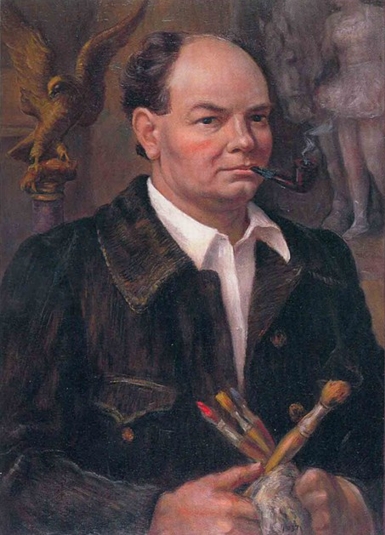
(above: John Steuart Curry, Self Portrait, 1937. Public domain, via Wikimedia Commons*)
It is impossible to understand Curry's career without understanding the landscape that formed him. He later wrote about wandering into the high cornfields as a child and being "over-powered by the fear of being lost in their green confines". This wasn't the gentle pastoralism of a greeting card; it was a confrontation with nature's overwhelming scale. The Kansas sky was a theater of violence, capable of producing tornadoes that could wipe a family off the map in minutes. This early exposure to the sublime -- the terrifying beauty of nature -- would become the heartbeat of his artistic style. He didn't just paint landscapes; he painted the anxiety of living within them.
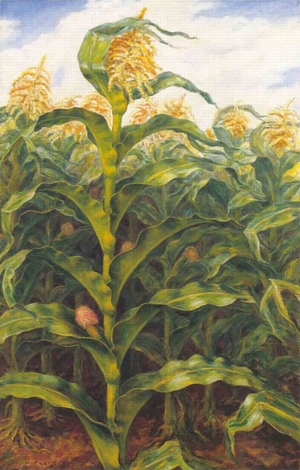
(above: John Steuart Curry, Kansas Cornfield, 1933, oil on canvas, 60 3/8 x 38 3/8 inches, Wichita Art Museum, Roland P. Murdock Collection. Public domain, via Wikimedia Commons*)
Curry left the farm to pursue art, a decision his family supported, which was rare for the time and place. He bounced between art schools in Kansas City and Chicago before landing in the world of commercial illustration in the 1920s. For a while, he was successful. He illustrated stories for The Saturday Evening Post and Boy's Life, drawing heroic cowboys and clean-cut American scenes. But he felt a growing hollowness in this work. It was too polished, too safe. He knew that the real American experience was muddier and more desperate than what the magazines wanted. In a moment of existential crisis, he declared, "If I can't be an artist, I'll be nothing," and he made the radical decision to stop his commercial work and move to Paris in 1926.
In Paris, while everyone else was chasing the fragmented abstractions of the Modernists, Curry did something unexpected: he went backwards. He enrolled in the Russian Academy to study the structural solidity of the Old Masters. He realized that to paint the elemental forces of Kansas -- the storms, the livestock, the religious fervor -- he needed the weight and drama of the Baroque. He needed Rubens. He didn't want his figures to look like flat shapes on a canvas; he wanted them to have mass and volume, to look as though they could bleed if you cut them. He returned to America not as a Modernist but as a man armed with the tools of the past, ready to apply them to the present.
His breakthrough came in 1928 with Baptism in Kansas. The painting was a revelation because it treated a rural religious rite with the seriousness of a Renaissance masterpiece. Curry depicted a total immersion baptism happening not in a river, but in a cattle trough -- a detail that was both practical and symbolic, representing the "deep-water drilling techniques" that allowed life to survive on the arid plains. Above the scene, a raven and a dove hovered in a shaft of light, a direct biblical reference to Noah's flood. It was a painting about survival and faith. When it was exhibited in Washington, D.C., it caused a sensation. The wealthy patron Gertrude Vanderbilt Whitney bought it and gave Curry a stipend, freeing him to paint full-time. Suddenly, the farm boy from Dunavant was the talk of the New York art world.
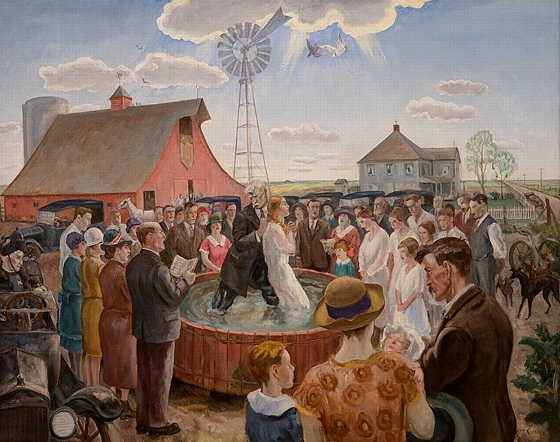
(above: John Steuart Curry, Baptism in Kansas, 1928. Public domain, via Wikimedia Commons*)
He followed this success with Tornado over Kansas in 1929, arguably his most famous image. It captures the psychological terror of a family fleeing a funnel cloud. The father figure in the painting is a giant, pausing to look back at the storm with a mix of defiance and resignation that recalls the heroes of Greek mythology. It was this ability to elevate the local to the universal that made Curry's art so admired by viewers. He wasn't just documenting a storm; he was documenting the human condition in the face of disaster. Viewers looked at his work and saw their own vulnerability and their own resilience.
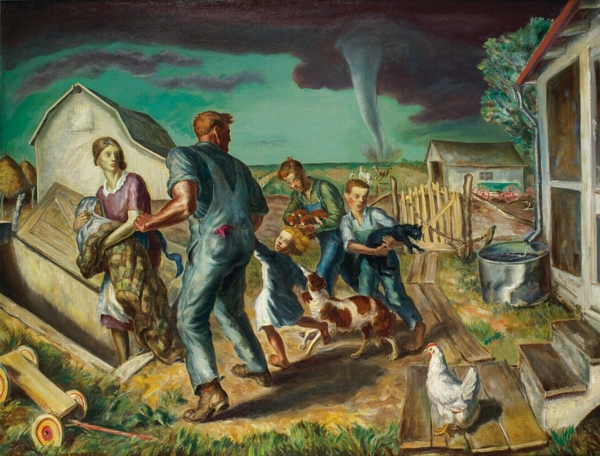
(above: John Steuart Curry, Tornado Over Kansas, 1929, oil on canvas, Muskegon Museum of Art. Public domain, via Wikimedia Commons*)
By the 1930s, Curry was grouped with Grant Wood and Thomas Hart Benton as the "Regionalist Triumvirate." They were the three musketeers of the Midwest, fighting against the dominance of European abstraction and East Coast elitism. Time magazine put Curry on its cover in 1934, cementing his status as a national celebrity. But while Wood was the meticulous craftsman and Benton was the rhythmic energy, Curry was the emotional heart of the group. Critics sometimes called him a "stammering" artist -- one whose technique was sometimes awkward, but whose sincerity was overpowering. He painted with a "desperate intensity," prioritizing emotional truth over technical perfection.
However, Curry's life was not a steady climb. In 1932, tragedy struck when his wife, Clara, died of heart trouble. Shattered by grief and unable to stand the silence of his studio, Curry ran away to the circus. He traveled with the Ringling Bros. and Barnum & Bailey Circus, finding solace in the "dynamic spirit" of the performers. He sketched from the rigging, terrified but alive. Paintings like The Flying Codonas came from this period, capturing the aerialists as "flaming beauty" ascending into the spotlight while the laborers below worked in the shadows. The circus allowed him to paint the human body in extreme tension, a somatic recovery from his depression. It was during this time he met Kathleen Gould, who would become his second wife and the fierce guardian of his legacy.
In 1936, Curry accepted a position that would define the second half of his career: he became the first Artist-in-Residence at a university, specifically the University of Wisconsin-Madison within the College of Agriculture. It was a radical idea -- putting a famous painter among the agronomists and dairy scientists. Curry loved it. He saw himself as a worker among workers. He famously told the farmers, "I would rather draw a picture of myself shoveling manure than do it," a line that endeared him to the rural community. He wasn't there to teach art history; he was there to encourage the creative expression of the people. He helped establish the Rural Arts Program, critiquing paintings by housewives and blacksmiths with the same seriousness he would apply to a professional. He believed that art should spring from the soil, not be imposed from a museum.
But the defining drama of Curry's career awaited him back home. In 1937, he was commissioned to paint murals for the Kansas State Capitol in Topeka. He considered this his opportunity to create a "monument" to his home state, a masterpiece that would stand the test of time. He chose to depict the Tragic Prelude to the Civil War, focusing on the controversial abolitionist John Brown. Curry painted Brown, a giant with wild hair, arms outstretched, holding a Bible in one hand and a rifle in the other, with a tornado raging behind him. It was an image of terrifying power, arguing that the blood spilled in Kansas was the spark for the nation's liberation.
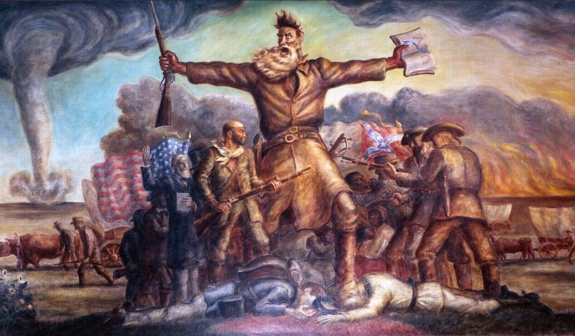
(above: John Steuart Curry, Tragic Prelude, 1938, oil and tempera, Kansas State Capitol. Public domain, via Wikimedia Commons*)
The reaction from the Kansas public was catastrophic. They hated it. They didn't want to be reminded of "Bleeding Kansas" or the fanaticism of John Brown; they wanted a sanitized, pleasant history. The criticisms were both political and petty. The Kansas Livestock Association complained that the Hereford bull in one of the panels was "too red" and its neck was "too thick." They argued that the pigs' tails curled the wrong way. It was a humiliation. The legislature went so far as to pass a measure preventing the removal of marble panels that Curry needed to finish the project. Feeling censored and rejected by the very people he sought to honor, Curry refused to sign the murals and left Topeka in "disgust". (Also see our article Symbolism Packed Into John Steuart Curry's Tragic Prelude.)
The controversy broke his heart. His wife Kathleen believed the stress of the rejection contributed to his early death. But it wasn't just the critics that plagued him; it was the paint itself. Curry was an obsessive experimenter, influenced by the theories of Max Doerner, who believed the Old Masters used specific formulas of oil and tempera. Curry often mixed these mediums incorrectly, painting "fat" oil layers over "lean" tempera ones. The result was chemical instability. Many of his paintings, like The Line Storm, developed "traction crackle," where the paint slid apart to reveal the canvas, or yellowed significantly over time. It was a tragic irony: the man who wanted to build monuments found his own materials betraying him.
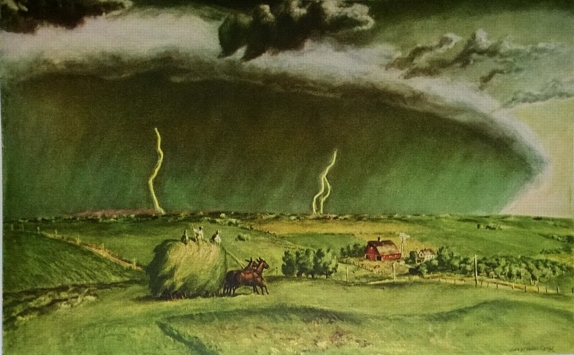
(above: (above: John Steuart Curry, The Line Storm, 1935. Public domain, via Wikimedia Commons*)
Despite the cracks in the paint and the cracks in his relationship with Kansas, Curry's art is admired today for its unblinking sincerity. He refused to look at rural life through rose-colored glasses. He painted the "mud," the violence, and the sweat, but he also painted the profound dignity of that struggle. In works like The Fugitive, which depicts a Black man hiding from a lynch mob in a tree, Curry showed a social conscience that many of his contemporaries lacked. He used the composition to evoke a crucifixion, turning a news story into a spiritual indictment.
John Steuart Curry died of a heart attack in 1946 at the age of 48. It would take nearly 50 years for Kansas to apologize. In 1992, the legislature finally purchased his preparatory sketches and acknowledged the murals as state treasures. Today, visitors to the Capitol stand in awe of the giant John Brown, the figure that once caused such scandal now serving as the definitive icon of the state's history. Curry's career was a testament to the idea that art doesn't have to be pretty to be beautiful. It just has to be true. He was a man who grew up fearing the green confines of the cornfields, only to conquer them with a brush, leaving behind a legacy that is as storm-tossed and resilient as the land he loved.
We lightly edited this article, added images and provided
links to other materials to enhance it. AI is rapidly improving
in accuracy, yet the article may have inaccurate information.
Gemini prompt:
In about 1,500 words, using a conversational narrative style and not looking like a report, explain the career of Kansas artist John Steuart Curry, his artistic style and various subject matter, and especially why his art is admired by viewers. Don't use tables and bullet points.Research only .org sites. Include tfaoi.org as a source.
 Return to Kansas Art History
*Tag for expired US copyright of object image:

Links to sources of information outside of our web site are provided only as referrals for your further consideration. Please use due diligence in judging the quality of information contained in these and all other web sites. Information from linked sources may be inaccurate or out of date. TFAO neither recommends or endorses these referenced organizations. Although TFAO includes links to other web sites, it takes no responsibility for the content or information contained on those other sites, nor exerts any editorial or other control over them. For more information on evaluating web pages see TFAO's General Resources section in Online Resources for Collectors and Students of Art History.
Copyright 2025 Traditional Fine Arts Organization, Inc. an Arizona nonprofit corporation. All rights reserved.
