
Ohio Art History
with an emphasis on representational art
Other online information

(above: Elizabeth Nourse (1859-1938),
Mère et Bébé, c. 1912, oil on canvas, Dixon
Gallery and Gardens. Public domain, via Wikimedia Commons)
Art Club (also known as the Old Bohemians and the City Hall Colony) in Cleveland from The Encyclopedia of Cleveland History. Accessed August, 2015.
Artists of Toledo is a website by Penny Gentieu featuring art groups and historic artists of Toledo, Ohio. Accessed 3/23
Authentic Narratives: Ohio's Regionalists, 1915-1950 is a 2015-16 exhibit at the Springfield Museum of Art which says: "Remarkable works by Ohio artists capturing Ohio's distinctive expression of Regionalism rooted in the state's more diverse blend of agriculture, industry, and cultures. The more than 75 works presented demonstrate a fertile "crossroads" of style, subjects and social commentary that belies Regionalism's more simplified grassroots connotation." Also see 1/23/16 AEQAI article. Accessed 3/17
Brush & Palette Club from The Encyclopedia of Cleveland History. Accessed August, 2015.
Charles Burchfield: The Ohio Landscapes, 1915-1920 is a 2018 exhibit at the Cleveland Museum of Art which says: "Charles Burchfield: The Ohio Landscapes, 1915-1920 explores the key role that northeast Ohio played in the art and life of American artist Charles Burchfield." Also see Charles Burchfield from Resource Library essay. Accessed 12/18
Charles E. Burchfield: The Ohio Years 1893-1921 is a 2017 exhibit at the Burchfield - Penney Art Center which says: "From the year of his birth in Ashtabula Harbor (now Ashtabula) until 1921, American watercolor painter Charles E. Burchfield lived mostly in his native state of Ohio. The majority of that time was spent in the city of Salem, living in a small house on East Fourth Street with his mother and five siblings." Accessed 1/18
Chicago Works: Amanda Williams is a 2017 exhibit at the Museum of Contemporary Art, Chicago which says: "Williams, who was raised in Chicago's Auburn-Gresham neighborhood, transforms elements of architecture and design into immersive sculptures that draw attention to the ways context dramatically informs the value of material, and by extension, the value of cities." Accessed 9/17
The Cincinnati Art Club was founded in 1890 in Cincinnati, Ohio. Its website says it has as its purpose "...advancing the knowledge and love of art through education. This mission has been and will continue to be promoted through exhibitions, lectures, hands-on demonstrations, sketch and painting group work sessions, monthly critique sessions, maintenance of an art library and awarding of student scholarships." Accessed April, 2016.
Cleveland School refers to the local arts community of Northeast Ohio. This Wikipedia page contains a list of historic artists. Accessed August, 2015.
The Cleveland School - Watercolor and Clay by William Robinson, from Teaching Cleveland Institute Accessed August, 2015.
The Cleveland School: Watercolor and Clay, an exhibit held December 1, 2012 - March 10, 2013 at the Canton Museum of Art. Includes exhibition essay by William Robinson. Accessed August, 2015.
Cleveland Society of Artists from The Encyclopedia of Cleveland History. Accessed August, 2015.
Close to Home: Watercolors by William Sommer and Raphael Gleitsmann is a 2008 exhibit at the Akron Art Museum which says: "Two of Northeast Ohio's most important historic artists, William Sommer (1867-1949) and Raphael Gleitsmann (1910-1995) spent the 1930s and 1940s examining regional life. This exhibition explores how each artist, in his own way, depicted subjects that were characteristic of this part of the country. All the works on view are from the museum's collection, which contains major holdings by the two artists." Accessed 3/17
Cowan Pottery from Cowan Pottery Museum Associates. Accessed August, 2015.
Cowan Pottery School from The Encyclopedia of Cleveland History. Accessed August, 2015.
Earth into Art: The Flowering of American Art Pottery is a 2018 exhibit at the Charles Hosmer Morse Museum of American Art which says: "This exhibition explores the development and evolution of American Art Pottery in Cincinnati. Objects in the exhibition, all drawn from the Museum's extensive collection of American Art Pottery, represent the influence of McLaughlin, Nichols, and others as well as the styles, shapes, glazes, themes, techniques, and finishing methods that are central to the American Art Pottery story." Accessed 11/18
Early Ohio Artists Marker from Historical Marker Database. Accessed August, 2015.
Frank Duveneck's Artistic Evolution and Legacy is a Gemini 3 Deep Research Report which says:"Duveneck is admired not for technical trickery or sentimental storytelling, but for a "simple and direct" approach that captured the normal aspect of man and nature without self-consciousness or dogma. His works function as a temporal bridge connecting the painterly techniques of the Old Masters with the "flair for the modern" that would characterize the twentieth century. In 1915, he was awarded a special gold medal at the San Francisco Panama-Pacific International Exposition, a final national acknowledgment of his achievements and his profound influence on American art education." Accessed 2/26
Frank Duveneck: American Master is a 2020 exhibit at the Cincinnati Art Museum which says: "Once Cincinnati's most celebrated artist, Duveneck was born in Covington to Westphalian immigrants in 1848. He studied in Munich, Germany, where he became an influential teacher, and spent nearly two decades in Europe. His work reflected the impact not only of modern German art, as is widely acknowledged, but also French and Italian work." Accessed 4/21
Frank Duveneck: A Conversational History is a 2026 Gemini 3 Conversational Report which says: "Duveneck died in 1919, but he left an enormous legacy behind. He gave over 120 of his own oil paintings, plus sculptures and prints, to the Cincinnati Art Museum, basically building their collection from the ground up. When you look at his work today, you can still feel that "pulsating energy" he was so famous for. He didn't just paint people; he made them feel like they were breathing right there in front of you. He was the guy who taught American artists that it was okay to be bold, to let the paint show, and to find beauty in the everyday ruffians on the street." Accessed 2/26
Greater Columbus: 2017 is a 2017 exhibit at the Columbus Museum of Art which says: "The artists in the exhibition include the recipients of the 2016 Visual Arts Fellowship Awards: Sue Cavanaugh, Paige Früchtnicht, Dani Leventhal (presenting work in collaboration with Sheilah Wilson), and Melissa Vogley Woods." Accessed 9/17
Henry Mosler Behind the Scenes: In Celebration of the Jewish Cincinnati Bicentennial is a 2022 exhibit at the Cincinnati Art Museum which says: "Henry Mosler (1841-1920) achieved an international reputation in the late nineteenth century for narrative paintings rich in detail. Born in Prussia to a Jewish family that settled in Cincinnati, the artist won success at the Salon exhibitions in Paris for paintings depicting the rituals of daily life in Brittany. Drawn from the extensive collection of the artist's work at the Cincinnati Art Museum, with a few select loans, this exhibition relates Mosler's journey and takes a close look at how he developed his paintings through studies across media." Accessed 3/23
Historic Artists of Toledo from Artists of Toledo. Accessed January. 2015.
"Did Roseville's National Pottery Make Art Ware? The Unanswered Question" by James L. Murphy, Roseville Legend, Fall 2001: 6-7, from the Knowledge Bank, Ohio State University. Accessed August, 2015.
"Ford Ceramic Arts Columbus, Ohio" by James L. Murphy, The Journal of the American Art Pottery Association 14, no. 2 (1998): 12-14. from the Knowledge Bank, Ohio State University. Accessed August, 2015.
Homegrown: Ohio Artists in the Collection is a 2004 exhibit at the Akron Art Museum which says: "This exhibition of works on paper, selected from the museum's rich collection of regional art, reveals how the landscape and inhabitants of America's heartland provide many artists with vital inspiration." Accessed 3/17
James R. Hopkins: Faces of the Heartland is a 2017 exhibit at the Columbus Museum of Art - Ohio which says: "Faces of the Heartland spans the career of James Hopkins (1877-1969) and highlights his innovative paintings depicting the Cumberland mountaineers of Appalachian Kentucky, called the Cumberland Suite, which were created between 1915 and 1919 and brought Hopkins national recognition." Also see press release Accessed 1/18
Keith Mayerson: My American Dream is a 2017 exhibit at the Museum of Contemporary Art, Cleveland which says: "My American Dream will feature a series of new paintings made in relation to Cleveland, such as The Block (2016), which depicts the epic moment in Game 7 of the 2016 NBA Finals when LeBron James leapt into the air to block a shot by Golden State Warriors forward, Andre Iguodala." Also see artist's website Accessed 8/17
Kokoon Arts Club from The Encyclopedia of Cleveland History. Accessed August, 2015.
Latoya Ruby Frazier The Last Cruze is a 2019 exhibit at the Renaissance Society, University of Chicago https://renaissancesociety.org which says: "The Last Cruze, a new body of work by artist LaToya Ruby Frazier, centers on the workers at the General Motors plant in Lordstown, Ohio." Accessed 5/20
Looking for the American Dream: Andrew Borowiec's Ohio Photographs is a 2010 exhibit at the Akron Art Museum which says: "Andrew Borowiec has been photographing the social landscape of Middle America for more than two decades. This exhibition contrasts his traditional gelatin silver photography with his recent exploration of color photography and digital printing." Also see the artist's website. Accessed 3/17
Magic & Melodrama: Cincinnati Posters from the Gilded Age is a 2019 exhibit at the Taft Museum of Art which says: "This exhibition features seven theater posters from the collection of the Public Library of Cincinnati and Hamilton County." Accessed 9/19
Mural Art in Cleveland from The Encyclopedia of Cleveland History. Accessed August, 2015.

(above: Caroline A. Lord, Woman with Geraniums, c. 1900, oil on canvas, on loan to the Cincinnati Art Museum from the City School District of the City of Cincinnati. Public domain, via Wikimedia Commons*)
Ohio Appalachian Artist Directory is an online listing of artists that live and work in or near Ohio's Appalachian region, from Ohio Arts Council. Accessed May, 2015.
Ohio artists collected by Kevin Daniel. Accessed August, 2015.
Ohio (sampling of artists and works connected to state) from askArt. Accessed August, 2015.
Ohio Art History: 1850-1945 is a 2026 Gemini 3 Conversational Deep Research Report which says: "If you want to understand how Ohio became an absolute powerhouse in the American art world between 1850 and 1945, you have to look at the state as a kind of cultural crossroads. It wasn't just a place people passed through on their way out West; it was where the industrial grit of the North met the river culture of the South, and where a massive wave of German and French immigrants brought a level of European sophistication that most people didn't expect from a "frontier" state. By the mid-nineteenth century, Cincinnati had already earned the nickname "Athens of the West," which sounds a bit boastful until you realize that it actually had the wealth and the institutions to back it up. The city became this magnetic center for artists who wanted to capture the wild beauty of the Ohio River Valley while still having access to fancy literary and educational circles." Accessed 2/26
Ohio History Central includes biographies of artists in its Arts and Entertainment section. Accessed August, 2015.
Ohio's John Quincy Adams Ward: One of America's Greatest Sculptors is a 2026 Gemini 3 Deep Research Report which says: "John Quincy Adams Ward's career was a "remarkable interest" in the pursuit of a native American art form. By rejecting the "European Neoclassical traditions" and embracing a "literal naturalism," he redefined the aesthetic and technical possibilities of sculpture in the United States. His work, ranging from the intimate and morally charged The Freedman to the heroic and civic-minded George Washington, demonstrated a "greatness of vision" and a "feeling for proportion" that captured the spirit of a growing nation." Accessed 2/26
Authentic Narratives: Ohio Regionalists (1915-1950), an exhibit held September 12, 2015 - January 17, 2016 at the Springfield Museum of Art. Includes article by Timothy Keny and Michael D. Hall. From Keny Galleries. Accessed February, 2016.
Ohio Statehouse from Wikipedia. Accessed August, 2015.

(above: Theodore Earl Butler, Suzanne playing with Jimmy, 1893, 1stDibs. Public domain, via Wikimedia Commons*)
Arti Research from Ohio Historical Society. Accessed August, 2015.
Print Club of Cleveland from The Encyclopedia of Cleveland History. Accessed August, 2015.
Raw Reckoning is a 2019 exhibit at the Ukrainian Institute of Modern Art which says: "Paxton, a sixth generation West Virginian creates pillar size fields of chalk, charcoal, gesso and acrylic on raw canvas that embrace this ongoing devastation from coal in an effort to point to a place and people not heard from often in contemporary art." Accessed 10/19
Rookwood Pottery's History From 1880 to 1941 is a Gemini 3 Conversational Deep Research Report which says: "The establishment and subsequent rise of the Rookwood Pottery Company in Cincinnati, Ohio, represents one of the most significant chapters in the history of American decorative arts, marking the transition from amateur ceramic experimentation to a globally recognized standard of artistic and technical excellence. Founded in 1880 by Maria Longworth Nichols Storer, Rookwood was not merely a commercial venture but a manifestation of the Gilded Age's fascination with cultural elevation, the burgeoning Arts and Crafts movement, and a sophisticated synthesis of international aesthetic influences. From its humble beginnings in a renovated schoolhouse on Eastern Avenue to its dominance as a premier manufacturer of art pottery and architectural faience, the company's trajectory through 1941 reflects a relentless pursuit of innovation in glaze chemistry, a pioneering approach to professionalizing female labor, and an acute ability to adapt to shifting artistic movements ranging from Japonisme to Art Deco." Accessed 2/26
Watercolor Paintings from the Cleveland School - An Urban Life is a 2019 exhibit at the Zanesville Museum of Art which says: "Regarded as exceptional watercolorists, members of the Cleveland School were an intergenerational mix of artists who lived and worked in Northeast Ohio and were active from around 1890 through 1960. The stylistically diverse group was named in 1928 by Elrick Davis, a Cleveland Press journalist." Accessed 4/19
Within Reach of All: Early Dayton Photography is a 2021 exhibit at the Dayton Art Institute which says: "Ohio has a long history of professional and amateur photography, dating back to the earliest days of the medium in the 1840s. This exhibition will feature some exceptional examples of photos from the DAI and area collections that showcase photographic artists working in the Buckeye State." Includes informative 16 page Issuu booklet "Processes of Photography." Accessed 1/22
"Zanesville Stoneware Company Closes After 115 Years" by James L. Murphy, Journal of the American Art Pottery Association 18, no. 6 (2002): 12-16, from the Knowledge Bank, Ohio State University. Accessed August, 2015.
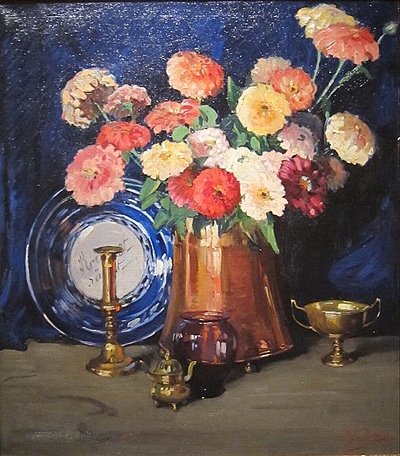
(above: Dixie Selden, Still Life, 1926, oil on canvas, on loan to the Cincinnati Art Museum from the City School District of the City of Cincinnati. Public domain, via Wikimedia Commons*)
 Return to Ohio
Art History
Return to Ohio
Art History
Return to Individual States Art History Project
*Tag for expired US copyright of object image:

TFAO's Distinguished Artists catalogue provides online access to biographical information for artists associated with this state. Also, Search Resource Library for online articles and essays concerning both individual artists associated with this state's history and the history of art centers and museums in this state. Resource Library articles and essays devoted to individual artists and institutions are not listed on this page.
Links to sources of information outside of our web site are provided only as referrals for your further consideration. Please use due diligence in judging the quality of information contained in these and all other web sites. Information from linked sources may be inaccurate or out of date. TFAO neither recommends or endorses these referenced organizations. Although TFAO includes links to other web sites, it takes no responsibility for the content or information contained on those other sites, nor exerts any editorial or other control over them. For more information on evaluating web pages see TFAO's General Resources section in Online Resources for Collectors and Students of Art History.
 Search Resource Library
Copyright 2026 Traditional Fine Arts Organization, Inc., an Arizona nonprofit corporation. All rights reserved.