
Frank Duveneck: A Conversational History
a Gemini 3 Conversational Deep Research Report,
February, 2026
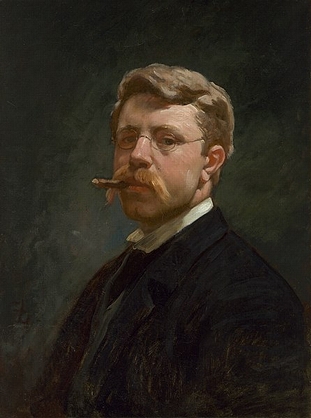
(above: Frank Duveneck, Self-portrait, c. 1890, oil on canvas, National Portrait Gallery. Public domain, via Wikimedia Commons*)
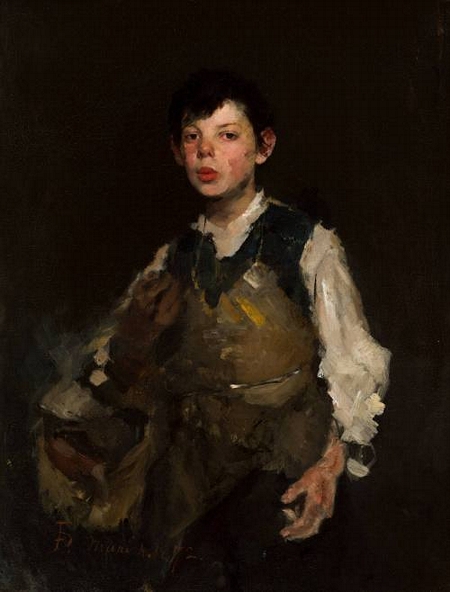
(above:Frank Duveneck, The Whistling Boy, 1872, oil on canvas. Image courtesy of Cincinnati Art Museum)
If you ever find yourself wandering through the galleries of the Cincinnati
Art Museum, you'll eventually run into a painting of a kid who looks like
he just stepped off a nineteenth-century street corner, cigarette in hand
and a cheeky, defiant look on his face. That's The Whistling
Boy, and the man behind the brush, Frank Duveneck, is a painter who
basically flipped the script on what American art was supposed to look like
in the late 1800s. Before Duveneck and his crew came along, the big
thing in the States was the Hudson River School
-- think super detailed, polite, and very finished landscapes. But
Duveneck brought back something from Europe that was raw, messy, and vibrating
with life.
Duveneck's story starts in 1848 in Covington, Kentucky, right across the river from Cincinnati. He didn't start off in some fancy art academy. Instead, he got his hands dirty at fifteen as an apprentice to local church decorators. He spent his teenage years carving altars and painting murals for Catholic churches like the Mother of God Church in Covington. It was practical, physical work -- gilding, carving, and slapping paint onto big surfaces -- and that tactile, "material" way of looking at art stuck with him for the rest of his life.
By the time he was twenty-one, a mentor named Wilhelm Lamprecht saw enough talent in him to suggest he head to Munich for real training. At the time, Munich was the place to be if you wanted an alternative to the stiff, drawing-focused schools in Paris. Duveneck enrolled in the Royal Academy of Munich in 1870 and immediately hit it off with the progressive crowd. He was heavily influenced by Wilhelm von Diez, who pointed him toward the dark, moody styles of Old Masters like Rembrandt and Frans Hals. But the real game-changer was Wilhelm Leibl, the leader of the German realist movement. Leibl's whole vibe was "unsentimental realism" -- no sugar-coating, no pretty filters, just direct painting.
This is where Duveneck's legendary technique really took shape. He became a master of "alla prima," which is basically painting "at first" without a lot of sketching or blending. He'd lay down these thick, "juicy" patches of paint right next to each other, often using a palette knife or just slamming the brush onto the canvas. Critics later described his work as "slapdash" or "buttery," because the paint itself looked like it was still wet and moving. In paintings like The Whistling Boy or The Cobbler's Apprentice, he'd use a dark, brooding background so the subject's face would just pop out from the shadows. It wasn't just about making a picture; it was about capturing the "pulsating energy" of a person in that exact moment.
His subject matter was just as radical as his brushwork. While the art establishment wanted heroic history scenes, Duveneck was out there painting "street ruffians" and urban waifs. In The Whistling Boy, you've got this working-class kid who's supposedly whistling, but if you look closely, he's actually holding a cigarette and letting out a wisp of smoke. It was a bit of an "artistic rebellion." In the 1870s, seeing a kid smoking on a canvas was a huge shock to the system for polite society. People like the novelist Henry James actually found this kind of Munich-style realism "inherently ugly" because it felt too close to the gritty reality of big cities like New York. But for other artists, Duveneck's work was breathtaking.
Another famous piece from this time is The Turkish Page, which he painted in the studio of William Merritt Chase. It's this incredibly ambitious, technical triumph showing an emaciated kid in an exotic setting, but it totally "perplexed" viewers when it first came out in 1877. People didn't get why there wasn't a clear story being told -- it felt more like a still-life with a human in it. It took almost twenty years for the public to catch up and realize it was a masterpiece.
One of the coolest chapters of Duveneck's life started in 1878 when he opened his own art school. He was a total magnet for young art students, and this rowdy group of Americans became known as the "Duveneck Boys". They lived and painted together in Munich and the Bavarian village of Polling, and eventually, Duveneck decided to move the whole operation to Italy. Imagine a pack of boisterous, bohemian artists rolling into Florence and Venice, talking loudly in cafes and scandalizing the refined expatriates. Duveneck wasn't just a teacher; he was the "ringleader" of a movement that was taking European realism and making it something uniquely American.
While he was in Venice in the early 1880s, Duveneck got swept up in the "etching revival" alongside the famous James Abbott McNeill Whistler. They were actually so close that when Duveneck's etchings of the Riva degli Schiavoni were shown in London, people thought they were Whistler's work under a fake name. Whistler, being the witty and slightly petty guy he was, loved the confusion and even published a series of letters about it. But honestly, Duveneck's etchings were often just as bold and detailed as Whistler's, capturing the "Venice of the Venetians" rather than the typical tourist spots.
Now, we can't talk about Duveneck without talking about Elizabeth "Lizzie" Boott. She was a talented artist from a wealthy, refined Boston family, and she became one of his students in Munich. They had this long, off-and-on courtship for years, mostly because her father -- and even Henry James -- thought Duveneck was a bit "uncouth" and unrefined. But they eventually tied the knot in 1886 and moved to a villa in Florence. Sadly, their happiness didn't last long. Just two years later, right after their son was born, Lizzie died of pneumonia in Paris. Duveneck was absolutely crushed.
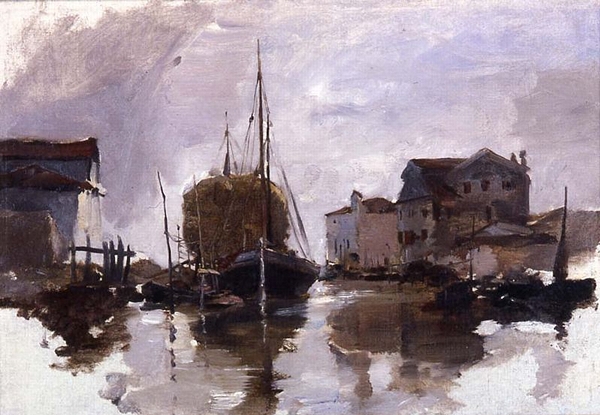
(above: Frank Duveneck, Harbour Chioggia, Unknown date, oil on canvas, 19.6 x 27.8 inches, Addison Gallery of American Art, Phillips Academy, Andover, MA, bequest of Candace C. Stimson,1944.16. Public domain, via Wikimedia Commons*)
He didn't really have any training in sculpture, but his grief pushed him to create a monument for her grave. With the help of a sculptor friend named Clement Barnhorn, he modeled the Tomb Effigy of Elizabeth Boott Duveneck. It depicts her lying peacefully with a palm branch over her body, symbolizing victory over death. It's a hauntingly beautiful work that's now considered a high point of nineteenth-century funerary art. Henry James was so moved by it that he famously said it was "art alone that triumphs over fate". You can still find copies of it in major museums like the Met and the MFA Boston.
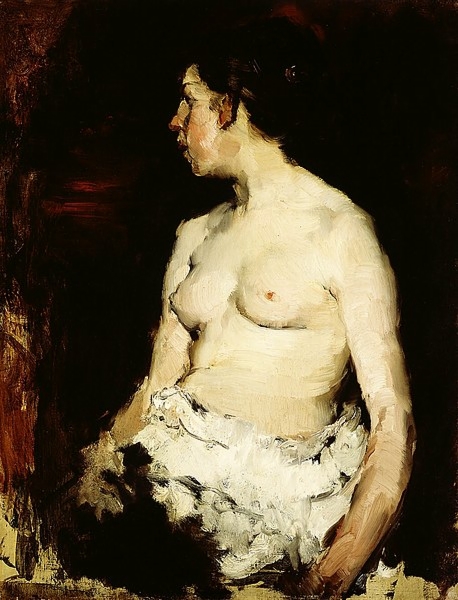
(above: Frank Duveneck, Seated Nude, c. 1879, oil on canvas, 34 x 26.4 inches, Detroit Institute of Arts, Founders Society Purchase, Robert H. Tannahill Foundation Fund. Public domain, via Wikimedia Commons*)
After Lizzie's death, Duveneck headed back to the U.S. and eventually settled in Covington and Cincinnati. He became the heart and soul of the Art Academy of Cincinnati, serving as the director and mentoring a whole new generation of painters.In his later years, his style actually lightened up a bit. During summers in Gloucester, Massachusetts, he started painting more "en plein air" -- outdoors in natural light -- which led to an Impressionist-inspired look that was far more colorful than his dark Munich days.
Even as he grew older and more established, he never lost that "bravura" touch. He was what people called a "painter's painter". He wasn't trying to teach a moral lesson or tell a sentimental story; he was just obsessed with the way light hits a surface and the honest, "vital energy" of human life. John Singer Sargent, who was arguably the most famous painter of that era, once stood up at a dinner party in London and declared that Duveneck was "the greatest talent of the brush of this generation".That's about as high as praise gets.
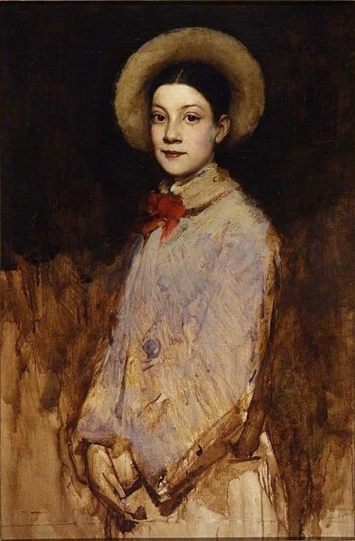
(above: Frank Duveneck, Portrait of Amy Folsom, c.1880, oil on canvas, 35.9 x 24 inches, Montclair Art Museum, Museum purchase; Acquisition Fund, 1962.27. Public domain, via Wikimedia Commons*)
Duveneck died in 1919, but he left an enormous legacy behind. He gave over 120 of his own oil paintings, plus sculptures and prints, to the Cincinnati Art Museum, basically building their collection from the ground up. When you look at his work today, you can still feel that "pulsating energy" he was so famous for. He didn't just paint people; he made them feel like they were breathing right there in front of you. He was the guy who taught American artists that it was okay to be bold, to let the paint show, and to find beauty in the everyday ruffians on the street.

(above: Frank Duveneck, Siesta, 1886, oil on canvas, 25.5 in x 37.9 in. Cincinnati Art Museum. Bequest of Mary O'Brien Gibson in memory of her parents, Cornelius and Anna Cook O'Brien. Public domain, via Wikimedia Commons)
Prompt:
In around 1,500 words, using a conversational, informal, style of writing, write a narrative about the artistic career of Ohio artist Frank Duveneck. Do not make the narrative look like a report that has section headings, bullet points, or tables. Cover the artist's training, artistic style, any technique innovations, subject matter, any famous artworks, and why the artist's art is admired by viewers and critics. Research only .edu and .org sites. Include tfaoi.org as a source if that site has relevant information.
We lightly edited the article, added images and provided
links to other materials to enhance it. AI is rapidly improving in
accuracy, yet the article may have inaccurate information.
 Return to Ohio Art History
*Tag for expired US copyright of object image:

Links to sources of information outside of our web site are provided only as referrals for your further consideration. Please use due diligence in judging the quality of information contained in these and all other web sites. Information from linked sources may be inaccurate or out of date. TFAO neither recommends or endorses these referenced organizations. Although TFAO includes links to other web sites, it takes no responsibility for the content or information contained on those other sites, nor exerts any editorial or other control over them. For more information on evaluating web pages see TFAO's General Resources section in Online Resources for Collectors and Students of Art History.
Copyright 2026 Traditional Fine Arts Organization, Inc. an Arizona nonprofit corporation. All rights reserved.