
Ohio Art History: 1850-1945
a Gemini 3 Conversational Deep Research Report
February, 2026
If you want to understand how Ohio became an absolute powerhouse in the American art world between 1850 and 1945, you have to look at the state as a kind of cultural crossroads. It wasn't just a place people passed through on their way out West; it was where the industrial grit of the North met the river culture of the South, and where a massive wave of German and French immigrants brought a level of European sophistication that most people didn't expect from a "frontier" state. By the mid-nineteenth century, Cincinnati had already earned the nickname "Athens of the West," which sounds a bit boastful until you realize that it actually had the wealth and the institutions to back it up. The city became this magnetic center for artists who wanted to capture the wild beauty of the Ohio River Valley while still having access to fancy literary and educational circles.
Take a man like Robert S. Duncanson, for instance. He was the first African American artist to really explode onto the international stage, and he did it right there in Cincinnati. Imagine him in the 1850s, supported by a mix of white abolitionists and one of the largest communities of free people of color in the country, painting these massive, lush landscapes that felt both romantic and a little bit magical. His murals for Nicholas Longworth's estate were a huge deal because they brought fine art into domestic spaces in a way that felt truly grand. Duncanson had this amazing ability to blend the local scenery with classical "Old World" vibes, like in his masterpiece A Dream of Italy, which he painted later in his career. He really set the stage for Ohio being a place where you could be from a marginalized background and still achieve world-class status if you had the talent.
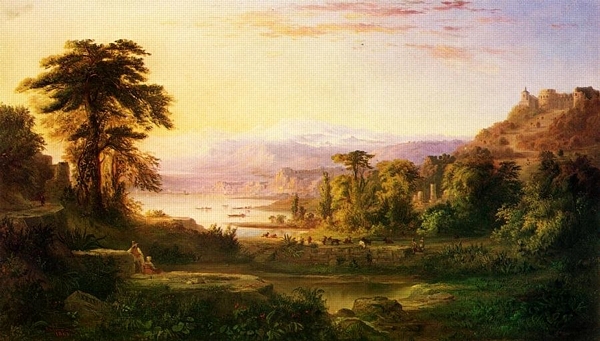
(above: Robert Seldon Duncanson, A Dream of Italy, 1865, oil on canvas, Birmingham Museum of Art. Public domain, via Wikimedia Commons*)
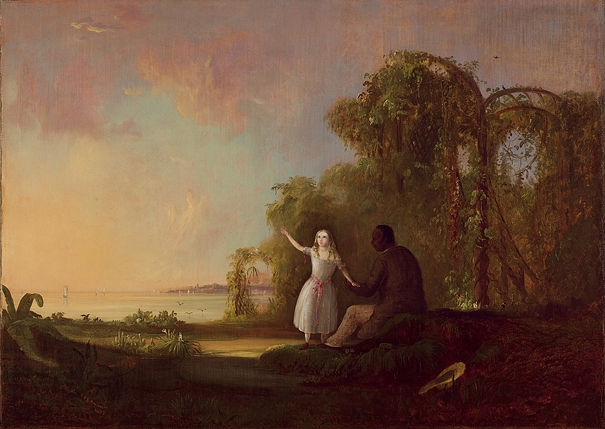
(above: Robert Seldon Duncanson (1821-1872), Uncle Tom and Little Eva, 1853, oil on canvas, Detroit Institute of Arts. Public domain, via Wikimedia Commons)
But the real "rockstar" moment for Ohio art happened in the 1870s when Frank Duveneck showed up. Born in Covington, right across the river, Duveneck went off to Munich and came back with a style that totally flipped the script on how people were "supposed" to paint. While the East Coast was still obsessed with very stiff, careful academic drawings, Duveneck and his "Duveneck Boys" were all about the "alla prima" technique-which basically means painting wet-on-wet right onto the canvas without any of those labor-intensive sketches. His famous painting The Whistling Boy is the perfect example; it has this raw, vigorous brushwork that feels alive and a bit messy in the best way possible. Duveneck was a legendary teacher at the Cincinnati Art Academy, and he was so well-loved that when he died, people called him the "Father of American Art". He even stayed involved in local drama; there's a funny story about him helping the police track down an art thief who cut a painting right out of its frame at the museum using a knife hidden in a cane.
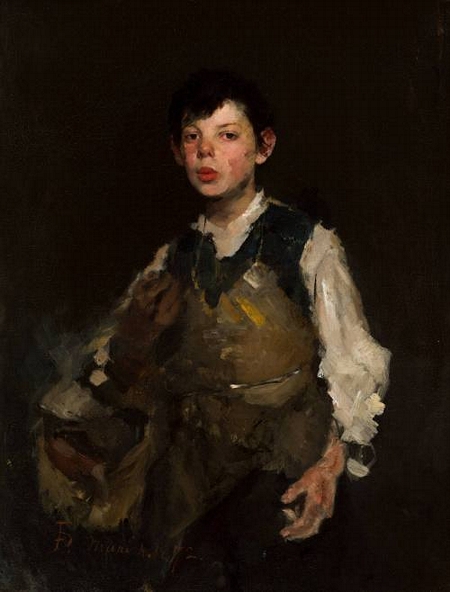
(above:Frank Duveneck, The Whistling Boy, 1872, oil on canvas. Image courtesy of Cincinnati Art Museum)
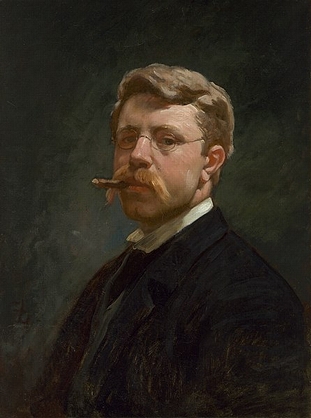
(above: Frank Duveneck, Self-portrait, c. 1890, oil on canvas, National Portrait Gallery. Public domain, via Wikimedia Commons*)
While the painters were busy with their brushes, Ohio was also leading a massive revolution in pottery. Maria Longworth Nichols Storer founded Rookwood Pottery in 1880, and she didn't just want to make jars; she wanted to make art. Rookwood was special because it started as an outlet for high-society women who did china painting as a hobby, but Nichols turned it into a world-class professional studio that felt more like an "overgrown family dwelling" than a factory. They were obsessed with innovation, especially when it came to glazes. They developed things like the "Tiger Eye" and the "Vellum" matte glaze, which made the pottery look almost like a painting. They also had a deep love for Japanese aesthetics, even hiring a Japanese expert named Kataro Shirayamadani, who brought a level of authenticity to their East Asian-inspired designs. This wasn't just a local trend; Rookwood won the Grand Prize at the 1900 Paris Exposition, proving that a little studio in Cincinnati could set the standard for the entire world. Down the road in Zanesville, places like Weller and Roseville were also cranking out "Art Pottery," though they were more about mass-producing those Arts and Crafts styles for everyone to enjoy.
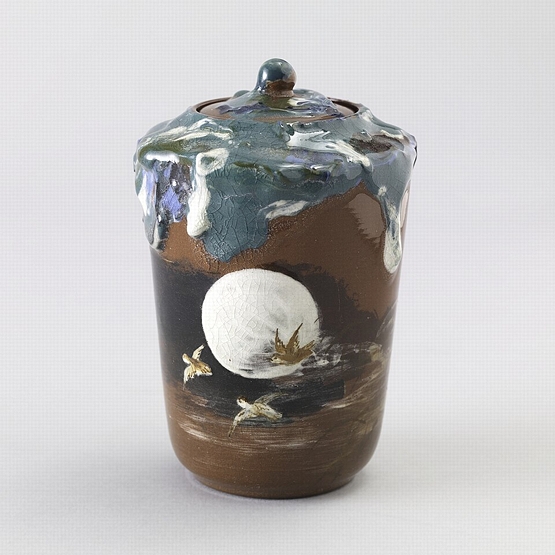
(above: Maria Longworth Nichols, Miniature
covered jar with moon, birds, and drip decoration, 1884, 4 5/16 x 3
1/8 inches, Cooper Hewitt, Smithsonian Design Museum. Public domain, via
Wikimedia Commons*)
If you look at sculpture, you can't skip John Quincy Adams Ward. He grew up on an Ohio farm modeling toy animals out of blue clay, and he eventually became the man who helped create a truly "American school of sculpture". He hated the idea that American sculptors had to go to Europe and copy old Greek statues. Instead, he wanted realism. His 1863 work, The Freedman, was revolutionary-it showed a Black man with broken chains just as the Emancipation Proclamation was taking effect. It wasn't a portrait of a specific person, but an "idealization" of hope and strength. Then you had Clement Barnhorn and Enid Yandell, who were both huge figures in the Cincinnati scene. Barnhorn was famous for his massive relief sculptures on cathedrals and his "art pianos" for the 1904 World's Fair. Yandell was a trailblazer herself, completing a four-year program at the Art Academy in just two years and becoming a leading sculptor at a time when women were mostly told to stay home.
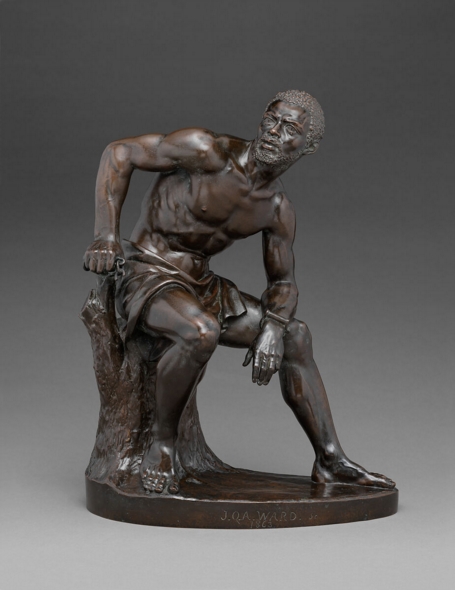
(above: John Quincy Adams Ward (American, Urbana, Ohio 1830-1910 New York), The Freedman, 1863, cast 1891, Bronze, 19 1/2 x 14 3/4 x 9 3/4 inches, Gift of Charles Anthony Lamb and Barea Lamb Seeley, in memory of their grandfather, Charles Rollinson Lamb, 1979, The Metropolitan Museum of Art.)
As we moved into the twentieth century, the creative energy started shifting up toward Cleveland. This is where the "Cleveland School" comes in -- a group of artists, mostly watercolorists, who were all connected to the Cleveland School of Art. These artists were really influenced by the Arts and Crafts movement and a bit of European modernism, but they kept it grounded in the local landscape. Henry Keller was the big mentor here. He founded this amazing art colony in Berlin Heights, near Sandusky, where artists could escape the industrial smog of the city and just paint outdoors, or "en plein air". It was a serious painting group, but they also had a lot of fun, and that communal vibe was exactly what allowed a unique regional style to develop.
One of Keller's most famous students was Charles Burchfield, who is probably the most original watercolorist Ohio ever produced. Burchfield had this wild, visionary way of looking at nature. During his "Golden Year" in Salem, Ohio, he would paint these landscapes that weren't just about what he saw, but what he felt and heard. He was a leader in synesthesia, basically visualizing sound -- like in his painting Church Bells Ringing, Rainy Winter Night, where the tones are dark and looming to capture a childhood fear of storms. He turned the everyday streets and railroad yards of northeast Ohio into these symbolic, almost haunting expressions of life.
Columbus also had its own stars, like Alice Schille and George Bellows. Schille was an absolute legend in the watercolor world, traveling all over Europe and North Africa to paint these tiny "miniatures" that were incredibly bold and modern. Personally, she was a bit shy, but her art had this "unusual courage" that let her master everything from Impressionism to Cubism. Meanwhile, Bellows took that Midwestern pragmatism he learned at Ohio State and brought it to New York, becoming a leader of the Ashcan School. He's the artist famous for those gritty boxing paintings like Stag at Sharkey's, where you feel like you're right in the middle of a dark, dangerous, "immoral" crowd. Even though he left for the big city, his style was totally informed by the enthusiasm and bold energy he cultivated back home in Columbus.
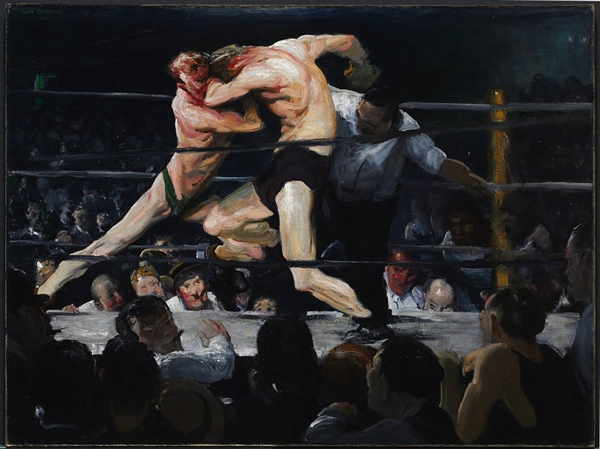
(above: George Bellows, Stag at Sharkey's, 1909, oil on canvas, Hinman B. Hurlbut Collection 1922.1133, Cleveland Museum of Art)
Now, we can't forget about the art that was happening right in people's homes. Textiles and quilting were a huge part of the social fabric -- literally. Back in the nineteenth century, a "quilting party" or "bee" was the social event of the season. Men and women would get together to help a friend prepare for a wedding, and they'd spend the time "eating sugar, singing, and talking nonsense" while they worked. It was a way to keep the community tight, especially in places like Zoar Village, which was a German utopian settlement in Tuscarawas County. The Zoarites were pacifists who shared everything, and they had a specific "Sewing House" where women worked around a long table to make clothing and linens. They even had a "one-print-suits-all" rule for their dress fabric to keep things modest and equal. These communal arts were just as important as the stuff hanging in museums because they represented the actual lives and bonds of the people living there.
So, when you look at that century of Ohio art from 1850
to 1945, it's really a story of growth and community. It started with people
like Duncanson and Ward trying to define what an "American" style
looked like, moved through the rowdy European-inspired realism of Duveneck
and the brilliant chemistry of Rookwood, and ended with the visionary modernism
of Burchfield. Ohio's geography gave it the wealth and the immigrants to
make all this happen, but it was the artists' willingness to form these
colonies and communal spaces that really gave the state its own unique,
sophisticated voice in the world of art.
We lightly edited this article, added images and provided
links to other materials to enhance it. AI is rapidly improving
in accuracy, yet the article may have inaccurate information.
Gemini prompt:
In about 2,000 to 2,500 words, using a conversational, informal, style of writing, write an article about the history of art in Ohio from 1850 through 1945. Do not make the article a report with section titles, bullet points or tables. Cover types of art including paintings, sculpture, pottery and textiles. Note anything special such as geography, culture, events and styles that differentiated Ohio art from other states. Identify the most highly regarded artists in the state during that time period and explain what is unique and special about their art that makes them important. Identify any early art colonies in the state, discuss why they developed and their importance. Research only .edu and .org sites.
 Return to Ohio Art History
*Tag for expired US copyright of object image:

Links to sources of information outside of our web site are provided only as referrals for your further consideration. Please use due diligence in judging the quality of information contained in these and all other web sites. Information from linked sources may be inaccurate or out of date. TFAO neither recommends or endorses these referenced organizations. Although TFAO includes links to other web sites, it takes no responsibility for the content or information contained on those other sites, nor exerts any editorial or other control over them. For more information on evaluating web pages see TFAO's General Resources section in Online Resources for Collectors and Students of Art History.
Copyright 2026 Traditional Fine Arts Organization, Inc. an Arizona nonprofit corporation. All rights reserved.