
Rookwood Pottery's History From 1880 to 1941
a Gemini 3 Conversational Deep Research Report, February, 2026
The establishment and subsequent rise of the Rookwood Pottery Company in Cincinnati, Ohio, represents one of the most significant chapters in the history of American decorative arts, marking the transition from amateur ceramic experimentation to a globally recognized standard of artistic and technical excellence. Founded in 1880 by Maria Longworth Nichols Storer, Rookwood was not merely a commercial venture but a manifestation of the Gilded Age's fascination with cultural elevation, the burgeoning Arts and Crafts movement, and a sophisticated synthesis of international aesthetic influences. From its humble beginnings in a renovated schoolhouse on Eastern Avenue to its dominance as a premier manufacturer of art pottery and architectural faience, the company's trajectory through 1941 reflects a relentless pursuit of innovation in glaze chemistry, a pioneering approach to professionalizing female labor, and an acute ability to adapt to shifting artistic movements ranging from Japonisme to Art Deco.
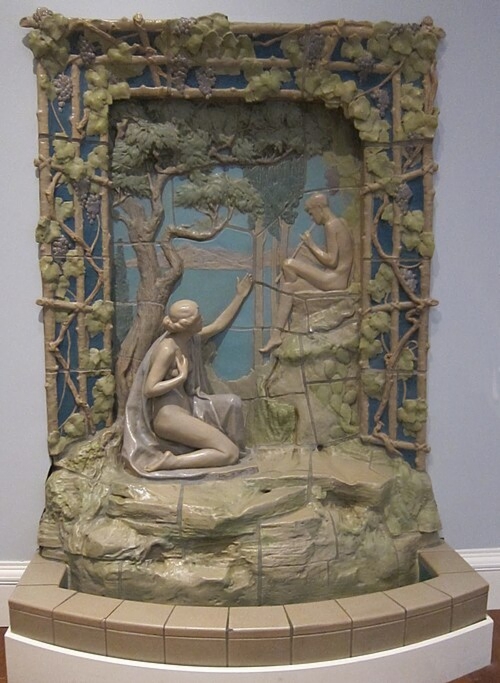
(above: Clement John Barnhorn, Fountain of the Water Nymph, Rookwood Pottery Company, architectural faience, 1913, Cincinnati Art Museum. Public domain, via Wikimedia Commons*)
Genesis of an Institution: 1880-1883
The origins of Rookwood Pottery are inextricably linked to the cultural awakening experienced by Maria Longworth Nichols at the 1876 Centennial Exhibition in Philadelphia. Exposure to the sophisticated ceramic traditions of Japan and the French "barbotine" wares ignited a desire to cultivate a native American art form that could rival the masterworks of Europe and Asia. Nichols, the daughter of the wealthy philanthropist Joseph Longworth, possessed both the social standing and the financial resources to transform her hobby of china painting into a full-scale industrial experiment. In March 1880, her father purchased a former schoolhouse at a sheriff's sale, providing the physical foundation for what she would name "Rookwood," after her family's country estate in Walnut Hills.
The early years of the pottery were characterized by intensive, often precarious experimentation with native Ohio River Valley clays and unstable kiln temperatures. The first kiln was fired on Thanksgiving Day in 1880, producing wares that were largely relief-worked on colored clay bodies, including shades of red, pink, grey, and sage green. During this formative period, Rookwood functioned partly as a commercial kiln for hire, where local enthusiasts could purchase "greenware" (unfinished pieces) to decorate themselves, a practice that mirrored the contemporary "DIY" movement in Cincinnati's elite social circles. However, Nichols soon realized that to achieve the "standard" look she envisioned, the pottery required a more disciplined and professionalized approach to decoration and glazing.
The professionalization of the pottery began with the appointment of Clara Chipman Newton as archivist and general assistant, who shared with Nichols the responsibility for overseeing the complex glazing processes. The addition of Laura Anne Fry, who worked at the pottery from 1881 to 1888, was particularly transformative; she is credited with introducing the use of the atomizer to apply slip, a technical innovation that allowed for the subtle, blended color gradations that would later characterize the "Standard" Rookwood aesthetic. This period was marked by a synthesis of European barbotine techniques -- painting with liquefied clay (slip) under a clear glaze -- and the emerging American preference for botanical realism.
Administrative Professionalization and the Taylor Era
In 1883, the trajectory of Rookwood shifted from a philanthropic artistic experiment toward a robust commercial entity with the hiring of William Watts Taylor as business manager. Taylor recognized that the pottery's long-term survival depended on financial discipline and a consistent artistic brand. Under his direction, Rookwood ceased the sale of greenware to amateur decorators, ensuring that every piece bearing the Rookwood mark was a professional product of the pottery's own studio. This strategic decision consolidated the brand's reputation for quality and exclusivity, eventually leading to the pottery's first profitable year in 1889, at which point it was able to settle its initial debts and operate as a self-sustaining corporation.
Taylor's management style was characterized by a meticulous monitoring of the decorating department. While he encouraged artists to engage with popular artistic trends, he also imposed a degree of aesthetic control to ensure that the pottery's output remained recognizable to collectors and critics. This era saw the institutionalization of the "Standard Glaze," a high-gloss, yellow-tinted clear glaze that became the pottery's signature. The Standard Glaze was typically applied over dark grounds -- browns, ambers, and deep greens -- with motifs of flora, fauna, or portraits painted in contrasting slips. The depth and warmth provided by this glaze formulation created a "glow" that became synonymous with Rookwood's early prestige.
Impact of Japonisme and the Arrival of Shirayamadani
A central pillar of Rookwood's aesthetic identity was its deep engagement with Japonisme, the Western fascination with Japanese art and design that swept through Europe and America in the late 19th century. Maria Longworth Nichols was a devoted student of Japanese motifs, drawing inspiration from Hokusai's Manga and the displays of Hizen and Satsuma ceramics she had seen in Philadelphia. The influence of Japanese woodblock prints was evident in the pottery's use of asymmetrical compositions, flattened perspectives, and specific motifs such as reeds, birds, and insects.
The recruitment of Kataro Shirayamadani in 1887 was perhaps the most significant event in the pottery's artistic history. As a professional Japanese artist, Shirayamadani did not merely imitate Japanese styles; he integrated them with American techniques to create a sophisticated cultural synthesis. His work, characterized by its fluid lines and subtle integration of form and decoration, elevated Rookwood's output to a level of refinement that few American competitors could match. Shirayamadani remained with the pottery for decades, serving as a vital bridge between the founding visionary era and the later periods of modernization.
Technological Flourishing and the Mount Adams Expansion
As Rookwood's fame grew, the schoolhouse on Eastern Avenue became inadequate for the company's expanding ambitions. In 1891-1892, a new, purpose-built pottery was constructed on the summit of Mount Adams, designed by H. Neill Wilson in a style that reflected the artisanal spirit of the company. This move was not just a change of location but a signal of Rookwood's status as a premier American institution. The Mount Adams facility was designed to facilitate a more scientific approach to ceramic production, including specialized rooms for chemistry and glaze experimentation.
The 1890s marked a period of extraordinary technological innovation, largely driven by the work of Stanley Burt and the formalization of Rookwood's chemistry department. Burt, a founding member of the American Ceramic Society, applied "chemical formulae" to the study of glazes, moving away from the "hit or miss" experimentation of the early years toward a disciplined material science. This scientific rigor led to the introduction of several iconic glaze lines in 1894: "Iris," a clear, colorless glaze often applied over white or light-colored slips; "Sea Green," which featured a transparent green tint ideal for aquatic themes; and "Aerial Blue," a short-lived but highly prized blue-tinted clear glaze.
The introduction of these new glazes represented a significant aesthetic shift. While the Standard Glaze was warm and dark, the Iris and Sea Green lines allowed for a cooler, more ethereal palette. These innovations were essential for capturing the transient atmospheric effects -- mist, moonlight, and water -- that were increasingly popular in Tonalist and Impressionist painting. The mastery of these "underglaze faience" techniques, where painting was executed in slip before the final firing, allowed Rookwood to produce pieces that functioned as permanent, ceramic versions of fine art canvases.
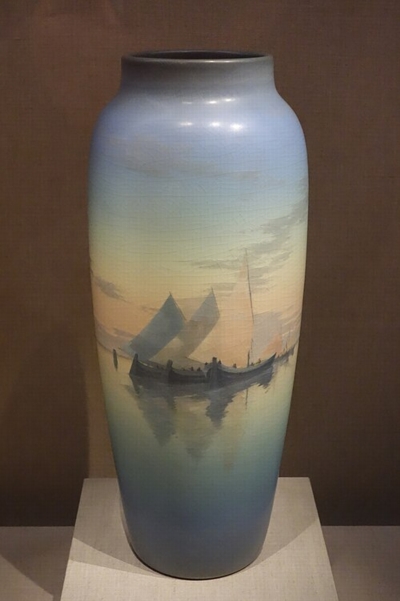
(above: Carl (Charles) Schmidt,
Vase, Rookwood Pottery Company, c. 1904, glazed earthenware,
De Young Museum. Public domain, via Wikimedia Commons*)
Crystalline Mystery: Tiger Eye and Goldstone
Among the most technically elusive achievements of this period were the crystalline glazes known as "Tiger Eye" and "Goldstone". Tiger Eye, which first appeared on a red clay body, produced a golden shimmer deep within the glaze, created by the suspension of crystalline particles. This effect was notoriously difficult to control, as the crystals only formed under specific cooling conditions in the kiln. Successful pieces of Tiger Eye were often treated as geological wonders, and the unpredictable nature of the glaze meant that no two pieces were ever identical.
Goldstone operated on a similar principle, with the glaze containing shimmering particles that caught the light with an "auriferous sheen". Decorators like Shirayamadani and Valentien often integrated these physical characteristics of the glaze into their designs, placing the crystalline concentrations as the "eyes" of painted fish or the centers of celestial motifs. This level of integration between material science and artistic intuition became the hallmark of Rookwood's output during the height of the Art Pottery movement.
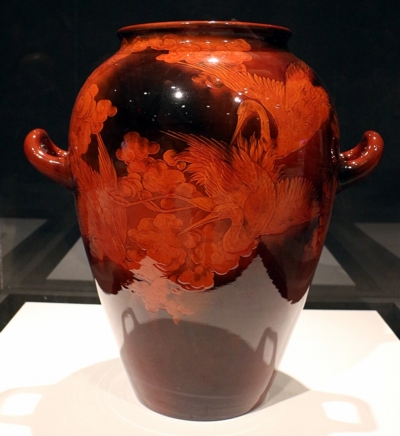
(above: Albert R. Valentien, Vase, 1893, Rookwood Pottery Company, Public domain, via Wikimedia Commons**)
International Recognition and the 1900 Paris Grand Prix
Rookwood's ambition was never confined to local or national markets. Under William Watts Taylor's guidance, the pottery actively sought validation on the international stage, participating in the Great Expositions that defined late 19th-century taste. After attracting attention at the 1889 Paris Exposition through their representatives, Davis Collamore & Co., Rookwood reached its zenith of international acclaim at the 1900 Paris Exposition Universelle.
The preparation for the 1900 exhibit was an exhaustive undertaking led by Albert R. Valentien, who spent months in Europe studying continental pottery and overseeing the Rookwood installation. The effort was rewarded with the Grand Prix, the highest honor a commercial manufacturer could receive, solidifying Rookwood's reputation as the equal of legendary European firms like Sèvres and Doulton. Valentien himself received a collaborative gold medal, and his personal standing was further elevated when one of his paintings was accepted into the prestigious Spring Salon that same year. This international recognition was a critical turning point; it allowed Rookwood to command high prices and established the pottery as a symbol of American cultural sophisticatedness in the eyes of European critics.
Architectural Division and Expansion of Scope
By the dawn of the 20th century, Rookwood had mastered the art of the decorative vessel, but William Watts Taylor sought new avenues for growth and artistic expression. In 1902, the company established its Architectural Faience division, which would soon become a major driver of Rookwood's revenue and cultural footprint. This division moved beyond the small-scale tabletop object into the realm of structural decoration, producing large-format tiles, mantels, and decorative panels for the burgeoning American architectural market.
The success of the architectural division was predicated on the development of matte glazes, most notably the "Vellum" glaze introduced in 1904. Unlike the high-gloss Standard and Iris glazes, Vellum was a transparent matte glaze that provided a soft, non-reflective surface. This texture was perfectly suited for the "scenic" landscape decorations that became a Rookwood specialty, as it allowed for a more naturalistic, painterly effect without the distraction of surface glare. The Vellum glaze became the foundation for large-scale architectural murals, allowing Rookwood artists to create expansive "ceramic paintings" for public spaces.
These installations demonstrated that ceramic art could be both functional and expressive on a monumental scale. The Rathskeller Room at the Seelbach Hilton remains one of the most complete examples of Rookwood's architectural capabilities, featuring custom-designed tiles that cover every surface of the subterranean space. Such projects required a high degree of collaboration between the pottery's chemists, artists, and the architects of the period, such as Frank M. Andrews and the firm of Samuel Hannaford & Sons.
Themes of the Frontier: Native American Portraiture
While botanical realism remained the most common subject for Rookwood decorators, the pottery also engaged with the contemporary American fascination with the "closing frontier". In the late 1890s and early 1900s, Rookwood produced a distinctive line of realistic portrait pottery featuring Native American figures. These pieces, often executed using the Standard Glaze on large vases, were frequently based on ethnographic photographs from government surveys.
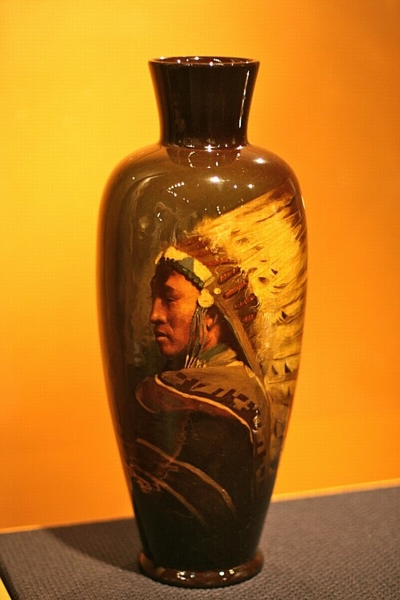
(above: Grace Young (American, 1869-1947). Vase, Chief Shavehead, Rookwood Pottery Company, ca. 1899. Glazed earthenware. Brooklyn Museum, Gift of Mr. and Mrs. Jay Lewis. Public domain, via Wikimedia Commons**)
Artists like Matthew Daly and William P. McDonald specialized in these portraits, translating the flat, monochromatic images of tribal leaders into three-dimensional art with rich, glowing tones. These works, such as Daly's 1899 vase depicting a Wichita woman, were intended as both aesthetic objects and cultural documents of a perceived "vanishing" race. This series represents a complex intersection of luxury commerce and the racial ideologies of the Gilded Age, where Indigenous identities were commodified for the parlors of the wealthy elite.
Labor Dynamics and the Role of Women
Rookwood Pottery was unique among late 19th-century industrial enterprises for its public commitment to the employment of women. Emily Faithfull, in her observations of American industry, noted that "perhaps there is no institution of the kind so successful as the famous Rookwood Pottery under the management of Mrs. Nichols," highlighting the role of women-workers in producing the "dainty bottles" and "Limoges jugs" that collectors admired. The pottery provided a venue for professional female decorators to exercise their skills in a field that was otherwise dominated by amateur clubs.
However, the internal hierarchy of Rookwood was not entirely egalitarian. While women like Clara Chipman Newton and Sallie Coyne were integral to the company's daily operations and artistic output, the top leadership and the most internationally celebrated roles -- such as head chemist or head decorator -- were often held by men like Stanley Burt and Albert Valentien. This duality reflected the broader tensions of the era: a burgeoning professional space for women that remained bounded by traditional Victorian gender roles. Nevertheless, Rookwood's success as a female-founded and female-staffed institution served as a powerful model for the Arts and Crafts movement's ideals of dignified, artisanal labor.
Modernization and the 1920s: The Transition to Soft Porcelain
Following the death of William Watts Taylor in 1913, Rookwood faced the challenge of adapting to a rapidly changing artistic landscape. The post-World War I era saw a shift away from the dark, somber tones of the Standard Ware and the botanical realism of the Vellum line toward the sleeker, more geometric aesthetics of Art Deco and modernism. To meet this demand, Rookwood introduced "Soft Porcelain" in the 1920s, a new body that was more delicate and diaphanous than the earlier stoneware.
This period was characterized by a push toward "good design" that was "timeless," featuring bowl and vase forms that were often simpler and more focused on the harmony between form and material. The use of "enamel paste" and "pâte-de-verre" techniques allowed for a diaphanous quality that rivaled contemporary French glass and porcelain. Decorators like E.T. Hurley continued to work during this period, but their styles evolved to incorporate the streamlined motifs of the 1920s. The pottery also expanded its architectural work, providing Art Deco tiles for the major infrastructure projects of the era, such as Cincinnati's Union Terminal.
Economic Eclipse: 1929-1941
The prosperity of the 1920s came to a definitive end with the 1929 stock market crash and the onset of the Great Depression. As a producer of luxury art goods, Rookwood was acutely vulnerable to the collapse of discretionary spending. The 1930s were a decade of relentless struggle for the pottery, as demand for high-end art pottery plummeted and major architectural projects were cancelled across the country.
Despite attempts to restructure and diversify, including the production of more utilitarian items, the company's high-cost, labor-intensive model was increasingly unsustainable in the depressed economy. The administrative and artistic brilliance that had sustained Rookwood for fifty years could not overcome the macroeconomic forces of the era. The company was hit hard by the loss of its core market and struggled with mounting debt throughout the late 1930s.
In 1941, the original era of Rookwood Pottery effectively came to a close when the company filed for bankruptcy. While the name and assets would be purchased and the pottery would undergo various reorganizations -- eventually moving production to Mississippi in the late 1950s -- the 1941 failure marked the end of the "Golden Age" of Cincinnati's most famous artistic institution. The bankruptcy was not just a financial failure but a cultural one, representing the end of a specific vision of hand-crafted, scientifically-informed art production that had flourished since 1880.
Legacy of Innovation
Rookwood Pottery's history from 1880 to 1941 is a narrative of remarkable cultural synthesis and technical achievement. By bridging the gap between the amateur art of the pottery clubs and the professional science of ceramic engineering, Rookwood elevated American craft to a level of global prestige. The company's ability to integrate diverse influences-from Japanese design principles to French glaze techniques -- ensured that its output remained at the forefront of the Art Pottery movement for over half a century.
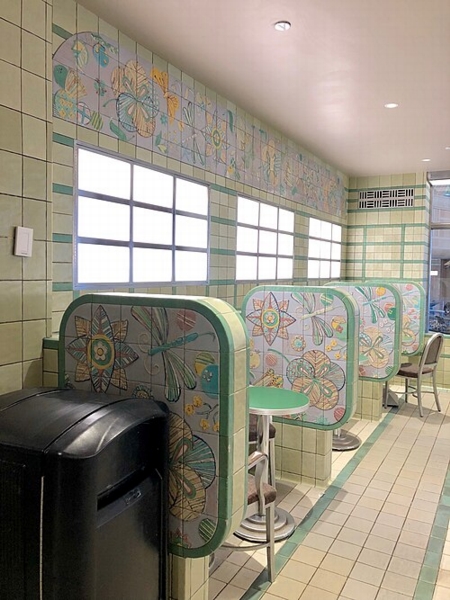
(above: Rookwood Tea Room (Graeter's Ice Cream Parlor), Cincinnati Union Terminal, Queensgate, Cincinnati, OH. Public domain, via Wikimedia Commons**)
The institutional legacy of Rookwood is visible not only
in the highly sought-after pieces in museum collections but also in the
very fabric of the American urban landscape, from the tiles of the Union
Terminal to the grand hotels of the Midwest. Even as the 1941 bankruptcy
brought an end to its most vibrant period, the thousands of original molds
and glaze recipes preserved by collectors and historians ensure that the
Rookwood story remains a central pillar of American industrial and artistic
history. The pottery stands as a testament to the fact that when original,
conscientious work is made paramount to commercial considerations, it can
command the appreciation of the public and the enduring respect of history.
Prompt:
In about 2,000 to 2,500 words, compose an article about the history of Rookwood Pottery in Cincinnati from 1880 through 1941. In composing your article use only paragraphs. Exclude section and paragraph headings, bullet points and tables. Research only .edu and .org sites.
We lightly edited the article, added images and provided
links to other materials to enhance it. AI is rapidly improving in
accuracy, yet the article may have inaccurate information.
 Return to Ohio Art History
*Tag for expired US copyright of object image:

and
**Tag for some rights reserved:

Links to sources of information outside of our web site are provided only as referrals for your further consideration. Please use due diligence in judging the quality of information contained in these and all other web sites. Information from linked sources may be inaccurate or out of date. TFAO neither recommends or endorses these referenced organizations. Although TFAO includes links to other web sites, it takes no responsibility for the content or information contained on those other sites, nor exerts any editorial or other control over them. For more information on evaluating web pages see TFAO's General Resources section in Online Resources for Collectors and Students of Art History.
Copyright 2026 Traditional Fine Arts Organization, Inc. an Arizona nonprofit corporation. All rights reserved.