
Ohio's John Quincy Adams Ward: One of America's Greatest Sculptors
a Gemini 3 Deep Research Report
December, 2025
The trajectory of American sculpture in the nineteenth century finds its most resolute and defining anchor in the life and work of John Quincy Adams Ward. Born on June 29, 1830, in the frontier town of Urbana, Ohio, his family was deeply woven into the fabric of the nascent American West. The Ward homestead, a sprawling 600-acre tract, served as the primary classroom for the young artist. It was here, in the mud of local creek-beds, that Ward first discovered the tactile joys of three-dimensional form, fashioning small figures of animals and people from the earth.
This early immersion in the materiality of the Ohio landscape was encouraged by a neighbor and local potter, Miles Chatfield. By the age of eleven, Ward had essentially been given the run of Chatfield's studio, where he learned the fundamental techniques of throwing clay and, more significantly, decorating utilitarian forms with bas-reliefs. This foundational experience with clay -- a medium that demands a direct, physical engagement with form -- distinguished Ward from the many contemporary sculptors who began their training with the intellectualized, subtractive process of marble carving. The influence of the Ohio environment also extended to his subject matter; Ward spent his youth witnessing the displacement of the Wyandot tribe, an experience that instilled in him a profound sense of the "poetic significance of the vanished and vanquished inhabitant" of North America, a theme he would later immortalize in his most famous early work.
Despite this innate talent, Ward's path to professional sculpture was initially thwarted by a lack of exposure to the broader art world. After attending a sculpture exhibition in Cincinnati in 1847, the seventeen-year-old Ward felt a crushing sense of discouragement, perceiving the gap between his rustic efforts and the polished, idealized marbles of the day as insurmountable. For a brief period, he pivoted toward the study of medicine, but the calling of the plastic arts proved too strong. In 1849, an invitation from his older sister, Eliza, and her husband, Jonathan Wheelock Thomas, brought him to Brooklyn, New York. This move was the pivotal moment in his biography, transitioning him from a provincial hobbyist to a serious student under the guidance of one of the most significant sculptors of the age.
The Crucible of Apprenticeship: Henry Kirke Brown and the Union Square Washington Monument
The Brooklyn studio of Henry Kirke Brown served as the site of Ward's formal transformation. Brown was a pioneering figure who had recently returned from Italy with a radical vision: he sought to move American sculpture away from the prevailing Neoclassical mode, which relied heavily on European marble and Greco-Roman allegories, toward a style that emphasized American themes and the expressive potential of bronze. Ward remained under Brown's tutelage for seven years, from 1849 to 1856, a period that saw him progress from a novice student to a vital studio assistant.
The most significant collaboration of this period was the execution of Brown's equestrian monument of George Washington for Union Square in New York City. Executed between 1853 and 1856, this project was a landmark in the development of the American bronze industry. Ward's contribution was so substantial that Brown, in a rare gesture of professional acknowledgment, inscribed "J.Q.A. Ward, asst." on the base of the monument alongside his own name. This experience provided Ward with a comprehensive mastery of the technical demands of monumental sculpture, including modeling large-scale figures in clay, creating complex plaster casts, and understanding the intricacies of bronze finishing.
Brown's influence extended beyond technique; Ward adopted Brown's belief that an American school of sculpture must be founded on the direct observation of nature and the representation of modern, nationally relevant subjects. This apprenticeship was the forge in which Ward's realist style was tempered, preparing him to become the foremost proponent of a "truthful observation of significant modern-day figures".
The Aesthetic Pivot: Rejection of Neoclassicism and the Rise of Realism
Ward's career began during a period when the American sculptural landscape was dominated by expatriates working in Italy, such as Hiram Powers and Horatio Greenough. These artists adhered to a Neoclassical aesthetic, producing smooth, white marble figures that often utilized mythological or historical allegories to convey abstract moral truths. Ward, however, became a leader of the second generation of American sculptors who sought a more visceral and immediate connection to the viewer.
The shift from Neoclassicism to realism in Ward's work was characterized by several key features. First was the move from marble to bronze, a medium that allowed for greater textural complexity and a sense of movement. Bronze, unlike the fragile and unyielding surface of marble, could capture the "richly textured surfaces and broadly modeled planes" that became hallmarks of the Beaux-Arts aesthetic Ward later integrated into his work. Second was the replacement of idealized, generalized features with individualized, specific details. Ward's figures possessed a "virility" and a "straightforward" quality that contemporary critics like Daniel Chester French noted as his most defining characteristic.
Ward's realism was not merely a stylistic choice but a philosophical stance. This approach made him the ideal candidate for portrait commissions, as he could capture the "physiognomic and psychological traits" of prominent citizens with an objectivity that commanded respect. His work sought to bridge the gap between the "American idea" and the timeless principles of proportion and truth, creating a national art form that felt both ancient in its weight and modern in its energy.
Technical Innovation and the Industrialization of American Bronze
A major aspect of Ward's historical significance lies in his contribution to popularizing and technically developing the bronze casting industry in the United States. Before the mid-nineteenth century, American sculptors were largely dependent on European foundries for bronze work. Ward, however, worked closely with domestic foundries to ensure that American artists could cast their work on "native shores." His early career included a stint at the Ames Manufacturing Company in Chicopee, Massachusetts, where he designed gilt-bronze sword hilts and other decorative objects for the Union Army. This industrial experience gave him a deep understanding of the casting process and the metallurgical properties required for large-scale monuments.
Ward's sculptures were initially produced using the French sand-casting method, a process involving firm sand molds that were efficient for reproducing textural detail in utilitarian and fine art objects. As the industry evolved toward 1900, many of his later works and posthumous casts utilized the lost-wax (cire perdue) process https://en.wikipedia.org/wiki/Lost-wax_casting , which relied on gelatin molds to achieve even higher levels of precision and allowed for the casting of complex compositions in a single piece.
Furthermore, Ward was an early adopter of the "galvanoplastic" duplicating technique, which used electroplating to create bronze reductions of his larger public works for the private market. This allowed his art to reach a wider audience of collectors and ensured his commercial success outside of the massive civic commissions that dominated his later years. His collaborative relationships with foundries like the Henry-Bonnard Bronze Company and the Gorham Manufacturing Company were instrumental in establishing a "national bronze casting industry" that could finally compete with the established houses of Europe.
The Indian Hunter and the Poetics of the Vanishing Frontier
In 1861, Ward established his own studio in New York City and began work on a theme that had haunted him since his youth in Ohio: the Native American. His first major independent success was The Indian Hunter, a work that depicted a Native American youth cautiously restraining a snarling dog while tracking prey. This sculpture was a radical departure from the "idealized, classically based figures" of previous generations; instead, Ward sought a "truthful delineation" of his subject.
To achieve this naturalism, Ward undertook a rigorous program of research that was unusual for the time. In 1864, he traveled to the Dakota Territory to observe Native Americans firsthand, completing numerous sketches and three-dimensional models based on his direct observations. This commitment to ethnographic accuracy allowed him to capture the specific details of physique and movement that lent the work its "bold and vigorous treatment". Originally modeled as a statuette, the work was enlarged to a full-size bronze and dedicated in Central Park in 1869 -- the first sculpture by an American artist placed in the park.
The sculpture was celebrated for its "fusion of realism and idealism" and secured Ward's prestige in the international art world after being displayed at the Paris Exposition of 1867. Critics admired the work for being designed "to be viewed in the round rather than frontally," a testament to Ward's growing sophistication in managing the complex spatial dynamics of a multi-figure composition. The work's significance to Ward was personal as well as professional; a replica of The Indian Hunter stands at his gravesite in Urbana's Oakdale Cemetery, serving as a permanent monument to his Ohio roots.
The Freedman: A Lexicon of Emancipation and Self-Liberation
While The Indian Hunter established Ward's reputation, The Freedman (1863) defined his moral and artistic legacy during the tumultuous years of the Civil War. Modeled in the fall of 1862, shortly after the announcement of the Emancipation Proclamation, the work is a profound commentary on the era's chief political and moral topic. The sculpture depicts an African-American man seated on a tree stump, caught in a moment of physical and symbolic transition. He has just broken the shackle on his right wrist, while the remnants of the chain still dangle from his left, signaling a status "between bondage and freedom." (Here's an Amon Carter Museum video about the sculpture. There are many other references to this sculpture online.)
The Freedman was a groundbreaking work for its time, representing the "first realist sculptural representation of an African-American". Unlike many abolitionist images that depicted enslaved people in a position of subjugation, pleading for sympathy from a white benefactor, Ward's figure is the "agent of his own freedom". Ward himself noted that he intended the figure to express a "conscious power to break things," shifting the narrative of emancipation from one of passive reception to one of internal poise and dynamic power.
Artistically, the work demonstrates Ward's ability to bridge the gap between classical precedent and modern realism. While the figure's twisting torso is likely derived from the Hellenistic Belvedere Torso, the face is modeled with "physiognomic precision" from life, suggesting a man of specific experience and character. In some castings of the work, Ward even inscribed a reference to the Massachusetts 54th, the first all-Black regiment in the Union Army, further linking the sculpture to the active military struggle for freedom. The work remains a powerful symbol of a "tragic past and hopeful future," admired by viewers and critics for its "noble interpretation" of the human quest for liberty.
Public Monuments and the Urban Landscape of New York
Following the success of his early "ideal" figures, Ward transitioned into a prolific career as a sculptor of public monuments. He ultimately contributed nine sculptures to the parks of New York City, earning him the unofficial title of the "Dean of American Sculptors". His work during this period was characterized by its ability to integrate with the surrounding urban environment, often through collaborations with the renowned architect Richard Morris Hunt, who designed many of the pedestals for Ward's monuments.
One of his most visible works is the larger-than-life standing statue of George Washington on the steps of Federal Hall on Wall Street (1883) . This bronze figure, depicting Washington at his first inauguration, is characterized by a "direct approach" and a sense of historical gravitas that captures the "truthful observation" of a significant national figure. Similarly, his monuments to Horace Greeley (1890) and Henry Ward Beecher (1891) demonstrate his skill in posthumous portraiture, utilizing death masks and photographs to create a "full flowering" of artistic expression that honored the legacy of these influential reformers.
Ward's commitment to historical accuracy was perhaps most evident in his monument to William Shakespeare (1872) in Central Park. To celebrate the tricentennial of the poet's birth, Ward combined a classical pose with painstaking details of Elizabethan dress, relying on surviving early representations of the Bard to ensure a "robust" and "truthful" likeness. Critics admired the sculpture for its "pensiveness," depicting the writer deep in thought and suggesting that "the world is a place where mental effort pays off". The presence of these monuments in public spaces served to establish a "national school of sculpture" that could educate and inspire the burgeoning American citizenry.
The Henry Ward Beecher Monument: A Synthesis of Art and Social Reform
The Henry Ward Beecher Monument (1891) stands as one of Ward's most complex and celebrated works. Dedicated to the esteemed clergyman, abolitionist, and orator, the monument was a "grateful gift of the multitudes" to honor the "great apostle of the brotherhood of man". Ward, having made Beecher's death mask himself, captured a "remarkable portrait" of the theologian, depicting him in a pensive manner wearing an Inverness cloak.
The monument is notable for its use of expressive genre groups on the base of the pedestal. On one side, a young Black woman placing a palm branch at Beecher's feet evokes his lifelong commitment to the abolitionist movement; on the other, a boy and girl placing a garland symbolize his devotion to children. This multi-figure composition, set upon a handsome polished granite pedestal designed by Richard Morris Hunt, represents the "American Renaissance" style at its peak. The monument was dedicated before 15,000 spectators, reflecting Ward's immense popularity and his role in creating a "full-scale bronze effigy" that resonated with the values of the nineteenth-century public.
Institutional Leadership and the Professionalization of American Sculpture
Ward's influence on the American art world extended far beyond his studio. He was a tireless advocate for the development of art organizations and the professionalization of the sculptor's craft. He was an original member of the Board of Trustees for The Metropolitan Museum of Art and served as its president in 1874. Furthermore, he was the founder and first president of the National Sculpture Society (1893 1904), an organization dedicated to fostering the highest standards of the plastic arts in the United States.
His dedication to institutional building was motivated by a desire to establish an American school of sculpture that was independent of European influence. Ward believed that American artists should be trained at home, and he frequently took on students and assistants, the most notable being Daniel Chester French. Through his teaching at the Metropolitan Museum of Art and Harvard University, he passed on his commitment to "truth for nature" and the "American idea" to the next generation of artists.
Ward's leadership in these organizations ensured that sculpture would play a central role in the civic life of the nation. He sat on the advisory committees for major international events, such as the World's Columbian Exposition (1893) and the Louisiana Purchase Exposition (1904), helping to shape the public's perception of American artistic achievements on the world stage. His career demonstrated a "happy conjunction of early bud and constant good fruit," where more than half a century of mastery was applied to the betterment of the national aesthetic.
Late Career and the Beaux-Arts Influence
In his later years, Ward's style began to evolve in response to the emerging Beaux-Arts aesthetic. After several visits to Europe in 1872 and 1887, his work began to express "grater movement" and "enlivened and modernized" surfaces. This was particularly evident in his collaboration with Paul W. Bartlett on the pediment sculptures for the New York Stock Exchange (1903) . Although the original marble sculptures have since been replaced with copies, the design demonstrated a "more complex relationship between the figure and their base," reflecting the influence of contemporary French art while maintaining Ward's core commitment to realism.
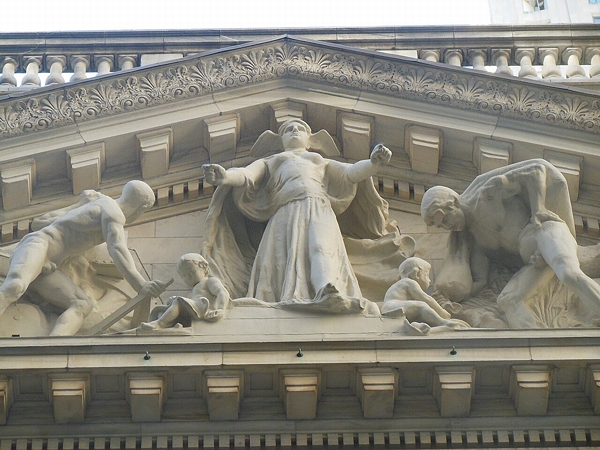
(above: The facade of the New York Stock Exchange with "Integrity Protecting the Works of Man," Public domain, via Wikimedia Commons**)
His involvement in planning the sculptural ornamentation for the Library of Congress and the triumphal arch for Admiral George Dewey (1899) further solidified his position as the "preeminent American sculptor" of his generation. Even as he aged, Ward remained a "hard worker and a good sportsman," continuing to accept major commissions despite failing health in the last five years of his life. His final works continued to emphasize the "masculinity" and "virility" that had always been his trademark, ensuring that his legacy would be one of strength and enduring presence.
Critical Regard and the Definition of the "American Idea"
John Quincy Adams Ward was admired by both critics and viewers for what was perceived as a fundamentally "American" approach to art. His rejection of Neoclassical sentimentality in favor of a "truthful observation" of the modern world resonated with a nation seeking to define its own cultural identity after the Civil War. Contemporary writers noted that his work was "male, in the highest sense," characterized by a "sheer virility of purpose and act" that set it apart from the more effete European traditions.
Lorado Taft, one of the most prominent art critics of the era, stated that Ward's work "bore no trace of the arrogance or the timidity" of less confident artists. He was seen as a "leader all his life," producing work that was "in advance of his day and generation." His ability to capture the "poetic significance" of the American experience -- whether through the figure of the Native American, the freed slave, or the modern statesman-anchored his hope "firmly in the value of the American idea." This commitment to truth and proportion ensured that his work would remain a "grateful gift" to the public for generations to come.
The admiration for Ward was also a result of his personal character. He was described as having a "powerful build" and a "deep strong voice," traits that were seen as being reflected in the "incisive and straight forward" nature of his work. His "intolerance of sham" made him a trusted figure in the art world, and his "passion for truth" ensured that his monuments would be seen not just as artistic objects but as moral statements on the nature of human life. As Taft eloquently summarized, Ward was a "realist to whom ideals were dearer than aught else that life could offer," a synthesis that defined the pinnacle of nineteenth-century American sculpture.
The Personal Life and Memorial Legacy of J.Q.A. Ward
Ward's personal life was marked by both professional triumph and personal tragedy. He was married three times: first to Anna Bannan in 1858, who died of illness; second to Julia Devens Valentine in 1877, who tragically died during childbirth in 1879; and finally to Rachel Smith in 1906. Rachel Smith was instrumental in the preservation of his legacy, helping to place his papers and works in numerous public institutions after his death in 1910.
Ward's commitment to his hometown of Urbana remained strong throughout his life. His birthplace and childhood home, built by his grandfather, is now listed on the National Register of Historic Places, serving as a permanent memorial to his Ohio roots. His burial in Urbana's Oakdale Cemetery, marked by a replica of The Indian Hunter, brings his career full circle-from the local clay of the Champaign plains to the pinnacle of the American art world and back to the soil that first inspired him.
The conservation of his monuments today, led by organizations like the Central Park Conservancy and the Municipal Art Society, ensures that his "technical mastery" remains on full display for modern audiences. Recent restoration efforts on the Beecher Monument and the Indian Hunter have utilized advanced scientific methods to return the bronze surfaces to their original glory, preserving the "historically correct patination" that Ward favored. These efforts reflect the enduring importance of his work as a "barometer of social change" and a testament to the "brotherhood of man".
The Permanent Dean of American Sculptural Realism
John Quincy Adams Ward's career was a "remarkable interest" in the pursuit of a native American art form. By rejecting the "European Neoclassical traditions" and embracing a "literal naturalism," he redefined the aesthetic and technical possibilities of sculpture in the United States. His work, ranging from the intimate and morally charged The Freedman to the heroic and civic-minded George Washington, demonstrated a "greatness of vision" and a "feeling for proportion" that captured the spirit of a growing nation.
Ward was not just a molder of clay and bronze; he was a molder of the American art world itself. His institutional leadership and his dedication to "developing an American school of sculpture" ensured that the profession would thrive long after his death. He remains the "Dean of American Sculptors" because he anchored his work in the "truth" of the human experience, creating monuments that are "indispensably very elegant and intellectual" while remaining accessible to the "multitudes of all classes". In the history of American art, Ward stands as a "revitalizing force," a sturdy and "sturdy American sculptor" who proved that the "American idea" could be expressed with a power and a beauty that was entirely its own.
We lightly edited this article, added images and provided
links to other materials to enhance it. AI is rapidly improving in
accuracy, yet the article may have inaccurate information.
Prompt:
In around 1,500 to 2,000 words, using an informal writing
style with only paragraphs (excluding section headings, bullet points, or
tables), compose an article about the career of Ohio sculptor artist John
Quincy Adams Ward. Cover the artist's training, artistic style, any technique
innovations, subject matter, most famous sculptures, and why they are greatly
admired by viewers and critics. Research only .edu and .org sites.
Gemini's Deep Research plan:
(1) Search for comprehensive biographical information about John Quincy Adams Ward on .edu and .org websites, focusing on his origins in Ohio and his early influences. (2) Research Ward's formal training and his apprenticeship under Henry Kirke Brown, examining how this period shaped his development as a sculptor. (3) Investigate Ward's artistic style and his specific move away from European Neoclassicism toward a more naturalistic, American realism. (4) Identify any technical innovations or specific bronze-casting techniques Ward introduced or popularized in the American sculpture scene. (5) Catalog his most significant works, such as The Indian Hunter, the statue of George Washington at Federal Hall, and the Beecher Monument, noting their locations and subject matter. (6) Analyze the themes and subject matter of his sculptures, particularly his focus on American figures and naturalistic human forms. (7) Explore critiques and scholarly evaluations from art historians to understand the reasons for his high regard among critics and his legacy as the dean of American sculpture. (8) Synthesize the gathered information to provide a detailed narrative that flows informally without the use of headings or lists, ensuring all research sources are limited to academic and organizational domains.
 Return to Kansas Art History
*Tag for expired US copyright of object image:

and
**Tag for some rights reserved:

Links to sources of information outside of our web site are provided only as referrals for your further consideration. Please use due diligence in judging the quality of information contained in these and all other web sites. Information from linked sources may be inaccurate or out of date. TFAO neither recommends or endorses these referenced organizations. Although TFAO includes links to other web sites, it takes no responsibility for the content or information contained on those other sites, nor exerts any editorial or other control over them. For more information on evaluating web pages see TFAO's General Resources section in Online Resources for Collectors and Students of Art History.
Copyright 2025 Traditional Fine Arts Organization, Inc. an Arizona nonprofit corporation. All rights reserved.
