
Frank Duveneck's Artistic Evolution and Legacy
a Gemini 3 Conversational Deep Research Report
February, 2026
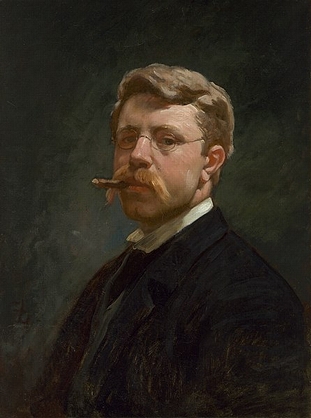
(above: Frank Duveneck, Self-portrait, c. 1890, oil on canvas, National Portrait Gallery. Public domain, via Wikimedia Commons*)
The history of American art in the late nineteenth century is defined by a seismic shift away from the meticulously finished, often sentimentalized landscapes of the Hudson River School toward a more visceral, direct, and European-influenced mode of representation. Central to this transformation was Frank Duveneck, an artist whose career serves as a bridge between the rigorous traditions of the Munich Royal Academy and the burgeoning spirit of American Modernism. Duveneck's contribution to the visual arts was not merely limited to his prolific output of paintings, etchings, and sculptures; it was equally rooted in his role as a charismatic educator who fostered a generation of "Duveneck Boys," thereby altering the trajectory of American art education and institutional collecting.
Immigrant Aesthetic
Frank Duveneck was born Frank Decker on October 9, 1848, in Covington, Kentucky, to Bernhard and Maria Decker, Westphalian immigrants who had settled in the German-speaking enclave across the river from Cincinnati. The early death of his father during a cholera epidemic when Frank was merely a year old necessitated his mother's remarriage to Joseph Duveneck, whose surname the artist would eventually adopt and utilize formally starting in 1886. Growing up within the working-class German community of the Ohio River Valley, Duveneck's early exposure to art was inherently practical and craft-oriented rather than academic.
At the age of fifteen, Duveneck began his formal introduction to the arts through an apprenticeship with Johann Schmitt, a local painter of religious subjects. This initial training was quickly supplemented by work with a German firm of church decorators, where he served under the Munich-trained Wilhelm Lamprecht. This period was critical in shaping Duveneck's understanding of art as a physical, material endeavor. He was involved in the carving, gilding, and painting of altars and murals for nineteenth-century ecclesiastical buildings, such as the Mother of God Church in Covington, Kentucky. This background in decorative crafts provided him with a unique tactile sensibility, a "material agency" that would later manifest in the heavy impasto and robust brushwork of his mature style.
By 1869, at the age of twenty-one, Duveneck's potential was recognized by Lamprecht, who encouraged him to seek advanced training in Europe. He chose Munich over Paris, a decision that would define his aesthetic development. At the time, Munich was the second most important center for art instruction in Europe, offering an alternative to the linear, drawing-focused curriculum of the French academies by emphasizing a more painterly, color-driven approach inspired by the Old Masters.
Munich Royal Academy and the Radical Realist Turn
Duveneck enrolled in the Royal Academy of Munich in January 1870, entering the class of Wilhelm von Diez. Von Diez was instrumental in guiding Duveneck toward an appreciation of the dark, strongly brushed styles of seventeenth-century masters such as Rembrandt, Frans Hals, and Diego Velázquez. However, the most profound influence on Duveneck's development during this period was his association with Wilhelm Leibl, the leader of the German realist movement. Leibl advocated for a style of "unsentimental realism" that emphasized the physical presence of the sitter and the raw application of paint, often referred to as "alla prima" or direct painting.
This Munich style was characterized by a dark palette, rapid brushwork, and rich impasto -- a direct challenge to the highly finished, polished surfaces demanded by the prevailing academic standards of the time. Duveneck's success at the Academy was nearly instantaneous. He received the institution's major prizes and was granted the rare privilege of free studio space and models. His work from these early years broke new ground in American art by introducing a "bravura" technique that prioritized the "vital energy" of the subject over the meticulous rendering of detail.
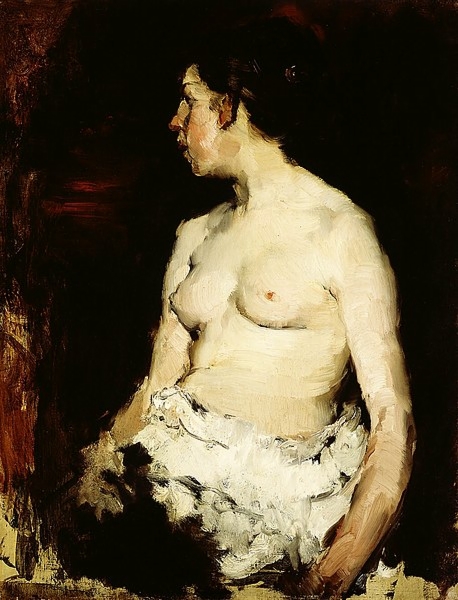
(above: Frank Duveneck, Seated Nude, c. 1879, oil on canvas, 34 x 26.4 inches, Detroit Institute of Arts, Founders Society Purchase, Robert H. Tannahill Foundation Fund. Public domain, via Wikimedia Commons*)
The significance of Duveneck's Munich training lies in his adaptation of these anti-academic European styles into what critics later recognized as a truly American form.While the French Impressionists were experimenting with light and broken color in the mid-1870s, Duveneck and his Munich colleagues were developing what could be termed "dark Impressionism". This style sought to capture the "pulsating energy of life" through vigorous, "slapdash" brushwork that seemed to quiver on the canvas.
Iconography of the Urban Urchin: Social Context and Psychological Depth
Duveneck's most celebrated works from his early Munich period involve portraits of working-class subjects, particularly "street urchins" and "ruffians". These paintings, such as The Whistling Boy (1872) and The Cobbler's Apprentice (1877), were heavily indebted to the lowlife genre tradition of the seventeenth century but were imbued with a modern, psychologically penetrating depth.
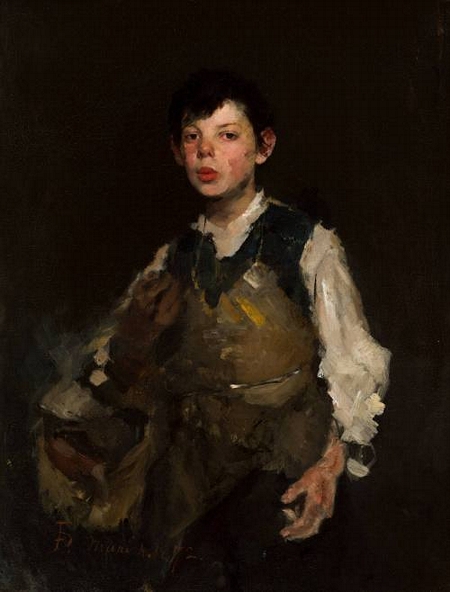
(above:Frank Duveneck, The Whistling Boy, 1872, oil on canvas. Image courtesy of Cincinnati Art Museum)
In The Whistling Boy, Duveneck presents a youth emerging from a deep, dark background, his face highlighted by bold, "buttery" strokes of undiluted paint. The painting is often cited as the "apex of Duveneck's abilities," representing a mastery of "juicy" brushwork that conveys a vivid, pulsing presence. However, the work also contains a subversive social element. While the title suggests a lighthearted scene, the boy is actually depicted holding a cigarette, his pursed lips releasing a faint wisp of smoke. This juxtaposition of childhood innocence with the gritty realities of urban poverty reflected the shifting social landscape of the nineteenth century, a period marked by extreme class conflict and the rise of the urban working class.
Critics of the era, including the novelist Henry James, were often perplexed by the "inherent ugliness" of Munich-style realism. To the conservative American art establishment, which favored nationalistic and studio-derived subjects, Duveneck's "ragamuffins" were uncomfortably close to the perceived dangerous classes of major American cities. Yet, it was precisely this lack of sentimentality and the "unabashed joy" in the expressiveness of the paint itself that garnered Duveneck the admiration of fellow artists and, eventually, a broader critical acceptance.
"Duveneck Boys" and the Communal Pedagogy
In 1878, Duveneck opened his own art school in Munich and the Upper Bavarian village of Polling, an event that would solidify his reputation as one of the most influential teachers in the history of American art. His students, a gregarious and often "rowdy" group known as the "Duveneck Boys," followed him across Europe, adopting his "slapdash" approach to painting and his commitment to direct observation from life.
The pedagogy Duveneck employed was a radical departure from the rigid, hierarchical structure of the academies. He encouraged a collaborative, communal atmosphere where students and teachers lived and worked together. The group included several artists who would go on to achieve significant fame, such as John Henry Twachtman, William Merritt Chase, Otto Bacher, and John White Alexander. This mentor-student relationship was characterized by a shared interest in "bravura" technique and a rejection of the moralistic, historical weight often demanded by the Paris Salon.
The influence of the "Duveneck Boys" was not confined to Germany. In 1879, at the invitation of Elizabeth Boott, Duveneck moved his school to Florence and Venice. This transition marked a significant shift in his artistic output, as the group encountered the brilliant light and architectural richness of Italy. The "Duveneck Boys" in Italy became a recognizable cultural phenomenon, often observed in cafes and restaurants, where their boisterous debates and unrefined "bohemian" manners both intrigued and scandalized the expatriate community.
Venice Etching Revival and the Whistler Interaction
During his sojourn in Venice between 1879 and 1881, Duveneck played a central role in the nineteenth-century "etching revival". Working alongside James Abbott McNeill Whistler and Otto Bacher, Duveneck began to experiment with the etching needle, producing large, bold plates that captured the "Venice of the Venetians" rather than the typical tourist monuments.
Duveneck's etchings were characterized by a sense of architectural richness and a "masterly draughtsmanship" that often rivaled Whistler's own work. In fact, the two artists were so closely associated that when Duveneck's etchings of the Riva degli Schiavoni were first exhibited in London in 1881, some members of the Society of Painter-Etchers suspected they were actually the work of Whistler using a pseudonym. This confusion prompted Whistler to publish a series of witty, often biting, correspondences known as "The Piker Papers".
Despite the potential for professional rivalry, the relationship between Duveneck and Whistler was one of mutual inspiration. Whistler was known to have admired Duveneck's etchings to the extent that he felt compelled to etch the same views himself. The technical cross-pollination between these artists helped to establish etching as an independent mode of artistic expression, rather than a mere means of replicating paintings.
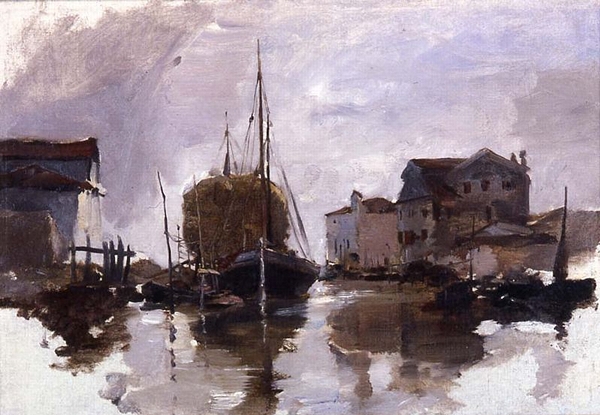
(above: Frank Duveneck, Harbour Chioggia, Unknown date, oil on canvas, 19.6 x 27.8 inches, Addison Gallery of American Art, Phillips Academy, Andover, MA, bequest of Candace C. Stimson,1944.16. Public domain, via Wikimedia Commons*)
Elizabeth Boott: Marriage, Tragedy, and Sculptural Transformation
The personal life of Frank Duveneck was inextricably linked to his artistic career through his marriage to Elizabeth "Lizzie" Boott in 1886. Boott, an accomplished painter and a member of a wealthy, socially prominent Bostonian family, had been one of Duveneck's most devoted students in Munich and Italy. Their courtship, which lasted several years, was often obstructed by the disapproval of her father, Francis Boott, and family friends like Henry James, who viewed Duveneck as a "coarse" and "unrefined" provincial.
The marriage, which took place in Paris when both were in their late thirties and early forties, was tragically short-lived. In 1888, just two years after their wedding and shortly after the birth of their son, Frank Boott Duveneck, Lizzie died of pneumonia in Paris. Duveneck was reportedly devastated by the loss, an event that significantly slowed his productivity and marked a profound shift in his artistic focus.
In the wake of this tragedy, Duveneck turned to sculpture -- a medium in which he had little prior formal training -- to create a monument to his late wife. With the assistance of the Cincinnati sculptor Clement Barnhorn, he modeled the Tomb Effigy of Elizabeth Boott Duveneck. The work is a recumbent funerary monument inspired by Gothic and Renaissance gisant effigies, depicting Lizzie resting peacefully with her arms folded and a palm branch stretching along her body, symbolizing victory over death.
The sculpture is widely considered a high point of nineteenth-century funerary art, praised for its "poignant" and "somber power". Henry James, once a critic of Duveneck's manners, was deeply moved by the monument, famously remarking that it was "art alone that triumphs over fate". The original bronze sits on her grave in the Allori Cemetery outside Florence, while replicas in marble, bronze, and plaster reside in major American museums, serving as a testament to both their personal bond and Duveneck's versatility as a master of various media.
Return to Cincinnati: Institutional Leadership and the Final Decades
Following the death of his wife and the arrangement for the future of their infant son, Duveneck returned permanently to the United States in 1888, eventually settling in his family home in Covington. While his later years saw a relative withdrawal from the international spotlight, his impact on the regional and national art scene remained unparalleled through his pedagogical work at the Art Academy of Cincinnati.
Duveneck began teaching at the Cincinnati Art Museum in 1890 and accepted a full-time position at the Art Academy in 1900, eventually becoming the director of the faculty. During this period, he became a "beloved and respected" figure, often referred to as the "father of American art." His influence on the Cincinnati art world extended beyond the classroom; he served as a mentor to collectors like Mary M. Emery and advised the museum on the formation of its collection, particularly in the realm of American Impressionism.
His later paintings, such as those produced during summer visits to Gloucester, Massachusetts, showed an evolution away from the dark Munich palette toward a lighter, "high-keyed" Impressionist style. This shift demonstrated his continued engagement with modern trends and his ability to regain the "gestural and expressive brushstrokes" of his youth while embracing a new sense of color and light.
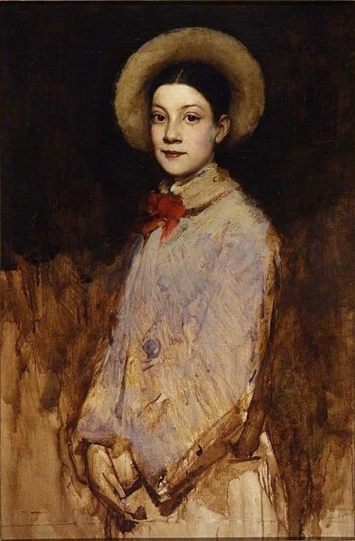
(above: Frank Duveneck, Portrait of Amy Folsom, c.1880, oil on canvas, 35.9 x 24 inches, Montclair Art Museum, Museum purchase; Acquisition Fund, 1962.27. Public domain, via Wikimedia Commons*)
The "Painter's Painter": Critical Admiration and Enduring Legacy
The admiration for Frank Duveneck among critics and fellow artists is perhaps best summarized by the often-quoted hyperbole of John Singer Sargent, who stated at a London dinner party: "After all's said, Frank Duveneck is the greatest talent of the brush of this generation". This reputation as a "painter's painter" stems from his exceptional control over the physical medium of paint -- the ability to manipulate "buttery" and "juicy" textures to create a sense of life that seemed to "quiver" with pulsating energy.
Duveneck is admired not for technical trickery or sentimental storytelling, but for a "simple and direct" approach that captured the normal aspect of man and nature without self-consciousness or dogma. His works function as a temporal bridge connecting the painterly techniques of the Old Masters with the "flair for the modern" that would characterize the twentieth century. In 1915, he was awarded a special gold medal at the San Francisco Panama-Pacific International Exposition, a final national acknowledgment of his achievements and his profound influence on American art education.
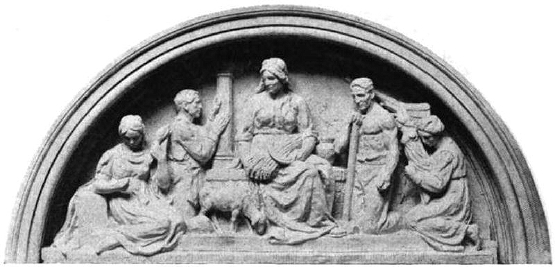
(above: Sculptural work by Ralph Stackpole, appearing at the Panama-Pacific International Exposition in San Francisco in 1915, over the main south entrance to the Palace of Industry. Figures in the tympanum represent, from left, Textiles, Architecture, Agriculture, Labor and Commerce. Photograph was published in 1915 in the book The Jewel City by Ben Macomber. Public domain, via Wikimedia Commons*)
Today, Duveneck's impact remains alive in the extensive collections he gifted to the Cincinnati Art Museum, comprising over 120 oil paintings, sculptures, prints, and drawings. For students of painting, his work continues to serve as an inspiration to develop a "technique of corresponding dignity," manifesting a deep consciousness of life and an intense conception of nature.

(above: Frank Duveneck, Siesta,
1886, oil on canvas, 25.5 in x 37.9 in. Cincinnati Art Museum.
Bequest of Mary O'Brien Gibson in memory of her parents, Cornelius and Anna
Cook O'Brien. Public domain, via Wikimedia Commons)
Prompt:
In around 1,500 words, using a conversational, informal, style of writing, write a narrative about the artistic career of Ohio artist Frank Duveneck. Do not make the narrative look like a report that has section headings, bullet points, or tables. Cover the artist's training, artistic style, any technique innovations, subject matter, any famous artworks, and why the artist's art is admired by viewers and critics. Research only .edu and .org sites. Include tfaoi.org as a source if that site has relevant information.
We lightly edited the article, added images and provided
links to other materials to enhance it. AI is rapidly improving in
accuracy, yet the article may have inaccurate information.
 Return to Ohio Art History
*Tag for expired US copyright of object image:

Links to sources of information outside of our web site are provided only as referrals for your further consideration. Please use due diligence in judging the quality of information contained in these and all other web sites. Information from linked sources may be inaccurate or out of date. TFAO neither recommends or endorses these referenced organizations. Although TFAO includes links to other web sites, it takes no responsibility for the content or information contained on those other sites, nor exerts any editorial or other control over them. For more information on evaluating web pages see TFAO's General Resources section in Online Resources for Collectors and Students of Art History.
Copyright 2026 Traditional Fine Arts Organization, Inc. an Arizona nonprofit corporation. All rights reserved.