
story. a non-profit organization dedicated to furthering education in American art through advocacy, publication and research
News Releases
FOR IMMEDIATE RELEASE
Tucson, AZ - August 21, 2025
BACKGROUNDER:
Traditional Fine Arts Organization (TFAO), is a non-profit entity dedicated to education in American representational art. It is a highly focused, micro-scale digital humanities organization that has established a significant and authoritative niche. Its operational model is characterized by extreme financial leanness, driven almost entirely by a dedicated volunteer workforce.
A core asset, the digital publication Resource Library -- a collection of articles and essays honoring the American experience through its art -- has undergone a critical strategic evolution, shifting from a primary publisher of museum-sourced content to an expert curatorial hub that organizes and provides pathways to a vast array of online resources. This pivot has allowed TFAO to achieve an outsized digital impact, measured in substantial and growing website traffic, that is entirely disproportionate to its minimal financial footprint. Key strengths include its operational efficiency, deep content authority in its chosen field, and strategic agility. Potential challenges center on long-term sustainability, particularly regarding its dependence on key personnel and its volunteer base. This report examines TFAO's unique structure, strategic direction, programmatic activities, and its distinct role within the broader arts and culture ecosystem.
Traditional Fine Arts Organization was established as an Arizona nonprofit corporation on August 5, 2003, and is recognized by the Internal Revenue Service as a 501(c)(3) tax-exempt organization. Though incorporated in Arizona, it is based in San Clemente, California.
The organization's mission has remained remarkably consistent across its public-facing materials, indicating a stable and clearly defined purpose. The core mission is to "provide education and nurturing understanding of American visual arts among diverse publics, with concentration on representational art". This mission is executed through several stated activities, primarily publication, but also including the provision of grants and other related educational initiatives. The tight focus on American representational art is a key strategic element, allowing TFAO to cultivate a deep and authoritative presence in a specific sub-field of art history, rather than attempting to cover a broader, more competitive domain.
TFAO's governance structure appears to adhere to standard non-profit best practices, with a board that conducts formal orientation for new members and performs annual written assessments of the chief executive. JP Hazeltine is identified in multiple sources as the organization's Director and President, suggesting a central leadership role.
The most illuminating detail regarding TFAO's operational scale is its financial status. The organization is required to file an IRS Form 990-N, an action reserved for small non-profits whose annual gross receipts are typically less than $50,000..This single data point provides the essential context for understanding TFAO's entire operational logic. It reframes the organization not as a traditional institution with significant overhead and fundraising needs, but as a micro-non-profit operating on a minimal budget that likely covers only essential costs such as web hosting and grant-makimg.
TFAO's ability to function and generate significant impact despite its financial scale is entirely dependent on its volunteer-centric operational model. The organization's vast repository of content and its ongoing curatorial work are driven by "seasoned volunteers" and "hundreds of individuals from all walks of life" who have contributed their time and talent over many years. The volunteering structure is designed for maximum flexibility, allowing individuals to contribute remotely and on their own schedules, a model well-suited to attracting those with a passion for library science, art history, and research.
By combining a zero-cost labor force (volunteers) with a low-cost distribution platform (its website), TFAO has engineered a model of extreme efficiency. Its impact, which is most tangibly measured by its website traffic and the sheer scale of its digital archive, is completely decoupled from its financial size. This model provides remarkable resilience against economic fluctuations and frees the organization from the pressures of constant fundraising. However, it also presents a potential vulnerability in its likely dependence on a small core of key volunteers, including its president. The long-term sustainability of such a model hinges on effective succession planning and the continuous recruitment and training of new volunteers to ensure knowledge transfer.
Resource Library is a centerpiece of TFAO's public service. Its history predates TFAO itself; the publication was founded in 1997 as Resource Library Magazine. TFAO acquired it in 2003 and renamed it Resource Library the following year. From its inception, it has been offered as a free, non-commercial, and ad-free public service.
By 2016, the Resource Library had amassed a substantial archive, including over 1,350 articles and essays by hundreds of named authors, thousands of other texts, and more than 24,000 images. The content spans American art from the pre-Colonial period to the present. Its core value proposition lies in the aggregation and permanent archiving of content sourced almost exclusively from non-profit art venues like museums and galleries. Crucially, this often includes valuable para-exhibition material-such as checklists, gallery guides, wall panel texts, and audio tour scripts-that is frequently ephemeral on museums' own websites and often unavailable elsewhere online. By capturing and preserving these materials, Resource Library serves a vital archival function that individual institutions, with their focus on current programming, often fail to provide.
In late 2016, TFAO initiated a significant strategic pivot. It "changed focus away from adding additional articles and essays" directly to Resource Library. Instead, the organization began "concentrating on furthering breadth and depth of information from other sources to place in Topics in American Art," one of its primary catalogues. This new focus involves systematically studying museum websites and other online sources to add curated references to its topic-based indexes.
This was not a retreat but a shrewd adaptation to a changing digital ecosystem and a clear-eyed assessment of its own operational model. This shift accomplished three things. First, it acknowledged the resource limitations of a volunteer-run organization to act as a primary publisher. Second, it anticipated and later capitalized on the explosion of high-quality digital content produced by museums themselves, a trend that was significantly accelerated by the COVID-19 pandemic, which forced institutions to enhance their online presence. Third, it strategically repositioned TFAO's role from a content creator to a more scalable and arguably more valuable role as an expert curator and knowledge navigator.
As a result, TFAO is no longer mainly focusing on publishing content; it is curating and organizing outside content. It now addresses a key challenge for modern researchers: information overload. Rather than simply providing another text, TFAO provides a vetted, structured pathway to the best available texts, images and other resources across the web, all contextualized within its established topical framework. This transforms the Resource Library and its associated catalogues into a meta-resource-a specialized, authoritative portal for the study of American representational art.
TFAO explicitly positions its website as an "alternate in-depth resource" for lifetime learners, particularly as traditional university art history programs face economic pressures that may limit enrollment. Presented as a comprehensive "digital library," it claims its website to be the "world's most valued and visited site devoted to American representational art". Its content is designed to be discoverable through major search engines, or internally via hierachial pathways, with the organization advising users to employ the site:tfaoi.org operator for targeted searches.
In this capacity, TFAO functions as a critical piece of public-facing digital humanities infrastructure. It serves a diverse audience, from students and scholars who use it as an encyclopedic starting point for research to members of the general public with an interest in American art. It steadfastly provides a non-commercial and privacy-respecting stance -- it installs no user-tracking cookies and contains no advertising -- distinguishing it from commercial art websites and data-driven platforms, aligning it firmly with an academic and library ethos.
TFAO functions as a specialized archival and dissemination platform for the museum sector. In an environment where institutional websites are constantly updated and old exhibition pages are often removed, TFAO acts as a "permanent memory" for the scholarly output of museums that may lack the resources or mandate for long-term digital archiving of temporary exhibition materials. By ensuring this valuable information remains aggregated, organized, and freely accessible, TFAO provides a public good to students, scholars, and the general public.
Performance data indicates that TFAO is dramatically exceeding its strategic goal. Website visits grew from 26,847 in May 2022 to 34,143 in January 2023, an increase of 27.2% in just eight months. This rate of growth, if annualized, would be more than 40%, far surpassing the 5% annual target. 2025 traffic explosively amplifies its vititation goal.
Even more significant is the method by which this growth was achieved. TFAO reports that its success in attaining first-page Google search results, including "#1 non-sponsored placement for several topics," was accomplished with "no SEO effort other than quality content". This claim validates a core principle of digital strategy: for niche subjects, deep subject-matter expertise and high-quality, well-structured content can be more powerful than active search engine optimization campaigns. The specificity of TFAO's focus, combined with the depth of its archived and curated content, has made its website so authoritative that search algorithms naturally prioritize it as the best available answer for relevant queries. TFAO's website, therefore, functions not merely as a repository but as a highly efficient "information magnet," organically drawing in a self-selecting audience of students, scholars, and enthusiasts who are actively seeking the specialized knowledge it provides. Its website structure causes high research relevance to AI bots.
TFAO provides grants to nonprofit institutions for programming and offers occasional financial assistance. However, the organization immediately and transparently qualifies this by describing its grant-making ability as limited when compared to funding giants.
Given the organization's financial standing as a 990-N filer, the term "grant" must be interpreted in a broader sense than a conventional cash award. The programs are better understood as strategic, in-kind support aligned with TFAO's mission. A prime example is the (non-current) offer to provide equipment -- a dedicated computer, monitor, and headphones -- to libraries to create a TFAO digital library kiosk. This is a non-cash, in-kind grant that directly serves the mission of expanding public access to its resources. Therefore, it is essential to distinguish TFAO's activities from those of traditional grant-making foundations like the recently curtailed National Endowment for the Arts (NEA) or members of Grantmakers in the Arts. TFAO's "grant-making" is an ancillary program of targeted support, with a formal application process.
TFAO's "research" activities are largely labor required to build and maintain its vast digital library. Volunteers conduct research to support the development of website sections like "Topics in American Art". The defined volunteer opportunities include "content development," "catalogue and database management," and "digital library research". This work is primarily curatorial and bibliographic in nature -- it involves identifying relevant online and print resources, writing descriptive summaries, and organizing links within TFAO's classification system. While this is a form of curatorial labor essential to the organization's function, it is distinct from the production of original, peer-reviewed academic research, although in some cases academic papers are included. The main purpose of this research is to build the TFAO informational infrastructure, not to publish standalone studies. TFAO articulates the merits of its world-wide review and content challenge system as compared to academic peer review.
TFAO states that it publishes "Catalogues," a "National Calendar of Exhibitions," and "Reports and Studies". An examination of these resources reveals that these terms are used to describe components of its integrated digital library rather than separate, standalone publications in the traditional sense.
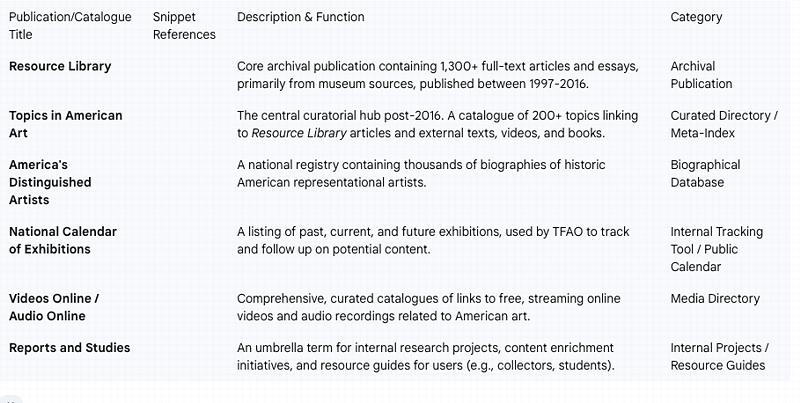 Organizational
Strengths and Core Competencies
Organizational
Strengths and Core Competencies
###
FOR IMMEDIATE RELEASE
Tucson, AZ - July 23, 2022 - Traditional Fine Arts Organization tfaoi.org / TFAO) presents online publication of its 2022 editions of "Arizona Art History" and "New Mexico Art History," recently redesigned, and expanded with dozens of images related to works by artists connected to the states.
TFAO president, John Hazeltine, says "This year's lavishly illustrated editions are the result of 24 years of research and publication by TFAO's Resource Library of numerous essays, plus scores of its articles. In addition, TFAO is working on 2022 editions of many other states. For California, Arizona, New Mexico and Texas art histories, recent Google searches place these topics on the first page of search results. This signifies Google's confirmation of the value of the presentations."
Hazeltine adds "In this year's editions, beyond Resource Library's articles and essays, are links to other online text resources, books, online videos and DVDs. He further adds "Our goal is to present comprehensive knowledge relating to these topics in American art."
-----
Traditional Fine Arts Organization / tfaoi.org / TFAO), established in 2003, is an in-depth resource for students, scholars, teachers, writers and collectors seeking further understanding and appreciation of American representational art. It is a non-profit organization dedicated to furthering education in American art through advocacy, publication and research. TFAO is 100% non-commercial and all services are provided free of charge.
Resource Library, a collection of articles and essays honoring the American experience through its art, is an online publication of TFAO, offering multiple ways to locate its articles and essays:
- Topics in American Art is a TFAO catalogue containing thousands of Resource Library articles and essays, in depth links to other online texts, video and audio recordings, references to DVDs, paper-printed books, articles, and more. Over 200 topics in American representational art may be found here.
- The Museums, Galleries and Art Centers index guides viewers to pages covering Resource Library sources listed by museum name.
- Sources of Articles Indexed by State within the United States refers viewers to pages covering Resource Library sources listed by state plus the District of Columbia.
- The Author Study and Index lists over 1,000 articles and essays by author name.
- The Chronological Index lists articles and essays published since 1997.
###
FOR IMMEDIATE RELEASE
Tucson, AZ - June 4, 2022 - Traditional Fine Arts Organization tfaoi.org / TFAO) presents online publication of its 2022 edition of "Historic American Art Colonies," recently redesigned, and expanded with 142 images related to works by artists connected to the colonies. Information on individual colonies are organized alphabetically and regionally.
TFAO president, John Hazeltine, says "This year's lavishly illustrated edition of 'Historic American Art Colonies,' is the result of fifteen years of research and publication by TFAO's Resource Library of numerous essays, plus scores of its articles specific to America's art colonies
Hazeltine adds "In this year's edition, beyond Resource Library's articles and essays, are links to other online text resources, books, online videos and DVDs. He further adds "Our goal is to present comprehensive knowledge relating to this topic in American art."
-----
Traditional Fine Arts Organization / tfaoi.org / TFAO), established in 2003, is an in-depth resource for students, scholars, teachers, writers and collectors seeking further understanding and appreciation of American representational art. It is a non-profit organization dedicated to furthering education in American art through advocacy, publication and research. TFAO is 100% non-commercial and all services are provided free of charge.
Resource Library, a collection of articles and essays honoring the American experience through its art, is an online publication of TFAO, offering multiple ways to locate its articles and essays:
- Topics in American Art is a TFAO catalogue containing thousands of Resource Library articles and essays, in depth links to other online texts, video and audio recordings, references to DVDs, paper-printed books, articles, and more. Over 200 topics in American representational art may be found here.
- The Museums, Galleries and Art Centers index guides viewers to pages covering Resource Library sources listed by museum name.
- Sources of Articles Indexed by State within the United States refers viewers to pages covering Resource Library sources listed by state plus the District of Columbia.
- The Author Study and Index lists over 1,000 articles and essays by author name.
- The Chronological Index lists articles and essays published since 1997.
###
FOR IMMEDIATE RELEASE
Tucson, AZ - May 24, 2022 - Traditional Fine Arts Organization tfaoi.org / TFAO) presents online publication of its 2022 edition of "California Art History," TFAO's most developed and acclaimed topic, earning Google's first page, first placement recognition via its search engine.
TFAO president, John Hazeltine, says "This year's lavishly illustrated edition of 'California Art History' is the culmination of twenty five years of research and publication by TFAO's Resource Library of 80+ essays, plus scores of its articles specific to the state's art history."
Hazeltine adds "In this year's 'California' edition, following Resource Library's articles and essays, are a listing of museums in California which have provided materials for this topic. Links to a plethora of online text and streaming video resources outside our website are listed after museums." He further adds "Following these resources is information about scores of offline resources including a sampler of paper-printed books, journals articles and DVDs. Our goal is to present comprehensive knowledge relating to this topic in American art."
-----
Traditional Fine Arts Organization tfaoi.org / TFAO), established in 2003, is an in-depth resource for students, scholars, teachers, writers and collectors seeking further understanding and appreciation of American representational art. It is a non-profit organization dedicated to furthering education in American art through advocacy, publication and research.
Resource Library, a collection of articles and essays honoring the American experience through its art, is an online publication of TFAO, offering multiple ways to locate its articles and essays:
- Topics in American Art is a TFAO catalogue containing thousands of Resource Library articles and essays, in depth links to other online texts, video and audio recordings, references to DVDs, paper-printed books, articles, and more. Over 200 topics in American representational art may be found here.
- The Museums, Galleries and Art Centers index guides viewers to pages covering Resource Library sources listed by museum name.
- Sources of Articles Indexed by State within the United States refers viewers to pages covering Resource Library sources listed by state plus the District of Columbia.
- The Author Study and Index lists over 1,000 Resource Library articles and essays by author name.
- The Chronological Index lists articles and essays published since 1997.
All TFAO services are provided free of charge.
###
FOR IMMEDIATE RELEASE
TFAO.ORG privacy policy underscores care for the privacy of visitors
Tucson, AZ - October 19, 2018 - TFAO.ORG has updated its privacy policy emphasizing care for the privacy of visitors.
John Hazeltine, President and Director of Traditional Fine Arts Organization, says "Privacy of visitors is very important to us We don't use tracking cookies or web beacons for our website. A side benefit is blazingly fast loading of pages. Our site doesn't sell anything. There are no forms to fill out. Visitors don't need to provide personally-identifying information to us for access to any portion of the site. We don't accept paid advertising either. Advertisers want to know how their money is being spent and information on who is seeing their ads. Sometimes advertisers also influence selection and placement of content to accompany their ads."
TFAO's website contains thousands of links to other websites. TFAO's links to other organizations' websites do not mean endorsements or affiliations. Hazeltine cautions that "Visitors to a a third-party website should always read the privacy policy of a third-party website before providing any information to it."
Tfaoi.org, established in 2003, is an in-depth resource for students, scholars, teachers, writers and collectors seeking further understanding and appreciation of American representational art. The site is an online service of Traditional Fine Arts Organization (TFAO), a non-profit organization dedicated to furthering education in American art through advocacy, publication and research. All TFAO services are provided free of charge.
###
FOR IMMEDIATE RELEASE
Tfaoi.org Expands Coverage of American Art
Tucson, AZ - October 5, 2017 - Tfaoi.org is adding free online coverage of exhibits at hundreds of additional art museums. The expanded coverage will vastly deepen resource material for hundreds of American art topics.
Online users will not only benefit from more in-depth material for art topics, they also have free access to thousands of essays and articles published in tfaoi.org's Resource Library. Tfaoi.org also provides a comprehensive directory of historic artists, explanations on how art museums function, how collectors may lend artworks to museums, and much more.
Tfaoi.org, established in 2003, is an in-depth resource for students, scholars, teachers, writers and collectors seeking further understanding and appreciation of American representational art. The site is an online service of Traditional Fine Arts Organization (TFAO), a non-profit organization dedicated to furthering education in American art through advocacy, publication and research. All TFAO services are provided free of charge.
###
FOR IMMEDIATE RELEASE
New edition of "Art History of Each State within the United States of America" available at tfaoi.org
Tucson, AZ - November 17, 2017 - Traditional Fine Arts Organization (TFAO) has revised and published online at tfaoi.org an updated edition of Art History of Each State within the United States of America. The catalog makes available online -- without charge to the public -- extensive information encompassing American representational art history.
For each state, there are links to TFAO's Resource Library articles and essays followed by: a list of the state's art museums which have provided materials to Resource Library; links to online resources outside the TFAO site, and information about offline resources including DVDs, paper-printed books, journals and articles. TFAO also provides online information on over 200 other topics related to American art.
Tfaoi.org, established in 2003, is an in-depth resource for students, scholars, teachers, writers and collectors seeking further understanding and appreciation of American representational art. The site is an online service of Traditional Fine Arts Organization (TFAO), a non-profit organization dedicated to furthering education in American art through advocacy, publication and research. All TFAO services are provided free of charge.
###
For further information please contact John Hazeltine, Traditional Fine Arts Organization, info@tfaoi.org

(above: Charles Willson Peale (1741-1827), The Artist in His Museum, 1822, oil on canvas, 103.7x 79.8 in. Pennsylvania Academy of the Fine Arts. Public domain, via Wikimedia Commons)
Background information on TFAO and key services:
Topics in American Art Introduction
About America's Distinguished Artists
Related 11/17 letter and email addresses
 Return to site map
TFAO catalogues:
TFAO's Distinguished Artists catalogue provides online access to biographical information for artists associated with this state. Also, Search Resource Library for online articles and essays concerning both individual artists associated with this state's history and the history of art centers and museums in this state. Resource Library articles and essays devoted to individual artists and institutions are not listed on this page.
*Tag for expired US copyright of object image:

Links to sources of information outside of our web site are provided only as referrals for your further consideration. Please use due diligence in judging the quality of information contained in these and all other web sites. Information from linked sources may be inaccurate or out of date. TFAO neither recommends or endorses these referenced organizations. Although TFAO includes links to other web sites, it takes no responsibility for the content or information contained on those other sites, nor exerts any editorial or other control over them. For more information on evaluating web pages see TFAO's General Resources section in Online Resources for Collectors and Students of Art History.
 Search Resource Library
Copyright 2022 Traditional Fine Arts Organization, Inc., an Arizona nonprofit corporation. All rights reserved.