
America's Distinguished Artists
a national registry of historic artists
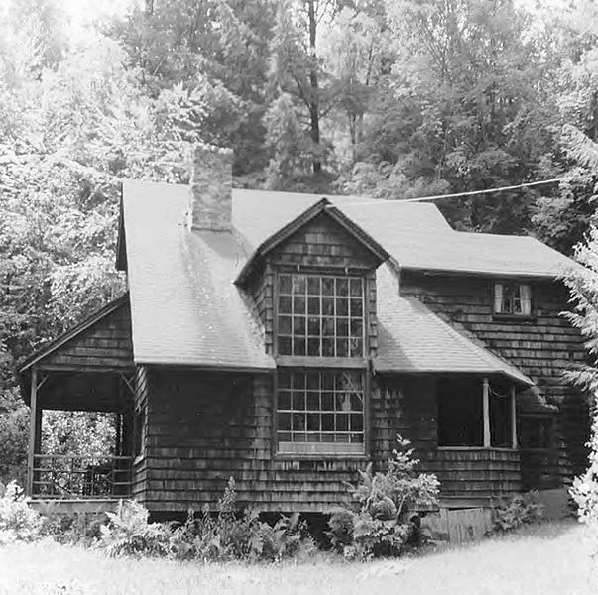
(above: Unidentified photographer, Field Studio, Pakatakan Artist Colony. National Park Service, National Register of Historic Places. Public domain, via Wikimedia Commons*)
Introduction
America's Distinguished Artists is a catalogue and national registry of historic artists sponsored by Traditional Fine Arts Organization (TFAO). Deceased American painters, photographers, sculptors and artisans of note who created representational art are indexed by last name in alphabetical order. An artist qualifies for inclusion in the catalogue if he or she produced significant artistic output while residing in the geographical area now encompassed by the boundaries of the United States. With thousands of artists researched, America's Distinguished Artists is the most complete and in-depth catalogue of its kind. Preference is given to artists featured in exhibits in museums and art centers
For each listed artist there is either:a link to a page in Resource Library with a biographical article or essay solely dedicated to an artist, or a link to a page with content related to an artist within a Resource Library article or essay, and in some cases a link to a page with biographical information from another source.
Twenty five years of cumulative research saves viewers considerable time in finding valuable biographical information. Viewers avoid accessing many websites listed on first page search results where the links are mainly tools for marketing purposes and provide scant biographical information.
Many Resource Library links are to articles and essays written by noted authors. The vast majority of links are to Resource Library articles and essays with source material from art museums. Editor's notes following Resource Library's articles and essays often contain artist information otherwise not easily found online.
All links to artist biographies contain 100% free information. We avoid websites that require a fee to view complete biographies and those that have information likely to be temporary. We receive no compensation for providing links to biographical information in other websites.
Starting in 1997, the catalogue was named Distinguished Artists Series. In 2005 it was renamed Distinguished Artists. In May 2008 the catalogue was renamed America's Distinguished Artists.
Contents are valuable to educators designing course content, scholars, students and librarians conducting research, plus art lovers everywhere seeking greater understanding of American art. Enjoy!

(above: Ernest Martin Hennings (1886-1956), Homeward Bound, 1933-1934, oil on canvas, 30.2 x 36.2 in. Smithsonian American Art Museum. Public domain, via Wikimedia Commons)
Presentation protocol for each artist name
A link to one Resource Library page is presented first, followed in some cases by a link to one outside source. If there is a mention of an artist in Resource Library, a link to a page referencing the artist is presented. There may be many Resource Library articles and essays citing the artist, so always search within Resource Library for additional references.
If a Resource Library article or essay is wholly dedicated to an artist there is usually no link to an outside source. If a Resource Library article or essay is not dedicated wholly to an artist there may be a link to one outside page if we judge information from it to be of importance beyond that included in Resource Library. We review all outside pages we can find via search before making a choice. We choose outside information in accordance with our guidelines in Reviewing existing listings and Accuracy and trustworthiness.
Finding additional images of artworks
Besides artwork images accessed through links to Resource Library pages referenced in the catalog, and images placed directly on catalog pages, many more images may be available online. A valuable source is Google Images. It uses an algorithm to find online images. Images of some artworks are duplicated several times. As your search continues beyond the first few images, it may devolve to images not related to the artist. A benefit of Google Images is that for each image you have access to the webpage containing it and therefore the context in which it was shown.

(above: Marsden Hartley, The Virgin of Guadalupe, c. 1918-19, oil and charcoal on paperboard, 31 7/8 x 23 7/8 inches, Metropolitan Museum of Art, Alfred Stieglitz Collection 1949, Public domain, via Wikimedia Commons*)
Recent editions
For the 2011-2012 edition, we researched all non-Resource Library artist listings in the America's Distinguished Artists catalogue. If a listing was from a non-Resource Library Web page, we added the word "from" following the artist's name plus the name of the outside source.
For the 2012-2013 edition, we added information regarding Resource Library citations.
The 2012-2013 edition served two purposes: visitors were given more information about Resource Library listings and our researchers gained better signals for searching inside and outside Resource Library for additional information in future editions of America's Distinguished Artists.
For the 2013-2014 edition, we checked all outside source citations for linkrot. We added artists as information on artists not previously listed became available from both newly published Resource Library essays and articles and from other online sources. If there was a previously listed Resource Library article or essay cited as being solely dedicated to an artist, we did not search for an outside source. If there was a Resource Library article or essay cited as not solely dedicated to an artist, and no outside source was listed, we searched for an outside source. If there was a Resource Library article or essay cited as not solely dedicated to an artist, and an outside source was listed, we checked for linkrot from that source, and if linkrot was found, searched the Web for a replacement source. If an outside source was listed, but no Resource Library listing, we did two things: 1. checked for linkrot from that source, and if linkrot was found, searched the Web for a replacement source; 2. searched Resource Library for a citation using a variety of keyword options.
For the 2014-2015 edition, we used the same protocol used for most recent edition, with one exception: if an outside source was listed, but no Resource Library listing, we did not search Resource Library for a citation because it was necessary to do so only once.
The 2015-2016 edition is following the same protocol as the prior edition.
For the 2016-2017 edition, we checked links to outside sources of biographies for linkrot. If no substitute source was found, the artist was deleted. In instances where there is a Resource Library link, but no outside link, we did not search for an outside link.
The 2017-2018 edition is following the same protocol as the prior edition.
The 2018-2019 edition is following the same protocol as the prior edition.
The 2021-2022 edition illustrated the catalog with over 1,000 artwork images.

(above: William Leigh, The
Hold Up (The Ambush), 1903, oil on canvas, Sid Richardson Museum, Fort
Worth, Texas. Public domain, via Wikimedia Commons*)
A word about linkrot:
Wikipedia defines linkrot as follows:
Linkrot from outside sources continues to be a problem, however it has gradually declined in recent years. In 2020, we removed all links to outside sources in the catalog, except for those tied to an artist featured in Resource Library.
Sometimes, sources cause linkrot by changing their main URL without providing an automatic bridge to their artist name URLs. An example is <http://www.bbhgallery.com/Nepote_Alexander_.htm> which changed to <.http://www.bodegabayheritagegallery.com/Nepote_Alexander_.htm> with no automatic linkage. Also, sources sometimes shift artist biographies to new folders in their websites without providing automatic linkage from the old URL to the new URL.
Since the inception of America's Distinguished Artists in 1997, linkrot for Resource Library essays and articles remains at zero percent.
Permissions from sources
When Resource Library published over time more than one article concerning an institution, there was created as an additional resource for readers a sub-index page containing links to each Resource Library article or essay concerning that institution, plus available information on its location and other descriptive information. .
Unless specifically described in editor's notes or headers within Resource Library or Resource Library Magazine pages containing articles and essays by named authors, such materials were published in 1997 through 2016 by either permission of a named institutional source within the Art Museum, Gallery and Art Center index, an author within the Author Study and Index, or a non-institutional source. In some cases, both the source and author provided permissions.
Permissions, in most instances, were provided by institutional sources specifically identified within the article or essay pages. As noted above, when Resource Library or Resource Library Magazine published over time more than one article or essay concerning an institution, it created, as an additional resource for readers, a sub-index page containing links to each Resource Library or Resource Library Magazine article or essay concerning that institution, plus available information on its location and other descriptive information. A typical notation at the end of an article or essay might be "Read more information, articles and essays concerning this institutional source by visiting the sub-index page for the (named institution) in Resource Library (or Resource Library Magazine in instances of publication by Traditional Fine Arts Organization's predecessor)" or similar wording.
Icons and legends
When an image is sourced from Wikimedia Commons, an icon tag is placed on the page containing it. The tags are:
*Tag for expired US copyright of object image:

and
**Tag for some rights reserved:

TFAO page directional icons are:
 Return to
and
 Go to
Go to
An invitation to museums
We advocate for museums to permanently make available materials about special exhibitions on their websites. Most museum websites have a "past exhibitions" section. Often, when information about an exhibition is first posted, a permanent URL is created that is carried forward in website sections for future, current and past exhibitions. A common format is: https//museumname.org/exhibitions/name of exhibit.
A wide variety of materials are posted by museums for an individual exhibition. Contents on a page for an exhibition may include narrative paragraphs about the exhibition, photos of art objects, plus links to: a press release for the exhibition, newspaper and magazine articles, promotional PSA videos, lecture videos, gallery guides, brochures and checklists.
Once a museum has decided upon a URL format for presenting online exhibition information, it is important that the format be maintained permanently. This is to prevent dead links in articles, research papers and other materials published by outside persons and organizations.
An effect of Covid temporary museum closures in 2020-21was that scores of art museums greatly enhanced the quality and quantity of online exhibit presentations.
How to find content on our site using search engines
Conduct keyword searches within our website and Resource Library, a collection of articles and essays honoring the American experience through its art, using the advanced search feature of these search engines:
Or, before entering keywords in a basic search, enter site:tfaoi.org.
Also see Indexes and information retrieval for more information.
Return to Topics in American Art - Site Guide
About Resource Library
 Resource Library is
a free online publication of nonprofit Traditional
Fine Arts Organization (TFAO). Since 1997, Resource Library and
its predecessor Resource Library Magazine have cumulatively
published online 1,300+ articles and essays written by hundreds of identified authors, thousands of other texts not attributable
to named authors, plus 24,000+ images, all providing educational and informational
content related to American representational
art. Texts and related images are provided almost exclusively by
nonprofit art museum, gallery and art center
sources.
Resource Library is
a free online publication of nonprofit Traditional
Fine Arts Organization (TFAO). Since 1997, Resource Library and
its predecessor Resource Library Magazine have cumulatively
published online 1,300+ articles and essays written by hundreds of identified authors, thousands of other texts not attributable
to named authors, plus 24,000+ images, all providing educational and informational
content related to American representational
art. Texts and related images are provided almost exclusively by
nonprofit art museum, gallery and art center
sources.
All published materials provide educational and informational content to students, scholars, teachers and others. Most published materials relate to exhibitions. Materials may include whole exhibition gallery guides, brochures or catalogues or texts from them, perviously published magazine or journal articles, wall panels and object labels, audio tour scripts, play scripts, interviews, blogs, checklists and news releases, plus related images.
What you won't find:
User-tracking cookies are not installed on our website. Privacy of users is very important to us. You won't find annoying banners and pop-ups either. Our pages are loaded blazingly fast. Resource Library contains no advertising and is 100% non-commercial. .
(left: JP Hazeltine, founding editor, Resource Library)
Links to sources of information outside our website are provided only as referrals for your further consideration. Please use due diligence in judging the quality of information contained in these and all other websites. Information from linked sources may be inaccurate or out of date. We neither recommend or endorses these referenced organizations. Although we include links to other websites, we take no responsibility for the content or information contained on other sites, nor exert any editorial or other control over them. For more information on evaluating web pages see our General Resources section in Online Resources for Collectors and Students of Art History.
*Tag for expired US copyright of object image:
Copyright 2023 Traditional Fine Arts Organization, Inc., an Arizona nonprofit corporation. All rights reserved.