
Grand Canyon's Iconic Desert View Watchtower
a 2026 Gemini 3.1 Pro Deep Research narrative

(above: Gunnar Widiorss, Desert
View Watchtower, 1932, watercolor on board, Museum of Northern Arizona.
Museum of Northern Arizona. Public domain, via Wikimedia Commons)
Near the eastern boundary of Grand Canyon National Park, the formidable Colorado River takes a dramatic turn northward, carving a profound chasm through eons of geologic time. Here, perched precariously on the precipice of the South Rim, sits the Desert View Watchtower. From this commanding seventy-foot vantage point, visitors see sweeping, panoramic views where the deep, shadowed depths of the canyon contrast with the distant, pastel horizons of the Painted Desert. The surrounding landscape stretches endlessly toward the Navajo and Hopi Reservations. Designed by the visionary architect Mary Colter for the Fred Harvey Company; it remains an iconic feature of the South Rim. She said: "First and most important, was to design a building that would become part of its surroundings; one that would create no discordant note against the time eroded walls of this promontory."
The Watchtower's cylindrical form recalls the ancient Puebloan towers of the Southwest, particularly those at Hovenweep and Mesa Verde. Colter, however, did not intend it to be a literal copy of any one prehistoric building. She called it a "re-creation," drawing upon several ancient structures and adapting their ideas to the spectacular site. The result has an almost mysterious quality: it looks ancient from a distance, yet its construction concealed a modern steel framework and concrete foundation beneath carefully selected stones.
Inside, the lowest level forms a large open room modeled after a traditional kiva, with a fireplace positioned so that it never blocks the sweeping views through the windows. Stairways from top to botom wind through successive galleries, each offering different vantage points, until the open top floor presents an unobstructed panorama. The entire building seems to dissolve into the rim rather than stand apart from it.
Colter was extraordinarily concerned with the appearance of those stones. She insisted that their naturally weathered surfaces remain uncut so that they would harmonize with the canyon walls. Each exterior stone was selected and positioned to create the appearance she wanted. She even incorporated deliberately constructed cracks, irregularities, decorative stones, and petroglyph-like details. The building therefore rewards the kind of sustained looking that painters practice: at one distance it is a strong silhouette; closer up it becomes a complicated arrangement of texture, color, shadow, irregular stone, openings, and lines.
For artists, the combination of architecture and landscape is unusually compelling. The Watchtower supplies a strong human-made vertical against the enormous horizontal sweep of the canyon. Its weathered masonry echoes the surrounding cliffs, while its windows and balconies create frames within frames. Morning and evening light can transform the structure's color and apparent age, and shadows emphasize its irregular stonework. A painter can treat it as architecture, landscape, historical subject, or all three at once.
The unique physical allure of the Watchtower quickly drew some of the early twentieth century's most accomplished artists. Among the first was Gunnar Widforss, a Swedish-American watercolorist who became known as the canyon's painter par excellence. Widforss likely heard of the tower through his close ties with the Fred Harvey Company and the Santa Fe Railway, which actively hired artists to document the Southwest in order to promote early tourism.
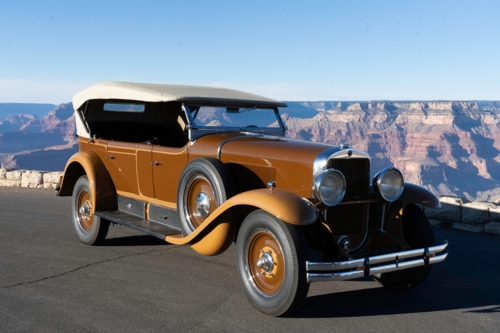
(above: 1929 Cadillac 341-B, the last remaining Harvey Car, on display at the New Mexico History Museum, 2025. Image: Courtesy of the NMHM Photo Archives. These vehicles transported Eastern US tourists from nearby Harvey hotels, such as the El Tovar, to points of interest.)
He was inspired to visit the tower because it satisfied his drive for intimate realism. Unlike earlier romantic painters who invented mythic landscapes, Widforss wanted to capture the authentic, complex light and true topography of the canyon directly from its rim. He deliberately avoided idealized mythology, choosing instead to capture the profound feeling of scale and an experiential authenticity that made his work a tangible memory of standing on the canyon rim.
Around the same time, the young Hopi artist Fred Kabotie was commissioned by Colter to decorate the first level Hopi Room. His Study for Watchtower Mural at Desert View, Grand Canyon was a preparatory work for his murals. He saw the Watchtower as a vital opportunity to share the deep, ancestral connections his people held with the canyon. These murals are richly symbolic narratives of Hopi history, preserving the authentic spiritual journey of his ancestors.
Fred Harvey Company artist Fred Geary painted walls and ceilings of the second and third floors, drawing inspiration from prehistoric sites across the Southwest. Particularly striking is the connection to the Abó Painted Rocks site in present-day New Mexico. The National Park Service explains that Geary used sketches made by Herman Schweizer in 1908, meaning that some images reproduced inside the Watchtower preserve a record of ancient pictographs that were already damaged or disappearing by the early 1930s.
Abstract artist Mark Rothko visited the Watchtower in 1938, and the experience left a lasting mark on his artistic vision. According to archives from The Mark Rothko Southwest History Project, Rothko visited the Watchtower at the Grand Canyon in 1938. During this trip, he painted a quick, early-career watercolor depicting artist Milton Avery and his daughter ascending the tower's circular stairway. He painted this in his early figurative/surrealist style long before he developed his iconic abstract blocks of color.
Note: We added content for enrichment and deleted some text from this Gemini narrative. It may contain inaccurate information because of how AI gathers and processes content. Sources are footnoted in the raw AI report but deleted here for a general audience.
You may also enjoy our articles listed below:
Grand Canyon Grandeur: Early Paintings and Prints from the Hays Collection from the Museum of Northern Arizona in Resource Library. Collector Abe Hays states, "For sixty years I have been trying to collect art of the Grand Canyon, Colorado Plateau, and other Arizona subjects, in both prints and paintings. At the top of my collecting interests are the Grand Canyon and Walpi, as I consider both to be the most important and relevant to our state's history. I particularly like to collect worthwhile artists whose best known and accomplished artwork was done in Arizona. In addition to those artists, I value William Henry Holmes, William R. Leigh, and Julian Scott. I have felt a responsibility to collect in this field and to provide the artists' works for future generations to enjoy."
The Barbizon School's Influence on Grand Canyon Landscape Paintings, 1860-1950, is a 2025 article by by Grok 3, 2025 which says: "The Barbizon School's influence on American Grand Canyon painters from 1860 to 1950 was profound, shaping their cultural inspirations, training, and technical approaches. Its emphasis on plein air painting, atmospheric effects, and emotional depth resonated with artists like Moran, Widforss, Akin, Leigh and Weir who captured the canyon's untamed beauty in Tonalist, Impressionist, Post-Impressionist, and Modernist styles. Through Barbizon-inspired techniques-muted palettes, loose brushwork, and a focus on mood-these artists created works that celebrated the Grand Canyon as a timeless, spiritual landscape, leaving a lasting legacy in American art." Accessed 8/25
A Canvas of Light and Time: Painting the Grand Canyon, 1860-1950 is a 2025 article by Gemini 2.5 Pro which says: "The Grand Canyon is more than a geological marvel; it is a crucible of American art. For centuries, its vast, silent expanse has challenged and inspired artists, serving as a canvas for the nation's evolving identity and artistic vision. In the ninety years between 1860 and 1950, a period of profound transformation in American culture and art, painters journeyed to its rim not just to document a landscape, but to grapple with concepts of the sublime, the spiritual, and the modern. They brought with them the traditions of European romanticism and the fresh perspectives of Tonalism, Impressionism, and Modernism, each artist translating the canyon's ineffable scale and complex light into a unique visual language. Their collective works created a portrait of the Grand Canyon that would forever shape the public imagination and secure its place as a national treasure, all while celebrating its pristine, natural beauty, free from the intrusion of human enterprise." Accessed 8/25
The Grand Canyon - Picturing the Void is a 2025 article by Gemini 2.5 Pro 2025 which says: "The most profound emotional allure of the Grand Canyon, for painters and viewers alike, may be its power as a symbol of geologic time. The "Canyon Reveals Rock", exposing one of the world's most complete geologic records. But more terrifyingly, it reveals the "Great Unconformity," a "mysterious gap in time" where hundreds of millions of years of Earth's history are simply "missing". Accessed November, 2025
The Painted Canyon: An Artistic Journey Through a Modern American Muse, 1870-1950 is a 2025 article by Gemini 2.5 Pro 2025 which says: "Ultimately, the artists who confronted the Grand Canyon did more than simply paint a place. Through their varied and often conflicting visions, they actively constructed our cultural understanding of this natural wonder. They transformed a geological immensity into a powerful and multifaceted American symbol: a national icon, a spiritual haven, a scientific marvel, and a premier canvas for modern art. Their collective work created a legacy in pigment and stone, a visual history as deep, layered, and enduring as the Canyon itself." Acesssed 8/25
The Sublime Canvas of the Grand Canyon: American Landscape Paintings from 1860 to 1950 is a 2025 article by Grok 3 which says: "The Grand Canyon, a colossal scar etched into Arizona's earth, has long captivated artists with its unfathomable scale, vibrant colors, and shifting light. From 1860 to 1950, American painters, working in the genres of Tonalism, Impressionism, Post-Impressionism, and Modernism, sought to capture its natural beauty, distilling the canyon's vastness into moments of emotional and visual resonance. These artists, unbound by human intervention in their depictions, focused on the raw, untamed splendor of the landscape. This article explores the contributions of five American artists who painted the Grand Canyon, delving into their cultural inspirations, the influence of their teachers, their technical prowess, and their critically acclaimed works." Accessed 8/25
Prompt:
 Return to Arizona Art History
Links to sources of information outside of our web site are provided only as referrals for your further consideration. Please use due diligence in judging the quality of information contained in these and all other web sites. Information from linked sources may be inaccurate or out of date. TFAO neither recommends or endorses these referenced organizations. Although TFAO includes links to other web sites, it takes no responsibility for the content or information contained on those other sites, nor exerts any editorial or other control over them. For more information on evaluating web pages see TFAO's General Resources section in Online Resources for Collectors and Students of Art History. Individual pages in this catalogue will be amended as TFAO adds content, corrects errors and reorganizes sections for improved readability. Refreshing or reloading pages enables readers to view the latest updates.
 Search Resource Library for everything about American
art.
Search Resource Library for everything about American
art.
Copyright 2026 Traditional Fine Arts Organization, Inc., an Arizona nonprofit corporation. All rights reserved.


