
AI Curiosities
The Grand Canyon - Picturing the Void
by Gemini 2.5 Pro 2025
For a painter, the Grand Canyon is both "the perfect vehicle" for art and a profound technical problem. Its "incomprehensible majesty" and "ever changing landscape" are notoriously "daunting" to capture. This technical challenge is a primary component of its allure.
The first challenge is the "myriad of detail" and sheer scale. Artists must learn to simplify. As plein air guides advise, "Don't try to paint the whole Grand Canyon". The solution is to paint "a unified mass with broader strokes, then apply just a few elements of detail" and to train the eye to see "the 'light family' and the 'shadow family' independently". Strong "diagonal lines" can guide the viewer's eye, and relative scale can be established by adding a "tiny person".
The second, more complex challenge is the inversion of traditional atmospheric perspective. In a typical landscape, objects in the distance become hazier and lighter. In the Canyon, the viewer stands above the atmosphere, which "bathes everything in a cool light, which gets stronger in the distance" within the chasm. As contemporary painter Amery Bohling explains, "If your rock in the foreground has the same color and value as your rock that is miles away, it will fail to read... You have to fade out that distant object". This makes the Canyon a compositional anti-landscape. It does not build up to a summit; it descends from the viewer's feet into a "void". The focal point, the river, is at the bottom. This radical inversion of perspective is the source of its unique artistic allure.
Thomas Moran is the artist most famously associated with the 19th-century interpretation of the Grand Canyon. After joining John Wesley Powell's 1873 expedition, he produced his monumental masterpiece, The Chasm of the Colorado (1873-74), which was promptly purchased by Congress.The allure of the Canyon for Moran, however, was not its literal truth. He famously stated, "I place no value upon literal transcripts from Nature. My general scope is not realistic; all my tendencies are toward idealization... Topography in art is valueless".

(above: Thomas Moran, Grand Canyon with Rainbow. 1912. Oil on canvas. de Young Art Museum. Gift of Mr. and Mrs. Robert F. Gill through the Patrons of Art and Music. 1981.89. License: Scuttlebutte, CC BY-SA 4.0 Scuttlebutte, CC BY-SA 4.0. via Wikimedia Commons**)
This statement is remarkable, coming from an artist accompanying a geological survey. It reveals his true purpose. Moran's paintings are "composite[s] of different locations", carefully constructed to blend "topography with myth". Heavily influenced by the English painter J.M.W. Turner, Moran used "prismatic color" to achieve a "visual and emotional effect". He rejected the role of mere documentarian to become the Canyon's myth-maker. The allure was the Canyon's potential to be transformed into an American epic, a "chasm of sublime" that could prove the new nation's landscape was more emotionally resonant and "Sublime" than any in Europe.
The allure of the Grand Canyon for painters did not end with Moran; it evolved. In the early 20th century, Gunnar Widforss was hailed by many as the "Grand Canyon painter par excellence" for precisely the opposite reason as Moran. Widforss's allure was intimate realism; he, "unlike most other artists... painted many scenes from within the depths of the canyon," focusing on accurate, rather than idealized, topography.

(above: Gunnar Widiorss, Desert View Watchtower, 1932, watercolor on board, Museum of Northern Arizona. Museum of Northern Arizona. Public domain, via Wikimedia Commons)
By the late 20th century, the allure had become deeply personal. For David Hockney, the Canyon's "lonely vastness" was a canvas for emotional projection. His 1998 painting, The Grand Canyon, was inspired by "childhood dreams of adventure" but also served as a poignant allusion to the "emptiness that the artist felt after losing many friends to the devastation of AIDS". For Hockney, the allure was also compositional -- a "microscopic lens" on its "surreal colors."
For today's en plein air painters, such as Amery Bohling, the allure is the physical and sensory experience of painting on the rim. It is an "inspired painting moment" that captures "the feeling of scale, the bugs in your paint, and the wind in your hair". The resulting artwork becomes a tangible "memory of being there" , valued for its experiential authenticity rather than its national or mythic baggage. This evolution clarifies the shifting nature of the Canyon's artistic appeal.
The most profound emotional allure of the Grand Canyon, for painters and viewers alike, may be its power as a symbol of geologic time. The "Canyon Reveals Rock", exposing one of the world's most complete geologic records. But more terrifyingly, it reveals the "Great Unconformity," a "mysterious gap in time" where hundreds of millions of years of Earth's history are simply "missing".
This confrontation with a non-human timescale-a history of "old life" (Paleozoic) and "earlier life" (Proterozoic) -- makes the landscape feel "vast and alien... impervious to the scales of human experience and emotion". This is the symbolic allure of The Void. Where mountains (the Tetons) represent the Summit, the Canyon represents the "chasm of sublime" , a "perceptual chasm". Its ultimate emotional power lies in its ability to evoke "nothingness" and force the viewer to confront their own absolute insignificance. This is the very definition of Burke's "terrible" and "awful" Sublime.

(above: Thomas Moran, Zoroaster Temple at Sunset, oil on canvas, Phoenix Art Museum. Public domain, via Wikimedia Commons*)
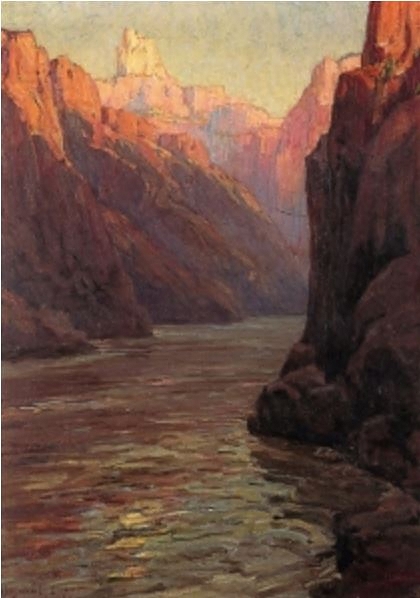
(above: Benjamin Chambers Brown, Grand Canyon, before 1942, 30 x 22 inches, Private collection. Source: The Athenaeum. Public domain, via Wikimedia Commons*)
This article is an excerpt of a larger one discussing towering
mountains and deep canyons. We added images and links to other
materials to this article to make it more interesting and educational for
your benefit. Although AI is rapidly improving its accuracy, this article
may have inaccurate information. It's safest to consider it a base
for further inquiry.
 Return to Arizona Art History
Return to AI Curiosities
*Tag for expired US copyright of object image:

and
**Tag for some rights reserved:

Links to sources of information outside of our web site are provided only as referrals for your further consideration. Please use due diligence in judging the quality of information contained in these and all other web sites. Information from linked sources may be inaccurate or out of date. TFAO neither recommends or endorses these referenced organizations. Although TFAO includes links to other web sites, it takes no responsibility for the content or information contained on those other sites, nor exerts any editorial or other control over them. For more information on evaluating web pages see TFAO's General Resources section in Online Resources for Collectors and Students of Art History.
Copyright 2025 Traditional Fine Arts Organization, Inc. an Arizona nonprofit corporation. All rights reserved.