
AI Curiosities
A Canvas of Light and Time:
Painting the Grand Canyon, 1860-1950
by Gemini 2.5 Pro 2025
The Grand Canyon is more than a geological marvel; it is
a crucible of American art. For centuries, its vast, silent expanse has
challenged and inspired artists, serving as a canvas for the nation's evolving
identity and artistic vision. In the ninety years between 1860 and 1950,
a period of profound transformation in American culture and art, painters
journeyed to its rim not just to document a landscape, but to grapple with
concepts of the sublime, the spiritual, and the modern. They brought with
them the traditions of European romanticism and the fresh perspectives of
Tonalism, Impressionism, and Modernism, each artist translating the canyon's
ineffable scale and complex light into a unique visual language. Their collective
works created a portrait of the Grand Canyon that would forever shape the
public imagination and secure its place as a national treasure, all while
celebrating its pristine, natural beauty, free from the intrusion of human
enterprise.
The Patriarch of the Canyon:
Thomas Moran

(above: Thomas Moran, Grand
Canyon with Rainbow. 1912. Oil on canvas. de Young Art Museum. Gift
of Mr. and Mrs. Robert F. Gill through the Patrons of Art and Music. 1981.89.
License: Scuttlebutte,
CC BY-SA 4.0 Scuttlebutte, CC BY-SA 4.0.
via Wikimedia Commons**)

(above: Thomas Moran, Zoroaster
Temple at Sunset, oil on canvas, Phoenix Art Museum. Public domain,
via Wikimedia Commons*)
No artist is more inextricably linked to the Grand Canyon
than Thomas Moran (1837-1926). An English-born painter from a family of
artists, Moran possessed a vision perfectly suited to the monumental landscapes
of the American West. His journey into the heart of the canyon country was
not merely artistic but was tied to the great cultural project of 19th-century
America: the exploration and celebration of the continent, a sentiment often
described as Manifest Destiny.
- Cultural Inspiration and Influence: Moran's artistic soul was forged in the crucible of English
Romanticism. His deep study of J.M.W. Turner instilled in him a love for
dramatic, light-filled compositions where nature's power was both beautiful
and terrifying. This influence, combined with guidance from the Philadelphia
marine painter James Hamilton, gave him the tools to interpret the American
landscape on a scale previously unimagined. When he joined F.V. Hayden's
geological survey of the Yellowstone region in 1871 and John Wesley Powell's
expedition to the Grand Canyon in 1873, his purpose was twofold: to create
illustrations for a national audience and to capture the sublime essence
of these newly discovered wonders. His paintings were not just art;
they were arguments for preservation. His monumental canvases, filled
with golden light and atmospheric grandeur, were instrumental in persuading
Congress to establish Yellowstone as the first national park and later
helped solidify the Grand Canyon's status as a national icon. ·
-
- Technical Prowess: Moran
was a master of the grand spectacle. His technique involved a sophisticated
blend of detailed observation and romantic idealization. He would make
countless sketches and watercolors in the field, absorbing the geological
intricacies and the fleeting effects of weather, which he would later synthesize
in his studio into enormous, breathtaking oil paintings. His use of color
was audacious, employing vibrant yellows, deep reds, and ethereal blues
to convey the canyon's dramatic moods. He was a master of light, using
it to carve out space, define form, and, most importantly, evoke a sense
of divine presence within the landscape. ·
- ·
- Acclaimed Artworks:
-
- Chasm of the Colorado (1873-74): This monumental work, now housed in the Smithsonian American
Art Museum, is Moran's definitive statement on the Grand Canyon. It is
a composite view, combining different perspectives to create an idealized,
awe-inspiring scene that captures the canyon's immense scale and geological
complexity.
-
- The Grand Canyon of the Yellowstone (1872): While
not of the Arizona canyon, this painting's success and its purchase by
Congress for the U.S. Capitol set the stage for Moran's career as the premier
painter of the West and directly influenced his approach to the Grand Canyon.
-
- Grand Canyon (From Hermit Rim Road) (1912): Painted later in his life, this work
shows a continued fascination with the canyon's atmospheric effects, capturing
a panoramic vista glowing under a soft, hazy light.
- ·
- ·
The Tonalist Mystic: Elliott
Daingerfield
While Moran painted the canyon's epic grandeur, other artists
sought its soul. Elliott Daingerfield (1859-1932) brought a quieter, more
introspective vision to the West, one shaped by the spiritual and atmospheric
concerns of Tonalism. Raised in North Carolina, Daingerfield's art
was a quest to find the divine manifest in the natural world.
-
- Cultural Inspiration and Influence: Daingerfield's primary mentor was the great American Tonalist
George Inness. From Inness, he learned to paint landscapes that were
less about a specific place and more about a state of mind or a spiritual
feeling. He was also deeply influenced by the French Barbizon School and
the visionary works of Albert Pinkham Ryder. When Daingerfield traveled
to the Grand Canyon in 1911 and 1913, he saw not a geological spectacle
but a place of profound silence and mystical power. His goal was to capture
what he called the "spirit of the canyon" through mood and suggestion
rather than literal depiction. ·
- ·
- Technical Prowess: Daingerfield
was a superb technician, employing the Tonalist method of layering thin
glazes of paint to achieve a deep, luminous glow. His palette was
often subdued, favoring subtle harmonies of color to create a unified,
atmospheric effect. He masterfully manipulated light and shadow not for
dramatic contrast, but to evoke a sense of mystery and timelessness, making
the solid rock of the canyon appear ethereal and dreamlike. ·
-
- Acclaimed Artworks:
-
- The Grand Canyon (c.
1911): This painting is a quintessential example of his Tonalist
approach, shrouding the canyon in a soft, purple haze, with the setting
sun creating a moment of quiet, spiritual reverence.
-
- Sunset Glory (c.
1915): Here, Daingerfield focuses on the transformative power
of light, dissolving the canyon's forms into an incandescent display of
color and atmosphere.
-
- The Sleep of the Hills:
While often depicting his beloved North Carolina mountains, this title
encapsulates his approach to landscape, viewing the natural world as a
place of slumbering, spiritual energy, a theme he carried to his canyon
works.
-
The Impressionist's Light:
William Robinson Leigh
As Tonalism explored the inner world, American Impressionism
turned its gaze outward to capture the fleeting, sensory experience of the
external world. William Robinson Leigh (1866-1955), after a rigorous
academic training in Munich, turned his attention to the American West,
applying an Impressionist's sensitivity to the brilliant light and color
of the region.
-
- Cultural Inspiration and Influence: Leigh initially worked as an illustrator, a profession that
honed his skills of observation and narrative. However, his true passion
was the landscape of the Southwest. He was inspired by the desire to capture
the authentic, high-key light and arid atmosphere of Arizona, a challenge
that academic formulas could not meet. While his drawing remained grounded
in his Munich training, his palette and handling of light show the clear
influence of the Impressionist movement's emphasis on capturing the momentary
effects of sunlight.
-
- Technical Prowess: Leigh's
strength lay in his ability to combine accurate drawing with a vibrant,
high-keyed color palette. He was a master of depicting the stark, clear
light of the desert, capturing the way it bleached surfaces and cast sharp,
colorful shadows. Unlike the Tonalists, he was not interested in mood but
in the visual truth of a moment in time, painting the canyon's sun-scorched
rock and brilliant blue skies with energetic brushwork.
-
- Acclaimed Artworks:
-
- Grand Canyon: Many
of Leigh's works bear this straightforward title, each a study in the changing
light, from the harsh glare of midday to the warm glow of sunset.
-
- The Great Abyss: This
title reflects his awe at the canyon's scale, but the painting itself is
an exercise in color and light, focusing on the interplay of sun and shadow
across the vast expanse.
-
- A Day in the Grand Canyon:
This work captures the brilliant, almost blinding, midday sun on the canyon
walls, showcasing his skill in rendering intense light without sacrificing
form or color.
-
The Desert's Poet: Fernand
Lungren
Fernand Lungren (1857-1932) was an artist who became utterly
captivated by the desert. After starting his career as an illustrator
in the circle of William Merritt Chase, a commission from the Santa Fe Railroad
brought him to the Southwest, a journey that would define the rest of his
artistic life.
-
- Cultural Inspiration and Influence: Lungren was profoundly influenced by the aestheticism of
James McNeill Whistler, which emphasized tonal harmony and evocative compositions.
He found in the desert Southwest the perfect subject matter for this approach.
He was not interested in the grand, sublime narrative of Moran, but in
the solitary, quiet beauty and the unique atmospheric phenomena of the
arid landscape-the afterglow, the stark shadows, and the endless sky. He
eventually settled in Santa Barbara, where his studio became a center for
artists drawn to the region's distinct character.
-
- Technical Prowess: Lungren's
work is characterized by its focus on the subtle harmonies of desert light.
He was a master of capturing the low, raking light of dawn and dusk, painting
canvases that glow with soft, opalescent color. His compositions are often
simplified and poetic, focusing on the abstract shapes of the landscape
and the delicate gradations of tone in the sky. He had an uncanny ability
to render the dry, clear air and the feeling of immense, silent space.
-
- Acclaimed Artworks:
-
- In the Abyss of the Grand Canyon: This painting places the viewer deep within the canyon, emphasizing
the towering, shadowed walls and the quiet, reflected light, creating a
feeling of profound solitude.
-
- The Grand Canyon:
Lungren's interpretations often focus on a limited, harmonious palette,
capturing the purple and blue tones of the canyon in shadow, contrasted
with the warm glow of a distant, sunlit rim.
-
- Afterglow: A recurring
theme in his work, these paintings are studies of the fleeting moments
after sunset, when the sky and landscape are suffused with a soft, ethereal
light.
-
-
The Modernist Observer:
Gunnar Widforss
By the early 20th century, a new artistic sensibility was
emerging, one that valued clarity, structure, and a more direct, less romanticized
approach to nature. The Swedish-born artist Gunnar Widforss (1879-1934)
became one of the foremost interpreters of the Grand Canyon in this modern
spirit.
- Cultural Inspiration and Influence: Widforss, known as the "Painter of the National Parks,"
was inspired by a deep, almost scientific reverence for the natural world.
His background in Scandinavian landscape painting, which prized direct
observation and clarity, provided a counterpoint to the romanticism of
Moran and the moody Tonalism of Daingerfield. He saw the National Parks
as pristine wildernesses to be rendered with fidelity and respect.
-
- Technical Prowess: Widforss
was an undisputed master of watercolor. His technique allowed for both
immense precision and subtle atmospheric effects. He rendered the complex
geology of the Grand Canyon with an architect's accuracy, yet his work
is never cold or merely illustrative. He had an exceptional eye for the
canyon's vast and complex compositions, using strong diagonal lines and
carefully balanced forms to lead the viewer's eye through the immense space.
His modernist sensibility is apparent in his clean compositions and his
focus on the underlying structure of the landscape.
-
- Acclaimed Artworks:
-
- Grand Canyon: Widforss produced numerous watercolors of the canyon, all characterized
by their clarity, detail, and masterful composition.
-
- View from Plateau at Head of Bright Angel Trail: This work showcases his ability to handle a complex, panoramic
scene with incredible detail and a sophisticated sense of color and light.
-
- A View From the North Rim of the Grand Canyon: This piece highlights his skill in capturing the distinct atmosphere
and light of the less-frequented North Rim, demonstrating his deep familiarity
with his subject.
-
-
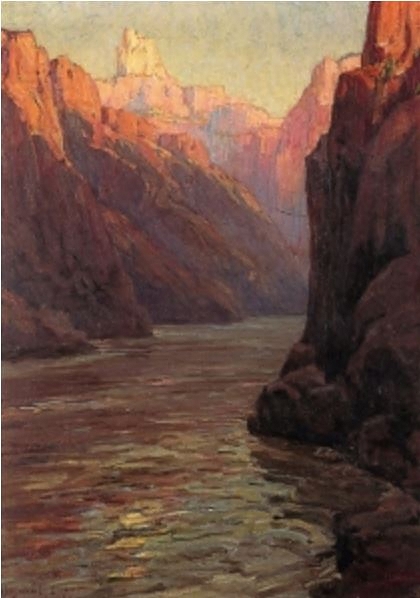
(above: Benjamin Chambers Brown, Grand
Canyon, before 1942, 30 x 22 inches, Private collection. Source:
The Athenaeum. Public domain, via Wikimedia Commons*)
From the sublime epics of Moran to the modern clarity of
Widforss, the painters of the Grand Canyon created a legacy as deep and
layered as the canyon itself. They were drawn to its rim by the promise
of a uniquely American subject, a landscape that was both a physical reality
and a powerful symbol. Through the lenses of Tonalism, Impressionism, and
Modernism, they looked into the great abyss and reflected back not only
its light and shadow but also the evolving artistic consciousness of a nation.
Their canvases ensured that the Grand Canyon would be seen not as a void,
but as a space filled with color, spirit, and an enduring, timeless beauty.
(above: Benjamin Chambers Brown, Grand
Canyon, before 1942, 30 x 22 inches, Private collection. Source:
The Athenaeum. Public domain, via Wikimedia Commons*)
Please don't rely on this AI-generated
text for accuracy. It has been lightly edited, yet may be laden with inaccurate
information. Consider it a base for further inquiry.
 Return to Arizona Art History
Return to AI Curiosities
*Tag for expired US copyright of object
image:

Links to sources of information outside
of our web site are provided only as referrals for your further consideration.
Please use due diligence in judging the quality of information contained
in these and all other web sites. Information from linked sources may be
inaccurate or out of date. TFAO neither recommends or endorses these referenced
organizations. Although TFAO includes links to other web sites, it takes
no responsibility for the content or information contained on those other
sites, nor exerts any editorial or other control over them. For more information
on evaluating web pages see TFAO's General
Resources section in Online
Resources for Collectors and Students of Art History.
Copyright 2025 Traditional Fine Arts Organization, Inc. an Arizona nonprofit corporation. All rights reserved.