
AI Curiosities
The Painted Canyon: An
Artistic Journey Through a Modern American Muse, 1870-1950
by Gemini 2.5 Pro 2025
The Unpaintable Canyon: A Crucible for American Art
For American artists of the late 19th and early 20th centuries,
the Grand Canyon was both a sublime revelation and a profound crisis. Its
geological immensity, its labyrinthine complexity, and its unique, color-saturated
atmosphere defied the established conventions of landscape painting, which
were largely forged in the gentler climes of Europe and the Eastern United
States. The Canyon presented a crucible, a testing ground where the very
identity of American art would be challenged and redefined. Confronted by
this "unpaintable" chasm, artists were forced to innovate, to
move beyond mere representation and toward interpretation, creating a body
of work that charts the course of American art's journey into modernity.
This artistic odyssey is framed by a fundamental tension
between literal transcription and creative idealization, a conflict articulated
most famously by the painter who first gave the Canyon its mythic visual
form, Thomas Moran. After his formative 1873 expedition, Moran declared,
"I place no value upon literal transcripts from Nature. My general
scope is not realistic; all my tendencies are toward idealization Topography
in art is valueless". This statement became the central artistic
problem for every significant painter who followed. It established a philosophical
divide: was the artist's role to be a faithful recorder of this geological
marvel, or a poet who translates its sublime essence into a new, idealized
reality?
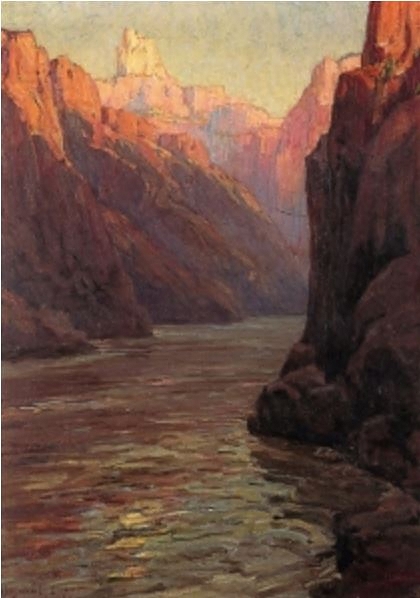
(above: Benjamin Chambers Brown, Grand
Canyon, before 1942, 30 x 22 inches, Private collection. Source:
The Athenaeum. Public domain, via Wikimedia Commons*)
The exploration of this artistic frontier was not a solitary
pursuit. It was fueled by the engines of corporate and national patronage.
The Atchison, Topeka and Santa Fe Railway, seeking to lure tourists to "America's
Wonderland," and the United States Government, funding geological surveys
to map its vast new territories, became the essential patrons of Canyon
art. These institutions were not passive funders but active curators
of a national image, providing artists like Moran, William Robinson Leigh,
and Elliott Daingerfield with the access and means to confront the Canyon. Their
commissions catalyzed a remarkable period of artistic production that shaped
not only the careers of individual artists but also the nation's collective
perception of its own landscape.
Over the ninety years from 1860 to 1950, artists answered
Moran's challenge in strikingly different ways, their responses tracing
a clear evolution in American artistic thought. The journey begins with
the sublime Romanticism of Moran himself, whose art helped forge the Canyon
into a national icon. It then turns inward with the moody, spiritual introspection
of Tonalism, as practiced by Elliott Daingerfield and DeWitt Parshall, who
sought the Canyon's soul rather than its likeness.
A new way of seeing emerged with the light-obsessed lens
of Impressionist-influenced painters like
William Robinson Leigh and Louis Akin, who focused on the transient effects
of the brilliant Southwestern sun. This evolution culminated in the fragmented,
personal visions of Modernism, where artists
such as Arthur Wesley Dow, Maynard Dixon, and Mary-Russell Ferrell Colton
deconstructed the landscape into its essential elements of form, color,
and design. Yet, running parallel to these modernizing trends was the persistent
power of meticulous Realism, championed
by the master watercolorist Gunnar Widforss, proving that the desire for
a "true" and beautiful depiction of the Canyon never faded. This
article traces that journey, exploring how a chasm of rock and river became
a canvas for a nation's changing identity.
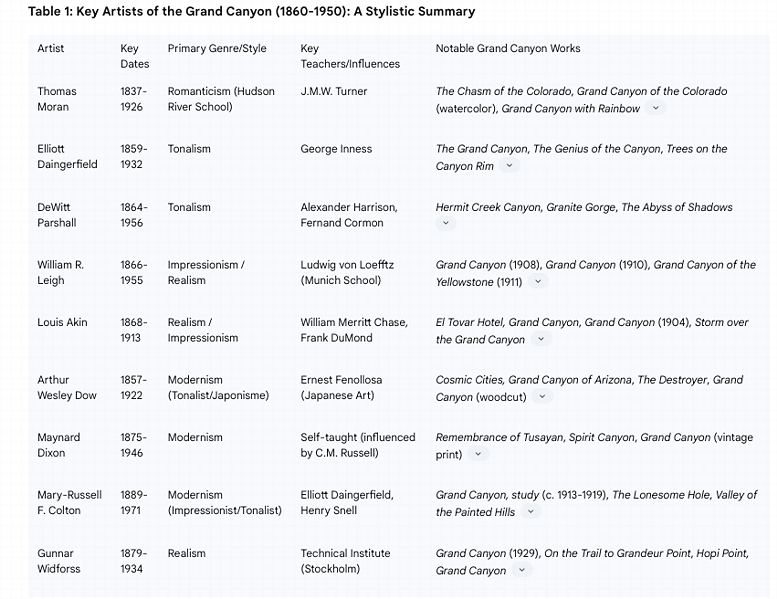
Part I: The Romantic Vision
Forging a National Icon (c. 1870s-1890s)
The initial artistic encounters with the Grand Canyon were
extensions of a grand national project. In the decades following the Civil War, the United States was consumed with
westward expansion and the forging of a distinct cultural identity. The
art of this period, dominated by the second generation of the Hudson
River School, sought to capture the Sublime-a philosophical and aesthetic
concept that found in nature a source of awe, terror, and evidence of divine
power. Artists ventured into the West not just to paint landscapes, but
to visually claim them for the nation, to present the American wilderness
as a landscape equal, if not superior, to any in the Old World. The Grand
Canyon, in its terrifying magnificence, was the ultimate subject for this
endeavor.
Artist Profile: Thomas
Moran (1837-1926), Architect of the Ideal West

(above: Thomas Moran, Zoroaster
Temple at Sunset, oil on canvas, Phoenix Art Museum. Public domain,
via Wikimedia Commons*)
-
- (A) Cultural Inspiration
-
- Thomas Moran's depictions of the West are inseparable
from the cultural and political currents of his time. His career was propelled
by the great post-war government surveys that sought to map and understand
the nation's newly acquired territories. He was invited as a guest artist
on Ferdinand V. Hayden's 1871 geological survey of Yellowstone and, two
years later, joined Major John Wesley Powell's expedition to the Grand
Canyon. His role was not merely documentary; it was persuasive. His
vivid watercolors and sketches, along with the photographs of William Henry
Jackson, were presented to Congress as powerful visual evidence in the
successful campaign to designate Yellowstone as America's first national
park in 1872. His subsequent Grand Canyon paintings served a similar
purpose, cementing the region's status in the national imagination and
promoting the tourism that would be facilitated by his railroad patrons. Moran's
art, therefore, was a key instrument in the American conservation movement,
helping a young nation recognize its wilderness as a source of profound
cultural pride and a divine inheritance worth preserving.
-
- (B) Influence of Teachers
-
- Though he began his career as an apprentice to a Philadelphia
wood-engraving firm, Moran was largely self-taught as a painter. His
true artistic education came from his intensive, lifelong study of the
English Romantic master Joseph Mallord William Turner. Moran revered Turner's
dramatic use of color, his ability to capture atmospheric effects, and
his capacity to imbue landscapes with epic emotion. He studied Turner's
prints and even traveled back to his native England to see the master's
paintings firsthand. This deep immersion in Turner's work allowed
Moran to break free from the tighter, more literal style of many of his
Hudson River School contemporaries and to develop a more expressive and
color-driven approach perfectly suited to the sublime landscapes of the
West.
-
- (C) Technical Prowess
-
- Moran's technical genius lay in his sophisticated method
of "idealization." During his expeditions, he worked tirelessly en
plein air, creating a vast portfolio of watercolor sketches and drawings
that captured specific geological formations, the unique colors of the
rock strata, and the transient effects of light and weather. Upon
returning to his studio on the East Coast, he would synthesize these disparate
studies into a single, monumental composition. The final oil painting was
not a depiction of a single, real vantage point but a composite view, carefully
orchestrated to be more dramatic, coherent, and emotionally powerful than
any photograph or literal transcript could be. Art critic Forbes Watson
observed Moran at work in his later years, noting how the artist would
first block out the entire canvas and then, "using small brushes,
he would finish" it inch by inch, a method revealing a remarkable
ability to "envision the whole while portraying the parts". This
process allowed him to transform the chaotic grandeur of the Canyon into
a structured, epic narrative painting.
-
- Acclaimed Artworks
-
- 1. The Chasm of the Colorado (1873-1874): This colossal 7-by-12-foot canvas
is Moran's definitive statement on the Grand Canyon and a landmark of American
art. Purchased by Congress for the then-princely sum of $10,000, it hung
in the U.S. Capitol and shaped the nation's visual understanding of the
Canyon for a generation. Painted from sketches made at Powell's Plateau
on the North Rim, the work is a masterclass in idealization, combining
multiple viewpoints into a single, awe-inspiring scene. Its composition
is dominated by a vast, V-shaped gulf that plunges into shadow, creating
what one scholar called an "apocalyptic atmosphere". Moran's
innovative decision to depict the Canyon from the rim, looking down into
its depths, established a visual paradigm that countless artists and photographers
would follow, transforming the viewer's experience from one of physical
travel along the river to one of sublime, almost vertiginous, contemplation.
-
- Grand Canyon of the Colorado (1873): This watercolor, now in the Gilcrease
Museum, offers a direct glimpse into Moran's creative process during the
Powell expedition. It brilliantly captures the raw colors he witnessed-dusky
blue-gray rocks, brilliant red striations, and pools of bright blue water.
Most compellingly, it features a large black boulder perched precariously
on a foreground ledge. This detail, a direct observation from the field,
functions as a powerful metaphor for the dynamic, ever-changing nature
of the landscape-a reminder that this seemingly eternal monument is in
a constant state of transformation. Moran recognized its symbolic power
and included it in the final version of The Chasm of the Colorado.
-
- Grand Canyon with Rainbow (1912): Painted
nearly four decades after his first visit, this work demonstrates Moran's
enduring fascination with the Canyon and his mature mastery of its atmospheric
effects. Here, the solid, ancient geology of the canyon is juxtaposed
with the ephemeral, transient beauty of a rainbow. The arc of light serves
not only as a compositional device but also as a symbol of hope and divine
promise, heightening the sense of spectacle and reaffirming the landscape's
status as a sacred, national space.
-

(above: Thomas Moran, Grand
Canyon with Rainbow. 1912. Oil on canvas. de Young Art Museum. Gift
of Mr. and Mrs. Robert F. Gill through the Patrons of Art and Music. 1981.89.
License: Scuttlebutte,
CC BY-SA 4.0 Scuttlebutte, CC BY-SA 4.0.
via Wikimedia Commons**)
-
The creation and reception of Moran's work reveal a process
by which art becomes an agent of cultural and political power. His journey
began with patronage from entities with vested interests: the U.S. government,
seeking to survey and promote its western territories, and railroads, seeking
to create tourist destinations. In response, Moran developed an "idealized"
style that transformed the raw, often chaotic reality of the Canyon into
a structured, heroic, and sublime spectacle that was more emotionally appealing
and symbolically potent than a literal depiction. These powerful images
were then widely reproduced and used to lobby Congress, resulting in the
creation of national parks and the purchase of the paintings themselves
for display in the nation's Capitol. Through this cycle, the artwork
transcended mere aesthetics. It became a strategic tool that constructed
a specific narrative of the American West-one of divine endowment and national
pride-that perfectly aligned with the expansionist and cultural ambitions
of the era. Moran's idealization was the very mechanism by which a geological
wonder was transformed into a national icon.
Part II: The Tonalist Mood
- Capturing the Canyon's Soul (c. 1890s-1920s)
As the 19th century drew to a close, a quiet revolution
was taking place in American landscape painting. Reacting against the detailed,
panoramic grandeur of the Hudson River School, a new generation of artists
embraced Tonalism. Influenced by the atmospheric
paintings of the French Barbizon School and the spiritual writings of American
Transcendentalists like Ralph Waldo Emerson and Henry David Thoreau, Tonalists
sought to capture not the literal appearance of a landscape, but its mood
and soul. They worked with a limited palette of closely related, harmonious
colors-grays, browns, and muted blues-and used soft, blurred edges and suggestive
forms to create what was described as a "dreamlike mood and feeling". For
these artists, the Grand Canyon was not a geological spectacle to be documented,
but a spiritual abyss to be felt.
Artist Profile: Elliott
Daingerfield (1859-1932), The Canyon as Dreamscape
-
- (A) Cultural Inspiration
-
- Elliott Daingerfield's art was animated by a deeply spiritual
worldview and a belief in the mystical connection between nature and the
divine. In 1911, he was invited by the Santa Fe Railway to join a
group of artists, including Thomas Moran and DeWitt Parshall, on a painting
trip to the Grand Canyon, a commission intended to generate images that
would encourage tourism. While the impetus was commercial, Daingerfield
interpreted the landscape through his own intensely personal and mystical
lens. The Canyon became for him a subject of profound spiritual power,
a place where he could explore themes of creation and eternity.
-
- (B) Influence of Teachers
-
- Daingerfield studied formally with the figure painter
Walter Satterlee in New York, but his most significant mentor was George
Inness, the leading figure of American Tonalism. Daingerfield shared
a studio building with the older artist and absorbed his philosophy and
technique. From Inness, he learned the crucial Tonalist practice of painting
from memory rather than direct observation, a method that prioritized imagination
and emotional response over factual accuracy. He also adopted Inness's
technique of applying thin layers of paint and varnish, or glazes, to create
a luminous, atmospheric glow that seemed to emanate from within the canvas
itself.
-
- (C) Technical Prowess
-
- Daingerfield was a master of what he called "selection,"
or evocative omission. He argued that an artist must paint "from nature...
in the sense of away, not by her, lest she has her way with you and not
you with her," a belief that the artist's feeling should dominate
the subject. His Grand Canyon paintings are prime examples of this
philosophy. They are not topographically accurate maps of specific locations
but are instead composites of his "first impressions and memories"
of the Canyon's light and color. He employed a palette of harmonious,
subtle tones and soft, blurred lines to dissolve the hard edges of the
rock, transforming the geological reality into a dreamscape that conveyed
a powerful sense of mood and spiritual wonder.
-
- Acclaimed Artworks
-
- The Grand Canyon (c.
1912): This painting, one of his most famous from the railway
commission, is a quintessential example of his Tonalist approach. It depicts
a non-specific, idealized vista, bathed in a golden, otherworldly light.
The distant canyon forms are blurred and rendered in atmospheric shades
of pink, blue, and purple, creating a composition that is less about a
place and more about a feeling of sublime, spiritual tranquility.
-
- The Genius of the Canyon:
This work highlights Daingerfield's tendency to merge Tonalism with Symbolism.
He often incorporated mysterious, ethereal figures into his landscapes,
and in this painting, he likely personified the spirit of the Canyon itself,
giving form to the immense, creative power he perceived in the landscape.
-
- Trees on the Canyon Rim:
As one of the celebrated works from the Santa Fe commission, this painting
likely offers a more intimate perspective. By focusing on the trees at
the edge of the abyss, Daingerfield would have used them as a dark, silhouetted
framing device to emphasize the luminous, atmospheric depth of the canyon
beyond, a classic Tonalist compositional strategy.
-
Artist Profile: DeWitt
Parshall (1864-1956), The Canyon in Shadow and Moonlight
- (A) Cultural
Inspiration
-
- DeWitt Parshall's deep engagement with the Grand Canyon
also began with a corporate commission. In 1910, he was part of the same
group of artists sponsored by the American Lithographic Company and the
Santa Fe Railway to paint the Canyon. The experience was transformative.
Upon first seeing the view, he was reported to have gone "quite moon-mad
and wandered for hours up on the rim in the unearthly splendor of its rays". For
the next seven years, the Canyon became his principal subject. His dedication
to the region is further evidenced by his role as a founder of the Society
of Men Who Paint the Far West, an organization dedicated to capturing the
unique landscapes of the region.
-
-
- (B) Influence of Teachers
-
- Parshall received a solid academic training in Europe,
studying at the Royal Academy in Dresden and later in Paris at the Académie
Julian under artists like Alexander Harrison and Fernand Cormon. This
background provided him with a strong command of draftsmanship and composition,
which he then adapted to his more atmospheric and moody interpretations
of the American West.
-
- (C) Technical Prowess
-
- Parshall is explicitly identified as a Tonalist who,
like Daingerfield, preferred to paint from memory to infuse his works with
a "romantic, moody feel". He was particularly celebrated
for his depictions of the Canyon under dramatic and varied atmospheric
conditions, especially his nocturnal and twilight scenes. Critics
praised his ability to render "luminous shadows" and his "splendid
technical treatment," noting that even when faced with the overwhelming
power of the Canyon, "the artist [is] ever present in the man". This
highlights his ability to subordinate the raw data of nature to a cohesive,
personal, and artistic vision, a core tenet of Tonalism.
-
- Acclaimed Artworks
-
- Hermit Creek Canyon (1910-1916): This
large oil painting captures Parshall's immediate, emotional response to
the Canyon's light. Using swift, expressive brushwork, he conveys his impression
of the sunlight and deep shadows playing across the canyon walls, focusing
on the "unearthly splendor" that so moved him on his first visit.
-
- Abyss of Shadows:
A moonlight view of the Canyon, this work was lauded as a "technical
accomplishment" that was "fine in arrangement". It
demonstrates Parshall's skill in creating a powerful composition using
a limited, low-key palette, capturing the mystery and profound quietude
of the Canyon at night.
-
- Granite Gorge: This
painting was described by contemporaries as being "quiet in color
and good in tone". Instead of relying on the "riot of color"
that fascinated Moran, Parshall used subtle tonal gradations to convey
the Canyon's immense depth and vastness, a clear demonstration of the Tonalist
emphasis on mood over spectacle.
-
The work of the Tonalist painters at the Grand Canyon signifies
a "privatization" of the sublime. The foundation of Tonalism was
rooted in the Transcendentalist philosophies of Emerson and Thoreau, who
advocated for a personal, direct, and mystical experience of the divine
in nature. This ethos was translated into artistic practice by mentors
like George Inness, who taught his followers to paint from memory, thereby
elevating the artist's internal, imaginative response above the external,
objective fact. Consequently, when artists like Daingerfield and Parshall
approached the Grand Canyon, their goal was not to produce a public document
of national pride, as Moran had done. Their aim was to create an intimate
record of a personal encounter. They created moody, dreamlike, and emotionally
charged scenes that were designed not to show the viewer what the
Canyon is, but to make the viewer feel what it is like to be
in the presence of the Canyon. This approach transforms the landscape
from a geological object to be cataloged into a psychological space-a canvas
for the viewer's own emotions, memories, and spiritual contemplation. The
railway may have commissioned a travel poster, but what it received was
a soul-scape.
Part III: The Impressionist
Light: A New Way of Seeing
(c. 1900s-1920s)
Emerging alongside the introspective mood of Tonalism was
a different artistic sensibility, one obsessed with light. American Impressionism,
particularly as it developed in the West, diverged from its French origins.
While French Impressionists often chronicled the fleeting moments of modern
urban and social life, artists in the American West turned their attention
almost exclusively to the landscape. They were captivated by the region's
intense, high-altitude sunlight and its dramatic effect on the arid terrain.
Working en plein air (outdoors), they employed brighter
palettes and broken, visible brushwork to capture the transient qualities
of light and atmosphere, seeking to record the specific, fleeting moment
as light bathed the canyon walls.
Artist Profile: William
Robinson Leigh (1866-1955), "The Sagebrush Rembrandt"
-
-
- (A) Cultural Inspiration
-
- William Robinson Leigh's long and celebrated career as
a painter of the West was ignited by the Grand Canyon. In 1906, the Santa
Fe Railroad offered him passage west in exchange for a painting of the
Canyon, an opportunity that, in his words, "revamped" his "entire
horizon". He was immediately captivated by the "magical
light" and the vibrant, unfamiliar colors of the Southwest -- hues
that Eastern critics, accustomed to a more subdued palette, often accused
him of fabricating. This initial commission convinced him that his
true artistic calling was to document the landscape and life of the American
frontier.
-
- (B) Influence of Teachers
-
- Leigh's artistic foundation was forged during more than
a decade of rigorous study at the Royal Academy in Munich, primarily under
the tutelage of Ludwig von Loefftz. The Munich School emphasized strong,
accurate draftsmanship and a direct, confident painting method known as alla
prima (wet-on-wet), which resulted in vigorous, textured brushwork. This
robust, academic training provided the structural backbone for his later
experiments with light and color.
-
- (C) Technical Prowess
-
- Leigh's style represents a masterful fusion of European
academic realism and American Impressionism. His outdoor studies, painted
directly on site, are explicitly described as "impressionist"
in their intent to faithfully capture the fleeting effects of light, color,
and value. He combined this focus on direct observation with the solid
drawing and compositional strength of his Munich training, creating works
that possessed both atmospheric vibrancy and structural integrity.Nicknamed
"America's Sagebrush Rembrandt," Leigh was a brilliant colorist
who skillfully used a palette of "crisp desert tones complemented
by brilliant violet shadows" to define the monumental forms of the
Canyon and capture the unique quality of Southwestern light.
-
- Acclaimed Artworks
-
- Grand Canyon (1908): This
oil on canvas board, held at the Gilcrease Museum, dates from his early,
formative trips to the region. It likely represents his direct, en
plein air response to the landscape, a powerful record of the
raw color and dramatic forms that first captivated his artistic imagination.
-
- The Grand Canyon (1910): A
work from a Christie's auction, this painting exemplifies Leigh's mature
style. It demonstrates a unique blend of "experimentation with Impressionist
technique and his skillful ability to record marquee elements of the American
West". The piece showcases his signature use of a high-keyed
palette and vibrant violet shadows to model the majestic buttes and convey
the intense desert sunlight.
-
- Grand Canyon of the Yellowstone (1911): While depicting a different canyon,
this oil study is significant for what it reveals about Leigh's process.
Curatorial notes describe it as a field work bearing the marks of plein-air creation,
such as embedded foreign matter. Furthermore, Leigh designed and built
the frame for this piece, indicating a holistic artistic vision that considered
the presentation of the work as integral to its effect. It speaks to his
deep engagement with the great canyons of the American West.
Artist Profile: Louis Akin
(1868-1913), Chronicler of the Canyon Rim
-
- (A) Cultural Inspiration
-
- Louis Akin was another artist whose western career was
launched and sustained by the Santa Fe Railway. Sent to Arizona in 1903,
his initial artistic project was to document the lives of the Hopi people
at Oraibi, with whom he lived for eighteen months and developed a deep
sympathy. However, he soon recognized the commercial potential of
the landscape itself. He turned his attention to painting the Grand Canyon,
creating panoramic and dramatic views designed to appeal to the burgeoning
tourist trade and promote the railroad's interests.
-
- (B) Influence of Teachers
-
- Akin's artistic training placed him at the heart of the
American Impressionist movement. He studied in New York City with William
Merritt Chase and Frank DuMond, two of the most influential teachers of
Impressionist principles in the country. This education provided him
with a strong foundation in the Impressionist concern for capturing the
effects of natural light and using a brighter, more varied color palette.
-
- (C) Technical Prowess
-
- Akin's approach was pragmatic and commercially astute.
His most famous and widely distributed image was not a unique oil painting
but a chromolithograph, a color print designed for mass reproduction on
posters and in brochures. While his early work shows the influence
of his Impressionist teachers, he later consciously adopted a more panoramic
and dramatic style, explicitly seeking to emulate the grand spectacles
of Albert Bierstadt to better capture the attention of tourists. His
work skillfully navigated the space between fine art and popular illustration,
making him a key figure in shaping the public's visual conception of the
Grand Canyon.
-
- Acclaimed Artworks
-
- El Tovar Hotel, Grand Canyon (1906/1907): This panoramic chromolithograph
is Akin's signature work and one of the most iconic images of the early
tourist era at the Grand Canyon. Commissioned by the Santa Fe Railway,
it depicts the newly built, grand hotel perched on the South Rim. The painting
masterfully blends the majestic natural wonder of the Canyon in the background
with the promise of modern comfort and civilization in the foreground,
making it the perfect promotional tool.
-
- Grand Canyon (1904): This
oil painting, dated just after his arrival in Arizona, likely reflects
the more direct influence of his Impressionist training. It would have
focused more on the subtle effects of light and color on the landscape,
before he shifted his style toward the more commercially viable panoramic
compositions.
-
- Storm Over the Grand Canyon: Though the original may be lost, the title of this reproduced
work suggests a painting in the dramatic, sublime tradition of Moran. It
indicates Akin's versatility and his willingness to embrace the more theatrical
aspects of the landscape to create a powerful and emotionally engaging
image for the public.
-
-
The artistic movement that has been labeled "Impressionism"
at the Grand Canyon was, in practice, a distinctly American and pragmatic
hybrid. It was not the radical, form-dissolving Impressionism of Claude
Monet, which would have been ill-suited to the solid monumentality of the
Canyon's geology. Instead, artists like Leigh and Akin forged a tempered
style that borrowed key Impressionist techniques-a brighter color palette,
a focus on the effects of light, and visible brushwork-while retaining the
descriptive realism necessary to convey the landscape's grandeur and satisfy
the commercial needs of their patrons. This led to a fascinating fusion
of styles. Leigh combined the rigorous draftsmanship of the Munich School
with the color and light of Impressionism, creating works that were both
atmospherically true and structurally sound. Akin blended his Impressionist
training with the panoramic drama of the earlier Hudson River School to
create accessible and popular images. This hybrid approach produced
an art that felt modern and vibrant but remained grounded in a recognizable
and awe-inspiring reality, a perfect synthesis for a subject that was at
once a natural wonder and a commercial destination.
Part IV: The Modernist
Form: Deconstructing a
Landmark (c. 1910s-1950s)
The arrival of Modernism at the Grand Canyon marked a fundamental
and radical departure from all previous artistic approaches. For modernist
painters, the Canyon was no longer a sacred subject to be faithfully rendered
or emotionally interpreted, but a vast reservoir of formal elements -- line,
color, shape, and rhythm. These artists began to deconstruct the iconic
landscape, using its powerful visual grammar to explore principles of abstraction,
design, and deeply personal expression. The goal was not to paint the Canyon,
but to create a new kind of art using the Canyon.
Artist Profile: Arthur
Wesley Dow (1857-1922), The Canyon Composed
-
- (A) Cultural Inspiration
-
- Arthur Wesley Dow was one of the most influential art
educators and theorists of American Modernism. When he traveled to the
Grand Canyon in 1911 and 1912, his journey was not one of discovery but
of application. He came to test his revolutionary artistic principles
against the most challenging landscape imaginable. He was uninterested
in its geology or its sublime connotations; instead, he saw in its structure
an example of "orderly world-building," a "geologic Babylon"
whose power lay in its fundamental elements of "Color," "line,"
and "cosmic" atmosphere. His mission was to distill this
overwhelming complexity into a harmonious and unified design.
-
- (B) Influence of Teachers
-
- Dow's most profound influence was not a single teacher
but an entire artistic philosophy: Japonisme. Through his association
with Ernest Fenollosa, the curator of Japanese art at the Museum
of Fine Arts, Boston, Dow absorbed the core principles of Japanese
aesthetics. He embraced the use of flattened perspectives, asymmetrical
compositions, and the crucial concept of Notan -- the
harmonious arrangement of light and dark spaces. He rejected the Western
tradition of realistic imitation in favor of a synthetic approach where
line, color, and mass were composed for purely aesthetic effect.
-
- (C) Technical Prowess
-
- As a teacher at institutions like Columbia University,
Dow revolutionized American art education, instructing a generation of
artists, including Georgia O'Keeffe, to approach a subject "first
as a design, afterward as a picture". He applied this method
rigorously to his Grand Canyon works. He deconstructed the "incomprehensible
scale" of the Canyon into simplified, flattened masses of color and
strong, rhythmic lines. His paintings and woodcuts are not views of
the Grand Canyon but "tonal symphonies" that use the Canyon's
forms to express abstract concepts of harmony, balance, and mood.
-
- Acclaimed Artworks
-
- Cosmic Cities, Grand Canyon of Arizona (1912): This large canvas is Dow's masterpiece
from his Canyon series and a landmark of early American Modernism. It is
a radical re-imagining of the landscape, where the buttes and temples are
transformed into abstract, architectural forms arranged in rhythmic patterns.
He uses a non-naturalistic palette of "cool blue and glittering silver"
and "flaming red-orange" to emphasize the composition's design
over its descriptive accuracy.
-
- The Destroyer (1911-13): The
title refers to the Colorado River, but the painting is a pure exercise
in design. The canyon walls are reduced to smooth, simplified masses of
color, while the river itself becomes a powerful, curving diagonal line
that structures the entire composition. The work is a clear demonstration
of Dow's principle of treating landscape as an arrangement of abstract
forms.
-
- Grand Canyon (1905,
woodcut): This early woodcut print perfectly illustrates Dow's
modernist approach in a different medium. He distills the "immense
geological wonder to subtle forms -- earthy reds floating above cool
violet shadows". The work expresses harmony and balance through
its careful composition of color and shape, completely abandoning the goal
of realistic grandeur.
Artist Profile: Maynard
Dixon (1875-1946), The Austere and Essential Canyon
-
- (A) Cultural Inspiration
-
- Maynard Dixon dedicated his life to finding and painting
an authentic, un-romanticized American West. He was drawn to the desert's
"inherent modernism" -- its stark, clean lines and vast,
empty spaces. He saw in the "minimalism of the cubed landscape"
a perfect subject for his evolving artistic style, one that could express
both the harsh desolation and the profound spiritual promise of the land.
-
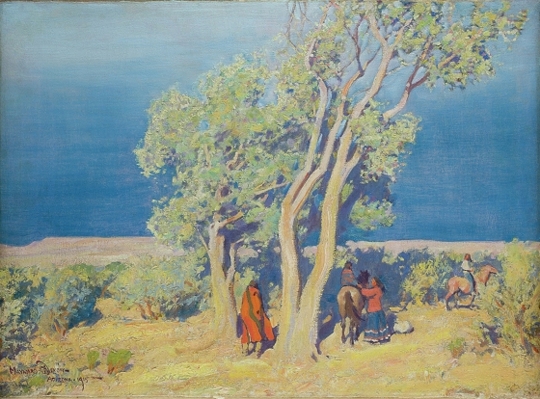
(above: Maynard Dixon, Navajo
Riders, 1915, 26 3/4 x 34 inches, Gift of the Roath Collection
at the Denver Art Museum, 2013.132. Photograph courtesy of the Denver
Art Museum)
-
- (B) Influence of Teachers
-
- Dixon was fiercely independent and largely self-taught.
Though he admired early Western illustrators like Frederic Remington, he
consciously forged his own path, developing a style that was uniquely his
own. His individualism was so strong that he famously declined an invitation
to join the acclaimed Taos Society of Artists, finding their bylaws and
collective aesthetic too confining.
-
- (C) Technical Prowess
-
- Dixon is regarded by many as one of "the most important
modernist in the West". His signature style is defined by powerful,
simplified compositions that reduce the landscape to its essential forms.
He utilized bold shapes, strong diagonal lines, and a masterful understanding
of light and shadow to create a profound sense of space and structure.
His later works are particularly notable for their austere beauty, characterized
by a spare application of paint and a subdued, harmonious color palette
that captures the quiet, monumental spirit of the desert.
-
- Acclaimed Artworks
-
- Remembrance of Tusayan (1915): The
title of this painting is deeply significant, referencing the ancestral
Puebloan name for the Grand Canyon region. This suggests a work that is
not merely a landscape but a meditation on deep time and the human history
embedded within the land, rendered in the bold, graphic style of his early
modernist period.
-
- Spirit Canyon: The
title alone evokes Dixon's interest in the mystical and spiritual dimension
of the landscape. This work likely uses his powerful, simplified forms
and dramatic use of light and shadow to convey a sense of the canyon as
a sacred, otherworldly place.
-
- Grand Canyon (vintage
print): The existence of commercially available prints of Dixon's
work speaks to the broad appeal of his stark, modern vision. These
prints allowed his unique interpretation of the Canyon --- austere,
powerful, and deeply spiritual-to reach a wider audience beyond the world
of fine art collectors.
Artist Profile: Mary-Russell
Ferrell Colton (1889-1971), A Modernist Vision in the Southwest
-
- (A) Cultural Inspiration
-
- Mary-Russell Ferrell Colton's life and art were inextricably
linked to the Colorado Plateau. As the co-founder of the Museum
of Northern Arizona in Flagstaff, she was a painter, curator, ethnographer,
and advocate, deeply immersed in the region's natural landscapes and its
native cultures. Her work was driven by a "sense of wonder at
the natural world" and a profound respect for the Hopi and Navajo
people, whose art and heritage she worked to preserve and promote.
-
- (B) Influence of Teachers
-
- Colton's artistic education provided her with a diverse
set of influences. Her studies with Elliott Daingerfield gave her a direct
link to the moody spirituality of Tonalism, while her time at the Philadelphia
School of Design for Women exposed her to the brighter palettes of Impressionism
and broader modern trends.
-
- (C) Technical Prowess
-
- Colton developed a sophisticated and personal style that
synthesized these varied influences. Her work is a masterful blend, combining
the "bright palette of impressionists" with the "restrained
color and simplified values of Tonalist works".Her paintings exhibit
a distinctly modernist sensibility in their use of simplified forms, strong
compositions, and decorative patterning. Some of her works even show the
influence of the geometric stylization of Art Deco and the flattened perspectives
of Japanese woodblock prints, marking her as an artist fully engaged with
the diverse visual language of her time.
-
- Acclaimed Artworks
-
- Grand Canyon, study (c.
1913-1919): This early oil-on-board study, listed in a Museum
of Northern Arizona exhibition checklist, represents one of her initial
encounters with the Canyon. It would have been a direct, fresh response
to the landscape, capturing her immediate impressions of its monumental
forms and unique color before they were filtered through more complex studio
compositions.
-
- The Lonesome Hole, Valley of the Little Colorado (1929): A major oil painting in the collection
of the Phoenix Art Museum, this work
depicts a landscape within the greater Grand Canyon ecosystem. It
showcases her mature style, with a strong, balanced composition and a nuanced
use of color to capture the vast, lonely, and powerful beauty of the high
desert.
-
- Valley Little Colorado (c.
1925): This painting of a red mesa beneath a dramatic, cloud-filled
sky received critical acclaim in its time. It demonstrates Colton's
skill in capturing the epic scale and dynamic atmosphere of the Colorado
Plateau, solidifying her reputation as a leading landscape painter of the
region.
A Counterpoint in Realism:
Gunnar Widforss (1879-1934), "Painter of the National Parks"

(above: Gunnar Widiorss, Desert
View Watchtower, 1932, watercolor on board, Museum of Northern Arizona.
Museum of Northern Arizona. Public domain, via Wikimedia Commons)
-
-
- (A) Cultural Inspiration
-
- While modernists were deconstructing the Canyon, Swedish-born
Gunnar Widforss was perfecting its realistic depiction. An expatriate who
"fell in love with the American landscape," Widforss was famously
encouraged by Stephen Mather, the first director of the National Park Service,
to dedicate his talents to painting the national parks. He took this
advice to heart, eventually making his home on the South Rim of the Grand
Canyon, which became his favorite and most profound subject.
-
- (B) Influence of Teachers
-
- Widforss's style was a product of his formal European
training. He studied at the Technical Institute in Stockholm, where he
developed a foundation in precise, realistic rendering that stood in stark
contrast to the emerging avant-garde movements of the time.
-
- (C) Technical Prowess
-
- Widforss was a virtuoso of the watercolor medium. At
a time when watercolor was often dismissed as a medium for preparatory
sketches, he used it to create highly finished, large-scale masterpieces
of "nearly photographic detail". His paintings are renowned
for their remarkable geological accuracy, meticulous draftsmanship, and
an unparalleled ability to render deep, atmospheric space. William
Henry Holmes, Director of the National Gallery of Art, praised his work
as giving a "more satisfactory understanding of the Grand Canyon than
any that have hitherto been attempted". Uniquely among his peers,
Widforss frequently made strenuous hikes deep into the Canyon to paint,
producing an extraordinary body of work from an inner-canyon perspective
that few artists had ever attempted.
-
- Acclaimed Artworks
-
- Grand Canyon (1929): This
iconic watercolor is a quintessential example of Widforss's mastery. It
was this work and others like it that prompted Director Holmes's praise
for its stunning accuracy in depicting both geological construction and
color, achieving a sense of grandeur that many felt was "well nigh
impossible to convey".
-
- On the Trail to Grandeur Point (c. 1930): This painting, often cited as one
of his finest, showcases his "virtuoso ability to create a tangible
sense of deep space". It captures the dynamic visual contrast
between the sharply rendered limestone cliffs in the foreground and the
hazy, distant temples of the canyon, twenty miles away.
-
- Hopi Point, Grand Canyon:
A classic view from the South Rim, this work demonstrates Widforss's exceptional
skill in capturing the intricate architectural details of the canyon's
buttes and mesas, all while maintaining a sense of its overwhelming scale
and atmospheric depth.

(above: Gunnar Widiorss, Cheops
Pyramid, Grand Canyon, watercolor, 12.5 x 9.5 in. Public domain, via
Wikimedia Commons)
The emergence of Modernism at the Grand Canyon signals
a fundamental reordering of the relationship between the artist and the
landscape. For earlier generations, represented by Moran and, in his own
way, Widforss, the Canyon was an external authority-a sublime or geological
truth to be revered, documented, and transcribed, however poetically. The
art, ultimately, served the landscape. For the modernists, this hierarchy
was inverted. The landscape served the art. Artists like Arthur Wesley Dow
treated the Canyon "first as a design," a collection of abstract
shapes and colors to be arranged according to aesthetic principles. Maynard
Dixon saw it as a source of "cubed" and "minimalist"
forms that echoed the austerity of the modern age. This inversion reveals
that by the early 20th century, the Grand Canyon had become so deeply embedded
in the American cultural consciousness that it could withstand deconstruction.
It was no longer just a place; it was an idea, a shared visual vocabulary
that artists could freely manipulate to explore the new language of Modernism.
The concurrent and enduring popularity of a meticulous realist like Gunnar
Widforss demonstrates that this was not a simple replacement of one style
by another. Rather, it shows that two powerful artistic impulses-the public
desire for a "true," recognizable image and the artist's desire
for a personal, expressive one -- coexisted, serving the different
and evolving cultural needs of a nation grappling with its identity in a
new century.
A Legacy in Pigment and
Stone
The artistic history of the Grand Canyon between 1870 and
1950 is a microcosm of American art's own dramatic evolution. It is a story
that begins with a challenge: how to capture a landscape so immense and
so alien that it seemed to defy the very tools of painting. The journey
to answer that challenge traces a profound narrative arc, moving from public
spectacle to private vision, from national myth-making to personal expression.
The story begins with Thomas Moran, who transformed the
Canyon from a remote geological curiosity into a potent symbol of divine
creation and American destiny. His sublime, idealized canvases were not
just paintings; they were foundational texts that helped define a national
identity rooted in the grandeur of its wilderness. The focus then shifted
inward with the Tonalists. Elliott Daingerfield and DeWitt Parshall turned
away from Moran's epic stagecraft, seeking instead the Canyon's soul. In
their moody, atmospheric dreamscapes, the Canyon became a site of spiritual
introspection, a quiet sanctuary for the contemplative mind.
This introspective mood was soon challenged by the brilliant
light of the Southwest, which captivated painters influenced by Impressionism.
Artists like William Robinson Leigh developed a robust, hybrid style, fusing
academic draftsmanship with the bright palette and plein-air immediacy
of Impressionism to capture the fleeting effects of the desert sun. This
pragmatic approach gave way to the radical deconstruction of Modernism.
For Arthur Wesley Dow, Maynard Dixon, and Mary-Russell Ferrell Colton, the
Canyon was no longer a subject to be depicted but a formal language to be
spoken. They broke the landscape down into its essential components of line,
color, and mass, using it as a vehicle to explore the most advanced artistic
ideas of their time.
Yet, this was never a simple, linear progression where
one style neatly replaced the next. It was a rich, complex, and overlapping
dialogue. The enduring popularity of Gunnar Widforss's meticulous, breathtakingly
accurate watercolors, created at the very height of the modernist impulse,
serves as a powerful testament to this complexity. His work demonstrates
a persistent and deeply felt need for an art of recognizable beauty and
scientific fidelity, a visual anchor in a rapidly changing world.
Ultimately, the artists who confronted the Grand Canyon
did more than simply paint a place. Through their varied and often conflicting
visions, they actively constructed our cultural understanding of this natural
wonder. They transformed a geological immensity into a powerful and multifaceted
American symbol: a national icon, a spiritual haven, a scientific marvel,
and a premier canvas for modern art. Their collective work created a legacy
in pigment and stone, a visual history as deep, layered, and enduring as
the Canyon itself.
Please don't rely on this AI-generated
text for accuracy. Consider it a base for further inquiry.
*Tag for expired US copyright of object
image:

 Return to Arizona Art History
Return to AI Curiosities
Links to sources of information outside
of our web site are provided only as referrals for your further consideration.
Please use due diligence in judging the quality of information contained
in these and all other web sites. Information from linked sources may be
inaccurate or out of date. TFAO neither recommends or endorses these referenced
organizations. Although TFAO includes links to other web sites, it takes
no responsibility for the content or information contained on those other
sites, nor exerts any editorial or other control over them. For more information
on evaluating web pages see TFAO's General
Resources section in Online
Resources for Collectors and Students of Art History.
Copyright 2025 Traditional Fine Arts Organization, Inc. an Arizona nonprofit corporation. All rights reserved.