
New York Art History, A Century of American Vision (1840-1940)
by Gemeni 2.5 Pro
The Quest for an American Canvas
Between 1840 and 1940, the United States underwent a profound and often tumultuous transformation, evolving from an agrarian republic into a global industrial power. At the heart of this metamorphosis was New York, a state and a city that served as the nation's cultural and economic crucible. It was here, amidst the currents of unprecedented growth, immigration, and social change, that a distinctly American artistic identity was forged. In the studios of New York City, along the banks of the Hudson River, and in the quiet towns of Long Island, artists grappled with the essential questions of their time: What did it mean to be American? What were the nation's defining values? And how could these be captured on canvas?
This report traces the evolution of American artistic expression through the nexus of New York, exploring a century-long dialogue between two fundamental pillars of the national psyche: the quasi-religious veneration of its vast, untouched wilderness and the earnest, often complex, attempt to define its moral character through depictions of human virtue. From the divine landscapes of the Hudson River School, through the introspective moods of Tonalism, and the light-filled moments of Impressionism, to the stark realities and abstract visions of Modernism, New York artists painted a nation in search of its soul. During this century, the state's great cultural institutions, including the Metropolitan Museum of Art and the Brooklyn Museum of Art, were founded and grew into world-class repositories, preserving the very art that told this evolving national story. This is the narrative of that art -- a visual record of a nation's journey from a promised Eden to the complexities of the modern world.
Part I: The Romantic Wilderness and the Hand of God (1840-c. 1875)
Romanticism and the Hudson River School
The story of a truly American art begins with the Hudson River School, the nation's first native art movement, which flourished from roughly 1825 to 1875. Centered in New York City, it was a deeply Romantic movement, born from a reaction against the prevailing neoclassicism of Europe, which looked to the ancient world for its subjects. These American painters turned instead to their own continent, finding in its landscape a subject worthy of the highest artistic expression. Their core philosophy was that the American landscape was a direct manifestation of God -- a "New World" Eden that offered spiritual renewal and a unique national identity untainted by the corruptions of the Old World.
The physical and economic landscape of New York was instrumental in the movement's rise. The opening of the Erie Canal in 1825 made the Hudson River a primary artery to the West, and New York City's burgeoning class of wealthy merchants provided the patronage necessary for artists to pursue their grand visions. A revolutionary aspect of their practice was the emphasis on sketching directly from nature, spending weeks and months in the Catskills, the Adirondacks, and the White Mountains to study the land firsthand -- a departure from the European tradition of composing idealized landscapes in the studio.
The conscious decision to depict the "untouched wilderness" was more than an aesthetic choice; it was a moral and political statement. In an era of fervent nationalism and "Manifest Destiny," these paintings presented the American landscape as a pristine, divine gift. This vision of nature stood in stark contrast to the rapid industrialization that was beginning to transform the country. Artists like Thomas Cole were deeply suspicious of this development, lamenting the encroachment of the railroad and its "copper-hearted barbarians." Consequently, their paintings of "virgin landscapes" and the use of symbols like the deer to represent "wilderness and innocence before the arrival of man" were deliberate acts of myth-making. They were crafting a foundational identity for America rooted in a pure, God-given nature, implicitly warning against the very progress that threatened to destroy it. This art was both a celebration of the American promise and a cautionary tale about its potential loss.
Thomas Cole (1801-1848)
Born in Lancashire, England, Thomas Cole emigrated to the United States in 1818 and is widely acknowledged as the founder of the Hudson River School. In 1825, a sketching trip up the Hudson River ignited a lifelong passion for the Catskill Mountains. His subsequent landscape paintings, exhibited in New York City, quickly brought him fame and the patronage of prominent figures like Luman Reed, a successful New York merchant. Cole established a studio in Catskill, New York, which became the movement's spiritual heart. His inspiration was the raw, romantic grandeur of the American scene, which he believed was uniquely suited to conveying profound moral and religious themes.
Cole's The Garden of Eden is the quintessential expression of the American wilderness as a divine paradise. The painting is an "imaginary virgin landscape" that explicitly maps the Biblical Eden onto the continent, imbuing the new nation with a sense of "destiny and providence." The canvas is filled with a vision of sublime, unspoiled nature: towering trees that rival the mountains in scale, a powerful waterfall, and a foreground teeming with vibrant, colorful flora. In this world, untouched by human industry or sin, nature exists in a state of perfect harmony. The painting is the foundational image of America as a new beginning, a paradise granted by God before the inevitable fall, perfectly aligning with the theme of a landscape devoid of any human corruption.
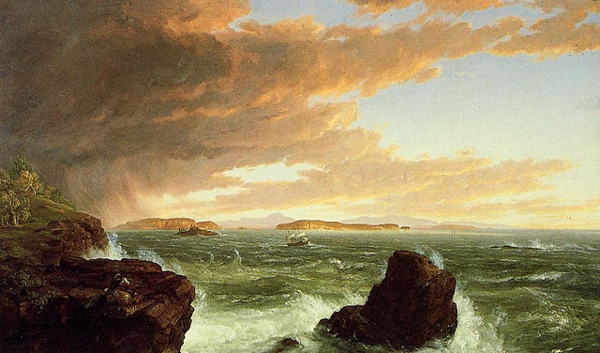
(above: Thomas Cole, View Across Frenchman's Bay From Mt. Desert Island, After A Squall, 1845, oil on canvas, 38.3 x 62.5 inches, Cincinnati Art Museum, Gift of Alice Scarborough. Public domain, via Wikimedia Commons*)
Additional paintings by Thomas Cole
Asher B. Durand (1796-1886)
A close friend of Thomas Cole, Asher B. Durand began his career in New York City as one of the nation's foremost engravers, a skill that honed his eye for precise detail. A pivotal sketching trip to the Adirondacks with Cole in 1837 permanently shifted his focus to landscape painting. Following Cole's death in 1848, Durand became the acknowledged leader of the Hudson River School and served as president of the National Academy Museum from 1845 to 1861. Through his influential "Letters on Landscape Painting," published in the New York periodical The Crayon, Durand championed the direct and faithful study of nature as the American artist's primary source of inspiration.
Based on sketches Durand made in the Catskill Mountains, In the Woods is a monumental embodiment of his artistic philosophy. The painting draws the viewer deep into the "shadowy solitude" of the forest, creating an atmosphere of quiet reverence. It is a scene entirely devoid of human presence; the only narrative is the natural life cycle of the forest itself, with ancient, moss-covered trees, both living and fallen, rising from the fertile ground. The meticulous rendering of leaves, bark, and stone reflects Durand's belief in empirical observation, yet the overall effect is deeply spiritual. The shafts of light filtering through the dense canopy transform the woods into a natural cathedral, a sacred space for contemplation and communion with the divine through His creation.

(above: Asher Brown Durand, View near Rutland, Vermont, 1837, oil on canvas, 29.2 x 36.2 inches, High Museum of Art. Public domain, via Wikimedia Commons*
Frederic Edwin Church (1826-1900)
Frederic Edwin Church, born in Hartford, Connecticut, was the only formal pupil of Thomas Cole, studying with the master in Catskill, New York, from 1844 to 1846. After establishing a studio in New York City, Church rapidly surpassed his teacher in fame, becoming the most celebrated painter in the United States by the mid-19th century. Inspired by the writings of the German naturalist Alexander von Humboldt, Church embarked on ambitious expeditions to South America and the Arctic, seeking out the world's most spectacular natural wonders. His grand, panoramic canvases were blockbuster events when exhibited in New York. His magnificent home and studio, Olana, which he designed himself overlooking the Hudson River in Hudson, New York, is now a State Historic Site and a testament to his artistic vision.
"Niagara," Church's massive canvas captures the sublime, terrifying power of one of North America's greatest natural wonders. This painting is a masterful depiction of a landscape free from human intervention. Church deliberately "eliminates walkways, fences, boats and any of the other signs of the tourist industry," presenting a raw, unmediated vision of nature's force. Commissioned in the aftermath of the Civil War, the painting was interpreted by contemporary audiences as a powerful symbol of a reunified nation, its "unbridled power and self-confidence" mirrored in the ceaseless energy of the falls. The tiny, invented viewing platform with its minuscule figures serves only to heighten the overwhelming scale and divine grandeur of the scene, reinforcing the Romantic idea of humanity's smallness in the face of God's creation.

(above: Frederick Edwin Church, Clouds over Olana, 1872, oil on paper, 8 5/8 x 12 1/8 inches, Olana State Historic Site, Hudson, New York. Public domain, via Wikimedia Commons*)
Additional paintings by Frederick Edwin Church
Part II: The Interior World: Tonalism, Impressionism, and the Virtuous Soul (c. 1870-1915)
Tonalism's Poetic Mood
As the 19th century progressed, the epic, moralizing grandeur of the Hudson River School gave way to a more intimate and introspective style known as Tonalism. Emerging in the 1870s, this movement shifted the focus from the sublime to the suggestive, from declarative statements about God and nation to quiet, poetic moods. Influenced by the French Barbizon painters, who emphasized atmosphere over topography, American Tonalists painted landscapes with an overall tone of colored mist, often depicting scenes at dawn, dusk, or in moonlight. Their philosophy was deeply personal, aiming to capture "the timelessness lurking behind each specific place and specific moment." Using soft edges, simplified forms, and a muted, harmonious palette, they preferred to evoke an emotional response rather than describe a specific location.
George Inness (1825-1894)
Born in Newburgh, New York, George Inness is a pivotal figure who bridged the Hudson River School and the Tonalist movement. His early work shows the influence of Cole and Durand, but his travels to Europe exposed him to the Barbizon painters, whose looser brushwork and emphasis on mood profoundly shaped his style. A deeply spiritual man, Inness was introduced to the theology of the Swedish mystic Emanuel Swedenborg in the 1860s. This philosophy, which posits a correspondence between the natural and spiritual worlds, became central to his art, leading him to create landscapes that sought to reveal the "reality of the unseen". Though he later settled in Montclair, New Jersey, Inness maintained his studio and his connections to the New York art world throughout his life.
Delaware Water Gap (1861) captures Inness at a moment of transition. While it retains the panoramic scope and recognizable location favored by the Hudson River School, its treatment of light and atmosphere points directly toward his mature Tonalist style. The scene is bathed in a soft, unifying golden light that blurs the edges of forms and emphasizes mood over minute detail. The landscape, while identifiable, begins to dissolve into broad, harmonious areas of color and tone. Unlike the wild, untamed nature of Cole or Church, Inness presents a pastoral scene where nature and civilization coexist peacefully. It represents a significant shift from a literal depiction of a place to an emotional and spiritual evocation of its essence.
Please click here to view artwork by George Inness
American Impressionism in New York
Impressionism arrived in America in the 1880s, largely inspired by French precedents and fueled by major exhibitions in New York, most notably the 1886 show organized by the Parisian dealer Durand-Ruel. American artists adopted the bright palette, broken brushwork, and focus on capturing the "fleeting moment" that characterized the French movement. However, American Impressionism was often a hybrid, blending the new style with the nation's strong tradition of realism; many American painters retained a greater emphasis on solid form and underlying draftsmanship than their European counterparts. New York City, with its bustling avenues, gaslit interiors, and newly created public spaces like Central Park, became a primary subject for this new generation of artists seeking to paint modern life.
As the artistic focus shifted from the vast wilderness to the human-centric world of cities, suburbs, and domestic interiors, the concept of virtue in art underwent a parallel transformation. The grand, moral allegories of the Romantics, located in the solitary contemplation of God's nature, gave way to more intimate portrayals of character and social bonds. Virtue was now to be found not in the landscape itself, but in the people who inhabited it. This domestication of virtue reflected a society turning inward to define its moral character through the quiet dignity of the individual, the strength of the family, and the bonds of community.
Childe Hassam (1859-1935)
A pioneer of American Impressionism, Frederick Childe Hassam was born in a suburb of Boston but settled in New York City in 1889, where he became the foremost Impressionist chronicler of the modern metropolis. After studying in Paris, he was one of the few Americans to immediately embrace the radical new style. In 1898, he helped found "The Ten," a group of artists who broke away from the conservative Society of American Artists to exhibit their more progressive work. A prolific and successful artist, Hassam found inspiration in the dynamic energy of New York's streets and the picturesque, historic towns of New England, which he visited during the summers.
Part of his renowned "Flag Series," The Avenue in the Rain is a quintessential example of American Impressionism applied to the urban landscape. Painted from a vantage point on Fifth Avenue, the work captures a moment of patriotic fervor just before the United States entered WWI. While the subject is a man-made environment, Hassam's true focus is on the atmospheric effects of a rainy day. The flags are not rendered as static symbols but dissolve into vibrant dabs of red, white, and blue, their colors reflecting on the wet, shimmering pavement. The entire scene -- the blurred figures with their umbrellas, the tall buildings receding into the mist -- is unified by a palpable sense of light and weather. Hassam transforms the city into a spectacle of dynamic, almost natural beauty, finding a modern, urban equivalent to the atmospheric effects sought by earlier landscape painters.

(above: Childe Hassam, Notre Dame Cathedral, Paris, 1888, oil on canvas, 43.82 x 54.93 cm, Detroit Institute of Arts. Public domain, via Wikimedia Commons*)
Additional paintings by Childe Hassam
Mary Cassatt (1844-1926)
Though she lived most of her life as an expatriate in Paris, Pennsylvania-native Mary Cassatt remained a pivotal figure in American art. In 1877, she was invited by her friend and mentor Edgar Degas to exhibit with the Impressionists, the only American to be officially part of the group. Cassatt became celebrated for her intimate and unsentimental portrayals of the domestic lives of women and children, a subject she treated with profound psychological insight and dignity. Her work was also deeply influenced by the bold compositions and flattened perspectives of Japanese woodblock prints, which she saw exhibited in Paris and integrated into her own innovative style.
One of Cassatt's most ambitious and powerful works, The Boating Party (1893) masterfully combines the bright palette of Impressionism with the strong, simplified forms of Japanese art. While set on the water, the painting's true subject is the complex and tender relationship between the figures. The mother, protectively holding her child, forms the secure emotional and compositional center of the work. The dark, powerful figure of the boatman, his back to the viewer, propels them forward, but his world seems separate from the intimate bond shared by mother and child. The painting is a profound meditation on the virtue of maternal care and the distinct roles within the family unit. Cassatt elevates this quiet, domestic moment into a universal statement on the strength, kindness, and deep responsibility inherent in the maternal bond.

(above: Mary Stevenson Cassatt, Self Portrait, c. 1878, guache on paper, 23.6 x 16.1 inches, Metropolitan Museum of Art. Public domain, via Wikimedia Commons*)
Additional paintings by Mary Cassatt
Part III: Confronting the Modern Age (c. 1900-1940)
The turn of the 20th century unleashed a torrent of new ideas that challenged the very definition of art. In New York, the undisputed center of the American art world, multiple artistic philosophies coexisted and competed. The Ashcan School, an offshoot of Realism, rejected academic gentility to depict the gritty, vibrant reality of the city's working-class life. In stark contrast, American Modernism, ignited by the groundbreaking 1913 Armory Show and championed by photographer Alfred Stieglitz at his 291 gallery, embraced the abstract, experimental languages of the European avant-garde. As a reaction to both the urban grit of the Ashcan artists and the internationalism of the Modernists, Regionalism arose during the Great Depression of the 1930s. It was a self-consciously American movement that turned away from the city, celebrating the perceived simplicity and traditional values of rural life.
John Sloan (1871-1951)
A central figure of the Ashcan School, John Sloan moved from Philadelphia to New York in 1904, joining his friends Robert Henri and George Luks. He became known for his vital and deeply empathetic depictions of everyday life, often observed from the window of his Greenwich Village studio. Sloan was captivated by the unvarnished humanity of the city - its tenements, parks, and saloons. Influenced by his socialist politics, his art is suffused with a democratic idealism and a focus on the working class, whom he portrayed with dignity and without condescension.
McSorley's Bar (1912) is a quintessential work of the Ashcan School, capturing the atmosphere of one of New York's oldest and most famous working-men's pubs. Sloan's depiction is not a moralizing tale of the evils of drink, but an affectionate, warm portrayal of a male-only community space. The virtue on display is one of camaraderie, fellowship, and the simple kindness of shared experience. Using a dark, rich palette reminiscent of the Old Masters, Sloan elevates this everyday scene into a powerful statement on social cohesion. The men are not anonymous figures but individuals engaged in conversation and quiet contemplation. It is a celebration of the unpretentious, democratic spaces where the city's working men found respite and connection.
Georgia O'Keeffe (1887-1986)
Born in Wisconsin, Georgia O'Keeffe became a central figure in American Modernism after moving to New York in 1918 at the invitation of the influential photographer and art dealer Alfred Stieglitz, whom she would later marry. As a key member of the "Stieglitz Circle," she helped pioneer a new, distinctly American form of modern art that sought to express emotional and spiritual truths through abstracted forms. While she is most famous for her large-scale paintings of flowers and the stark landscapes of New Mexico, her time in New York produced some of the most iconic images of the modern American city.
In her iconic work Radiator Building - Night, New York (1927), O'Keeffe transforms the American Radiator Building, a symbol of New York's corporate and technological power, into an object of mysterious, sublime beauty. She abstracts the skyscraper's form, emphasizing its bold, dark mass and dramatic setbacks, while capturing the ethereal glow of its illuminated windows against the deep blue of the night sky. The building becomes a modern, man-made mountain, emitting its own light and veiled in clouds of steam. The painting brings the century-long artistic journey full circle: the search for the sublime, which began for the Hudson River School painters in the untamed wilderness of the Catskills, is now found in the heart of the modern metropolis. O'Keeffe demonstrates Modernism's power to find a new kind of "natural beauty" in the geometry and energy of the urban environment.

(above: Georgia O'Keeffe, Lake George Reflection, c. 1921-22, oil on canvas, 58 x 34 inches, Christie's. Public domain, via Wikimedia Commons*)
Eastman Johnson (1824-1906)
Born in Lovell, Maine, Eastman Johnson established a studio in New York City and became one of the nation's leading genre painters after extensive study in Europe. His sensitive handling of light and his detailed, psychologically astute portrayals of his subjects earned him the nickname "The American Rembrandt". Significantly, Johnson was one of the first major American artists to portray African-American life with depth and humanity, moving beyond the prevalent caricatures of the era to capture the dignity and individuality of his subjects.
Painted in the same year that the Emancipation Proclamation took effect, the small, quiet painting, The Lord Is My Shepherd (1863), is a monumental work of figurative art that powerfully embodies the virtue of dignity. In 1863, the simple act of a Black man reading the Bible was a profound political statement, as literacy had been systematically denied to the enslaved as a means of control. Johnson portrays his subject with immense respect. The man sits humbly, bathed in a soft light that highlights his contemplative expression and the weathered texture of his hands holding the book. He is not a passive recipient of charity but an active agent in his own spiritual and intellectual liberation. The title alludes to faith and hope, while the act of reading -- likely from the Book of Exodus, with its powerful message of freedom -- symbolizes the pursuit of self-determination and full citizenship in a nation remade by war. This masterpiece portrays kindness not as an act of giving, but as the recognition of another's inherent, virtuous humanity.
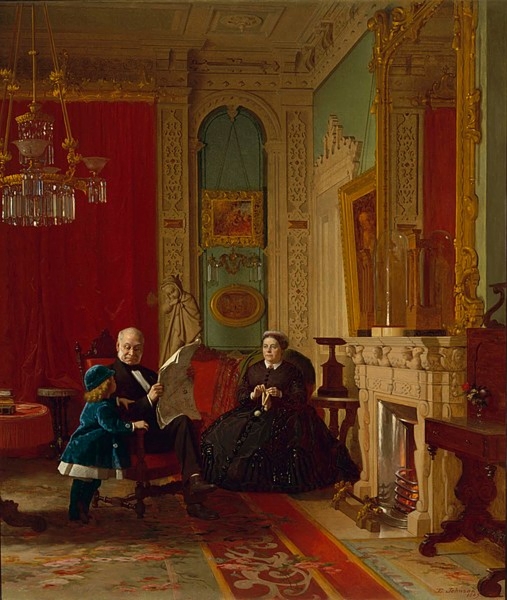
(above: Eastman Johnson, The Brown Family, [grandson William Adams Brown (1865-1943), James Brown (1791-1877), wife Eliza Brown (1803-1890)] 1869, oil on canvas, 38.5 x 32.3 inches, M. H. de Young Memorial Museum, Gift of Mr. and Mrs. John D. Rockefeller 3rd. Public domain, via Wikimedia Commons*)
Aditional paintings by Eastman Johnson
An Evolving American Vision
The century of artistic expression in New York from 1840 to 1940 reveals a nation in constant dialogue with itself. The journey began with an outward gaze, as the artists of the Hudson River School looked to the vast, external wilderness to find evidence of God's favor and a unique national identity. Their canvases established a foundational myth of America as a pristine Eden, a moral landscape that stood as both a promise and a warning. As the century wore on and the nation urbanized, the artistic gaze turned inward. The locus of virtue shifted from the sublime landscape to the human heart, explored through the intimate domestic scenes of the Impressionists, the communal warmth of the Ashcan realists, and the profound dignity of individuals striving for freedom.
By the early 20th century, the artists of Modernism found
a new kind of sublime not in the wilderness, but in the steel and glass
canyons of New York City itself. Through all these transformations, New
York remained the stage, the subject, and the crucible. The art produced
there did not merely document the changing face of America; it actively
constructed its vision of itself -- a complex, often contradictory, but
endlessly compelling portrait of a nation in search of its soul.
Note: Tables within AI reports formatted
in a manner incompatible with functionality of our page editing software
have been deleted. Please don't
rely on this AI-generated text for accuracy. It has been lightly edited,
yet may be laden with inaccurate information. Consider it a base for further
inquiry
 Return to New
York Art History
Return to New
York Art History
Return to Individual States Art History Project
*Tag for expired US copyright of object image:

Links to sources of information outside of our web site are provided only as referrals for your further consideration. Please use due diligence in judging the quality of information contained in these and all other web sites. Information from linked sources may be inaccurate or out of date. TFAO neither recommends or endorses these referenced organizations. Although TFAO includes links to other web sites, it takes no responsibility for the content or information contained on those other sites, nor exerts any editorial or other control over them. For more information on evaluating web pages see TFAO's General Resources section in Online Resources for Collectors and Students of Art History.
 Search Resource Library
Copyright 2025 Traditional Fine Arts Organization, Inc., an Arizona nonprofit corporation. All rights reserved.