
America's Distinguished
Artists
a national registry of
historic artists
Aditional paintings by
Thomas Cole
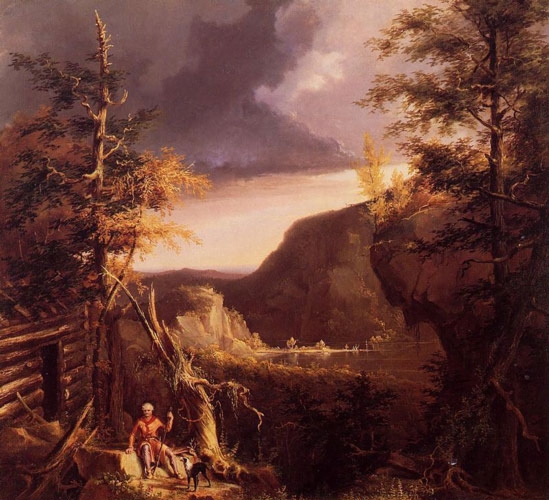
(above: Thomas Cole, Daniel Boone
Sitting At the Door of His Cabin on the Great Osage Lake Kentucky, 1826.
Source: Wikimedia Commons - public domain*)

(above: Thomas Cole, A View
of the Mountain Pass Called the Notch of the White Mountains, 1839,
oil on canvas, 40.1 x 61.3 inches, National Gallery of Art, Washington DC,
Andrew W. Mellon Fund. Public domain, via Wikimedia Commons*)
- Thomas Cole, a prominent American artist in the
early 19th century, is widely recognized as the founder of the Hudson River School,
a movement known for its romantic portrayal of the American landscape.
Cole's work is characterized by its grand, sweeping views of nature, imbued
with allegorical themes and a sense of the sublime.
-
- Cole's motivation for painting stemmed from a
deep appreciation of nature and a desire to convey moral and philosophical
messages through his art. One of his notable works, "The Old Mill
at Sunset" (1844), depicts a harmonious coexistence of settled community
and pristine wilderness, symbolizing Cole's ideal vision for America. This
painting reflects his hope for the nation to thrive under the careful watch
of divine providence, where human development and natural beauty are in
balance.
-
- Cole's career began in Ohio, but he moved to
New York City in 1825 to pursue his artistic ambitions. He quickly made
a name for himself with a series of Catskill Mountain scenes, which were
acquired by influential figures in the New York art world. In 1826, Cole
became one of the founding members of the National Academy of Design, an
institution aimed at promoting fine arts in America through instruction
and exhibition.
-
- Cole's time in Europe significantly influenced
his style and subject matter. During his travels, he was particularly inspired
by the works of Claude Lorrain, a French painter known for his idealized
landscapes. This European influence is evident in the balanced compositions
and allegorical content of Cole's paintings. Upon returning to America,
Cole produced several major series, including "The Course of Empire"
(1836) and "The Voyage of Life" (1839), which explore themes
of civilization's rise and fall and the journey of human life, respectively.
-
- "The Course of Empire" is a five-part
series that illustrates the progression of a civilization from its primitive
beginnings to its ultimate destruction and desolation. This series serves
as a cautionary tale about the dangers of overreach and moral decay, reflecting
Cole's apprehension about the direction of contemporary society. "The
Voyage of Life," on the other hand, consists of four paintings that
depict the stages of human life from childhood to old age, each stage accompanied
by its own set of challenges and spiritual reflections. These works highlight
Cole's belief in the importance of spiritual guidance and the transient nature of human existence.
-
- In summary, Thomas Cole's paintings are a testament
to his deep reverence for nature and his philosophical contemplation of
human progress and morality. His works not only celebrate the beauty of
the American landscape but also serve as a medium for conveying profound
allegorical messages. Cole's legacy as a pioneering figure in American
art continues to influence and inspire to this day.
-
- The preceding brief essay was generated by AI
mainly from our texts published online and edited by us in July 2024.
Return to Coa-Con
*Tag for expired US copyright of object
image:

Links to sources of information outside
of our web site are provided only as referrals for your further consideration.
Please use due diligence in judging the quality of information contained
in these and all other web sites. Information from linked sources may be
inaccurate or out of date. TFAO neither recommends or endorses these referenced
organizations. Although TFAO includes links to other web sites, it takes
no responsibility for the content or information contained on those other
sites, nor exerts any editorial or other control over them. For more information
on evaluating web pages see TFAO's General
Resources section in Online
Resources for Collectors and Students of Art History.
 Search Resource Library
Copyright 2022 Traditional Fine Arts Organization, Inc., an Arizona nonprofit corporation. All rights
reserved.