
New York Art History

with an emphasis on representational art
Other online information page 3

(above: Unidentified photographer, Students at Shinnecock Hills Summer School of Art in Southampton, N.Y., c. 1895, William Merritt Chase papers, circa 1890-1964. Archives of American Art, Smithsonian Institution. Public domain, via Wikimedia Commons*)
National Arts Club website. Accessed August, 2015.
National Association of Women Artists website. Accessed August, 2015.
New York Accents: The New York Influence on Telfair's Collections, an exhibit held June 7, 2013 - July 6, 2014 at the Telfair Museum of Art. Includes online tour. Accessed April, 2015.
New York Art History: Artistic Evolution, 1840-1940, is a 2025 article by Grok AI, whick says: "In the century spanning 1840 to 1940, New York emerged as a vibrant hub of artistic expression, where painters wove beauty and the classic virtues of charity and kindness into their works. The state's landscapes, from the Hudson River Valley's rolling hills to the bustling streets of Manhattan, inspired artists across movements -- Romanticism, Tonalism Impressionism / Post-Impressionism, and Modernism. Each movement brought distinct approaches to capturing the world, yet many artists shared a commitment to evoking emotional depth, moral resonance, and a celebration of human connection, often reflecting virtues like compassion and generosity. Drawing from sources such as Traditional Fine Arts Organization (TFAO) and other nonprofit, educational, and governmental archives, this narrative explores how these movements unfolded in New York, spotlighting six acclaimed artists who shaped this era and left lasting impacts on society." Accessed 7/25
New York Art History, A Century of American Vision (1840-1940) is a 2025 article by Gemeni 2.5 Pro AI, whick says: "The century of artistic expression in New York from 1840 to 1940 reveals a nation in constant dialogue with itself. The journey began with an outward gaze, as the artists of the Hudson River School looked to the vast, external wilderness to find evidence of God's favor and a unique national identity. Their canvases established a foundational myth of America as a pristine Eden, a moral landscape that stood as both a promise and a warning. As the century wore on and the nation urbanized, the artistic gaze turned inward. The locus of virtue shifted from the sublime landscape to the human heart, explored through the intimate domestic scenes of the Impressionists, the communal warmth of the Ashcan realists, and the profound dignity of individuals striving for freedom. By the early 20th century, the artists of Modernism found a new kind of sublime not in the wilderness, but in the steel and glass canyons of New York City itself. Through all these transformations, New York remained the stage, the subject, and the crucible. The art produced there did not merely document the changing face of America; it actively constructed its vision of itself -- a complex, often contradictory, but endlessly compelling portrait of a nation in search of its soul." Accessed 7/25
New York Art Worlds, 1870-1890 is a 2022 exhibit at The Metropolitan Museum of Art which says: "Drawing largely from the American Wing's varied collections, the display investigates the vibrant cosmopolitan and modern art world that emerged in the city during the post-Civil War years, laying the groundwork for today's international cultural capital." Accessed 3/23
New York Experienced is a 2019 exhibit at the American Folk Art Museum which says: "New York Experienced explores the connection between self-taught art and the New York spirit through a selection of works from the American Folk Art Museum's collection made in the greater New York City area." Accessed 4/19
New York Genealogical and Biographical Society website. Accessed August, 2015.
New York State Capitol from State of New York (see murals section). Accessed August, 2015.
Michael W. Padwee maintained as of May 2013 "a blog about ceramic and terra cotta tiles used in architecture and architectural ornamentation in New York" named Tiles in New York. Mr. Padwee is an historian and collector of United States art tiles. He also maintained at the 2013 access date a website named Historic U.S. Tile Installations. Accessed August, 2015.
Patteran: A Living Force and Moving Power, an exhibit focused on the history of the Buffalo-based Patteran Society founded in 1933 and devoted to modernism. The exhibit was held April 10 - September 27, 2015 at the Burchfield Penney Art Center. Accessed February, 2016.
Peconic Art Colony: "A New Glimpse of the Heyday of the Peconic Art Colony" By Marjorie Kaufman, New York Times, Published: May 14, 1995. Accessed August, 2015.
The Radical Camera: New York's Photo League, 1936-1951 from Columbus Museum of Art. Includes link to media article, videos, Accessed August, 2015.
Regional Artists of the Finger Lakes and Central New York State Artists from John Sutton. Accessed August, 2015.
Roaring into the Future: New York 1925-35 is a 2017 exhibit at the Munson-Williams-Proctor Arts Institute which says: "Roaring into the Future features more than 100 artworks - fashion arts, paintings, decorative arts, and video and music - including masterpieces from the MWPAI collection by Reginald Marsh, John Storrs, and Stuart Davis." Accessed 8/17
Roycrofters website. Accessed August, 2015.
Seneca Ray Stoddard: Capturing the Adirondacks is a 2016 exhibit at the Munson-Williams-Proctor Arts Institute which says: "Capturing the Adirondacks illustrates how Stoddard's alluring images of landscapes, travelers, and explorers captivated viewers and shaped attitudes toward New York's natural scenery." Accessed 8/18
Sanctuaries of the Soul: Beauty, Virtue, and the Historic Artist Colonies of New York ia a 2025 article by by Gemini 2.5 Pro AI which says: "The historic artist colonies of New York, from their inception in the late 19th century through the crucible of the Great Depression, were far more than picturesque gatherings or simple stylistic movements. They were profound and deliberate philosophical projects, born from a desire to heal a perceived rift in the soul of American culture -- a chasm that had opened between life and art, labor and beauty, industrial progress and the human spirit. The communities at Roycroft, Byrdcliffe, Woodstock, and Shinnecock were sanctuaries where artists sought to build a new kind of American Arcadia, one founded on the belief that the creation of beauty was a virtuous and necessary act."Accessed 7/25
A Sense of Time: The Historical Art of L. F. Tantillo is a 2021 exhibit at the Albany Institute of History & Art which says: "By looking at a single Tantillo painting, a viewer can be transported back in time to when the Hudson River was a major highway with vessels of all shapes and sizes plying the waters or imagine how seventeenth and eighteenth-century Albany, Kingston, and Manhattan may have looked." Accessed 5/21
Street Smart: Photographs of New York City, 1945-1980 is a 2017 exhibit at the Bruce Museum which says: "This exhibition features 30 photographs, chiefly drawn from the Bruce Museum's permanent collection, including work by Larry Fink, Herman Leonard, Leon Levinstein, John Shearer, and Garry Winogrand. Street Smart provides a glimpse at life in the city during the post-war period and at how street-savvy New Yorkers navigated its bustling landscape." Accessed 3/17
Society of American Artists from Wikipedia. Accessed August, 2015.
The Story of the Armory Show, Online Exhibition 2013, Celebrating the Centennial of the 1913 Armory Show from Archives of American Art. Accessed August, 2015.
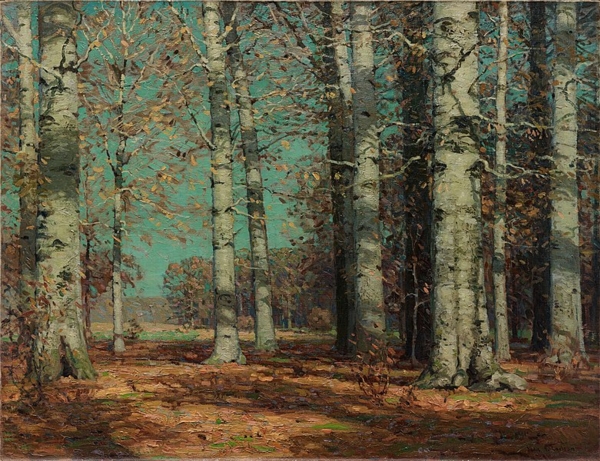
(above: John F. Carlson, Autumn Beeches, c. 1908-1915, oil on canvas, Dallas Museum of Art. Public domain, via Wikimedia Commons*)
Go to New York Art History: Other online information page 4
 Return to New York Art History
Links to sources of information outside of our web site are provided only as referrals for your further consideration. Please use due diligence in judging the quality of information contained in these and all other web sites. Information from linked sources may be inaccurate or out of date. TFAO neither recommends or endorses these referenced organizations. Although TFAO includes links to other web sites, it takes no responsibility for the content or information contained on those other sites, nor exerts any editorial or other control over them. For more information on evaluating web pages see TFAO's General Resources section in Online Resources for Collectors and Students of Art History.
*Tag for expired US copyright of object image:

 Search Resource Library
Copyright 2025 Traditional Fine Arts Organization, Inc., an Arizona nonprofit corporation. All rights reserved.