
New York Art History: Artistic Evolution, 1840-1940
by Grok AI
July, 2025
In the century spanning 1840 to 1940, New York emerged as a vibrant hub of artistic expression, where painters wove beauty and the classic virtues of charity and kindness into their works. The state's landscapes, from the Hudson River Valley's rolling hills to the bustling streets of Manhattan, inspired artists across movements -- Romanticism, Tonalism Impressionism / Post-Impressionism, and Modernism. Each movement brought distinct approaches to capturing the world, yet many artists shared a commitment to evoking emotional depth, moral resonance, and a celebration of human connection, often reflecting virtues like compassion and generosity. Drawing from sources such as the Traditional Fine Arts Organization (TFAO) and other nonprofit, educational, and governmental archives, this narrative explores how these movements unfolded in New York, spotlighting six acclaimed artists who shaped this era and left lasting impacts on society.
The Dawn of Romanticism (1840-1870)
In the 1840s, New York's art scene was dominated by the New York a Romantic movement that celebrated the sublime beauty of nature as a reflection of divine presence and human virtue. Painters sought to capture the awe-inspiring landscapes of the Catskills, Adirondacks, and Niagara Falls, infusing their works with moral undertones. The Romantic ideal, as described on Wikipedia, emphasized subjectivity, imagination, and a reverence for nature, often portraying it as a space for reflection and spiritual renewal. Artists like Thomas Cole, a founder of the Hudson River School, believed nature's grandeur could inspire virtues such as humility and kindness, encouraging viewers to cherish the environment and each other.
Thomas Cole (1801-1848)
Born in England and emigrating to the United States in 1818, Thomas Cole settled in Catskill, New York, where the Hudson Valley's dramatic vistas fueled his vision. His paintings, such as The Oxbow (1836, though just outside our period), depicted nature's majesty with a Romantic lens, blending meticulous detail with emotional depth. Cole's inspiration came from his belief that nature was a divine creation, a sentiment echoed in his Kindred Spirits (1849, painted by Asher B. Durand in Cole's memory), which portrays two figures in a landscape symbolizing friendship and harmony. Cole's work, as noted on Artchive.org, influenced society by fostering an appreciation for America's wilderness, indirectly supporting early conservation efforts and inspiring communal values of stewardship and care.
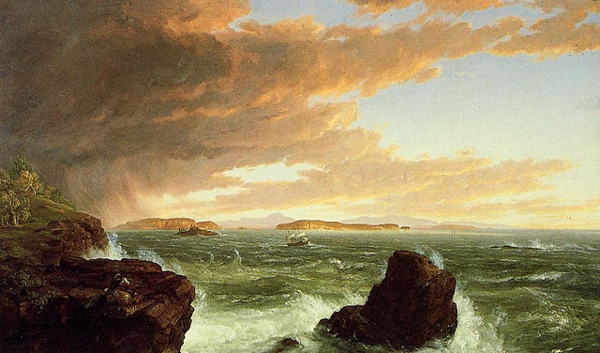
(above: Thomas Cole, View Across
Frenchman's Bay From Mt. Desert Island, After A Squall, 1845, oil on
canvas, 38.3 x 62.5 inches, Cincinnati Art Museum, Gift of Alice Scarborough.
Public domain, via Wikimedia Commons*)
Additional paintings by Thomas Cole
Tonalism's Quiet Reverie (1880-1915)
By the 1880s, Tonalism emerged as a softer, more introspective response to Romanticism's grandeur. Characterized by muted palettes and atmospheric effects, Tonalist paintings, as described on Wikipedia, evoked a meditative mood, often using landscapes to suggest inner peace and quiet generosity. In New York, artists like George Inness and James McNeill Whistler (who spent time in the state) used Tonalism to explore beauty as a subtle, emotional force, aligning with virtues like charity through their depictions of serene, contemplative scenes.
George Inness (1825-1894)
Born in Newburgh, New York, George Inness grew up immersed in the Hudson Valley's landscapes. His Tonalist works, such as The Home of the Heron (1893), featured hazy, dreamlike scenes that invited viewers to pause and reflect. According to TFAO, Inness drew inspiration from the spiritual qualities of nature, influenced by Swedenborgian philosophy, which emphasized divine love and kindness. His paintings, with their soft edges and earthy tones, encouraged a sense of calm and empathy, subtly urging society to value introspection and connection over materialism. Inness's influence extended to later artists, shaping American landscape painting's emotional depth.
Please click here to view artwork by George Inness
Impressionism's Vibrant Embrace (1870-1900)
Impressionism, arriving in New York by the 1870s, shifted focus to capturing fleeting moments of modern life with vivid colors and loose brushstrokes. As noted on Smarthistory.org, American Impressionists like those at the Pennsylvania Academy of the Fine Arts (accessible via TFAO,) adapted French techniques to depict New York's urban and rural scenes, emphasizing light and movement. Their works often celebrated communal joy and human connection, reflecting virtues like kindness through depictions of shared moments - picnics, strolls, and family gatherings.
Childe Hassam (1859-1935)
Born in Boston but a longtime New York City resident, Childe Hassam became a leading American Impressionist. His paintings, such as Fifth Avenue in Winter (c. 1890), captured New York's bustling streets with vibrant hues and dynamic brushwork. TFAO highlights Hassam's time at Shinnecock, Long Island, where he painted luminous landscapes that radiated optimism and community. Inspired by the interplay of light and human activity, Hassam's works celebrated urban life's shared beauty, fostering a sense of civic pride and collective kindness. His leadership in "The Ten," a group of progressive artists, challenged academic norms, encouraging freer artistic expression that resonated with a broader public.

(above: Childe Hassam, Notre Dame Cathedral, Paris, 1888, oil on canvas, 43.82 x 54.93 cm, Detroit Institute of Arts. Public domain, via Wikimedia Commons*)
Additional paintings by Childe Hassam
Post-Impressionism's Expressive Turn (1886-1910)
Post-Impressionism, as described on Artchive.org, built on Impressionism's innovations but emphasized emotional and symbolic depth. In New York, artists explored bold colors and structured forms to convey personal and universal truths, often embedding virtues like charity in their depictions of human struggle and resilience. This movement bridged Impressionism's spontaneity with Modernism's experimentation, influencing New York's growing avant-garde scene.
William Merritt Chase (1849-1916)
Born in Indiana, Chase moved to New York City in 1878, becoming a pivotal figure in American art. His Post-Impressionist works, such as The Nursery (c. 1890), blended vibrant colors with structured compositions, as noted on TFAO. Inspired by European masters and everyday life, Chase painted scenes of domestic warmth and leisure, subtly promoting values of family and care. As a teacher at the Art Students League and Shinnecock, he mentored generations of artists, fostering a culture of artistic generosity that shaped New York's art community. His eclectic style, blending Impressionist light with Post-Impressionist structure, encouraged society to embrace beauty in the ordinary.

(above: William Merritt Chase, Carmencita, c. 1890, oil on canvas, 69 7/8 x 40 7/8 inches, Metropolitan Museum of Art (NYC). Gift of Sir William Van Horne, 1906. Public domain, via Wikimedia Commons*)
Additional paintings by William Merritt Chase
Modernism's Bold New Vision (1900-1940)
By the early 20th century, Modernism took hold in New York, with movements like Abstract Expressionism emerging in the 1940s, as noted on MoMA.org. Artists rejected traditional forms, using abstraction to explore emotional and spiritual truths. In New York, the Armory International Exhibition of 1913 introduced radical European influences, but local artists adapted these ideas to reflect American experiences, often emphasizing universal virtues through expressive forms.
Max Weber (1881-1961)

(above: Max Weber, Joel's Cafe, c.
1909-10, oil on canvas, 22 x 27 inches, Joel's Bohemia in Manhattan.
Public domain, via Wikimedia Commons*)
Born in Russia and immigrating to Brooklyn in 1891, Max Weber became a pioneer of American Modernism. His works, like Chinese Restaurant (1915), used bold colors and fragmented forms to capture urban energy. As noted on MoMA.org, Weber drew inspiration from New York's diverse immigrant communities, reflecting themes of inclusion and empathy. His paintings, influenced by Cubism and Fauvism, celebrated cultural diversity, encouraging society to embrace compassion across differences. Weber's teaching at the Art Students League further spread Modernist ideas, shaping New York's avant-garde.
Georgia O'Keeffe (1887-1986)
Though born in Wisconsin, Georgia O'Keeffe made New York City her home in the 1920s, where she created iconic Modernist works like Black Iris (1926). As discussed on MoMA.org, her close-up views of flowers and cityscapes used abstraction to evoke emotional depth and beauty. Inspired by nature and urban life, O'Keeffe's paintings invited contemplation, subtly reflecting virtues like kindness through their serene intensity. Her work, exhibited at Alfred Stieglitz's galleries, elevated women's voices in art, inspiring societal shifts toward gender equality and emotional openness.

(above: Georgia O'Keeffe, Lake George Reflection, c. 1921-22, oil on canvas, 58 x 34 inches, Christie's. Public domain, via Wikimedia Commons*)
Impact on Society
These artists, through their diverse styles, transformed New York's cultural landscape. Cole's Romantic landscapes sparked early environmental awareness, while Inness's Tonalist works encouraged introspection. Hassam and Chase brought beauty to everyday life, fostering communal pride, and Weber and O'Keeffe pushed boundaries, promoting inclusivity and emotional depth. Their emphasis on beauty and virtues like charity and kindness-whether through nature's reverence, shared human moments, or abstracted emotions - resonated deeply, shaping New York's identity as a global art center by 1940. Their legacies, documented on sites like TFAO,, MoMA.org, and Artchive.org, continue to inspire reflection and compassion.
AI Prompt:
"Using narrative format, in about 1,200 words, describe artistic expression through paintings in the state of New York within the time period from 1840 through 1940, including romanticism, tonalism, Impressionism, post-Impressionism and modernism. Focus on art which emphasized beauty and classic virtues such as charity and kindness. Include brief biographies of up to six acclaimed artists within that time period who worked or lived in that state, focusing on the inspiration for their paintings and sculptures and how they influenced society. For your research, use TFAOI.org as a major source of information. Also use other .org websites plus .edu and .gov websites. Do not research .com websites."
Please don't rely on this AI-generated text for accuracy. It has been lightly edited, yet may be laden with inaccurate information. Consider it a base for further inquiry.
 Return to New York Art History
TFAO's Distinguished Artists catalogue provides online access to biographical information for artists associated with this state. Also, Search Resource Library for online articles and essays concerning both individual artists associated with this state's history and the history of art centers and museums in this state. Resource Library articles and essays devoted to individual artists and institutions are not listed on this page.
*Tag for expired US copyright of object image:

Links to sources of information outside of our web site are provided only as referrals for your further consideration. Please use due diligence in judging the quality of information contained in these and all other web sites. Information from linked sources may be inaccurate or out of date. TFAO neither recommends or endorses these referenced organizations. Although TFAO includes links to other web sites, it takes no responsibility for the content or information contained on those other sites, nor exerts any editorial or other control over them. For more information on evaluating web pages see TFAO's General Resources section in Online Resources for Collectors and Students of Art History.
 Search Resource Library
Copyright 2025 Traditional Fine Arts Organization, Inc., an Arizona nonprofit corporation. All rights reserved.