
California Art History
with an emphasis on representational art
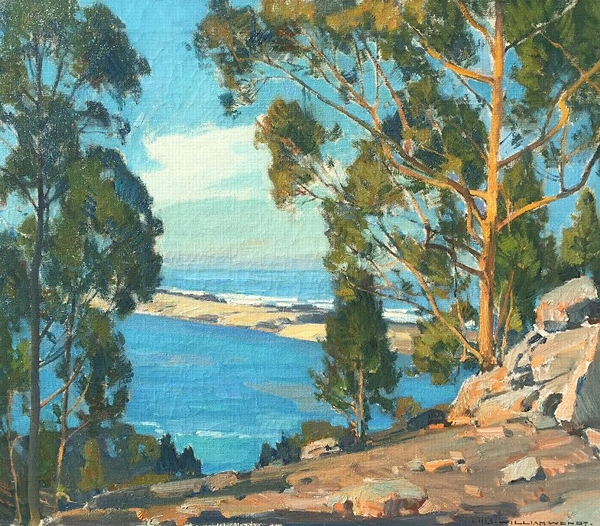
(above: William Wendt (1865-1946), The Bay, The Bar, The Sea, The Sea, 1925. Public domain, via Wikimedia Commons)
Resource Library articles honoring the American experience through its art
P-Z
also see: A-B California Car-CSU E-I L-O
 Go to Painted
Light: California Impressionist Paintings from the Gardena High School Los
Angeles Unified School District Collection, hosted by CSU Dominguez
Hills in 1999, featuring works by Franz A. Bischoff, Jessie Arms Botke (1883-1971),
Maurice Braun (1877-1941), Benjamin Chambers Brown, Alson Skinner Clark,
Leland S. Curtis, Maynard Dixon, Victor Clyde Forsythe, John (Jack) Frost,
Joe Duncan Gleason, Armin Carl Hansen, Sam Hyde Harris, Clarence Kaiser
Hinkle, Frank Tenney Johnson, Emil Jean Kosa, Jr., Jean Mannheim, Peter
Nielsen, Edgar Alwin Payne, Hanson Duvall Puthuff, John Hubbard Rich, Carl
Clemens Moritz Rungius, Walter Elmer Schofield, Clyde Eugene Scott, Jack
Wilkinson Smith, James Guifford Swinnerton, Marion Kavanagh Wachtel, William
Wendt (1865-1946) and Orrin Augustine White.
Go to Painted
Light: California Impressionist Paintings from the Gardena High School Los
Angeles Unified School District Collection, hosted by CSU Dominguez
Hills in 1999, featuring works by Franz A. Bischoff, Jessie Arms Botke (1883-1971),
Maurice Braun (1877-1941), Benjamin Chambers Brown, Alson Skinner Clark,
Leland S. Curtis, Maynard Dixon, Victor Clyde Forsythe, John (Jack) Frost,
Joe Duncan Gleason, Armin Carl Hansen, Sam Hyde Harris, Clarence Kaiser
Hinkle, Frank Tenney Johnson, Emil Jean Kosa, Jr., Jean Mannheim, Peter
Nielsen, Edgar Alwin Payne, Hanson Duvall Puthuff, John Hubbard Rich, Carl
Clemens Moritz Rungius, Walter Elmer Schofield, Clyde Eugene Scott, Jack
Wilkinson Smith, James Guifford Swinnerton, Marion Kavanagh Wachtel, William
Wendt (1865-1946) and Orrin Augustine White.
Go to Painted
Light: California Impressionist Paintings: The Gardena High School/Los Angeles
Unified School District Collection which toured to The Irvine Museum
in 1999.
Go to Painting
Partners, a 1998 exhibit at The Irvine Museum, displaying an interesting
selection of California paintings that examines the close relationships
that exist among artists. These relationships may be direct, as in husband
and wife teams such as Edgar Payne (1883-1947) and Elsie Palmer Payne (1884-1971),
Elmer Wachtel (1864-1929) and Marion Kavanagh Wachtel (1876-1954), or Edouard
Vysekal (1890-1939) and Luvena Buchanan Vysekal (1873-1954). Other relationships
reflect parent and child, such as Elanor Colburn(1866-1939) and her daughter
Ruth Peabody (1898-1966). The greatest relationships, however, are those
between close friends. Among the many pairings of painting partners are
Hanson Puthuff (1875-1972) and Sam Hyde Harris (1889-1977), who were lifelong
friends and frequently accompanied each other on painting trips. Likewise,
the bond between Guy Rose (1867-1925) and John Frost (1890-1937) has often
been compared to that of uncle and nephew.
Go to Painting
World War II: The California Style Watercolor Artists on display
in 2010 at The Oceanside Museum of Art, an historic first examination of
paintings by California Style watercolor artists on the subject of WWII.
Over 60 paintings depicting scenes of California mobilizing for the war
as well as images of the war overseas will be on view. Featured artists
include Arthur Beaumont, Rex Brandt, Hardie Gramatky, Dong Kingman, Barse
Miller, Phil Paradise, Charles Payzant, Ed Reep, Millard Sheets, and Milford
Zornes.
Go to Peaceful
Awakening: Spring in California, an Irvine Museum 2007 exhibition,
adorning the walls of the galleries with gentle rolling hills, secluded
meadows and valleys covered with brilliant wildflowers as far as the eye
can see.
Go to Pop!
From San Francisco Collections, a 2004 exhibit at the San Francisco
Museum of Modern Art. Drawn from local private and museum collections, as
well as SFMOMA's own, Pop! features some one hundred paintings, sculptures
and works on paper. Included are pieces by such luminary New York artists
as Andy Warhol, Claes Oldenburg, and Roy Lichtenstein alongside works by
California artists Ed Ruscha, Wayne Thiebaud, and Robert Arneson, among
others, underscoring the role of the West Coast in this pivotal movement
and demonstrating the wealth of quintessential Pop art holdings in the Bay
Area,
Go to Preserving
California's Gold. a1999 article by Sarah Bessera. In 1986, the Oak
Group was born out of conversations between veteran landscape painter
and muralist Ray Strong of Santa Barbara and landscape painter Arturo Tello.
In the more than 12 years since its founding, these 30 Santa Barbara area
painters have become eloquent and dedicated political activists in defense
of endangered lands. They have become the role models for other painting
groups who want to protect open spaces in other regions of the State.
Go to Representing
LA, Pictorial Currents in Contemporary Southern California Art, featured at the Frye Museum in 2000, the first group exhibition
to explore the rich and varied representational painting, drawing, printmaking,
and sculpture produced by Southern California artists from 1990 to 2000,
filling a gap in West Coast and Southern California art history by surveying
and interpreting about 80 works by 70 artists working in representational
or realist styles and approaches.
Go to Romance
of the Bells: The California Missions in Art, a 2004 travelling
exhibition organized by The Irvine Museum. When people think of California,
the visual image that often comes up is that of a gentle land, with rolling
hills of oak trees and wildflowers, dotted with buildings of weathered adobe
walls and red-tiled roofs. These and other idyllic images of old California
are rooted in the romantic period of California's past that is associated
with the missions. Twenty-one California missions and a number of branch
missions (asistencias) were founded between 1769 and 1823, yet that
brief period of barely 54 years had a lasting effect on the artistic and
social fabric of our Golden State.
Go to Scene in Oakland, 1852-2002: Artworks Celebrating the City's 150th
Anniversary, on view in
2002 at the Oakland Museum of California, an exhibition of paintings, drawings,
watercolors and photographs dating from 1852 to 2002, featuring views of
Oakland by 48 prominent California artists. The scenes depicted include
a wide variety of the city's landmarks, districts, architecture and activities
Go to Sierra
Grandeur is on exhibit in 2001 at the Wildling Art Museum. It presents
a selection of oil paintings from the Schaeffer Foundation Collection, comprises
paintings of the Sierra Nevada by California artists active between 1880
and 1950, and includes paintings by Orrin White, Edgar Payne Carl Henrik
Jonnevold, Paul Lauritz, Jones Messiman, and Leland Curtis.
Go to The
Sixteenth National Biennial Exhibition of the Los Angeles Printmaking Society,
a 2001 exhibit at the Laband Art Gallery, Loyola Marymount University. Since
its inception in the early 1970s, the National Biennial Exhibition of
the Los Angeles Printmaking Society has been the only regular survey
of the evolving field of printmaking presented in California.
Go to Society
of Six: American Masters of Color, a 2003 Wiegand Gallery show of
Society of Six paintings with works from numerous private collections and
the Oakland Museum of California. They were once deemed
"too rough and audacious for the refined Bay Area art establishment."
Now the works of 'The Six' are regarded as the most advanced painting of
the early 20th century in Northern California. The
Society of Six -- Selden Conner Gile, August F. Gay, Maurice Logan, Louis
Siegriest, Bernard von Eichman and William H. Clapp -- were plein air painters
who worked closely together in Northern California from about 1915 to 1930,
and who came to be celebrated for their fresh and direct approach.
Go to Spacious
Skies: California Impressionist Cloud Studies and Seascapes, a 1998
exhibit at The Irvine Museum. Along with paintings of cloud-filled
skies, the museum will portray the natural cycle of California's water.
We will follow water from the rains of winter to the snow pack of the Sierra
Nevada Mountains, the streams and rivers that drain into valleys, and the
lakes and beaches that are the ultimate destination of the water, before
it returns to the sky as evaporation.
Go to Spring
in California, a 2003 Irvine Museum exhibit of landscape and flower
paintings. The familiar nostalgic ideal of California as an unsullied Eden
is evident in numerous paintings executed nearly a century ago. Bygone vistas
of gentle rolling hills, covered with brilliant wildflowers as far as the
eye could see, adorn the walls of the museum. Many of these works were painted
in meadows and plateaus deep in the hills but a surprising number of them
are located in or near what are now bustling cities.
Go to Surf
Culture: The Art History of Surfing, a 2003 exhibit at the San Jose
Museum of Art surveying the connection between the visual arts and surfing.
It has been featured in The New York Times as well as numerous other
national publications throughout its tour with stops in Hawaii and Virginia
Beach, VA.
Go to This
Side of Eden: Images of Steinbeck's California, a 1998 exhibit at
the Laguna Art Museum, which covers a tumultuous period in California's
and the country's history, two world wars and the Great Depression, and
features over fifty works of art from forty different artists reflecting
California in the 1920's, 30's and 40's. Many of the works in the exhibition
reflect Steinbeck's literature and influence.
The exhibition represents an intrinsic view of an inspiring and trying time that generated both art and literature of great historic and artistic value. Works include rural scenes in the Salinas Valley and early Monterey as well as local customs and life during those years. Several important watercolors by Millard Sheets discovered in 1988 showing the lives of 1930's migrant fieldworkers are part of the exhibit Other artists include Leon Amyx, Bruce Ariss, Albert Barrows, Jane Berlandina,·Peggy Worthington Best, Lee Blair, Lester Boronda, Burton Boundey, Frances Brooks, Lois Green Cohen, Sam Colburn, George Corbit, James Peter·Cost, George DeMaine, Albert Thomas DeRome, Marguerite Dorgeloh, James Fitzgerald, Oscar Gaigiani, Frank J. Gavencky, August Gay, Jay Hannah, Armin Hansen, Doug Kingman, Emil Kosa Jr., Art Landy, Jeannette Maxfield Lewis, Xavier Martinez, Frank Harmon Myers, Smith O'Brien, Gottardo Piazzoni, Julius Pommer, Granville Redmond, Henrietta Shore, Ray Strong, Herman Struck, Alexander Warshawsky and Willaim Harvey Wiliiamson. (left: Art Landy, Field Workers (untitled), c. 1935)
Go to Treasures
of the Sierra Nevada, a 1998 exhibit at the Natural History Museum
of Los Angeles County. It feature 45 on location paintings by historic and
contemporary artists of the California Art Club. Historic paintings are
on loan by Joan Irvine Smith Fine Arts, Inc. The following California Art
Club artists are featured: Meredith Brooks Abbott, Peter Adams, Ken Auster,
Paula V. Bacinski, Suzanne Baker, Lisa Bloomingdale Bell, John Bohnenberger,
John Budicin, Carole Cooke, Richard Coons, Michael Dancer, David Damm, Karl
Dempwolf, Dennis Doheny, Don Durborow, Esther Engelman, Ted Goerschner,
Donald Hildreth, Tom Hoon, Rick Humphrey, David Jonas, S. Burkett Kaiser,
Jean LeGassick, Kevin Macpherson, Stephen Mirich, Ralph Oberg, Daniel Pinkham,
Ray Roberts, Amy Sidrane, Marilyn Simandle, Tim Solliday, Alexey Steele,
Leonid Steele, George Strickland, and Sarah Vedder.
Go to Un/Familiar
Territory, a 2003 exhibition of work by ten artists that addresses
the interface of cultural place and personal identity at the San Jose Museum
of Art. Co-curated by Senior Curator JoAnne Northrup and Director of Education
Val DeLang, the exhibition includes a wide range of viewpoints and media
by the following artists: Ruth Boerefijn, Enrique Chagoya, Albert Chong,
Allan deSouza, Cia Foreman, Arnold J. Kemp, Bari Kumar, Dinh Q. Lê,
Juan Carlos Quintana, and Consuelo Jiménez Underwood.
Go to USC
Collects California on display in 2000 at the USC Fisher Gallery,
spanning a hundred years and reflecting a wide range of media and styles
The exhibition is articulated around three main groupings: "Representing
California," "Making Art in California" and Maynard Dixon's
"Jinks Room" murals. It ranges from the landscapes of Charles
L. A. Smith, Aaron Edward Kilpatrick (1872-1953), Emil Jean Kosa, Jr. and
Frances Hammell Gearhart (1869-1958), to Julius Shulman's photographs of
urban Los Angeles and Reverend Ethan Acres' exuberant "Miracle at La
Brea."
Go to The
Vanishing Landscape, a 2002 exhibit at The Irvine Museum which comprises
a selection of paintings by leading California Impressionists that show
various familiar parts of California as they appeared prior to development.
It is a unique look at our communities in vistas that no longer exist, truly
a show of vanishing landscapes.
Go to Views
and Visions: Celebrating California, a 2006 exhibit at the Reynolds
Gallery. It is a celebration of California's beauty through a special invitational
show featuring some of the region's finest landscape painters. The exhibit
features the oil paintings of well-known Santa Barbara artist Meredith Brooks
Abbott and her daughter, Whitney Abbott. Other participating artists associated
with the Westmont Art Council and Art Department are Sandy Leue Rogers,
wife of Westmont Physics Professor Warren Rogers, Barry Berkus, Patricia
Chidlaw, Tom Cummings, Jim Dow, Priscilla Fossek, Karen Gruszka, Jeremy
Harper, Ruth Ellen Hoag, David Holt, Joan Landis, Wayne McCall, Leonardo
Nunez, Karin Shelton, Erling Sjovold, Garrett Speirs, Cory Steffen, Nicole
Strasburg, Arturo Tello, Karin Young.
Go to Well
of Gold and Other Paintings of Summer in California, a 2003 exhibit
at The Irvine Museum which portrays California as experienced by our Plein-Air,
or outdoors, artists of the past century. The name of this exhibition is
also the title of a painting by Phil Dike (1906-1990) from 1928. Painted
in broad strokes of thick oil paint, it shows a small family farm and the
hard working people who struggle to make their future in this land of great
potential. Another painting of bygone California is Rain After the Frost,
1937, by Dike's friend and painting companion Rex Brandt (1914-2000). Set
on a railroad crossing, Brandt painted the feeling of the cold, windy and
dreary day with the sentimentality of a simpler time and place.
William
Alexander Griffith (1866-1940): Plein Air Painter, a 1999 exhibit
at the Oceanside Museum of Art. Griffith came in 1918 to San
Diego for what was to be only a sabbatical year. He became so enamored of
the painting possibilities of this beautiful state that he left his twenty-one
year position as head of the Art Department at the University of Kansas
and brought his wife and five children to California in order to become
a full-time painter. He settled in Laguna Beach and became a charter member
of the Laguna Beach Art Association along with fellow painters and neighbors,
Edgar and Elsie Payne, William Wendt, Anna Althea Hills and Frank Cuprien.
The historical importance of these painters has inspired many exhibitions
throughout the country.
Go to Winds
of Change: Progressive Artists, 1915-1935, a 2004 exhibit at The
Irvine Museum. When compared to the plein-air style, the work of Modernist
artists tends to favor overall flatter surface designs instead of portraying
realistic three-dimensional effects of natural depth. The forms they create
usually follow rhythmic lines that echo or complement each other. Moreover,
they tend to intensify colors in larger, simpler brushstrokes and simplify
forms such as houses, hills, and trees by using stylized sets of patterns.
Among the artists represented are Frank Myers (1899-1956),
Elanor Colburn (1899-1939), Emil Kosa, Jr. (1903-1968), Francis Todhunter
(1884-1963), Phil Paradise (1905-1997) and Mischa Askenazy (1881-1961).
Go to A
Woman's Touch: Selected Women Artists in California, a 2004 exhibit
at The Irvine Museum. Far from being limited to a dilettante role, women
artists in California were important figures in the early part of the twentieth
century and excelled in landscape painting, as well as portrait, figural,
and still-life. Moreover, they set the standard in such diverse media as
oil painting, watercolor, and sculpture. Not all California painters were
inspired by the French Impressionists. Starting in about 1914, a group of
progressive artists, usually women, began to show works of strong modernist
principles. Among these were Mabel Alvarez (1891-1985), Elanor Colburn (1866-1939),
Meta Cressey (1882-1964), Helen Forbes (1891-1945), Donna Schuster (1883-1953)
and Elsie Palmer Payne (1884-1971). Their bold use of color and line is
in stark contrast to the realistic appearance of the Plein-Air paintings
usually associated with this period.
Go to Yosemite:
Art of an American Icon, a 2007 exhibit at the Autry National Center
- Museum of the American West. From an ideal of wilderness to the complex
and often congested experience of the park today, this exhibition explores
Yosemite's changing visual identity and cultural role as a national destination.
By giving us a broader look at Yosemite as a complex, multifaceted landscape
rich in aesthetic and human diversity, it aims to reveal this course and
more.
Go to Yosemite:
Art of an American Icon, a 2008 exhibit at the Nevada Museum of
Art. The power of art-to shape the way we see, use and protect Western lands-is
the focus of this exhibit. From romantic depictions of wilderness to images
of the complex and often congested experience of the park today, it explores
Yosemite's changing visual identity and cultural role as a national destination.
Yosemite spans three centuries and includes works by Albert Bierstadt,
Ansel Adams, Eadweard Muybridge, Chiura Obata and Anne Brigman.
Go to You
See: The Early Years of the UC Davis Art Faculty, a 2008 exhibition
at the Hearst Art Gallery at Saint Mary's College, the largest public exhibition
ever of work by University of California, Davis faculty members Robert Arneson,
Roy De Forest, Manuel Neri, Wayne Thiebaud and William T. Wiley. The exhibition
includes 36 works from the Nelson's permanent collection. "The Palace
at 9 a.m.," Arneson's enormous ceramic ode to his '50s-era Davis tract
home, anchors the show, together with three Thiebaud masterworks and three
of Neri's most admired figurative sculptures. "Crash," Arneson's
bronze homage to Jackson Pollock, is also included, together with rarely
seen paintings, drawings and prints by De Forest and Wiley. The five Davis
artists are sometimes identified with "California funk," characterized
by bawdy irreverence, iconoclasm and self-deprecating humor.
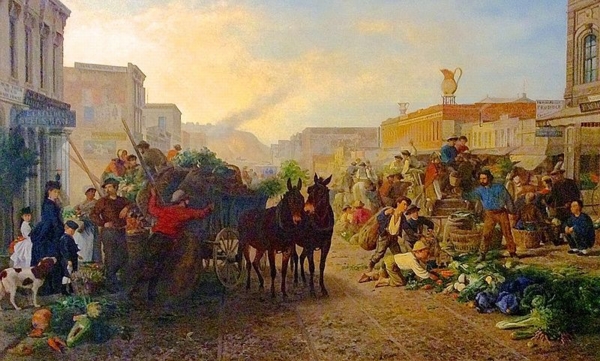
(above: William Hahn, Market Scene, Sansome Street, San Francisco, oil on canvas, 60 x 96? inches, Crocker Art Museum. Public domain, via Wikimedia Commons*)
Articles contained in Resource Library without named authors listed by article name in alphabetical order:A-B Cal Car-CSU E-I L-O P-Z
Also see: Pacific Coast Painting: Alaska, California, Hawaii, Oregon, Washington: 19th-21st Century
Resource Library articles and essays devoted to individual artists and institutions may not be listed in California Art History.
TFAO's Distinguished Artists catalogue provides online access to biographical information for artists associated with California. Also, Search Resource Library for online articles and essays concerning both individual artists associated with this state's history and the history of art centers and museums in California.

(above: Albertus Del Orient Browere, The Lone Prospector, 1853, oil on canvas, Oakland Museum of California. Public domain, via Wikimedia Commons*)
 Return to California Art History
Return to Individual States Art History Project
Links to sources of information outside of our web site are provided only as referrals for your further consideration. Please use due diligence in judging the quality of information contained in these and all other web sites. Information from linked sources may be inaccurate or out of date. TFAO neither recommends or endorses these referenced organizations. Although TFAO includes links to other web sites, it takes no responsibility for the content or information contained on those other sites, nor exerts any editorial or other control over them. For more information on evaluating web pages see TFAO's General Resources section in Online Resources for Collectors and Students of Art History.
*Tag for expired US copyright of object image:

Copyright 2022 Traditional Fine Arts Organization, Inc., an Arizona nonprofit corporation. All rights reserved.