
California Art History
with an emphasis on representational art

(above: Thomas Hill, Palo Alto Spring, 1879, oil on canvas, 86 5/8 x 138 3/8 in., Cantor Art Center. Public domain, via Wikimedia Commons)
Resource Library articles honoring the American experience through its art
Cal
also see: A-B Car-CSU E-I L-O P-Z
 Go to The
California Art Club, established
in 1909, the Western United States' largest professional art organization.
Starting in 1913, and continuing for many years, the club held annual exhibitions
in the Los Angeles Museum of History, Science and Art in Exposition Park,
which evolved into the Natural History Museum of Los
Angeles County, with the art component
moving to Wilshire Boulevard and named the Los Angeles
County Museum of Art. In the fall of
1927 the club moved into its first "permanent" clubhouse, the
elegant Hollyhock House designed inside and out by Frank Lloyd Wright. Exhibitions, lectures
and gala social functions were held at Hollyhock for fifteen years. In 1999,
the club opened the California Art Club Gallery in the Old Mill building
in San Marino, CA. The Old Mill was built in 1816 as a grist mill to Mission
San Gabriel and is believed to be the oldest commercial building in Southern
California. Also see California
Art Club 90th Annual Gold Medal Exhibition,
Old California, In
the Tradition: Paintings of San Diego County by the San Diego Chapter of
the California Art Club and California Art Club Forms First Regional Chapter in San Diego County.
Go to The
California Art Club, established
in 1909, the Western United States' largest professional art organization.
Starting in 1913, and continuing for many years, the club held annual exhibitions
in the Los Angeles Museum of History, Science and Art in Exposition Park,
which evolved into the Natural History Museum of Los
Angeles County, with the art component
moving to Wilshire Boulevard and named the Los Angeles
County Museum of Art. In the fall of
1927 the club moved into its first "permanent" clubhouse, the
elegant Hollyhock House designed inside and out by Frank Lloyd Wright. Exhibitions, lectures
and gala social functions were held at Hollyhock for fifteen years. In 1999,
the club opened the California Art Club Gallery in the Old Mill building
in San Marino, CA. The Old Mill was built in 1816 as a grist mill to Mission
San Gabriel and is believed to be the oldest commercial building in Southern
California. Also see California
Art Club 90th Annual Gold Medal Exhibition,
Old California, In
the Tradition: Paintings of San Diego County by the San Diego Chapter of
the California Art Club and California Art Club Forms First Regional Chapter in San Diego County.
Go to California
Dreamin': Contemporary Art from the Bank of America Collection, a 1999
exhibit at the Bank of America Gallery, located within Charlotte's Mint
Museum of Craft + Design. While many think of the Statue
of Liberty as symbolizing the American melting pot, it is in fact the state
of California which truly showcases the diversity in American culture. And
in no arena is this more emphatically 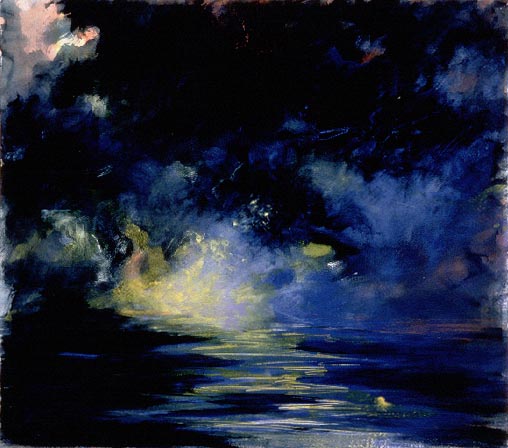 stated than in the visual arts. The artists working
in the state over the last thirty years represent the range of aesthetic
styles, ethnic backgrounds and approaches to subject matter found throughout
the country
stated than in the visual arts. The artists working
in the state over the last thirty years represent the range of aesthetic
styles, ethnic backgrounds and approaches to subject matter found throughout
the country
Go to California,
The Golden Years: Selections from the Bowers Permanent Collection,
a 2002 exhibit at the Bowers Museum of Cultural Art featuring landscapes
and figure paintings. Visitors will find familiar scenes of Laguna Beach
and Orange County, as well as views of southern and northern California,
painted by such noted artist as William Wendt and Joseph Kleitsch. Figure
paintings in the Impressionist style include Guy Rose's beautiful portrait
of Marguerite (c. 1900-1910) and Fannie Duvall's Confirmation
Class, San Juan Capistrano (1897), one of the earliest works included
in the exhibition.
 Go to California
Impressionists at Laguna , a 2000 exhibit
at the Florence Griswold Museum organized by Florence
Griswold Museum curator Jack Becker, consists of twenty-six paintings by
over a dozen California artists and selected works by members of the Lyme
Art Colony, providing opportunity to compare and contrast the styles and
subjects of the Lyme and Laguna Impressionists. The exhibition examines
how the colonies contributed to the very identity of their regions; in the
case of Laguna as a new Eden of perpetual sunshine, and for Lyme as a place
rooted in traditional New England values. (left: William Wendt (1865-1946),
South Coast Highway, Laguna Beach, 1918, oil on canvas, 12 x 16 inches,
Mr. and Mrs. Thomas B. Stiles II)
Go to California
Impressionists at Laguna , a 2000 exhibit
at the Florence Griswold Museum organized by Florence
Griswold Museum curator Jack Becker, consists of twenty-six paintings by
over a dozen California artists and selected works by members of the Lyme
Art Colony, providing opportunity to compare and contrast the styles and
subjects of the Lyme and Laguna Impressionists. The exhibition examines
how the colonies contributed to the very identity of their regions; in the
case of Laguna as a new Eden of perpetual sunshine, and for Lyme as a place
rooted in traditional New England values. (left: William Wendt (1865-1946),
South Coast Highway, Laguna Beach, 1918, oil on canvas, 12 x 16 inches,
Mr. and Mrs. Thomas B. Stiles II)
Go to California
Impressionists, a 1997 Crocker Art Museum exhibit originated by
the Georgia Museum of Art and the Irvine Museum. It brings together canvassed
by major artists who adopted the techniques of painting directly from nature
using short brush strokes from French Impressionism. They likewise sought
to capture ephemeral effects of light and atmosphere of California landscape
motifs. Works by artists working in both Northern and Southern California
are featured, allowing comparisons between their approaches. Of special
importance are the paintings created by William Merritt Chase and Childe
Hassam during their visits to the state in 1914. These compliment views
created by artists such as Bischoff, Rose and Wendt, who spent significant
portions of their life working on the West Coast.
Go to California
Impressions Featuring Landscapes from the Wendy Willrich Collection,
a 2006 exhibit at the de Young Museum. The exhibition shows 33, turn-of-the
century paintings and watercolors from the collection of Bay Area art patron
Wendy Willrich and selections from the permanent collection of the Fine
Arts Museums.
Go to California Landscape into Abstraction: Works from the Orange County
Museum of Art, on exhibit
in 2014 at the Orange County Museum of Art, includes fine examples of 19th
and early 20th century landscape painters such as Frank Cuprien, Elmer Wachtel,
and James Milford Zornes. By the 1940s, the stylistic tension between the
two schools seems to be fully in place with the Modernists -- including
Oskar Fischinger, Helen Lundeberg, Agnes Pelton, Frederick Wight, and Stanton
McDonald Wright -- approaching the landscape as a vehicle for expressionist,
surrealist, or hard-edge influences. 
Go to "California
Mission Hosting Art Exhibitions", an introduction to exhibits held
in the Spring of 2004 at Mission San Juan Capistrano.
Go to California
Paintings 1910-1940: Selections from Mills College Art Museum on
exhibit in 2000 at the Orange County Museum of Art, organized by Adjunct
Curator Ann Harlow from the collection of Mills College Art Museum in Oakland.
The exhibition includes many paintings that have been shown rarely, if at
all, in recent decades. Among them are canvases by many acclaimed California
Impressionists, including Maurice Braun (1877-1941), Anne Millay Bremer
(1868-1923), Clark Hobart (1868-1948), Jules Eugene Pages (1867-1946), Joseph
Raphael (1869-1950), Granville Redmond (1871-1935), Matteo Sandona (1881-1964)
and William Wendt (1865-1946). (left: Anne Bremer, Ravenlocks,
c. 1920, oil on canvas, 30 1/2 x 25 inches, Mills College Art Museum, Estate
of Albert M. Bender)
Go to California Pottery: From Missions to Modernism, a 2003 exhibition at the Autry Museum
of Western Heritage of the art of the everyday, presenting an unprecedented
survey of aesthetically inventive and historically significant commercially
produced tiles, tableware, gardenware and accessories that were made between
1900 and 1955 by more than forty-five of the hundreds of commercial potteries
that once flourished in California. The designs range from color-splashed
interpretations of traditional forms to radical innovations that changed
the way we live. Bill Stern, executive director of the Museum of California
Design, curated the exhibition, which was drawn from forty-four California
collections.
Go to California
Scene Paintings from 1930 to 1960, a 2013 exhibit at the Pasadena
Museum of California Art, curated by Gordon McClleland, featuring
close to 75 artworks, including oil paintings, watercolors, drawings, and
prints created in the decades when this was California's most celebrated
type of art. Some of the works in this exhibition were included in 1930s
and 1940s exhibitions of Regionalist, American Scene, and WPA art in major
museums across America. Works by key artists are featured in the exhibition,
including Phil Dike, Emil Kosa Jr., Phil Paradise, Millard Sheets, Paul
Sample, Ben Messick, Rex Brandt, and Dong Kingman.
Go to The
California State Capitol Museum in Sacramento, California which holds
an impressive collection of fine art. Visitors can see historic and modern-day
paintings and sculptures dated from the mid-1850s forward. The collection
includes portraits of thirty five governors as well as portraits of icons
of American history including George Washington and Abraham Lincoln. While
some scholars attribute the Lincoln portrait to Jane Stuart, daughter of
Gilbert Charles Stuart, others favor William Wynstanley, an English artist
known for his copies of Gilbert Stuart's Washington portraits.
Go to California
Style: 1930s and 1940s, a 1998 exhibit at the Ventura Museum of
History and Art featuring sixty watercolor paintings, depicting scenes from
the Depression and War years, by the most prominent artists of the time,
including Millard Sheets, Phil Dike, Rex Brandt and many others, the exhibit
provides a vivid portrait of Southern California during this dynamic period.
Go to California
Style: 1930s and 40s, a 1977 exhibit at the Orange County Museum
of Art with approximately sixty watercolor works by more than twenty California
artists, including Rex Brandt, Phil Dike, and Millard Sheets.
Go to California
Style: Art and Fashion of the California Historical Society
, a 2007 exhibit at the Autry National Center - Museum
of the American West in which visitors step back over 100 years to experience
California's remarkable Victorian-era opulence. Classic California and Western
American paintings are exhibited alongside sumptuous ball gowns and magnificent
19th century wedding dresses, offering an invaluable glimpse of life, land,
work, and fashion during this unique period.
Go to California's
Native Grandeur: Preserving Vanishing Landscapes, a 2004 exhibit
at The Irvine Museum in conjunction with The Nature Conservancy of California.
It employs historical landscape paintings to illustrate the natural beauty
of the seven ecological regions of California: the South Coast, the Central
Coast, the Desert, the Great Valley, the Sierra Nevada, the Shasta-Cascades,
and the North Coast. This unique exhibition is intended to raise public
awareness to the delicate balance under which California's wealth of diverse
plant and animal species exists.
Go to California
Paintings, 1910 - 1940 from the Mills College Art Museum, a 2000
exhibit at the Laband Art Gallery, which casts light on a period that saw
the simultaneous flowering of art in San Francisco, Los Angeles and San
Diego. It was in the years around the 1915 Panama-Pacific Expositions in
San Francisco and San Diego that California artists developed a style of
landscape painting that fused an academic "naturalist" philosophy
with the techniques of Impressionism, and that eventually led to other modes
of artistic expression and experimentation. At the same time public interest
in the visual arts was stimulated and a number of public and private arts
institutions were established in the new urban centers up and down the coast.
(left: Anne Bremer (1868-1923), Carmel, c. 1920, oil on canvas,
28 3/4 x 23 3/4 inches, Gift of Albert M.Bender, 1925.14)
Go to California:
The Art of Water, a 2016 exhibit at the Cantor Arts Center devoted
to artistic portrayals of California's most precious resource. Featuring
more than 50 works made by eminent artists and photographers including Albert
Bierstadt, David Hockney, William Keith, Richard Misrach and Carleton Watkins,
California: The Art of Water explores objects made over the last
two centuries that helped to shape ideas about water in California.
Go to California,
This Golden Land of Promise: The History of California Through Art,
a 2001 exhibition organized by The Irvine Museum that tells the fascinating
history of California through a selection of important and rare paintings.
Starting with the earliest entry of human beings in the Western Hemisphere,
some 20,000 years ago, to the Gold Rush of 1849, the story of California
is shown in historical paintings, engravings and photographs of artifacts.
Go to Canyons
and Deserts: Picturing the Western Landscape, which explores artists'
continuing fascination with the monumental grandeur of the American West.
From the local canyons of Laguna and the Arroyo Seco to the vast panoramas
of the Grand Canyon and painted desert, California artists have captured
the power, beauty, and mystery of the Western landscape. The 1999 exhibition,
on view at the Orange County Museum of Art South Coast Plaza Gallery, presents
a selection of paintings, prints, and photographs by prominent California
artists drawn primarily from the permanent collection. From the early twentieth-century
painters William Wendt, Carl Oscar Borg, Fernand Lungren, and Conrad Buff
to photographers Edward Weston, Philip Makanna, and Richard Misrach, each
artist's work records a personal approach to the unique qualities of the
West as subject.

(above: William Wendt, Lupine Patch, 1921, Bonhams. Public domain, via Wikimedia Commons*)
Articles contained in Resource Library without named authors listed by article name in alphabetical order:A-B Cal Car-CSU E-I L-O P-Z
Also see: Pacific Coast Painting: Alaska, California, Hawaii, Oregon, Washington: 19th-21st Century
Resource Library articles and essays devoted to individual artists and institutions may not be listed in California Art History.
TFAO's Distinguished Artists catalogue provides online access to biographical information for artists associated with California. Also, Search Resource Library for online articles and essays concerning both individual artists associated with this state's history and the history of art centers and museums in California.
 Return to California Art History
Return to Individual States Art History Project
Links to sources of information outside of our web site are provided only as referrals for your further consideration. Please use due diligence in judging the quality of information contained in these and all other web sites. Information from linked sources may be inaccurate or out of date. TFAO neither recommends or endorses these referenced organizations. Although TFAO includes links to other web sites, it takes no responsibility for the content or information contained on those other sites, nor exerts any editorial or other control over them. For more information on evaluating web pages see TFAO's General Resources section in Online Resources for Collectors and Students of Art History.
*Tag for expired US copyright of object image:

Copyright 2022 Traditional Fine Arts Organization, Inc., an Arizona nonprofit corporation. All rights reserved.