
Iowa's Early Art History
by Grok 3.0
The history of art in Iowa up to 1945, is like uncovering a quiet, steady river carving its way through the heartland -- nothing flashy like the glittering salons of Paris or the bohemian buzz of New York, but something deeply rooted, shaped by the land itself and the people who tilled it. Iowa, with its endless cornfields, rolling prairies, and those sturdy river valleys snaking through the state, has always been a place where art mirrored life: practical, resilient, and tied to the rhythms of the seasons. We're talking about a story that starts with the raw marks of ancient hands on rock faces and evolves into the bold, earthy canvases of the Regionalists, all without veering into those non-representational swirls that would come later. Let's wander through this together, like a road trip across the state, stopping at the key moments and faces that made Iowa's artistic soul so distinct.
Statehood in 1846 brought a flood of immigrants -- German, Scandinavian, Irish -- each hauling not just plows and hopes but sketchbooks and paints. Early artists were often itinerant, capturing the virgin prairie in watercolors and oils that romanticized the untouched wilderness. Think of Seth Eastman, a military artist who passed through in the 1840s, painting forts and Native villages with a Hudson River School eye for dramatic light on the bluffs. But the real heartbeat came from locals like John James Audubon, who, while not Iowan-born, tramped through the state's wetlands in the 1840s, adding Iowa birds to his famous folios -- those vivid, feathered portraits that celebrated the wild abundance before the plow turned it under. Iowa's geography shone here: the Des Moines and Mississippi rivers became muse and medium, with artists like these using portable kits to document steamboats churning upstream or buffalo herds thundering across the plains. It was different from, say, the rugged mountainscapes of Colorado or the coastal dramas of California; Iowa art in this era was about vast openness, a kind of optimistic emptiness waiting to be filled, free from the industrial grit of Eastern cities.
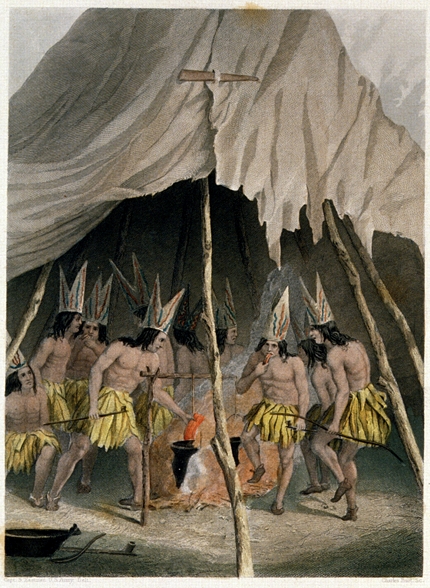
(above: Seth Eastman, Dance to the Giant, c. 1850, engraving, 12 1/2 x 9 5/16 inches, Denver Art Museum, Museum Purchase, 1966.105)
By the mid-19th century, as farms sprouted and towns like Dubuque and Iowa City took root, art shifted toward portraiture and still lifes -- practical reflections of prosperity. Local painters set up studios in Cedar Rapids or Des Moines, churning out likenesses of stern farmers and their families, often in the folk art tradition. These were self-taught folks, like the itinerant limners who traveled county fairs, rendering faces with flat colors and symbolic props: a Bible for piety, a cornucopia for the harvest. What set Iowa apart was the subject matter -- cornstalks and quilt patterns sneaking into compositions, symbols of the agrarian life that bound communities.
Events like the Civil War interrupted this, of course; Iowa sent thousands of troops, and art turned somber, with soldiers' sketches from battlefields near Vicksburg capturing the mud and camaraderie of Midwestern regiments. But post-war, the 1870s brought a boom: the railroad snaked through the state, linking isolated farms to markets, and with it came art academies. The Iowa State Agricultural College (now Iowa State University) in Ames started offering drawing classes in 1871, emphasizing realistic rendering for engineers and architects. It was utilitarian art, born of the land-grant ethos -- drawing the lay of the fields, not dreaming of distant castles.
Enter the 1880s and 1890s, and you see the stirrings of something more professional. The state's first art association, the Iowa Art Club, formed in Des Moines in 1893, hosting exhibitions that drew from Chicago's World's Columbian Exposition spillover. Influences trickled in via the railroads: Impressionism's light play tempted some, but Iowa artists adapted it sparingly, softening the harsh prairie glare rather than chasing Parisian gardens. Figures like Ada Ross, a Des Moines painter active in the 1890s, blended Tonalism's moody landscapes with local flavor: her canvases of Iowa's foggy mornings over the Raccoon River evoke Whistler but ground it in the scent of turned soil. Geography mattered hugely; the Loess Hills in western Iowa, those wind-sculpted dunes, inspired undulating lines in sketches that mimicked the waves of the ocean but smelled of clay. Events like the 1893 Panic squeezed budgets, pushing artists toward illustration for farm journals -- depicting bountiful harvests to sell seed catalogs. This commercial bent differentiated Iowa from artistic hotbeds like Massachusetts, where patrons funded grand histories; here, art fed the family farm, literal and figurative.
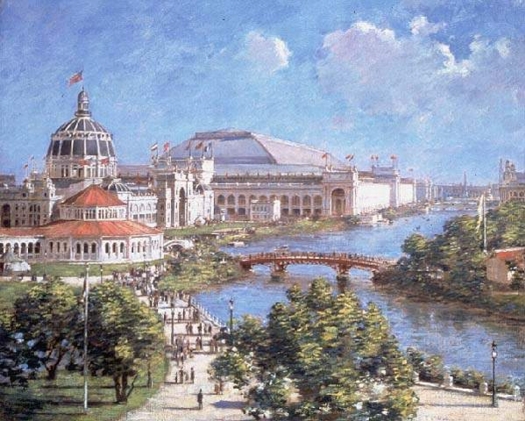
(above: Theodore Robinson, World's Columbian Exposition, c. 1894, oil on canvas, 25 x 30 inches, Crystal Bridges Museum of American Art, 2010.73. Public domain, via Wikimedia Commons*)
As the clock ticked toward the 20th century, Iowa's art found its stride in Realism, fueled by the state's role as America's breadbasket. The 1900s saw the rise of the Stone City Art Colony, a pivotal happening we'll circle back to, but first, the broader evolution. Styles leaned figurative, with a nod to the Ashcan School's grit, but Iowa's version was cleaner, more hopeful -- capturing small-town parades or one-room schoolhouses rather than urban slums. The Davenport Municipal Art Gallery, founded in 1926, became a hub, showcasing works that celebrated the Mississippi's steamboat era fading into memory. Subject matter zeroed in on the rural idyll: windmills creaking against blue skies, silos like sentinels in the flatlands. What made it special was the isolation; without New York's galleries pulling talent east, Iowa nurtured homegrown voices, influenced by correspondence courses from the Art Institute of Chicago but flavored by potlucks and county fairs. The Great War in 1917 scattered some artists overseas, where they sketched trenches, but returning doughboys brought back a renewed appreciation for the heartland's peace -- think quiet pastures over barbed wire.
Now, let's talk about the 1930s, because that's when Iowa's art really bursts into color, thanks to the twin engines of economic despair and federal largesse. The Dust Bowl's edges brushed Iowa's fields, turning golden corn to gray grit, and the Great Depression hit hard -- farm foreclosures, breadlines in Sioux City. But out of this grew the Regionalism movement, a defiant "art of the people" that put Iowa on the map. Unlike the cosmopolitan modernism brewing in Europe or the social realism of New York's Diego Rivera murals, Iowa Regionalism was unapologetically local: it glorified the farmer's toil, the quilt-maker's stitch, the blacksmith's forge.
The Works Progress Administration (WPA) poured in, funding murals in post offices from Mason City to Keokuk -- vibrant scenes of pioneers threshing wheat or families gathered at harvest suppers. These weren't abstract; they were storytelling in paint, with figures straight from Grant Wood's studio models. The style evolved from 19th-century realism but added a folkloric warmth, using bold outlines and saturated colors to make the everyday epic. Iowa's flat terrain lent itself perfectly -- no dramatic peaks to compete with, just endless sky framing human endeavor. Events like the 1933 Stone City Art Colony, spearheaded by Adrian Dornbush and Edward Buk Ulreich, gathered dozens of artists in a riverside camp near Anamosa, sketching the limestone quarries and sketching collaborative visions. It was a fleeting utopia, lasting just two summers, but it birthed networks that rippled statewide, differentiating Iowa as a cradle of communal creativity amid national strife.
Grant Wood is the colossus of this era, the artist who put Iowa's pitchfork in the pantheon of of American icons. Born in 1891 near Anamosa, Wood grew up steeped in the Gothic arches of rural churches and the straight lines of barbed-wire fences. Trained in Chicago and Europe, he rejected the avant-garde frippery, returning home in 1928 to champion "American Gothic" realism. His 1930 masterpiece, American Gothic, with its stern farmer and daughter framed by that Carpenter Gothic window, isn't just a painting -- it's a manifesto. Why is Wood so crucial? He captured Iowa's essence: the stoic pride in simplicity, the tension between Puritan restraint and fertile abundance. Unlike Thomas Hart Benton's sinuous Missouri river bends, Wood's lines are angular, mirroring the grid of plowed fields. His work evolved the style from mere documentation to symbolic narrative -- Daughters of Revolution (1932) skewers small-town pretensions with teacups and Washington portraits.
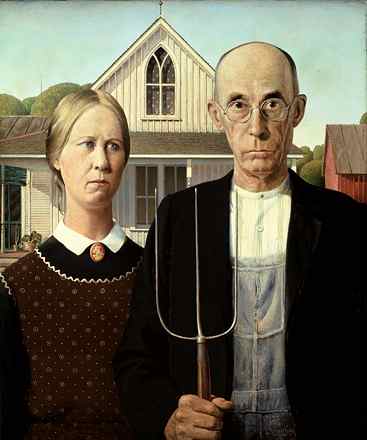
(above: Grant Wood, American Gothic, 1930, oil on beaverboard, 29 1/4 x 24 5/8 inches. Friends of American Art Collection. All rights reserved by The Art Institute of Chicago and VAGA, New York, NY, 1930.934, sourced fom our article Grant Wood At 5 Turner Alley)
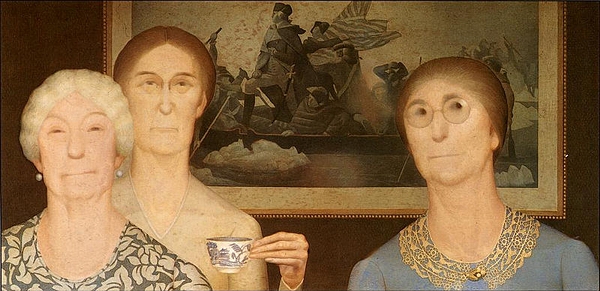
(above: Grant Wood, Daughters of Revolution, c. 1932, oil on masonite, 20 x 39 15/16 inches, Cincinnati Art Museum, The Edwin and Virginia Irwin Memorial, 1959.46. Public domain via Wikimedia Commons*)
No conversation about Iowa art pre-1945 skips the other titans of Regionalism. Thomas Hart Benton, though Missouri-born, had deep Iowa ties -- his serpentine figures and jazz-inflected energy appear in WPA commissions like the Iowa State Capitol's historical panels, completed in 1936. Then there's Wood's contemporaries, like Marvin Cone, his lifelong friend and fellow Cedar Rapids native. Cone's paintings soften Wood's severity with luminous greens and harvest golds, capturing the optimistic side of rural life. Cone embodied the evolution from Impressionist light to Regionalist solidity, teaching at Coe College and exhibiting nationally, proving Iowa could produce subtlety amid the bold strokes. His death in 1957 came later, but through 1945, he was a quiet force, his works in the Figge Art Museum today testament to Iowa's nuanced palette.
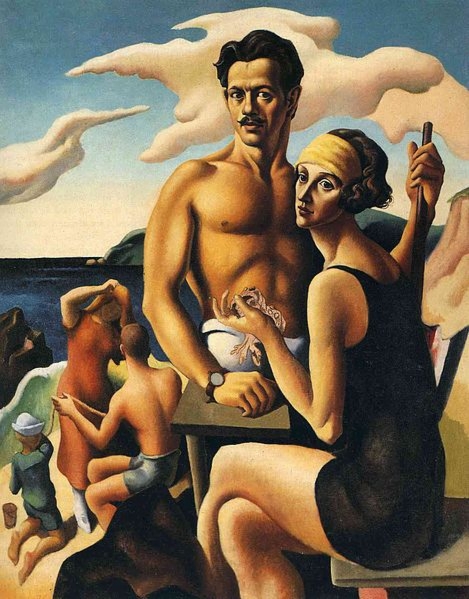
(above: Thomas Hart Benton, Self-Portrait with Rita, 1922, oil on canvas, National Portrait Gallery, Washington. Public domain, via Wikimedia Commons*)
Let's not overlook the sculptors and illustrators who rounded out this era. Christian Petersen, a Danish immigrant settling in Iowa City in 1934, brought European training to stone and bronze, creating WPA reliefs like for the University of Iowa Library -- figures of farmers and scholars intertwined, symbolizing the state's intellectual-agricultural blend. He expanded Iowa art beyond canvas, using local limestone to carve the human form in repose, evolving from classical anatomy to folksy narrative. Meanwhile, illustrators like John Steuart Curry, another Regionalist pillar with Iowa connections through exhibitions, penned covers for Collier's magazine depicting cyclone-chased prairies -- dramatic yet rooted, influencing how the nation saw the heartland during FDR's New Deal.
What ties this all together is Iowa's unique alchemy: a
geography of boundless flats fostering introspective realism, events like
the Depression birthing communal colonies, and subjects celebrating the
unsung -- quilters, threshers, town gossips. Wood's importance stems from
myth-making, turning stereotypes into symbols; Benton's from injecting vitality;
Cone's from poetic balance; Petersen's from tactile storytelling. Through
1945, Iowa art evolved from petroglyph whispers to mural roars, always distinct
-- humble, hearty, horizon-bound. It's a story that invites you to pull
over on a country road, sketch the silo, and feel the land's quiet genius.
If you're ever driving I-80, pause at a roadside stand; that's Iowa art,
alive and well.
We lightly edited this article, added images and provided
links to other materials to enhance it. AI is rapidly improving
in accuracy, yet the article may have inaccurate information.
 Return to Iowa Art History
*Tag for expired US copyright of object image:

Links to sources of information outside of our web site are provided only as referrals for your further consideration. Please use due diligence in judging the quality of information contained in these and all other web sites. Information from linked sources may be inaccurate or out of date. TFAO neither recommends or endorses these referenced organizations. Although TFAO includes links to other web sites, it takes no responsibility for the content or information contained on those other sites, nor exerts any editorial or other control over them. For more information on evaluating web pages see TFAO's General Resources section in Online Resources for Collectors and Students of Art History.
Copyright 2025 Traditional Fine Arts Organization, Inc. an Arizona nonprofit corporation. All rights reserved.