
The Soil and the Soul: A History of Art in Iowa (1830-1945)
by Gemini 2.5 Pro
To really understand the history of art in Iowa, you have to start with the dirt. It sounds cliché, but in Iowa, the land isn't just a setting; it's the main character. For nearly a century, from the early explorers of the 1830s to the end of World War II, artists struggled with how to look at this place. It wasn't the dramatic verticality of the Rockies or the enclosed, intimate forests of the East. It was a landscape of horizon lines, rolling swells, and a light so sharp it could cut glass. The story of representational art in Iowa is really the story of artists learning to stop looking at the prairie through European eyes and starting to see it for what it actually was.
In the very beginning, long before the famous Regionalists showed up, the artists were essentially explorers. In the 1830s and 40s, men like George Catlin and Karl Bodmer traveled up the Missouri River, which forms Iowa's western edge. They weren't there to make "art" for galleries; they were there to document a world that was rapidly changing. What's fascinating is how even these keen observers struggled with Iowa's unique geology. The Loess Hills in western Iowa have these strange, terrace-like formations called "catsteps" -- little shelves caused by the slipping of the windblown soil. If you look at the sketches by Bodmer or Audubon from that time, you rarely see them. It wasn't until later geologists and artists really sat with the landscape that these unique, stair-step features started appearing in the visual record. It was as if the landscape was so alien to their Romantic training that they literally couldn't draw what was right in front of them.
As Iowa transitioned from a frontier to a settled state in the late 19th century, the "wild" aspect disappeared, replaced by a desire for civilization and refinement. This brings us to Charles Atherton Cumming, a name that dominated Iowa art for decades. Cumming founded the art department at the University of Iowa and was, by all accounts, a rigid traditionalist He taught his students to paint like the French Academics -- precise anatomy, and high-minded themes. He famously hated Modernism, writing a pamphlet with the shocking title Democracy and the White Man's Art, in which he argued that modernism was a degradation of civilized culture. For Cumming, art was something you imported to the Midwest to fix its roughness, not something that grew out of the cornfields. But despite his conservatism, he gave his students -- including a young Grant Wood -- incredible technical skills. He taught them discipline, which turned out to be exactly what they needed to eventually rebel against him.
The real shift happened in the 1920s, a decade often called "The Regionalist Epiphany." Two high school friends from Cedar Rapids, Grant Wood and Marvin Cone, went to Europe to become "real" artists. They spent a summer in Paris painting picturesque scenes-misty bridges, old churches, soft light. They were trying to be Impressionists. But when they brought those paintings back to Iowa, something felt wrong. Impressionism was invented in the Seine Valley, where the air is moist and the light is diffused. Iowa is different. The air here is often dry, the shadows are hard, and the light is relentless. Their fuzzy, soft-focus paintings looked like lies against the backdrop of the sharp prairie horizon.
Grant Wood was the first to crack the code. During a trip to Munich in 1928, he saw the paintings of the Northern Renaissance masters like Hans Memling and Albrecht Dürer. These weren't soft paintings. They were hard, clear, and packed with precise details. Wood realized that this "primitive" clarity was the perfect language for the Midwest. He came back to Cedar Rapids and decided to paint Iowa not as a blurry dream, but as a hard-edged reality. He famously said that all his best ideas came to him while milking a cow, a bit of myth-making that signaled his turn away from the Bohemian artist persona toward the farmer-philosopher.

(above: Grant Wood, Self-Portrait, c. 1925, Figge Art Museum. Public domain, via Wikimedia Commons*)
This new vision exploded onto the national scene in 1930 with American Gothic. Everyone knows the image -- the sour-faced man with the pitchfork and his daughter standing in front of a Carpenter Gothic house in Eldon, Iowa. But to understand why it matters, you have to look past the parody. Wood was using that hard, Flemish technique to capture something specific about the American pioneer spirit. The vertical lines of the pitchfork are repeated in the man's overalls and the window frames, locking the figures into a rigid grid of moral certainty. At the time, Eastern critics thought he was making fun of the "backward" Midwest, but Iowans mostly saw it as a tribute to their resilience. It was a declaration that these grim, hardworking people were worthy of being treated like Renaissance nobility.
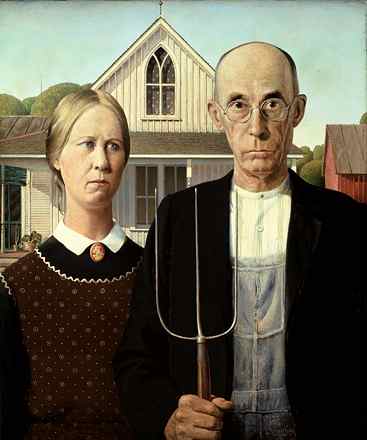
(above: Grant Wood, American Gothic, 1930, oil on beaverboard, 29 1/4 x 24 5/8 inches. Friends of American Art Collection. All rights reserved by The Art Institute of Chicago and VAGA, New York, NY, 1930.934, sourced fom our article Grant Wood At 5 Turner Alley)
Wood didn't just paint people; he manicured the landscape. In paintings like Young Corn (1931) and Stone City, Iowa (1930), he turned the unruly countryside into a geometric fantasy. The hills are swollen and round, looking almost like inflated balloons or Art Deco patterns. The corn isn't just growing; it's marching in perfect, rhythmic rows. This was art providing a sense of order during the chaos of the Great Depression. In Young Corn, the bulbous trees and sweeping hills suggest a fertility that is almost supernatural, offering a comforting image of abundance when real farmers were struggling with drought and economic collapse. He wasn't painting a snapshot of a farm; he was painting the idea of a farm.
One of Wood's most touching works from this period is Woman with Plants (1929), a portrait of his mother, Hattie. He poses her like a Madonna, holding a potted beefsteak begonia and a snake plant. These aren't delicate flowers; they are tough, drought-resistant survivors, just like the woman holding them. By placing his mother against a stylized agrarian backdrop, he was creating a secular saint for the region, grounding the entire Regionalist movement in the figure of the pioneer matriarch.
While Wood was the loud, public face of the movement, his friend Marvin Cone was the quiet poet. Cone taught at Coe College in Cedar Rapids and painted the same landscapes but with a completely different emotional temperature. If Wood's landscapes were fantasies of plenty, Cone's were meditations on silence. His "River Bend" series, particularly River Bend No. 5 (1938), shows the sweeping curves of the Iowa river valleys with a muted, earthen palette. He didn't puff up the hills like Wood; he analyzed their structure. His composition often pulled the viewer's eye in a circle through the valley, emphasizing the vast, open space that defines the region.
Cone is also fascinating for his "haunted" interiors. In works like Uncle Ben (1951), he painted empty rooms in Victorian houses with doors standing slightly ajar. There are no people, just the suggestion that someone has just left. These paintings capture a specific Midwestern melancholy -- the quiet dust motes dancing in an old house, the sense of time passing slowly in a small town. They are psychologically deep, suggesting that the "simple" rural life had its own complex inner world.
Cone also had a surprising interest in the circus. He painted vibrant, slightly garish scenes of county fairs, like Carnival Graces. Here, he depicted three African American performers on a stage, watched by a crowd of white men seen only from behind. It's a complex image about looking and being looked at, highlighting the racial and cultural distances that existed even in the intimacy of a small-town fair. It showed that Iowa art could be about more than just corn; it could be about the strange, fleeting spectacles that broke up the monotony of rural life.
The physical heart of this movement was the Stone City Art Colony, an experimental school that Wood and his friends ran for two summers in 1932 and 1933. They took over a defunct limestone quarry town and invited artists to come live and work together. The accommodations were legendary: they repurposed old ice delivery wagons -- the kind used before electric refrigerators -- and turned them into dormitories. Artists painted murals on the sides of these wagons and slept in them. It was a bohemian paradise with a distinctly Iowan flavor. They wore overalls, worked in the sun, and threw costume parties where the usually buttoned-up Grant Wood once appeared dressed as a "Pink Angel," complete with wings and a pink flannel nightgown. It was a brief, magical moment where the hierarchy of the art world was flattened, and the "ice wagon artist" became a symbol of creative survival during the Depression.
As the Depression deepened, the government became the biggest patron of the arts, and Iowa received a wealth of murals through New Deal programs. This wasn't just about decoration; it was about defining history. One of the most intellectual of these murals is Evolution of Corn (1938) by Lowell Houser in the Ames Post Office. Houser had spent time in Mexico and was influenced by the Mayan revival. His mural is a diptych: on one side, you have a Mayan farmer cultivating maize with ancient tools and indigenous motifs; on the other, a modern Iowa farmer stands with a theodolite and scientific instruments. Houser was brilliantly linking the local Iowa crop to a grand, transnational history of civilization, elevating the farmer to the status of a scientist and historian.
Not everyone got along in this small art world, though. Francis Robert White led a group of artists who chafed under Grant Wood's dominance. White and his "Cooperative Mural Painters of Iowa" actually beat out Wood for a commission at the Cedar Rapids Federal Courthouse (now City Hall). White's mural, The Opening of the Midwest, documents the industrial and settler history of the region. These murals were controversial and were even painted over later in the century before being restored. They remind us that the "Regionalist" style wasn't a monolith; it was a battleground where artists fought over who got to tell the story of the state.
Another significant muralist was John Bloom, a native of DeWitt, Iowa, who had studied at Stone City. His mural Shucking Corn (1939) in the DeWitt Post Office (now City Hall) is a gritty, energetic depiction of the harvest. Unlike Wood's frozen, idealized tableaux, Bloom's figures are in motion, capturing the sweat and physical exertion of the work. It's a celebration of the community labor that defined farm life before total mechanization took over.
While the painters were covering walls, a Danish immigrant named Christian Petersen was transforming the campus of Iowa State University in Ames. Petersen was the nation's first permanent artist-in-residence at a university, a role that allowed him to integrate art directly into the lives of agriculture and engineering students. His masterpiece is the Fountain of the Four Seasons (1940) at the Memorial Union. It features four limestone maidens representing the planting, growing, harvesting, and resting cycles of the corn crop. It's a deeply respectful work, blending classical sculpture with Osage chanting themes and local agricultural reality. But perhaps his most iconic work is The Cornhusker (1941), a bronze statue of a shirtless young man peeling an ear of corn. Petersen treated this farm kid with the same heroic dignity that Michelangelo gave to David. Commissioned as the world was sliding into war, it was a reminder that the "soldier of the soil" was just as vital to the nation's survival as the soldier on the battlefield.
By 1945, the era was coming to a close. Grant Wood died
early in 1942, leaving the movement without its charismatic leader. The
end of World War II brought the GI Bill and a flood of new students and
ideas to the universities. The art department at the University of Iowa,
under Lester Longman, began to pivot aggressively toward the avant-garde
and Abstract Expressionism, viewing the Regionalists as old-fashioned and
provincial. But for those few decades, artists in Iowa did something remarkable.
They stopped apologizing for where they were from. They looked at the rolling
hills, the red barns, and the stoic faces of their neighbors, and they saw
the stuff of high art. They proved that you didn't need a cathedral or a
mountain range to find beauty; you just needed to look closely at the soil
beneath your feet.
We lightly edited this article, added images and provided
links to other materials to enhance it. AI is rapidly improving
in accuracy, yet the article may have inaccurate information.
 Return to Iowa Art History
*Tag for expired US copyright of object image:

Links to sources of information outside of our web site are provided only as referrals for your further consideration. Please use due diligence in judging the quality of information contained in these and all other web sites. Information from linked sources may be inaccurate or out of date. TFAO neither recommends or endorses these referenced organizations. Although TFAO includes links to other web sites, it takes no responsibility for the content or information contained on those other sites, nor exerts any editorial or other control over them. For more information on evaluating web pages see TFAO's General Resources section in Online Resources for Collectors and Students of Art History.
Copyright 2025 Traditional Fine Arts Organization, Inc. an Arizona nonprofit corporation. All rights reserved.