
New Mexico Art History

with an emphasis on representational art

(above: William Herbert Dunton, My Children, 1920, oil on canvas, New Mexico Museum of Art. Public domain, via Wikimedia Commons*)
Other online information, page two:
New Mexico (sampling of artists and works connected to state) from askArt. Accessed August, 2015.
New Mexico Art Tells New Mexico History, a website from the New Mexico Museum of Art. Inlcudes themes with images of artworks and artist biographies. Accessed March, 2015.
New Mexico State Capitol Art Collection from Collector's Guide. Accessed August, 2015.
Russell Lee's FSA photography in New Mexico is a 2019 exhibit at the New Mexico Museum of Art which says: "Photographer Russell Lee created some of his finest work while traveling the United States for the Farm Security Administration. Among the communities he documented in New Mexico were Hobbs, Holman, Peñasco, Taos, Wagon Mound, and Quemado." Accessed 12/19
The Sacred and the Sublime: Evolution of Oil Painting and Sculpture in New Mexico (1835-1885) is a 2025 article by Gemini AI which says:" The period from 1835 to 1885 in New Mexico was a dynamic crucible for artistic evolution, characterized by a profound interplay between continuity and change. The deeply rooted santero tradition, with its focus on devotional retablos and bultos, remained the spiritual and artistic heart of Hispanic communities. These works, crafted from local materials with ingenious resourcefulness, embodied a unique "stylized realism" and profound spiritual idealism, serving as essential "plug-ins to the divine" and a source of comfort, guidance, and identity amidst a tumultuous historical transition. The art of santeros like José Rafael Aragón, Molleno, Pedro Antonio Fresquís, Juan Miguel Herrera, and José Benito Ortega consistently emphasized beauty through spiritual essence, promoted positive virtues through iconic representation, and lifted people's spirits by providing tangible connections to their faith and heritage. The stylistic shifts, including the increasing influence of indigenous aesthetics and the movement towards simplified, quasi-abstract forms, demonstrate an organic adaptation that prioritized spiritual function over academic norms.
Towards the close of this era, the arrival of the railroad in 1879 marked a new chapter, bringing increased external interest and the emergence of Anglo-American artists like Peter Moran and Thomas Moran. These artists, primarily through prints and watercolors, began to document the unique landscapes and cultures of New Mexico with a more conventional realist approach. While their work contributed to a broader understanding and appreciation of the region, it also foreshadowed the commodification of native arts and the eventual decline of the traditional santero profession due to competition from mass-produced religious items.
In synthesis, the art of New Mexico from 1835 to 1885 reveals a compelling narrative of resilience and adaptation. Whether through the deeply personal and spiritually charged creations of the santeros or the emerging documentary efforts of Anglo-American artists, the artistic output of this period consistently fulfilled its purpose: to emphasize beauty, reinforce positive virtues, and uplift the human spirit in a land undergoing profound transformation. This dual artistic evolution laid the groundwork for New Mexico's enduring and unique artistic identity, a legacy that continues to inspire and resonate today." Accessed 6/25
"Santa Fe 400th: Creative to our core."by Douglas Fairfield, art historian, educator, and former curator for the Albuquerque Museum of Art & History, was published online in The Santa Fe New Mexican, website August 1, 2010. The article discusses New Mexico art history from prehistoric rock art to more recent times. Accessed August, 2015.
Southwestern Allure: The Art of the Santa Fe Art Colony, held October 8, 2013 - December 29, 2013 at the Boca Museum of Art, and subsequently held from April 25, 2014 - July 27, 2014 at the New Mexico Museum of Art. Accessed August, 2015.
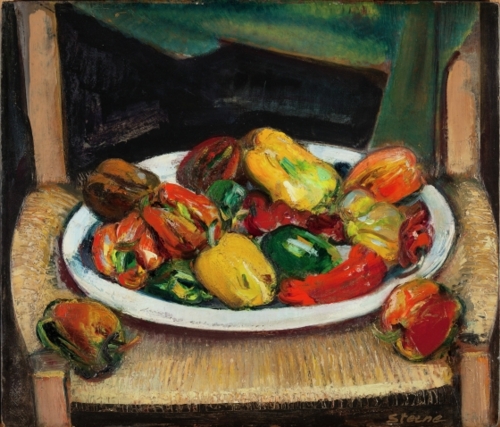
(above: Maurice Sterne, New Mexico Still Life, c. 1919, oil on board; 20 1/2 x 23 1/2 inches, Denver Art Museum, William Sr. and Dorothy Harmsen Collection by exchange, 2013.5)
The Taos Municipal Schools Historic Art Collection, an exhibit held September 21, 2013 - January 26, 2014 at the Harwood Museum of Art, University of New Mexico. Includes 85-page .pdf file describinbg the collection. Accessed January, 2015.
Painters in Taos, New Mexico Prior to 1940 from askArt. Accessed August, 2015
Picturing Passion: Artists Interpret the Penitente Brotherhood is a 2019 exhibit at the New Mexico Museum of Art which says: "The exhibition illustrates how artists who were new to the Southwest in the early part of the 20th century looked to Moradas, Penitente processions, traditions, and material culture as source material for their work and as a distinctive feature of New Mexican culture." Accessed 12/19
Taos Moderns is a 2016-17 exhibit at the Albuquerque Museum, which says:"Confluence of cultures and perspectives in Taos seen in Albuquerque Museum's exhibition of works on paper.... Modernism was a cultural movement that triumphed by the middle of the last century. It prioritized personal experience, social consciousness, awareness of essential impulses, and novelty of form and expression. The works in Taos Moderns demonstrate various ways such issues were addressed." Accessed 11/16 Also see Taos Moderns from Harwood Museum. Accessed 11/16
Tesoros de Devoción (Treasures of Devotion) is a website presented by New Mexico History Museum, a division of the New Mexico Department of Cultural Affairs. It features devotional objects created in New Mexico and biographical information on the artists who created them. The site contains three interpretative videos, a curriculum and other texts. Accessed March, 2015. Accessed March, 2015.

(above: José Rafael Aragón,
Our Lady of Mount Carmel (Nuestra Señora del Carmen), 9.3
x 7.2 inches, Barnes Foundation. Public domain, via Wikimedia Commons*)
Thinking New Mexico: A Centennial Exhibition, an exhibit held May 25 - September 1, 2012 at New Mexico State University Art Gallery, Williams Hall. Includes Thinking New Mexico: 1912-2012, an exhibit catalog in .pdf form. Accessed March, 2015.
The Taos Society of Artists by Ernest L. Blumenschein, (via Google Books: full view) Original from Harvard University, The American Magazine of Art, By American Federation of Arts , published 1916, v.8 (1916-1917). Digitized Jul 2, 2007. Accessed August, 2015.
Virgil Ortiz: Revolution - Rise Against the Invasion is a 2018 exhibit at the Colorado Springs Fine Arts Center at Colorado College which says: "Ortiz's Revolt storyline transports the viewer back more than 300 years to the historical events of the 1680 Pueblo Revolt, and then hurtles forward through time to the year of 2180 -- introducing a cast of characters along the way." Also see artist's website. Accessed 11/18
We Lead, Others Follow is a 2021 exhibit at the Albuquerque Museum which says: "Here, women at the helm of photography studios were tenacious, exhibiting their work at World's Fairs and being celebrated by photography organizations. They survived tumultuous decades when the economy was affected by world wars, depression, and disease. They made a good living, supporting their families through their photography and lasting longer in the business world than many of their male counterparts. They were determined to not only make their mark, but serve as a guiding light. They knew that their ultimate success relied upon the passing on of their experience and knowledge to other women." Accessed 12/21
Women Artist Pioneers of New Mexico, by Dottie Indyke. from Collector's Guide. Accessed August, 2015.
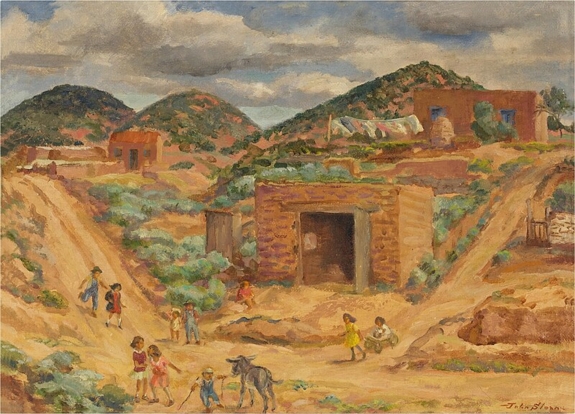
(above: John Sloan, Crossways, Santa Fe, 1940, oil on masonite, 17.5 x 24 inches, Delaware Art Museum, 1163. Public domain, via Wikimedia Commons*)
 Go to other
online information, page three
Go to other
online information, page three
 Return to New Mexico Art History
Links to sources of information outside of our web site are provided only as referrals for your further consideration. Please use due diligence in judging the quality of information contained in these and all other web sites. Information from linked sources may be inaccurate or out of date. TFAO neither recommends or endorses these referenced organizations. Although TFAO includes links to other web sites, it takes no responsibility for the content or information contained on those other sites, nor exerts any editorial or other control over them. For more information on evaluating web pages see TFAO's General Resources section in Online Resources for Collectors and Students of Art History.
*Tag for expired US copyright of object image:

 Search Resource Library
Copyright 2026 Traditional Fine Arts Organization, Inc., an Arizona nonprofit corporation. All rights reserved.