
New Mexico Art History

with an emphasis on representational art

(above: Joseph Henry Sharp (1859-1953), Fireside, c. 1900, oil on canvas, on loan to the San Diego Museum of Art. Public domain, via Wikimedia Commons*)
Other online information, page one:
New Mexico Native American Pottery
Cochiti Pottery in the Early Twentieth Century:is a Gemini 3 Pro Deep Research Report which says: "The cultural and artistic evolution of the Cochiti Pueblo during the early twentieth century represents one of the most sophisticated responses to colonialism and the commodification of indigenous identity in the American Southwest. At the heart of this transformation was the interaction between Cochiti potters and the expansive tourism infrastructure developed by the Fred Harvey Company, specifically through the "Indian Detours" program. This period, stretching roughly from the arrival of the railroad in 1880 to the onset of World War II, saw the birth of a unique figurative tradition known as monos, characterized by a blend of traditional materials and radical social commentary. The development of these figures was not merely a commercial endeavor but a complex act of cultural preservation and quiet subversion, as potters utilized the very tourists who purchased their wares as subjects for satirical critique." Accessed 3/26
San Ildefanso Pottery in the Early Twentieth Century is a 2026 article by Gemini 3 which says: "The high desert sun of New Mexico casts long, amber shadows over the adobe walls of San Ildefonso Pueblo, a place where the earth itself has always been the primary medium of expression. In the early years of the twentieth century, this small Tewa-speaking community sat at a quiet crossroads of history. The ancient traditions of pottery making, which had sustained the Pueblo people for a millennium, were facing a slow decline. For generations, the women of San Ildefonso crafted sturdy, utilitarian vessels -- broad-shouldered ollas for water storage and wide bowls for grain -- but the arrival of inexpensive, mass-produced metal pails and enamelware from the burgeoning American industrial machine began to render these clay tools obsolete. It was during this fragile period of transition that a remarkable convergence of archaeology, tourism, and individual artistic genius would transform San Ildefonso pottery from a fading domestic craft into a world-renowned fine art." Accessed 3/26
Santa Clara Pueblo Ceramics in the Fred Harvey Era is a 2026 Gemini 3 article which says: "The early twentieth century served as a transformative epoch for the Santa Clara Pueblo, a Tewa-speaking community situated along the Rio Grande in northern New Mexico. During this period, the production of pottery underwent a profound metamorphosis, transitioning from a localized, utilitarian practice rooted in millennia of communal tradition to a sophisticated art form curated for a burgeoning global tourist market. This shift was catalyzed by the strategic interventions of the Atchison, Topeka and Santa Fe Railway and its hospitality partner, the Fred Harvey Company. Through the establishment of the Indian Department in 1901 and the subsequent launch of the "Indian Detours" in 1926, these corporate entities did not merely facilitate travel; they actively participated in the aesthetic and economic reshaping of Pueblo life." Accessed 3/26
Sky City Crucible: Acoma Pottery in the Era of Fred Harvey Indian Detours is a 2025 article by Gemini 3 which says: "The high desert plateau of western New Mexico serves as a landscape where the ancient and the modern have engaged in a century-long dialogue, mediated through the tactile medium of clay. At the heart of this cultural intersection lies the Acoma Pueblo, or Sky City, a settlement perched atop a 370-foot sandstone bluff that has remained continuously inhabited for over a millennium. By the dawn of the twentieth century, this ancestral stronghold became the focal point of a transformative economic and artistic movement, driven by the expanding reach of the Atchison, Topeka and Santa Fe Railway and the sophisticated marketing machinery of the Fred Harvey Company. The development of Acoma pottery during this period was not merely a continuation of domestic craft but a deliberate evolution of style, materials, and motifs designed to meet the expectations of a new class of travelers. These "detourists," arriving in the rugged New Mexico interior via luxury "Harveycars," sought a tangible connection to a culture they were told was vanishing, prompting Acoma potters to refine their techniques and visual language into a form that was both deeply traditional and highly marketable." Accessed 3/26
Zuni Pottery In the Fred Harvey Era is a 2026 Gemini article which says: "The early twentieth century in the American Southwest was defined by a profound collision between ancient sedentary cultures and the rapid expansion of industrial capitalism. At the heart of this transformation was the Zuni Pueblo, or A:shiwi, a community that had occupied the high desert plateaus of western New Mexico for millennia. For the A:shiwi people, the ceramic arts were never merely decorative; they were functional vessels for water and prayer, manifestations of a matrilineal tradition that linked the physical land to the spiritual realm of the ancestors. However, as the Santa Fe Railway and the Fred Harvey Company began to market the "Indian Country" to a burgeoning class of eastern travelers, the Zuni ceramic tradition underwent a strategic and stylistic evolution. This period, roughly spanning from 1895 to 1940, saw the emergence of a characteristic Zuni style that balanced the demands of a new commercial market -- fueled by the luxury "Indian Detours" -- with the internal necessity of cultural preservation." Accessed March, 2026
Zuni Silversmithing: 1855-1955 is a 2026 Gemini 3 Deep Research report which says: "The evolution of Zuni silversmithing between 1855 and 1955 represents one of the most significant periods of cultural adaptation and artistic refinement in the American Southwest. This era saw the Zuni people transform from masters of ancient lapidary traditions into world-renowned silversmiths, navigating the complex pressures of colonial expansion, the rise of industrial tourism, and the shifting demands of a global art market. To understand this trajectory, one must first recognize the Zuni as a linguistic and cultural isolate, possessing a heritage that reflects deep physical and cultural rootedness in the Colorado Plateau. While their neighbors -- the Navajo (Diné) and the Hopi -- engaged in frequent exchange, the Zuni maintained a core identity that eventually manifested in a style of jewelry entirely distinct from surrounding traditions." Accessed 4/26
Other Native American Art

(above: John Sloan, 1871-1951, Ancestral Spirits (The Koshare) 1919, oil on canvas, New Mexico Museum of Art. Gift of Dr. Edgar L. Hewett, 1920, 45.23P. Public domain, via Wikimedia Commons*)
American Jewelry from New Mexico is a 2018 exhibit at the Albuquerque Museum which says: "Rather than focus on a single culture group, individual artist, time period, or medium as have most jewelry exhibitions and publications, American Jewelry from New Mexico tells the stories of diverse heritages simultaneously, as artists live, in concert, trade, and adaptation with their neighbors" Accessed 8/18
Awa Tsireh: Pueblo Painter and Metalsmith is a 2017 exhibit at the Heard Museum which says: "This exhibit explores the paintings and metalworks of San Ildefonso artist Awa Tsireh (Alfonso Roybal)." Accessed 7/18
Embroidered History: Colchas and the Stitch that Defined a Region is a 2019 exhibit at the Harwood Museum, University of New Mexico hich says: "Spanning continents and centuries, the Northern New Mexican colcha is a journey of craft, culture, and geopolitics that is defined by the hands of New Mexican women. Colchas are embroidered textiles or blankets whose origins have been traced as far back as the 16th-century when New Mexico was New Spain, and expeditions packed with Iberian textiles were making their way up the Rio Grande Valley." Also see 37 minute video Colcha Circle: A stitch in Northern New Mexico Culture Accessed 11/19
Indigenous Art, Culture, and Community: Works from the Ruth and Sidney Schultz Collection is a 2023 exhibit at the Albuquerque Museum which says: "Indigenous Art, Culture, and Community explores how artistic creation at Indian Market has been the center of creative community building and how over the last century it has grown to include artists from Indigenous nations across the United States and Canada." Accessed 3/23
The Leekya Family: Master Carvers of Zuni Pueblo is a 2017 exhibit at the Albuquerque Museum which says: "Marketed primarily by regional Indian art traders around the area of Gallup, New Mexico, Leekya Deyuse (known as Leekya) emerged in the early- to mid- 1900s as Zuni Pueblo's most famous commercial carver." Also see 6/17/17 article in Albuquerque Journal. Accessed 8/17
Nora Naranjo Morse: Gathering Ground is a 2019 exhibit at the Colorado Springs Fine Arts Center at Colorado College which says: "Throughout her career as a sculptor, Nora Naranjo Morse has confronted contradictions between what she knows as a Kha P?o (Santa Clara Pueblo) woman and what she observes in the world. As a young artists, she began to move away from working on traditional pottery when she understood how the art market commodified Pueblo culture. Naranjo Morse took up the role of cultural critic, addressing the impact of Westernization within her Tewa community." Accessed 2/20
Other New Mexican Art
Alcove Shows 1917-1927 is a 2014 exhibit at the New Mexico Museum of Art which says: "Exhibitions in the alcoves at the New Mexico Museum of Art date to its 1917 founding as the Art Gallery of the Museum of New Mexico and were part of the "Open Door" policy suggested by artist Robert Henri's. Small one-person exhibitions were held in the gallery alcoves through the 1950s, resuming in the mid-1980s, and again in the early 1990s. Many of the artists' works in those early alcove exhibitions form the historical core of the museum's collection.... During the museum's first decade there were approximately three hundred alcove exhibitions. Some were paintings of the Southwest by Henri's friends and colleagues who he persuaded to visit Santa Fe. On view as well were Native American pottery and weaving, Chimayo weavings, and shows of such diverse art and ethnographic materials as Chinese paintings, Japanese woodblock prints, Old Master etchings, Indonesian textiles, Pre-Columbian sculpture, Sioux ledger drawings, Aboriginal paintings, as well as art from Cornwall and New Zealand." Accessed 10/24
Another World: The Transcendental Painting Group is a 2022 exhibit at the Baker Museum which says: " Initiated in New Mexico in 1938, the Transcendental Painting Group set out to explore spiritually heightened abstraction, employing free-wheeling symbols and imagery drawn from the collective unconscious. Under the guidance of Raymond Jonson and Emil Bisttram, artists Agnes Pelton, Lawren Harris, Florence Miller Pierce, Horace Pierce, Robert Gribbroek, William Lumpkins, Dane Rudhyar, Stuart Walker and Ed Garman sought, per their manifesto, 'to carry painting beyond the appearance of the physical world, through new concepts of space, color, light and design to imaginative realms that are idealistic and spiritual.'" Accessed 6/22
The Artistic Odyssey of Higinio V. Gonzales: A Tinsmith & Poet in Territorial New Mexico is a 2015-16 exhibit at the Albuquerque Museum which says: "After more than a century of obscurity, art historian and tinsmith Maurice Dixon discovers that a New Mexican artisan, formerly known only as the Valencia Red and Green Tinsmith, is actually Higinio V. Gonzales, a prolific and bilingual 19th-century educator, artisan, poet, and musician." Also see City of Albuquerque GOVTV video. Accessed 2/17
Artists from New Mexico in Wikipedia. Accessed August, 2015.
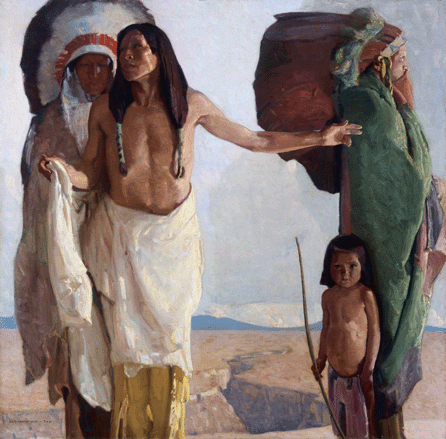
(above: Ernest L. Blumenschein (1874-1960), The Peacemaker (The Orator), 1913. Courtesy of the Anschutz Collection. Public domain, via Wikimedia Commons*)
In the Brinton Museum 2017 Spring/Summer Newsletter, Volume 18, Number 1, read an article about Catharine C.Critcher (1868-1964), a member of the Taos Society of Artists.
The Canvas and the Carving: New Mexico Artistry, 1885-1945, Through Lenses of Beauty and Uplift is a 2025 article by Gemini which says: "This period stands as a testament to the transformative power of cultural fusion, where Indigenous, Hispanic, and Anglo influences intricately intertwined to forge a uniquely New Mexican artistic identity. Throughout this era, artists, driven by individual creative genius and a profound connection to their environment and communities, produced a body of work that continues to inspire and uplift. This collective artistic endeavor significantly contributed to the enduring cultural richness of the state, serving as a powerful reflection and shaper of identity. Across all artistic movements and individual artists, a strong sense of identity-whether cultural, spiritual, or regional -- emerges as a core theme. Santeros created art that embodied communal and ethnic identity. Artists of the Taos and Santa Fe colonies sought to capture a "distinctive view of the nation" and a profound "sense of place". Native artists like Allan Houser explicitly aimed to "give people a sense of self, so they could be better humans". Art in New Mexico during this period was not merely decorative; it was a powerful tool for defining, preserving, and asserting identity in a rapidly changing world. It helped communities and individuals navigate cultural shifts, express their values, and find beauty and strength in their heritage, thereby fulfilling the mandate of "lifting people's spirits" by affirming who they were and what they could become." Accessed 6/25
The Carved Line: Block Printmaking in New Mexico is a 2017 exhibit at the Albuquerque Museum which says: "This exhibition includes prints by internationally known New Mexico artists including Gustave Baumann, Willard Clark, Howard Cook, Betty Hahn, T.C. Cannon, Fritz Scholder, Frederick O'Hara, Melanie Yazzie, Adja Yunkers and previously unpublished works by other artists such as Tesuque Pueblo artist Juan Pino, Margaret Herrera Chávez, Tina Fuentes, Yoshiko Shimano, Ruth Connely, Leon Loughridge, and Scott Parker." Accessed 2/17
Dorothy Peterson: Painting New Mexico is a 2017 exhibit at the Roswell Museum and Art Center which says: "From landscapes to still life, Peterson's paintings span a range of subject matter, underscoring her mastery of this challenging medium. What all these works share, however, is a love for the history, geography and cultures of New Mexico." Accessed 8/17
Everyday People: The Photography of Clarence E. Redman is a 2018 exhibit at the Albuquerque Museum which says: "The Redman collection from Photo Archives captures the everyday life of people in Albuquerque in the 1940s and 1950s." Also see photos in New Mexico Digital Collections Accessed 12/18
Harold Joe Waldrum: Las Sombras is a 2019 exhibit at the Tucson Museum of Art which says: "Harold Joe Waldrum (1934-2003) was a painter, etcher, photographer, author, and teacher, as well as an activist for the preservation of historic churches." Also see artist website Accessed 1/20
The Harwood Collection: Work by Women is a 2018 exhibit at the Harwood Museum of the University of New Mexico which says: "This is a museum-wide exhibition of art by women in the collections of the Harwood Museum of Art. The artists in Work by Women are pioneers. They are stewards of the living legacy of Taos Arts, described by Harwood director Richard Tobin as "a complex narrative shaped over centuries by the confluence of Native American, Hispano and Anglo cultures against the towering landscape of Taos."" Also see entry in Beyond Taos blog Accessed 3/18
"How the Santa Fe Art Colony Began." by Suzanne Deats, from Collector's Guide. Accessed August, 2015.
How the West Is One: The Art of New Mexico, an exhibit held April 20, 2007 - February 19, 2012 at the Museum of Fine Arts, Santa Fe. Includes audio. Accessed March, 2015.
Los Cinco Pintores from taospainters.com. Accessed August, 2015.
Los Ochos Pintores from AskArt.com. Accessed August, 2015.
Looking Back: Interactions, an exhibit held January 25 through May 12, 2002 at the Museum of Fine Arts, Santa Fe. Accessed March, 2015
Mabel Dodge Luhan and the Remarkable Women of Taos by Darlene Dueck, curator for The Anschutz Collection, from The Mabel Dodge Luhan House. Accessed August, 2015
"'New Deal' Art in New Mexico, by Kathryn Flynn, from Collector's Guide. Accessed August, 2015.

John Sloan, 1871-1951, Music in the Plaza (Plaza, Evening, Santa Fe), 1920, oil on canvas, New Mexico Museum of Art. Gift of Mrs. Cyrus McCormick, 1952, 326.23P. Public domain, via Wikimedia Commons*)
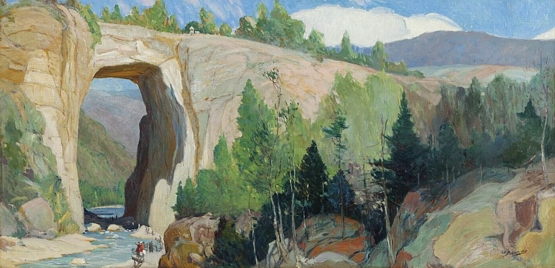
(above: Oscar E. Berninghaus, Natural Bridge, c. 1914, oil on board laid down on panel, 21 x 42 7/8 inches, Christie's. Public domain, via Wikimedia Commons*)
 Go to other
online information, page two
Go to other
online information, page two
 Return to New Mexico Art History
Magazines paper-published magazines and journals
Links to sources of information outside of our web site are provided only as referrals for your further consideration. Please use due diligence in judging the quality of information contained in these and all other web sites. Information from linked sources may be inaccurate or out of date. TFAO neither recommends or endorses these referenced organizations. Although TFAO includes links to other web sites, it takes no responsibility for the content or information contained on those other sites, nor exerts any editorial or other control over them. For more information on evaluating web pages see TFAO's General Resources section in Online Resources for Collectors and Students of Art History.
*Tag for expired US copyright of object image:

 Search Resource Library
Copyright 2026 Traditional Fine Arts Organization, Inc., an Arizona nonprofit corporation. All rights reserved.