

The Canvas and the Carving:
New Mexico Artistry, 1885-1945, Through Lenses of Beauty and Uplift
by Gemini 2.5, June 6, 2025
I. Introduction: A Confluence of Cultures and Artistic Awakening
New Mexico, prior to the late 19th century, existed as a remote frontier, its cultural fabric intricately woven from Indigenous, Spanish, and Mexican traditions. This prolonged isolation fostered a unique, deeply localized artistic heritage, most notably the santero art form, which became an integral part of community life. Despite the formal conclusion of the Mexican-American War in 1848, which brought New Mexico under U.S. control and introduced new legal and demographic frameworks, the region's distinct cultural identity, marked by its Spanish language, Catholic faith, and traditional arts, largely endured.
The year 1885 marked a profound turning point, ushered in by the arrival of the transcontinental railroad in 1879-1880, which dramatically ended New Mexico's long-standing isolation. This new infrastructure initiated what has been termed a "culture rush," facilitating an influx of new materials, innovative ideas, and a steady stream of European-American artists, writers, and anthropologists. These newcomers arrived eager to document and interpret the "exotic Southwestern landscape" and its native inhabitants. This period witnessed the establishment of vibrant art colonies in Taos and Santa Fe, attracting artists captivated by the region's unique light, dramatic scenery, and rich blend of cultures.
Within this dynamic period from 1885 to 1945, oil painting and sculpture in New Mexico underwent significant evolution. Artists, both native and newly arrived, consistently emphasized beauty, positive virtues, and the lifting of people's spirits, navigating between the direct portrayal of realism and the elevated visions of idealism. This report will explore this evolution through the work and creative inspirations of seven critically acclaimed artists, revealing how art served as a powerful medium for cultural expression and human affirmation during a transformative era.
The "culture rush" that began with the railroad's arrival presented a complex duality. While it brought unprecedented recognition and new resources to New Mexico's art scene, it simultaneously introduced commercial pressures that risked diluting the inherent authenticity of traditional arts. The ongoing tension between preserving established forms and adapting to new markets and external influences became a central dynamic in the region's artistic development. The remarkable persistence of santero art, despite these external pressures, underscores the deep cultural and spiritual roots of art in New Mexico, demonstrating its role as a vital force in cultural resilience. Furthermore, the influx of Anglo artists and the continued presence of Indigenous and Hispanic traditions fostered a unique "cultural fusion". Art became a crucial medium for cross-cultural engagement and interpretation, reflecting attempts by newcomers to understand, romanticize, or even, at times, appropriate the "other." This dynamic contributed to a distinctive regional aesthetic that balanced diverse influences, and for native artists, it offred a means to preserve and express their identity amidst societal changes, marking a shift from being merely documented subjects to active self-representatives.
II. Echoes of Devotion: The Enduring Santero Tradition
The santero tradition, deeply rooted in New Mexico's Spanish colonial past, involved self-taught artists creating devotional images known as santos. These took two primary forms: retablos, which were paintings on wood panels, and bultos, three-dimensional carved wooden sculptures. These sacred objects were central to the spiritual lives of New Mexicans, serving as intercessors and providing a direct connection to the divine in a region where access to formal clergy was often limited. For the faithful, santos were not merely artistic creations but were considered "plug-ins to the divine." The materials used were typically local, including hand-hewn pine boards, gesso prepared from native gypsum and animal glue, and pigments derived from local minerals and plants. This distinctive folk art style diverged significantly from academic European traditions, often described as "naive" yet possessing a profound "soulful and stirring" quality.
The economic landscape for santeros shifted dramatically with the opening of the Santa Fe Trail in 1821 and the subsequent arrival of the railroad in the 1880s. These new trade routes brought inexpensive, mass-produced prints and plaster statues from the East, directly competing with the handcrafted santos and threatening the livelihoods of traditional artists. This economic pressure led to a notable decline in the santero profession. However, the tradition demonstrated remarkable resilience, sustained particularly by loyal patrons such as the Penitentes, a lay religious brotherhood. Later, organizations like the Spanish Colonial Arts Society, founded in 1925, actively promoted and preserved these traditional Hispanic arts, including wood carving, ensuring their continuity. The survival of santero art, despite the onslaught of industrialization and commercial competition, underscores its deep cultural and spiritual integration within New Mexican communities. This persistence reflects not only the artistic skill of the santeros but also a profound cultural resistance to external commercial and religious influences, emphasizing the intrinsic value of locally made, spiritually resonant objects over mass-produced alternatives.
Artist Spotlight 1: José Rafael Aragón (c. 1796-1862)
José Rafael Aragón is widely regarded as the "premier santero of his time," known for his prolific and versatile output, which included large altar screens for churches and hundreds of works for private clients. His extensive career spanned over four decades, commencing before 1820 and continuing into the early part of the period under review. Aragón's works were characterized by their "strongly and sensitively rendered" quality and "careful attention to detail". His sculptural figures, in particular, were noted for their "creative decorative motifs, color contrasts, elongated and graceful proportions, [and] delicate features". A curator specifically admired the "fine details and gracefully simple expression that Aragón achieved on Mary's face" in his paintings. He remained uninfluenced by formal Spanish painting, embodying a unique "folk artist" counter-culture. His art, focused on the depiction of saints, inherently emphasized spiritual beauty and positive virtues, serving to uplift the faithful through devotional imagery.
Artist Spotlight 2: José Benito Ortega (1858-1941)
José Benito Ortega is recognized as the "last of the notable pre-revival santeros" and was arguably the most prolific, active from the 1870s into the early 1900s. He primarily worked in remote villages near Mora, his home, producing traditional images for Penitente moradas and for church, chapel, and private use, even as the Catholic Church encouraged the use of mass-produced plaster statues. Ortega's figures, often crafted from scrap materials like mill board and calico rags, were distinguished by their "crude carving of hands and feet" yet possessed a "sensitive, individual touch" in their facial features. His work, such as Our Father Jesus of Nazareth (ca. 1885), powerfully conveys the "suffering of Christ" through its pose and graphic representation of bleeding, providing spiritual solace and a poignant reminder of faith's virtues. Despite the humble nature of his materials, Ortega's art provided essential spiritual connection and uplift for isolated communities, embodying a form of "stylized realism" that prioritized spiritual truth and emotional resonance over strict academic accuracy. This approach highlights a distinct interpretation of realism, where the purpose was to make sacred figures relatable and meaningful for devotional practice, demonstrating that art could be deeply beautiful and significant without adhering to Western academic conventions.
III. The Lure of the Land: Realism and Romanticism in the Art Colonies
The arrival of the transcontinental railroad in 1879-1880 initiated a "culture rush," drawing European-American artists and anthropologists to New Mexico with the intent of documenting native lifestyles. These artists were profoundly captivated by the region's unique light, dramatic landscapes, and the distinct Indigenous and Hispanic cultures. Taos quickly emerged as a prominent art community after artists like Joseph Sharp, Ernest Blumenschein, and Bert Phillips visited in the late 1890s, leading to the formation of the influential Taos Society of Artists in 1912. Concurrently, Santa Fe developed its own vibrant art colony, with groups such as Los Cinco Pintores forming in the 1920s.

(above: Joseph Henry Sharp (1859-1953), Fireside, c. 1900, oil on canvas, on loan to the San Diego Museum of Art. Public domain, via Wikimedia Commons*)
Many of these early artists were academically trained realists who sought to capture the "romantic lure" of the Southwest.Their works depicted Native American and Hispanic people engaged in daily activities and religious rituals, often rendered with a romantic and impressionistic style. These pieces functioned as both "ethnographic studies and nostalgic portrayals of an almost bygone era." Their art frequently emphasized the inherent beauty of the landscape and the perceived harmony of its inhabitants with nature. This period reflects a complex interplay between art, anthropology, and tourism. While artists genuinely aimed to capture the unique qualities of New Mexico's cultures, their output was also shaped by external demands from journals and tourists, as well as their own cultural perspectives. The "uplifting" aspect of their work could sometimes be intertwined with a romanticized or even stereotypical gaze, reflecting the power dynamics prevalent during that era. This tension between objective documentation and subjective idealization, and the potential for perpetuating stereotypes, forms a critical dimension of the art from this period.
Artist Spotlight 3: Ernest Blumenschein (1874-1960)
Ernest Blumenschein, a co-founder of the Taos Society of Artists, initially worked as an illustrator in New York before his serendipitous arrival in Taos in 1898, following a wagon wheel mishap during an assignment. He quickly became one of the most celebrated Taos painters, evolving his style from post-impressionist leanings to a more modernist approach.Blumenschein's work primarily focused on Native Americans and the American Southwest. His paintings were "painstakingly executed," "beautiful, bright, and often had extremely dense pigment" due to his meticulous layering.While some of his themes might be viewed through a lens of commoditization, his art "in spirit... exalts them." He discovered "an aesthetic 'field rich in possibilities'" in the western scene, employing brilliant hues to uplift and celebrate his subjects. His artistic endeavors aimed to convey the inherent dignity and beauty of both the people and the landscape.
Paintings by Ernest L. Blumenschein
Artist Spotlight 4: Bert Geer Phillips (1868-1956)
Bert Geer Phillips, another pivotal founding member of the Taos Society of Artists, was the first of the pioneering artists to establish permanent residence in Taos in 1898. Trained in New York and Paris, Phillips consistently maintained an academic realist style throughout his distinguished career. His primary artistic focus lay in "figurative pieces of the people of the New Mexico pueblos," which he depicted in "romantic surrounds, often by firelight". His "sympathetic portrayals of Native Americans were born out of deep familiarity with their culture and their surroundings." Phillips epitomized the romanticism characteristic of the early Taos artists, blending traditional academic training with a "romantic interpretation of life emphasizing the beautiful and the idyllic through art." His work aimed to uplift by presenting an idealized, lyrical vision of Native American life and the captivating New Mexico landscape. The New Mexico landscape, for many artists of this era, transcended mere scenery; it became a profound muse, shaping their artistic styles and philosophies. It served as a source of spiritual connection and a vehicle for expressing universal truths, moving beyond simple realism to a more idealized or abstracted representation of nature's grandeur and its capacity to uplift the human spirit.
Paintings by Bert Geer Phillips
IV. Abstracting the Spirit: Modernism and Inner Visions
Following New Mexico's statehood in 1912, a new wave of artists, some embracing "radically Modern" ideas, arrived, bringing with them European and American modernist sensibilities. While academic realists often congregated in Taos, Santa Fe became a significant hub for modernists, largely due to the Museum of Fine Arts' "Open Door policy," which actively encouraged progressive artists to exhibit their work. Modernist art, in contrast to strict replication, emphasized a "personal and emotional response to the world". Artists sought to evoke a "sense of place" through "simplified, abstracted compositions and bold colors," consciously moving away from literal imitation of visual appearance. This shift from external documentation to internal expression represents a broader trend in American art, where regionalism evolved from literal depiction to a more profound, often abstract, exploration of place and identity. For New Mexico, this meant the unique environment was not just a subject but a catalyst for artistic innovation that aimed to uplift the spirit through pure form, color, and emotional resonance, demonstrating art's capacity to transcend the tangible.
Artist Spotlight 5: Georgia O'Keeffe (1887-1986)
Georgia O'Keeffe, one of the most significant artists of the 20th century, made her initial journey to northern New Mexico in 1929. She found profound new inspiration in its "stark landscape and Native American and Hispanic cultures".Although she permanently relocated to New Mexico after 1949, she spent most summers living and working in the state for two decades prior to that move. O'Keeffe's work in New Mexico was deeply spiritual; she expressed that the landscape and mountains felt "promised to her by God." She transformed her "personal connection to the desert landscape" into art that "transformed her life and art." Her iconic abstract compositions, such as those depicting enlarged flowers and bones, were rooted in her keen observation of the natural world, yet they transcended realism to convey profound beauty and spiritual essence. She aimed to offer others "a new way to see the West," emphasizing its inherent beauty and timelessness.

(above: Georgia O'Keeffe, Lake George Reflection, c. 1921-22, oil on canvas, 58 x 34 inches, Christie's. Public domain, via Wikimedia Commons*)
Artist Spotlight 6: Raymond Jonson (1891-1982)
Raymond Jonson, a "foremost 20th century non-objective painter in America," was a leading figure of the Transcendental Painting Group, which he co-founded in New Mexico in 1938. Heavily influenced by Wassily Kandinsky, Jonson held a fundamental belief that art was a "spiritual endeavor." His "nonrepresentational painting" aimed "to stimulate in others, through deep and spontaneous emotional experiences of form and color, a more intense participation in the life of the spirit". He sought to express "universal principles that are universal and enduring" and to convey "the feeling of order, joy and freedom." His shift to abstract images in 1929 marked a "major step toward depicting the spiritual world and transcending the physical." Jonson's art was a direct pursuit of spiritual uplift and an idealized vision of cosmic harmony, intentionally contrasting with the "realism, strife, pain and greed" of the world. This commitment to creating art as a counterpoint to societal hardship, particularly during the Great Depression and on the cusp of World War II, reveals art's role as a psychological and spiritual balm. Artists like Jonson consciously strove to offer solace and hope by providing an idealistic vision of harmony and spiritual fulfillment, directly aligning with the objective of "lifting of people's spirits" through an alternative perspective.
V. Sculptural Narratives: Dignity and Cultural Heritage
While the santero tradition remained a vital artistic force, particularly through its dedicated revival efforts , the period from 1885 to 1945 also witnessed the emergence and diversification of secular and modern sculpture in New Mexico. The Works Progress Administration (WPA) during the Great Depression (1930s-1940s) played a significant role in supporting unemployed artists, including sculptors, by commissioning public art. This initiative provided new opportunities for artists and expanded sculptural output beyond traditional religious figures, commissioning "ten sculptural pieces" in New Mexico between 1935 and 1943. The WPA transformed the art landscape by democratizing art and making it accessible to a broader public. It fostered a sense of collective identity and civic pride through public works, directly contributing to "lifting people's spirits" during a national crisis. For sculpture, this meant a move beyond the purely devotional into secular, narrative, and commemorative forms, allowing artists to explore themes of cultural dignity on a public platform, thereby expanding art's societal role.
Artist Spotlight 7: Allan Houser (1914-1994)
Allan Houser, a Chiricahua Apache artist, is recognized as one of the most influential Native American artists of the 20th century. His formal art training began in painting at the Santa Fe Indian School from 1934 to 1938. Although he later became renowned for his bronze sculptures, he began experimenting with sculpture, initially carving small figures in wood, during World War II while residing in Los Angeles. His first major sculpture commission, a memorial in stone for fallen Indigenous soldiers, was received in 1948. Houser's art was deeply rooted in his Chiricahua Apache heritage and the stories his father shared about tribal hardships and their "enduring strength and dignity." He aimed to "honor the Chiricahua Apache and other tribes, as well as the human values of all people". Recurring themes in his work included "Apache dancers, warriors, families, and figures offering prayer or a peace pipe," as well as the "universal theme of mother and child". Houser explicitly articulated his fundamental intention: "Human dignity is very important to me. I feel that way toward all people... In my work, this is what I strive for: this dignity, this goodness that is in man. I hope I am getting it across. If I am, then I am doing what I have always wanted."
His work, encompassing both painting and early sculpture, consistently emphasized positive virtues, cultural pride, and the uplifting of the human spirit through realistic and dignified portrayals. Houser's early training under Dorothy Dunn at the Santa Fe Indian School initially emphasized a "flat, two-dimensional style". However, Houser deliberately diverged from this stricture, opening the door to a lifetime of experimentation that incorporated Western modernist influences while steadfastly honoring his Apache heritage. His work, even in its nascent stages, possessed a distinct "sculptural feel". This illustrates the complex negotiation Native American artists undertook to maintain cultural authenticity while engaging with broader art movements. Houser's artistic journey exemplifies how artists can draw strength from their heritage to create universally resonant works that speak to human dignity and resilience, thereby uplifting not only their own community but also a wider audience. This also represents a significant progression from purely "ethnographic" documentation by external observers to self-representation by Native artists, asserting their own narratives and artistic freedom.
VI. Conclusion: A Harmonious Legacy
From 1885 to 1945, New Mexico's art scene underwent a profound transformation, yet a consistent thread remained woven throughout: the unwavering pursuit of beauty, the articulation of positive virtues, and the aspiration to lift people's spirits. The enduring santero tradition, exemplified by the devotional works of José Rafael Aragón and José Benito Ortega, continued to provide spiritual solace and embody a unique folk aesthetic, deeply resonant with its audience.

(above: Santo from the exhibit Santos and Retablos)
The arrival of academically trained artists led to the formation of influential art colonies in Taos and Santa Fe. Figures such as Ernest Blumenschein and Bert Geer Phillips, through their blend of realism and romanticism, celebrated the majestic beauty of the landscape and the inherent dignity of its diverse inhabitants, often with an idyllic or exalting gaze.The emergence of modernism saw artists like Georgia O'Keeffe and Raymond Jonson pushing artistic boundaries, translating the region's spiritual essence into abstract forms that evoked profound beauty, order, joy, and cosmic harmony, serving as a powerful counterpoint to societal strife. Sculpture, diversified by federal art programs during the Great Depression, found new voices in artists like Allan Houser, who powerfully conveyed themes of human dignity, strength, and cultural heritage, adeptly bridging traditional forms with modernist sensibilities.

Ernest L. Blumenschein, Landscape with Indian Camp, 1920, oil on canvas, 51 1/4 x 43 inches, Denver Art Museum,The Roath Collection, 2013.137)
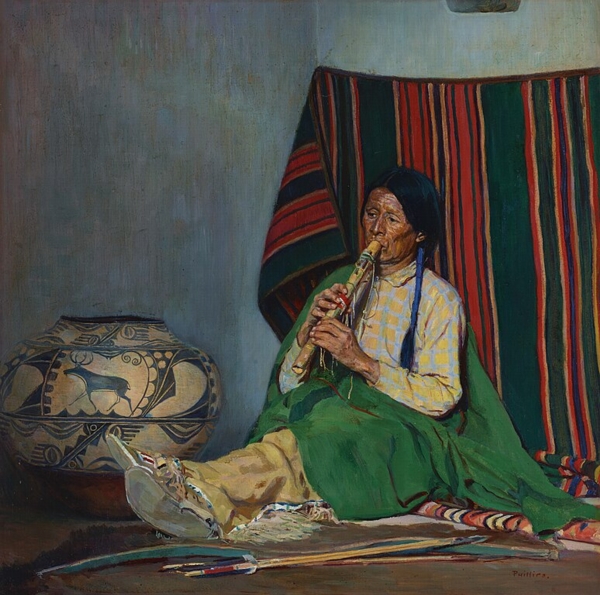
(above: Bert Geer Phillips, The Magic Deer Song, c. 1926, oil on board, 20 12 x 20 12 inches, Christie's. Public domain via Wikimedia Commons*)
This period stands as a testament to the transformative power of cultural fusion, where Indigenous, Hispanic, and Anglo influences intricately intertwined to forge a uniquely New Mexican artistic identity. Throughout this era, artists, driven by individual creative genius and a profound connection to their environment and communities, produced a body of work that continues to inspire and uplift. This collective artistic endeavor significantly contributed to the enduring cultural richness of the state, serving as a powerful reflection and shaper of identity. Across all artistic movements and individual artists, a strong sense of identity-whether cultural, spiritual, or regional -- emerges as a core theme. Santeros created art that embodied communal and ethnic identity. Artists of the Taos and Santa Fe colonies sought to capture a "distinctive view of the nation" and a profound "sense of place". Native artists like Allan Houser explicitly aimed to "give people a sense of self, so they could be better humans". Art in New Mexico during this period was not merely decorative; it was a powerful tool for defining, preserving, and asserting identity in a rapidly changing world. It helped communities and individuals navigate cultural shifts, express their values, and find beauty and strength in their heritage, thereby fulfilling the mandate of "lifting people's spirits" by affirming who they were and what they could become.
Also see The Sacred and the Sublime: Evolution of Oil Painting and Sculpture in New Mexico (1835-1885) is a 2025 article by Gemini AI which says:" The period from 1835 to 1885 in New Mexico was a dynamic crucible for artistic evolution, characterized by a profound interplay between continuity and change. The deeply rooted santero tradition, with its focus on devotional retablos and bultos, remained the spiritual and artistic heart of Hispanic communities. These works, crafted from local materials with ingenious resourcefulness, embodied a unique "stylized realism" and profound spiritual idealism, serving as essential "plug-ins to the divine" and a source of comfort, guidance, and identity amidst a tumultuous historical transition. The art of santeros like José Rafael Aragón, Molleno, Pedro Antonio Fresquís, Juan Miguel Herrera, and José Benito Ortega consistently emphasized beauty through spiritual essence, promoted positive virtues through iconic representation, and lifted people's spirits by providing tangible connections to their faith and heritage. The stylistic shifts, including the increasing influence of indigenous aesthetics and the movement towards simplified, quasi-abstract forms, demonstrate an organic adaptation that prioritized spiritual function over academic norms.
Note: Please don't rely on this AI-generated text for accuracy. It has been lightly edited, yet may be laden with inaccurate information. Consider it a base for further inquiry.
 Return to New Mexico Art History
Our Distinguished Artists catalogue provides online access to biographical information for artists associated with this state. Also, Search Resource Library for online articles and essays concerning both individual artists associated with this state's history and the history of art centers and museums in this state. Resource Library articles and essays devoted to individual artists and institutions are not listed on this page.
*Tag for expired US copyright of object image:

Links to sources of information outside of our web site are provided only as referrals for your further consideration. Please use due diligence in judging the quality of information contained in these and all other web sites. Information from linked sources may be inaccurate or out of date. TFAO neither recommends or endorses these referenced organizations. Although TFAO includes links to other web sites, it takes no responsibility for the content or information contained on those other sites, nor exerts any editorial or other control over them. For more information on evaluating web pages see TFAO's General Resources section in Online Resources for Collectors and Students of Art History.
 Search Resource Library
Copyright 2025 Traditional Fine Arts Organization, Inc., an Arizona nonprofit corporation. All rights reserved.