
Iowa's Art Story Between 1850 and 1945
by Chat GPT
Between 1850 and 1945, Iowa quietly nurtured a rich tradition of painting and other media -- shaped by its rolling prairies, small towns, limestone quarries, and tight-knit communities. As the world convulsed through industrialization, war, economic depression, and cultural shifts, Iowa's artists responded with a unique voice -- grounded not in East Coast salons or European capitals, but in the quietly steadfast rhythms of Midwestern life. Their story is one of place, perseverance, and a deep love of land and community.
In those years, the emergence of artists out of Iowa's farmland and small towns was in part driven by geography and social change. Unlike coastal regions, Iowa offered wide horizons, open skies, and fertile, far-reaching landscapes -- ideal for artists drawn to nature, rural life, and small-town rhythms. The slow transformation of towns, the decline of certain industries (such as local quarry towns), and the upheavals of economic hardship gave Iowa artists subject matter that felt both timeless and urgently contemporary. As other American and European artists moved toward abstraction or avant-garde experimentation, a distinct strain of realism, regionalism, and representational painting took hold in Iowa -- often rooted in a firm conviction that art should reflect "our place."
Perhaps the single most important chapter in that story is the career of Grant Wood. Born in 1891 outside Anamosa, Iowa, raised in Cedar Rapids, Wood became the face of what would be called Regionalism -- a style that celebrated rural America in all its earnestness and quiet dignity. Grant Wood's life was woven deeply into Iowa: after a childhood on a farm and an apprenticeship in a metal shop to support his family, he eventually saved enough to study art, including in Paris, and returned to his home state with renewed resolve.

(above: Grant Wood, Self-Portrait, c. 1925, Figge Art Museum. Public domain, via Wikimedia Commons*)
In returning to Iowa, Wood made a conscious decision: he would paint Iowa -- and make Iowa worthy of art. He turned his gaze not to New York or Paris, but to the land and people around him. He painted farmhouses, small towns, rolling hills, and the honest faces of rural folks. His art became not just about representation, but about identity -- a celebration of Midwestern life. As the Iowa PBS description of his work puts it, "the rolling hills and scenic landscapes of Iowa, painted in a famously unique style" made Wood world-famous.
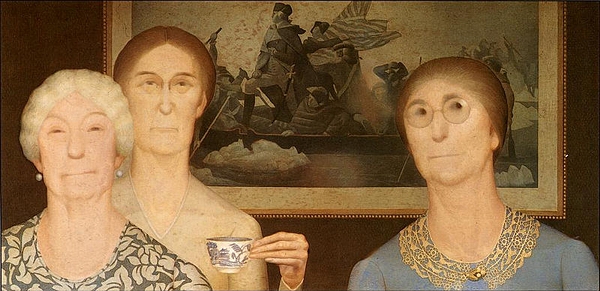
(above: Grant Wood, Daughters of Revolution, c. 1932, oil on masonite, 20 x 39 15/16 inches, Cincinnati Art Museum, The Edwin and Virginia Irwin Memorial, 1959.46. Public domain via Wikimedia Commons*)
One of the best-known paintings in American art, American Gothic launched Wood into international fame. With its stern-faced farmer clutching a pitchfork beside a woman in front of a modest white house, the work captured something more than a portrait: it captured a mood, an identity, a mythos. But Wood's oeuvre is richer than a single canvas. In 1929, shortly after returning from Europe, he painted Woman with Plants, a quiet, introspective portrait of his mother that straddles the moment when Wood was shifting from the Impressionistic sensibility he absorbed abroad toward the sharply defined realism of Regionalism.
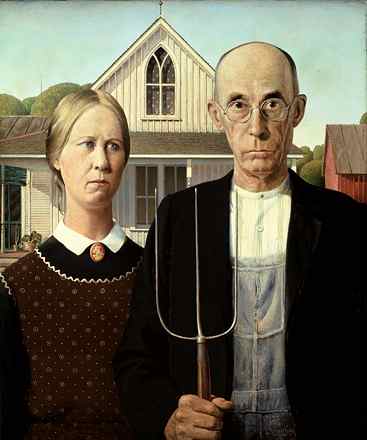
(above: Grant Wood, American Gothic, 1930, oil on beaverboard, 29 1/4 x 24 5/8 inches. Friends of American Art Collection. All rights reserved by The Art Institute of Chicago and VAGA, New York, NY, 1930.934, sourced fom our article Grant Wood At 5 Turner Alley)
Also in 1930, Wood created Stone City, Iowa -- a landscape rooted in the limestone-quarry town of Stone City, not far from Cedar Rapids. Though the town was in decline due to the collapse of its quarry-based economy, Wood rendered it with sweeping, almost surreal hills and rivers, giving the place a nostalgic grandeur. That painting would become emblematic of his mature style and of Iowa art's connection to place.
What made Wood's work special, beyond his technique, was his conviction that his home state -- with its modest houses, humble people, and quiet landscapes -- could be the subject of great art. In the early 1930s, as the country reeled under the Great Depression, a cultural shift occurred: people were looking inward, to their roots, to their own communities. Wood captured that moment. As one longtime faculty member at the University of Iowa observed, Wood became "at the forefront" of a movement that celebrated local culture for what it was, what it had been, and what it could be.
But Wood was not alone. A few years younger than him, and almost always associated with him, was Marvin Cone, born in the same city of Cedar Rapids in 1891. Cone started as a close friend of Wood's; the two traveled together -- including to Europe -- and shared an ambition to embed fine art within Midwestern soil. Cone's approach to landscape and nature was deeply personal. Rather than aiming for photographic realism, he painted the way nature felt to him. His vision was to express inner truths through the outer world -- to use landscape as a symbol for deeper meaning. As he once said, "The purpose of art is not to reproduce life, but to present an editorial, a comment on life ... Art symbolizes the whole of life." The result was a body of work suffused with thoughtfulness and emotion -- sometimes brooding, sometimes serene, always haunting. Works such as River Bend (1935) channel the quiet yet potent force of Iowa's land; its rolling hills, its waterways, its skies. Others, like Storm Clouds Over Church (1943),show a brooding mood, a sense of nature's drama and emotional resonance. Though Cone never achieved the national name recognition of Wood, within Iowa and among his contemporaries he was deeply respected. As the Cedar Rapids Museum of Art reports, many of his best-known works remain in their permanent collection -- testifying to a deep, persistent local admiration.
In 1932, inspired by their shared dedication to Iowa and to art rooted in place, Wood and Cone -- along with others -- established the Stone City Art Colony on the old limestone-quarry estate of John A. Green near Stone City, Iowa. They leased quarry buildings and converted them into studios and living quarters; when demand exceeded dorm capacity, they even brought in ice wagons, which artists painted and used as homes. For two summers -- 1932 and 1933 -- the colony became a magnet for artists from across the Midwest. It offered accessible residency for artists who could not easily travel to the coast or Europe. For many, it was the first time they could live and work in a community dedicated solely to art. Faculty included Wood himself, Edward Rowan, and Adrian Dornbush, and students included a lively mix of emerging artists.
Although the colony was short-lived and ended for financial reasons after only two seasons -- despite the generosity of Wood and his peers, who taught for free -- its impact was lasting. It signified a turning point: art did not have to exist only in big cities or academic capitals. It could be created in rural towns, in quarries, in sleeping cars turned studio on the prairie. For the community, it affirmed that Iowa could forge its own artistic identity.
Beyond Wood and Cone, though less well-known today, there were other Iowa artists working during this period whose stories hint at continuing currents of creativity. One such figure is Eve Drewelowe, born in 1899 in New Hampton, Iowa. Though her career extended well beyond 1945, her formative years overlapped that period. Her early works included oils, watercolors, and pen-and-ink drawings, and she exhibited nationally. While she later explored abstraction, which falls beyond your requested period, her journey reflects both the possibilities and the challenges for women artists in Iowa in the early 20th century -- navigating social constraints, gender bias, and evolving artistic trends.
But if Wood and Cone laid the foundation, Iowa's true ascendancy in art came from what they stood for: commitment to place, to community, to a vision of art grounded in real lives. Their most iconic Iowa works -- for Wood, paintings like American Gothic, Stone City, Iowa, Woman with Plants - and for Cone, meditative landscapes such as River Bend -- remain testaments to their philosophy. Through color and form, they made Iowa -- its farms, towns, landscapes, people - worthy of art history.
One reason their art resonates so strongly is because their realism was not simply documentary. Wood's landscapes and portraits are often stylized, with hills and trees patterned, colors flattened, perspectives slightly distorted, so that the reality of the land and people becomes slightly idealized -- almost mythic. In Stone City, Iowa (1930), Wood does not present a commerce-worn quarry town; he renders it as a serene, almost fantastical landscape with soft hills, ornamental trees, and luminous light -- as if recalling childhood memories rather than recording bare facts. In that, Iowa art -- at least as personified by Wood and Cone -- stands apart from many other American states. Where East Coast art might chase European fashion, abstraction, or cosmopolitan themes, Iowa art embraced parsimony, sincerity, and place. It refused to treat the Midwest as a mere "backwater," but as the center of its own stories.
Moreover, the creation of an art colony in a decaying quarry town shows how Iowa's environment -- geology, economy, social rhythm -- shaped its art. The limestone quarries, the decline of industries, the ebb and flow of rural towns - all found their way into the art. The decision to found a colony in a former quarry was not incidental; it was symbolic. It was place-conscious, grounded in history and rooted in community.
By the time WWII began, and abstract expressionism loomed on the horizon, Iowa's painting tradition had already established a firm identity. Yes -- many mid-century developments transformed art in America, but in Iowa, before abstraction took hold, there was real human art born out of land, community, and commitment.
When you walk through the galleries of the Cedar Rapids Museum of Art today, you can still see that legacy. The museum -- established 1905 -- holds the world's largest collection of works by Grant Wood and Marvin Cone. Wood's original studio (the former carriage house at 5 Turner Alley) stands just a few blocks away - a tangible site where the myth of American Regionalism was forged.
The story of art in Iowa between 1850 and 1945 is not one of flashy avant-garde breakthroughs, but of quiet conviction, of subtle power, of rootedness. It's a story of artists who turned away from Europe's grandeur and big-city glitz, who looked instead to Iowa fields, small towns, local people. They painted not just what they saw -- but what they felt: the dignity of labor, the serenity of landscape, the pride of place. Their brushstrokes remind us that art does not always need to be loud to be resonant, that home -- even in a quiet Midwestern state -- can be the very center of artistry, memory, and meaning.
Our Grok prompt:
Write an article of 1,600 to 2,500 words about the following subject
matter that reads like a compelling story rather than an informational report.
Make the tone warm, approachable, and engaging. Write your article using
only paragraphs. Don't include tables or bullet points. The subject matter
for this article is the story of artistic painting and other relevant artistic
media from 1850 through 1945 specifically in the state of Iowa. Note any
special influences such as geography, events, changes in styles and other
things that differentiated Iowa art from other states. If you identify early
art colonies in the state, discuss why they developed and their importance.
Discuss the most highly regarded artists in that state during the time period.
For each of those artists discuss what is unique and special about their
art that makes them so important. If available, discuss the influence of
their teachers, cultural shifts, evolving art trends, and other factors.
Identify and discuss several iconic artworks for each above artist, with
the condition that you will provide a direct link to a web page displaying
an image of each of those artworks on a .org website. Provide the hyperlink
to the relevant page. Don't provide URLs for pages with relevant images
on .com websites.
We lightly edited this article, added images and provided
links to other materials to enhance it. AI is rapidly improving
in accuracy, yet the article may have inaccurate information.
 Return to Iowa Art History
*Tag for expired US copyright of object image:

Links to sources of information outside of our web site are provided only as referrals for your further consideration. Please use due diligence in judging the quality of information contained in these and all other web sites. Information from linked sources may be inaccurate or out of date. TFAO neither recommends or endorses these referenced organizations. Although TFAO includes links to other web sites, it takes no responsibility for the content or information contained on those other sites, nor exerts any editorial or other control over them. For more information on evaluating web pages see TFAO's General Resources section in Online Resources for Collectors and Students of Art History.
Copyright 2025 Traditional Fine Arts Organization, Inc. an Arizona nonprofit corporation. All rights reserved.