
Rocky Mountain Modern: How Colorado Forged Its Own American Scene
by Gemini 2.5 Pro
When you think of American Regionalism, you probably picture a painting you've seen a thousand times: Grant Wood's American Gothic, that severe-looking farmer with his pitchfork and daughter, standing stiffly before their modest farmhouse. This painting, and the "American Scene" movement it championed, was a powerful, defiant rejection of European abstraction in the 1930s. In the depths of the Great Depression, America's most celebrated artists -- the "Regionalist Triumvirate" of Wood, Thomas Hart Benton, and John Steuart Curry -- all turned their backs on Paris and New York. They looked inland, to the "heartland," arguing that the nation's salvation lay in a return to its rural, agricultural roots. They painted a world of rolling hills, hardworking farmers, and small-town virtue. But just over the horizon, where the Great Plains shatter against the Front Range, a different kind of American Scene was being born.
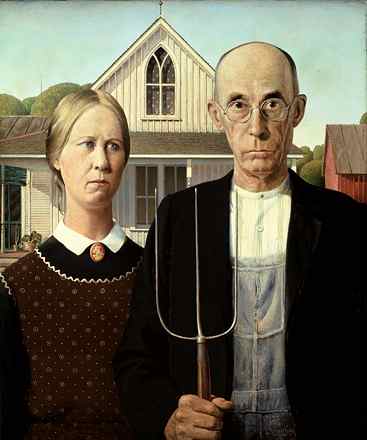
(above: Grant Wood, American Gothic, 1930, oil on beaverboard, 29 1/4 x 24 5/8 inches. Friends of American Art Collection. All rights reserved by The Art Institute of Chicago and VAGA, New York, NY, 1930.934) see Cedar Rapids Museum of Art Grant Wood At 5 Turner Alley)
Colorado's story was not the Midwest's. Its brand of Regionalism was forged from a different set of materials, shaped by a landscape that was less pastoral and more violent. This was a region defined by "purple mountains' majesty", but also by the "industrial ruins" of mining booms and the raw, ecological trauma of the Dust Bowl. The artists who rose to prominence here were not painting gentle nostalgia. They were capturing the energy of the rodeo, the "ghosts" of abandoned mining , and the profound, complex relationship between humanity and a sublime, often brutal, environment. This is the story of how Colorado, driven by a handful of visionary artists and a revolutionary art school, created a unique, muscular, and modern chapter in American art.
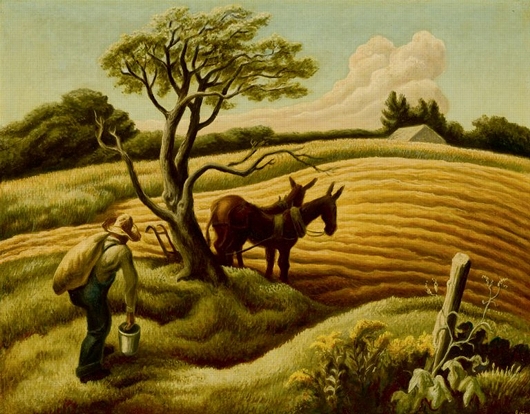
(above: Thomas Hart Benton, Noon, 1939, tempera and oil on board, 22 x 28 inches, Sothebys. Public domain, via Wikimedia Commons*)
The Dust and the Grandeur
To understand Colorado Regionalism, you first have to understand the Colorado of the 1930s. It was not the gentle, agrarian ideal of Iowa or Kansas. The state was reeling from a twofold catastrophe. First was the same economic devastation of the Great Depression that had crippled the rest of the nation. But Colorado's Eastern Plains were also the epicenter of an ecological disaster: the Dust Bowl. This was the "dirty thirties".Between 1930 and 1939, southeastern Colorado received 205 fewer inches of moisture than it had the previous decade. In Baca County, a region that had 237,000 acres of wheat in production in 1930, farmers harvested just 150 acres by 1936. Dust storms literally blacked out the sun, forcing towns to turn on street lights during the day, and "dust pneumonia" reached epidemic proportions.
This stark reality shaped a different artistic consciousness. While Midwestern Regionalism was often a "nostalgic" look at an idealized agrarian past, Colorado's artists were surrounded by a history that was more recent, more industrial, and more visibly haunting. The state's identity was built not just on farming, but on the boom-and-bust cycles of mining. This gave Colorado artists a "romanticized myth of American western culture" that had nothing to do with plows and hay bales. Their "American Scene" was one of ghost towns, high-altitude landscapes, and the dynamic, modern spectacle of the American cowboy. The challenge was not just to capture the "amber waves of grain," but to find a visual language for the state's "spacious skies" and "purple mountains majesty" , a task that had fascinated painters since Albert Bierstadt first romanticized them in the 1800s.
The New Deal's "Mural Machine"
This regional artistic impulse collided with a massive wave of federal funding. President Franklin Delano Roosevelt's New Deal, a sweeping agenda to rescue the country from the Depression, included an unprecedented number of programs to employ artists. The Public Works of Art Program (PWAP), the Treasury Section of Painting and Sculpture, and the Works Progress Administration (WPA) were designed to provide relief, but also to "boost morale" by making art accessible to all people. These programs commissioned thousands of murals for public buildings, especially post offices and libraries. Artists were explicitly encouraged to paint in the "American Scene" style -- realistic depictions of "ordinary citizens" and "uplifting subjects" that people knew and loved. This federal mandate for accessible, local art created a perfect economic engine for a regional movement. And in Colorado, one institution was uniquely positioned to become the West's "mural machine."
That institution was the Broadmoor Art Academy (BAA) in Colorado Springs. Founded in 1919, the BAA had already been attracting high-caliber artists to the Pikes Peak region, which was rivaling Taos and Santa Fe as a dynamic arts hub. But in the 1930s, under new leadership, it became a "major force in art instruction and national art activity". It became the very epicenter of Colorado Regionalism, training the artists who would go on to define the movement and fill the state's public buildings with their visions of the West.
Boardman Robinson: The Godfather of the Colorado Scene
The man who transformed the Broadmoor Art Academy was Boardman Robinson. A towering figure in every sense, Robinson was a nationally renowned muralist, cartoonist, and illustrator who was recruited from the Art Students League of New York to teach at the BAA in 1930. A year later, he took over as the school's director and completely remade it in his image. Robinson was a passionate believer in composition and draftsmanship, and he "took the preciousness out of art and make it an honest trade".When the New Deal art projects launched, Robinson, who had powerful connections, essentially turned the academy -- which became the Colorado Springs Fine Arts Center (CSFAC) in 1936 -- into a "western focal point" for the federal mural programs.
Robinson's influence was staggering. He developed a "mural-painting curriculum" that was so successful, it became a veritable factory for winning competitive federal commissions. Between 1936 and 1940, an astonishing forty murals were awarded to students and graduates of the CSFAC, and another twenty were won by its teachers.Robinson himself painted one of the state's most important murals, Colorado Stock Sale (1940), for the Englewood Post Office. This painting is a quintessential example of Colorado Regionalism. It takes the "American Scene" mandate -- a realistic depiction of local life -- and applies it to a subject that is pure Colorado: a horse auction. It is a masterful, muscular composition that dignifies a moment of contemporary Western commerce, a perfect reflection of the style and ethos he drilled into his students.
Frank Mechau: Champion of the Modern West
If Robinson was the godfather, Frank Mechau was the breakout star. A Colorado native who grew up in Glenwood Springs and attended the University of Denver, Mechau was the living embodiment of the new Western artist. He studied in New York and Paris, absorbing the lessons of European modernism, but he rejected the idea of becoming an expatriate. "America is the place for American artists," he declared, returning to Colorado in 1932 at the height of the Depression. He was a "champion" of the American West as a subject for modern art. He taught at the CSFAC alongside Robinson, and his influence was electric.
Mechau's talent was immediately recognized. The year 1934 was monumental for him. He received his first New Deal commission, the powerful Horses at Night, for the Denver Public Library. That same year, he became the first Colorado artist ever to be awarded the prestigious Guggenheim Fellowship. But his most important work was a painting that served as a bold declaration of artistic independence for the entire region. That painting was Rodeo #1 (1934) .
Rodeo #1, now in the Denver Art Museum, is Mechau's masterpiece. It's a massive canvas, over seven feet long, that depicts a vibrant, chaotic rodeo scene. Mechau submitted this painting to the 1934 Whitney Biennial in New York, a show dominated by East Coast artists and the "bleak representations of the Dust Bowl's effects". Mechau's painting was an act of artistic insurgency. It was not a "bleak" or suffering West. It was a "vibrant, energetic scene" that used his signature modern style -- simplified figures, strong lines, and a dynamic composition influenced by his study of the Italian Renaissance -- to "elevate western life to a grand scale". By sending Rodeo #1 to New York, Mechau was, as the Denver Art Museum notes, "boldly declar[ing] not only the vitality of the American West, but also the importance and viability of western subjects in modern American art".
The Prospectors: Charting the Ghosts of the Past
While Robinson and Mechau were building a heroic, masculine vision of the West in Colorado Springs, a second, quieter hub of Regionalism was forming 70 miles north. At the University of Colorado in Boulder, a collaborative of artists-most of them women-was exploring a completely different, though equally "Western," theme: the ghost town. In 1931, a group of five faculty members formed "The Prospectors," an art collaborative dedicated to "specializing in the emerging Regionalism art movement". The group included Gwendolyn Meux Waldrop, Frances Hoar Trucksess, Frederick Clement Trucksess, and Virginia True, but its most significant member was Muriel Sibell Wolle.
Muriel Sibell Wolle, a professor of fine art at the university, became the premier "artist as archivist" of the vanishing West. She was fascinated by the state's mining history and embarked on a lifelong quest to document its "ghost towns and mining camps". She sketched "over a thousand mining towns." racing against time to capture their "industrial ruins" before, as she feared, they "collapsed, burned down, or were torn down". Wolle's most important artworks are not giant murals, but her beloved books, which compiled these meticulous on-the-spot sketches. Works like Ghost Cities of Colorado (1933) and Stampede to Timberline (1949) are her legacy, a "pictorial record" of places like Central City and Nevadaville. This "little-studied" group of female artists, who were the "drivers of cultural life" in Boulder , created a different kind of Regionalism. If Mechau was painting the vitality of the modern West, Wolle was documenting the memory of its past.
The Magafan Twins: Prodigies of the American Scene
The two strands of Colorado Regionalism -- the heroic modernism of the CSFAC and the historical documentation of the Boulder school -- all came together in the remarkable story of Ethel and Jenne Magafan. Identical twins born in Chicago but raised in Colorado, the Magafans were artistic prodigies. A "terrific art teacher" at Denver's East High School, Helen Perry, recognized their talent and introduced them to Frank Mechau.They became Mechau's apprentices, assisting him on his murals, before enrolling at the Colorado Springs Fine Arts Center to study under both Mechau and Boardman Robinson.
The sisters were the ultimate products of the Colorado "mural machine" and became national stars of the New Deal art scene. At just 22, Ethel became one of the youngest artists in the country to receive a WPA mural commission. Together, they became prolific muralists, "driv[ing] all over the country in an old station wagon" to complete their commissions. The press adored them, writing stories about their "talent, good looks, and quirky habits". Their public art was a perfect, optimistic expression of the American Scene. Ethel's The Horse Corral (1942), a mural for the South Denver Post Office, is a clear and brilliant homage to her teacher, Mechau, full of motion and energy. Jenne's study for Cowboy Dance (1941), a mural in Texas, captures that same celebratory, vital spirit of the West.
But the Magafans' career also reveals the central tension of the entire Regionalist movement. Their public art, funded by the government, was required to be optimistic and "upbeat". Their private paintings, however, tell a different story. These works were described as "eerie," "surreal," and "disturbing". One critic specifically cited Jenne's 1943 painting, Deserted Street, as "a disturbing portrait of her twin in an abandoned mining town". This single image is a stunning revelation. It merges the two great Colorado themes. -- the vital artist and the ghost town -- and exposes the "psychological and physical tensions of the Great Depression and World War II" that lurked just beneath the sunny surface of the official "American Scene."
A Legacy Etched in Stone (and Canvas)
After World War II, the great "debate" over the future of American art was settled. The New York "pro-Modernist critics" won. Abstract Expressionism, a liberal, abstract style, became the "new American art". Regionalism, with its realistic, figurative storytelling, was "soundly rejected". It came to be seen as "politically problematic and retrogressive" , too close to the propaganda art of the regimes America had just defeated. The Colorado artists, sensing the change, moved on. The Magafan twins relocated to the Woodstock art colony in New York. Vance Kirkland became a celebrated abstractionist.The "American Scene" as a movement was over.
But the legacy of Colorado's unique chapter was permanent. The artists of the 1930s had succeeded in their primary mission: they forged a visual identity for their region that was authentic, modern, and entirely their own. They rejected the Midwestern agrarian model and gave the nation a new set of icons: the explosive energy of Mechau's rodeo, the haunting memory of Wolle's ghost towns, and the thundering vitality of the wild horse. But their greatest legacy was not just the art; it was the infrastructure. The institutions that Robinson, Wolle, and Kirkland built and led -- the Colorado Springs Fine Arts Center, the University of Colorado's art department, and the University of Denver's School of Art-became the permanent foundation for the state's future. They did more than just paint the local scene; they transformed Colorado from a seasonal "sketching ground" into a self-sustaining, vital, and permanent center for American art.
We lightly edited this article, added images and provided links to other materials to enhance it. AI is rapidly improving in accuracy, yet the article may have inaccurate information.
 Return to Colorado Art History
*Tag for expired US copyright of object image:

Links to sources of information outside of our web site are provided only as referrals for your further consideration. Please use due diligence in judging the quality of information contained in these and all other web sites. Information from linked sources may be inaccurate or out of date. TFAO neither recommends or endorses these referenced organizations. Although TFAO includes links to other web sites, it takes no responsibility for the content or information contained on those other sites, nor exerts any editorial or other control over them. For more information on evaluating web pages see TFAO's General Resources section in Online Resources for Collectors and Students of Art History.
Copyright 2025 Traditional Fine Arts Organization, Inc. an Arizona nonprofit corporation. All rights reserved.