
From Pikes Peak to the Mind's Eye: A History of Colorado Art, 1925-2000
by Gemini 2.5 Pro
To understand the story of art in Colorado one must first understand the land itself. The state's artistic identity is built on a fundamental duality: a tension between the staggering, undeniable physical reality of its geography and the potent, romantic mythology of the American West. This tension is the engine that powered the region's great stylistic shifts, from the crisp Realism of its early days to the narrative-driven Regionalism of the Great Depression and the psychological explorations of Modernism.
The landscape was the obvious, inescapable starting point. Artists described Colorado's "mountainous glory" as a veritable "paradise for painters." The "spectacular view of Pikes Peak," for example, was a central feature of the Broadmoor Art Academy, naturally encouraging en plein air painting and the development of what the New York Times had, even by 1920, identified as an "admirable chance to develop a fresh and strong school of landscape painting". But Colorado artists were not just painting a place; they were interpreting an idea. Their work was immediately filtered through the "increasingly prevalent romanticized myths of American western culture". This mythology was specific, differentiating Colorado's art from other landscape traditions. It was a recent, contested history, obsessed with the "ghosts of Indians, mountain men, and pioneers". This fascination with a romanticized past was, in itself, a form of erasure. The reverence for "empty landscapes" and "ghosts" allowed artists to treat the land as a "blank canvas," overlooking the "deep history and Native peoples who had populated them". This act of constructing a specific, nostalgic identity, born from the friction between the real land and the powerful myth, became the raw material for the 75-year artistic journey to come.
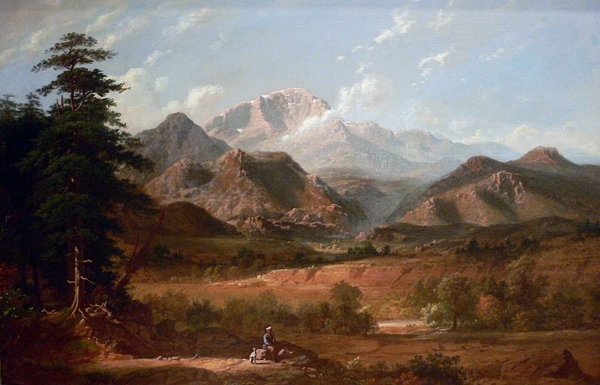
(above: George Caleb Bingham, View of Pike's Peak, 1872, oil on canvas, 28.1 x 42.2 inches, Amon Carter Museum of American Art,1967.27. Public domain, via Wikimedia Commons)
The year 1925 marks the moment this raw potential began to professionalize. The scattered, romantic impulses of individual artists were consolidated by the creation of powerful, competing institutions that forged a true, professional art scene. These "crucibles" provided the infrastructure that allowed Colorado to transition from a frontier painting destination into a nationally recognized hub for both Regionalism and Modernism. The first, and arguably most foundational, was the Broadmoor Art Academy (BAA) in Colorado Springs. By 1925, the BAA, which had been founded in 1919, was already a "major force in art instruction and national art activity," one that "rivaled Taos". It attracted a stunning roster of high-caliber national artists as instructors and students, including Birger Sandzén, Ward Lockwood Frank Mechau, and Adolf Dehn. Rooted in the Pikes Peak landscape tradition, the BAA became the natural home for the state's powerful Regionalist impulse. A second center of gravity formed in 1929, when the artist Vance Kirkland arrived in Denver to become the "founding director of the University of Denver's new art school". This established a two-pole system in the state: the BAA in the south, grounded in the landscape, and the new university program in Denver, led by a man who would become a tireless academic and fearless Modernist experimenter. This dual-hub structure explains how two seemingly competing styles, Regionalism and Modernism, could develop simultaneously and with such vigor.
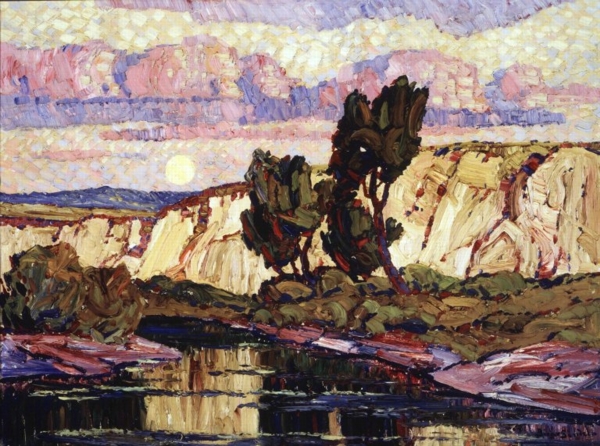
(above: Birger Sandzén (1871-1954), Creek at Moonrise, c. 1921, oil on canvas, 35.8 x 48 in. Brooklyn Museum, gift of Dr. and Mrs. Henry Goddard Leach. Public domain, via Wikimedia Commons)
The first of these styles to dominate the state, Regionalism, was not an arbitrary aesthetic choice. It was a direct response to a national crisis. The Great Depression provided a new, urgent purpose for the "romantic myths" that had long defined Colorado's identity. The New Deal art programs, designed to create a relatable "American Scene" and provide artist relief, found fertile ground in the BAA. In fact, BAA instructor George Biddle "proposed a program for artist relief through murals to his former classmate, Franklin Delano Roosevelt". Under the leadership of its new director, the muralist Boardman Robinson, the BAA became nationally "recognized for... American Regionalism" and a "Western focal point for Works Progress Administration mural projects".
This new movement was defined by specific artists and collectives. In 1931, the art collaborative The Prospectors was co-founded by Gwendolyn Meux Waldrop. This group specialized in the "emerging Regionalism art movement, also referred to as American Scene Painting". Their work, described as "vintage regional paintings", was built on a manifesto that explicitly "claimed inspiration from... the ghosts of Indians, mountain men, and pioneers", directly connecting the 19th-century myth to the 1930s style.
One of the most important artists from this group was Muriel Sibell Wolle (1898-1977). A professor of fine arts at the University of Colorado and a member of The Prospectors, Wolle created a uniquely Colorado-specific form of Regionalism. She was an artist-historian. She "visited and sketched over a thousand mining towns in the American West," becoming one of the nation's first and most prolific "ghost town" chroniclers. Her work captured the "industrial ruins" of the 19th-century mining boom, a core theme of Colorado's identity. Her lithograph Gladstone, Colorado is a perfect example of her style. Its importance lies not in formal innovation but in its archivalimpulse. Wolle was visually preserving the very "ghosts" the Regionalists revered, documenting a past of boom and bust that differentiated Colorado's story from the agrarian pastoralism of the Midwest.
If Wolle documented the state's past, Ethel Magafan (1916-1993) embodied the success of its new art institutions. Magafan grew up in Colorado Springs and was a direct product of the BAA, where she studied composition and mural painting under Frank Mechau and Boardman Robinson. She became a prolific national muralist for the New Deal's Section of Fine Arts. Her most important artwork in the state is The Horse Corral, a 1942 mural for the South Denver, Colorado Post Office . This work is a perfect synthesis of the Colorado Regionalist style. It features dynamic, muscular horses and laborers, a favorite subject of her teacher, Mechau. It celebrates the "American Scene" with a distinctly Western, non-agricultural flavor. Its federal commission demonstrates how the regional style developed at the BAA became part of the national visual language.
The climax of this era, and arguably the single most important event in the 75-year history, was the 1936 opening of the Colorado Springs Fine Arts Center (CSFAC). The BAA, having achieved national recognition for its American Regionalism, had "outgrew its former home". Funded by philanthropist Alice Bemis Taylor, the new CSFAC was a "temple on the bluff," a revolutionary institution that was, in itself, a complete thesis on the state of Colorado art. The building's design by John Gaw Meem was a "revolutionary" fusion of styles, a "Pueblo-style monolithic poured concrete structure" that boldly integrated "Southwestern, Art Deco, and Classic architectural elements". It was, physically, a blend of the regional and the modern.
The art commissioned for the building proves this point. It shows that in 1936, these styles were not sequential; they were simultaneous and fused. The institution's director, Boardman Robinson (1876-1952), the very "father" of the BAA's Regionalist school, created the most important public-facing work: five frescoes over the main entryway. These murals, depicting the "five arts" (sculpture, drama, dance, music, art), are described as being executed in a "faintly cubistic style". This is a monumental detail. The state's leading Regionalist was using a Modernist (Cubist) vocabulary for his signature commission, proving the styles were actively blending.
This blend is visible throughout the building. In the courtyard, fellow BAA instructor Frank Mechau painted a massive, 60-foot "fresco composition of horses". This was a premier example of the dynamic, Western-themed Regionalism he championed. But inside, the story changed. In the auditorium, the Denver sculptor Arnold Rönnebeck (1885-1947) created "three panels in aluminum" over the doors, depicting "Pueblo and Hopi Indian Kachina masks."This was pure Modernism. The industrial material (aluminum) and the direct, non-romanticized depiction of indigenous art represented a significant leap beyond the Regionalists' "ghosts." This was confirmed in the theatre lobby, where the CSFAC commissioned the leading Taos Modernists Andrew Dasburg, Kenneth Adams, and Ward Lockwood to paint the "Art Deco style murals". A visitor in 1936 would, therefore, walk past Robinson's Regionalist-Modernist blend, into a courtyard of pure Regionalism, and then inside to find Rönnebeck's Indigenous Modernism and Dasburg's European-style Art Deco. The CSFAC was not a provincial outpost; it was a sophisticated institution that saw all these styles as part of one vibrant, contemporary conversation.
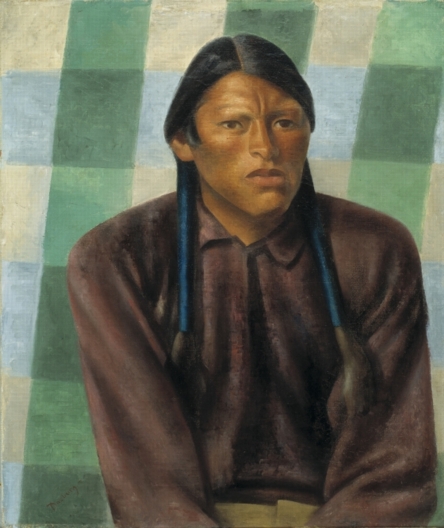
(above: Andrew Dasburg, Bonnie, 1927, oil on canvas, 26 x 22 inches, Denver Art Museum, The Lucile and Donald Graham Collection, 1981.624)
While the CSFAC tells the public story of Modernism's arrival, Vance Kirkland (1904-1981) tells the personal one. His career is the stylistic evolution in miniature. When he arrived in 1929 as the founding art director at the University of Denver, he "began his career painting realistic landscapes in watercolor", aligning himself with the state's dominant tradition. But Kirkland was an intellectual who "never want[ed] to get comfortable in his art". His painting evolved through five distinct periods, moving from Realism to, crucially, Surrealism.
The key work from this Modernist, non-abstract phase is Woden's Ring, painted in 1945. This "Surrealist watercolor and gouache paint on paper" is explicitly described as a "nightmare landscape". The date and description are profoundly important. It was painted in the final, traumatic year of World War II. This reveals the other great driver of stylistic change. While the Great Depression fueled the nostalgic, backward-looking impulse of Regionalism, the global trauma of World War II made that style feel insufficient. Woden's Ring represents a total break from the Colorado tradition. It is a "landscape," but it is not Pikes Peak. It is the internal, psychological landscape of the subconscious, rendered in the international language of Surrealism. While Muriel Sibell Wolle was documenting the past, Vance Kirkland was grappling with the "nightmare" of the present. His work is the pivot point, showing a leading Colorado artist turning away from the purely regional and embracing the universal language of Modernism.
This traditional history, however -- one defined by men like Robinson, Mechau, and Kirkland -- is incomplete. In recent years, groundbreaking research has revealed a parallel history of "trailblazing" female artists whose contributions were "overlooked and erased". A 2016 exhibition at the University of Denver, "Early Women Artists of Colorado," was the culmination of a two-year research project by 32 advanced students and their professor, Annette Stott. This project, a long-term research partnership with the Kirkland Museum of Fine & Decorative Art, uncovered "surprising information" about eighteen "imaginative, determined early women artists." This research revealed they were not hobbyists, but "career artists, mothers, educators, institutional founders, wives, commercial artists, and trailblazers", categorized in the exhibition into groups like "Revolutionary Artist-Educators". This new context re-centers artists like Gwendolyn Meux Waldrop, one of the 18 women studied, confirming that her role as a co-founder of the Regionalist group The Prospectors was central, not peripheral. This evolving understanding shows that women were not just participants but "institutional founders" in a dynamic, mutually supportive community.
By the year 2000, the 75-year arc of Colorado art had completed its journey. The scene had evolved from one of identity creation to one of mature self-reflection. The institutions born in the 1920s and 30s -- the CSFAC, the Denver Art Museum, and the University of Denver -- were now historical entities themselves, actively curating and analyzing their own "rich artistic heritage". The period is marked by this self-reflection, with institutions mounting historical surveys like "Colorado Abstract +10: A History" and the "Early Women Artists" research. The Kirkland Museum of Fine & Decorative Art, which preserves the studio and legacy of Vance Kirkland, became a key repository for this entire story, from 19th-century Realism to 20th-century Modernism. The eventual merger of the Kirkland with the Denver Art Museum symbolized this final consolidation, as the "rich collections of Colorado art" were fully integrated into the state's flagship museum. The story that began in 1925 with an art of documentation, capturing a "paradise for painters", had transitioned through an art of myth-making in the 1930s, and an art of introspection in the 1940s. By 2000, it had become an art of historical analysis, as a mature cultural scene looked back to rediscover its own complex and "erased" histories, finally securing its legacy.
We lightly edited this article, added images and provided links to other materials to enhance it. AI is rapidly improving in accuracy, yet the article may have inaccurate information.
Our prompt to Gemini 2.5 Pro:
Write 1,500 to 2,000 words in a conversational style about the history of Colorado art, including regionalism, modernism and realism from 1925 through 1925. Use only paragraphs and don't use bullet points or tables. Explain why styles changed. Note anything special such as geography, events and other subject matter that differentiated Colorado art from other states.
Identify artists deemed most important during these years and explain why. For each artist, discuss his or her most important artworks and why each is important. Do not include abstract expressionist artworks. For your research, use only.org and .edu websites Do not research .com websites.
 Return to Colorado Art History
*Tag for expired US copyright of object image:

Links to sources of information outside of our web site are provided only as referrals for your further consideration. Please use due diligence in judging the quality of information contained in these and all other web sites. Information from linked sources may be inaccurate or out of date. TFAO neither recommends or endorses these referenced organizations. Although TFAO includes links to other web sites, it takes no responsibility for the content or information contained on those other sites, nor exerts any editorial or other control over them. For more information on evaluating web pages see TFAO's General Resources section in Online Resources for Collectors and Students of Art History.
Copyright 2025 Traditional Fine Arts Organization, Inc. an Arizona nonprofit corporation. All rights reserved.