
AI Curiosities
A Century on Canvas: Charting Virginia's Artistic Soul, 1840-1940
by Gemini 2.5 Pro
The Commonwealth at a Crossroads
In 1840, the Commonwealth of Virginia stood as a society of profound contradictions. It was a cradle of American democracy, yet its economy was inextricably bound to the institution of chattel slavery. Its cultural identity was fiercely American, yet its planter class looked eastward, emulating the manners and tastes of the British aristocracy. This complex social fabric found its most potent expression on the canvases of its artists. The history of painting in Virginia during the century from 1840 to 1940 is not merely a chronicle of shifting aesthetic preferences; it is a vivid and often poignant reflection of the state's tumultuous journey through the final years of the Old South, the cataclysm of the Civil War and Reconstruction, and the uncertain dawn of the modern age.
This period witnessed a dramatic evolution in what Virginia's artists and patrons deemed worthy of representation. The artistic narrative arcs from a near-total preoccupation with lineage, captured in the formal portraiture of the antebellum elite, to a post-war discovery of the land, as artists sought solace and a new identity in the state's picturesque landscapes. Finally, it culminates in an embrace of light, as a new generation of internationally trained painters brought the vibrant palettes of Impressionism, Post-Impressionism and the bold compositions of Modernism to the Old Dominion. To trace this evolution is to witness a society grappling with its past, present, and future, rendering its very soul in oil and pigment.

(above: George Cooke (1793-1849), Patrick Henry arguing the "Parson's Cause," c. 1834. Courtesy of the Virginia Historical Society, Richmond, Virginia. Public domain, via Wikimedia Commons)
Part I: The Antebellum Easel: Portraiture as Power and Progeny (1840-1861)
Before the Civil War, the story of painting in Virginia was overwhelmingly the story of the portrait. For the state's wealthy planter class, a portrait was more than a likeness; it was a declaration of status, a record of dynastic succession, and a crucial instrument in the construction of a carefully curated identity. The demand for these canvases supported a class of itinerant and seasonal artists, who traveled through the upper South in search of commissions from families eager to see themselves immortalized. Within this dominant genre, two distinct stylistic currents emerged, embodied by the era's two most significant portraitists: Thomas Sully and George Caleb Bingham. The preference for one style over the other reveals a fundamental tension within the antebellum Virginian psyche.
Thomas Sully, the acclaimed master of the period, offered his patrons a vision of romantic, aristocratic grace. Having spent his youth in the South and trained in England under the influence of Sir Thomas Lawrence, Sully's style was described as "warm, lush," and glamorous. His portraits, with their bravura brushwork and rich colors, appealed directly to the planter class's self-image as a landed gentry in the European tradition. To commission a Sully was to align oneself with Old World elegance and cultural sophistication.
In stark contrast stood the work of the Virginia-born George Caleb Bingham. During his periods of activity in the state, particularly while based in Petersburg from 1840 to 1844, Bingham practiced a "flat geometric realism" often called the "plain painter" style. Unlike his more romantic contemporaries, Bingham did not soften contours or idealize his subjects. His portraits are direct, robust, and unvarnished, presenting sitters with a stoic and pragmatic honesty. This style resonated with the other side of the Virginia gentry's identity: that of the self-reliant, grounded American landowner.
The simultaneous flourishing of these two opposing styles is telling. The same elite class that sought Sully's lush romanticism also desired Bingham's plainspoken realism. This duality in artistic taste was not a simple matter of varied supply; it was a reflection of a divided soul. The Virginia planter saw himself as both a worldly aristocrat and a rugged American individualist. The choice of a portraitist was, therefore, an act of identity curation. In commissioning a Sully, a patron projected an image of refined lineage and European sensibility. In commissioning a Bingham, he presented himself as a man of the soil, a master of his domain, embodying a distinctly American form of power.
Part II: A Land Remade: Landscape, Memory, and Genre After the War (1865-1900)
The Civil War irrevocably shattered the world that had sustained the tradition of antebellum portraiture. With the plantation economy destroyed and its social order upended, Virginia's artists and patrons turned their gaze away from the human face and toward the land itself. In the state's rolling hills and tranquil valleys, they sought not just new subject matter, but "spiritual recovery" and a way to forge a new, more pastoral identity. This period saw the rise of landscape painting, alongside the emergence of genre scenes that attempted to make sense of the new, complex social realities of the post-war South.
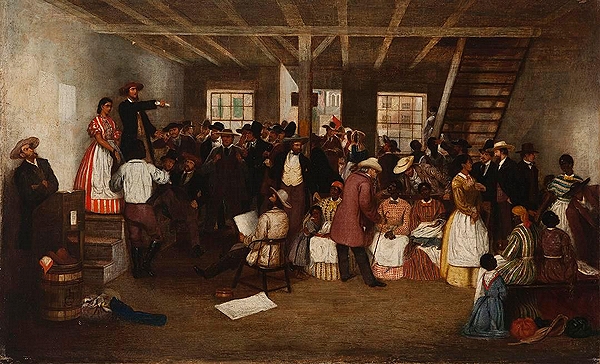
(above: Lefevre James Cranstone (1822-1893, Slave Auction, Virginia, c. 1862, oil on canvas, 11.75 x 19.50 in. Courtesy of the Virginia Historical Society, Richmond, Virginia. Public domain, via Wikimedia Commons)
A powerful influence was the 19th-century "worship of nature," which manifested in a surge of interest in the "picturesque landscape". The idea was not to render nature with photographic accuracy, but to compose a scene "like a picture," often by altering landscape features to create a more harmonious and emotionally resonant view. This impulse was amplified by the influence of the French Barbizon School, whose artists painted idealized scenes of a simpler, rural past. This aesthetic found fertile ground in Virginia, inspiring a group of painters sometimes referred to as the "Washington Landscape School".
No artist better exemplifies this movement than Richard Norris Brooke. After studying in Paris and absorbing the Barbizon ethos, Brooke returned to his native Warrenton to paint the Virginia landscape as a source of "inspiration and renewal" in an age of unsettling industrialization and social change. His work, and that of his contemporaries, represented an attempt to reconstruct a Virginian identity rooted in the timeless beauty of its natural environment.
At the same time, another group of artists was engaged in a different kind of reconstruction -- that of memory. Painters like John Adams Elder, a Confederate veteran from Fredericksburg, dedicated their careers to memorializing the war. His dramatic battle scenes and poignant depictions of Confederate soldiers became foundational images for the burgeoning "Lost Cause" mythology, a narrative that sought to frame the Southern cause as noble and its defeat as tragic and heroic.
This era also saw the rise of a uniquely Virginian form of genre painting. Richard Norris Brooke, in addition to his landscapes, gained national acclaim for his deeply humanistic and sympathetic scenes of African American life. In works like A Pastoral Visit, he deliberately chose to depict his Black subjects with a dignity and "sober and truthful treatment" that stood in stark opposition to the prevalent racist caricatures of the time.
The art of post-war Virginia was thus a landscape of competing visions for the future, fought on canvas. The heroic, memorializing art of John Adams Elder sought to redeem the past and solidify a Confederate identity for a defeated people. In contrast, the work of Brooke -- both his healing landscapes and his groundbreaking genre scenes -- looked toward a different future. His art found solace in nature and, crucially, acknowledged the shared humanity of all Virginians, including its newly freed African American citizens. These were not merely different artistic choices; they were competing blueprints for the cultural and spiritual reconstruction of the Commonwealth.
Part III: New Light for the Old Dominion: Impressionism and Modernism Arrive (1900-1940)
As the 20th century began, Virginia's art scene underwent another profound transformation. Having spent the previous decades absorbing and adapting 19th-century European styles, the state became an active participant in the international dialogues of Impressionism and Modernism. This shift was driven not by Virginians traveling abroad, but by world-class artists choosing to make the Commonwealth their home, bringing with them a modern, cosmopolitan vision.
The most prominent of these was Gari Melchers, an artist of international renown who settled at his country estate, Belmont, in Falmouth in 1916. Trained in Germany and France, Melchers had moved beyond academic realism to embrace a "modified impressionist style" defined by "vibrant color, natural lighting, loose, textural brushwork and pattern". He applied this sophisticated, modern sensibility to the subjects around him, painting the people and landscapes of his adopted home. His works included sensitive "negro studies" that captured the spiritual life of the local African American community, viewing his subjects through a lens of modern humanism.
An even more direct infusion of European modernism came with the arrival of Pierre Daura. Arguably the "greatest artist active in Virginia in the twentieth century," Daura was a Spanish painter who had been deeply involved in the modernist movements of Paris. Wounded fighting against Franco in the Spanish Civil War and stripped of his citizenship, he was visiting his wife's family in Virginia when World War II erupted, compelling him to stay. In the mountains of Rockbridge County, he found a refuge from the turmoil of Europe. Daura began to paint the local landscape and its people, uniquely adapting a "modernist's understanding of composition and color to traditional subject matter". His stated goal was to "rekindle the worship of nature," a 19th-century impulse filtered through a thoroughly 20th-century aesthetic.
For both Melchers and Daura, Virginia became a sanctuary. Melchers, returning to America after a long and successful expatriate career, found in Falmouth a peaceful place to apply his mature, light-filled style. Daura, a political refugee, found in the serenity of the Blue Ridge Mountains the stability to process his trauma and create a powerful synthesis of modernist principles and regional subjects. Their presence transformed Virginia's art scene. In the 19th century, Virginian artists had to leave for Europe to find their voice. In the early 20th century, European-trained masters came to Virginia to find refuge and a new sense of place, turning the Old Dominion into an unlikely and dynamic haven for modernist expression.
Part IV: Six Virginia Masters: A Biographical Portfolio
The century between 1840 and 1940 was defined by a remarkable cohort of artists who either hailed from Virginia or chose to make it their home. Their collective work tells the story of the state's artistic evolution, from the formal realism of the antebellum era to the vibrant modernism of the early 20th century. The following six figures were instrumental in shaping the art of the Commonwealth.
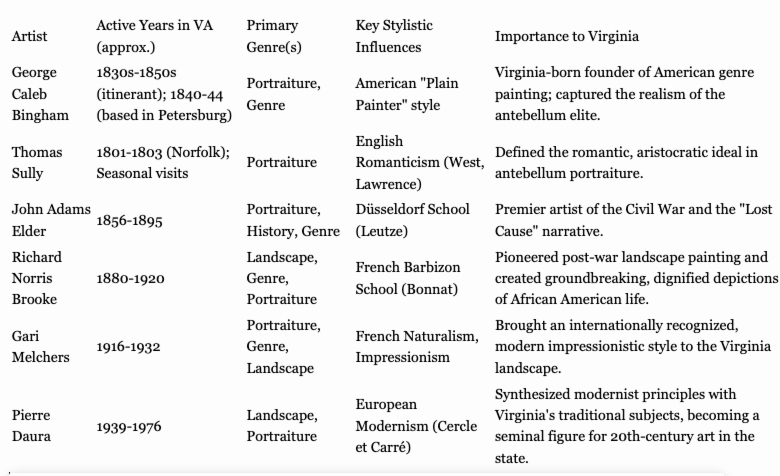
George Caleb Bingham (1811-1879)
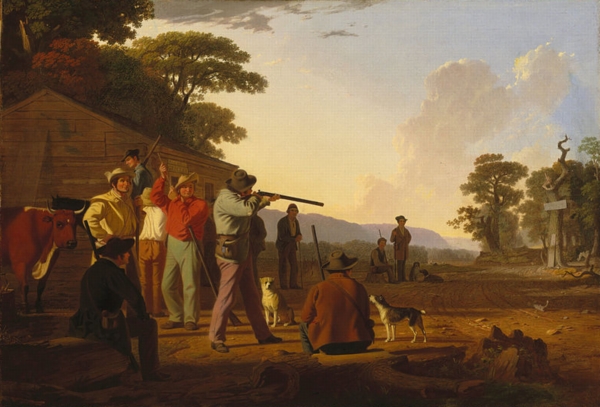
(above: George Caleb Bingham, Shooting for the Beef, c. 1850, oil on canvas, 33.3 x 49 inches, Brooklyn Museum, Dick S. Ramsay Fund, 40.342. Public domain, via Wikimedia Commons*)
Thomas Sully (1783-1872)
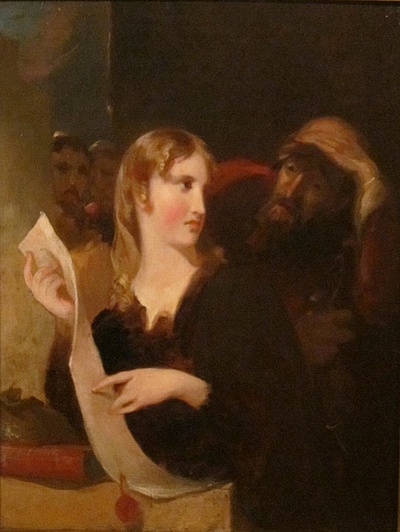
(above: Thomas Sully, Portia and the Merchant of Venice, 1836, oil on wood panel (recto and verso), 22.37 x 17.93 inches, Cincinnati Art Museum. Public domain, via Wikimedia Commons*)
·
John Adams Elder (1833-1895)
Richard Norris Brooke (1847-1920)
Gari Melchers (1860-1932)

(above, Gari Melchers, Joan of Arc, oil on canvas, 30 x 23 inches, Indianapolis Museum of Art. Public domain, via Wikimedia Commons*)
Pierre Daura (1896-1976)
From Likeness to Landscape to Light
The century from 1840 to 1940 was one of profound and often violent transformations for the Commonwealth of Virginia, and its art provides an unparalleled record of that journey. The evolution of its dominant painting genres charts a clear and telling progression. It began with an art of likeness, where the formal portraiture of Bingham and Sully served to codify the lineage and power of a confident, slave-holding aristocracy. It was shattered by war and remade into an art of the landscape, as painters like Brooke sought healing in the pastoral ideal, while artists like Elder sought to mythologize the conflict that had redefined their world. Finally, with the arrival of world-class talents like Melchers and Daura, it became an art of light, as the brilliant palettes of Impressionism and the structural clarity of Modernism were brought to bear on the timeless subjects of the Virginia scene.
By 1940, the artistic landscape of Virginia was unrecognizable from what it had been a century earlier. No longer a provincial outpost reliant on itinerant painters, it had become a dynamic and surprisingly modern center of creation. It was a place where local character and global currents converged on the canvas, creating a rich, complex, and enduringly fascinating chapter in the history of American art.
Please don't rely on this AI-generated
text for accuracy. It has been edited, yet may have inaccurate information.
Links are ours. Nonessential parts of the report were deleted.
Our prompt to Gemini 2.5 Pro:
 Return to Virginia Art History
Return to AI Curiosities
Links to sources of information outside of our web site are provided only as referrals for your further consideration. Please use due diligence in judging the quality of information contained in these and all other web sites. Information from linked sources may be inaccurate or out of date. TFAO neither recommends or endorses these referenced organizations. Although TFAO includes links to other web sites, it takes no responsibility for the content or information contained on those other sites, nor exerts any editorial or other control over them. For more information on evaluating web pages see TFAO's General Resources section in Online Resources for Collectors and Students of Art History.
Copyright 2025 Traditional Fine Arts Organization, Inc. an Arizona nonprofit corporation. All rights reserved.