
South Carolina Art History: A Century of Light and Spirit, 1845-1945
by Gemeni 2.5 Pro
Page 2
The Impressionist Moment: Capturing the Fleeting Southern Light (1890-1920)
As the 19th century closed, a new artistic force arrived from France, one that shifted the focus from the moody interiority of Tonalism to the objective, scientific observation of the external world. Impressionism was a revolution in light and color. Its practitioners moved their easels outdoors -- en plein air -- to capture the fleeting, momentary effects of sunlight on a landscape, using broken brushstrokes and a vibrant palette to record their optical sensations. American artists, many trained in Paris, adapted this new language to create a "uniquely American expression" of the style.
South Carolina, with its brilliant coastal light, lush subtropical gardens, and picturesque historic cityscapes, became an irresistible destination for this new generation of painters. The state was no longer just a repository of memory but a vibrant, living subject full of light and color waiting to be captured. The importance of the movement in the region is underscored by exhibitions such as "Impressionism and the South" at the Greenville County Museum of Art.
One of the foremost American Impressionists, Childe Hassam (1859-1935), was drawn to the South in the mid-1920s. A peripatetic and patriotic painter, Hassam sought out quintessentially American locales, and in Charleston, he found a wealth of inspiration. His paintings from this visit demonstrate his fascination with "flickering light on the surface of buildings," a central concern of Impressionism. His presence in the city helped solidify its status as a significant site within the broader landscape of American art.

(above: Childe Hassam, Notre Dame Cathedral, Paris, 1888, oil on canvas, 43.82 x 54.93 cm, Detroit Institute of Arts. Public domain, via Wikimedia Commons*)
Additional paintings by Childe Hassam
Another key artist was William Posey Silva (1859-1948). A Georgia native who began his professional art career at the age of 48, Silva studied in Paris before eventually settling in the burgeoning art colony of Carmel, California. (Please click here to view artworks by artists affiliated with the Carmel colony.). Despite his West Coast home, he maintained strong ties to the Southeast, making frequent painting trips in the 1920s and becoming an active participant in the Charleston Renaissance.

(above: William Posey Silva, Cabins, South Carolina Low Country, 1935, oil on canvas mounted on Masonite, 25.1 x 30 inches, Johnson Collection, Spartanburg, South Carolina. Public domain, via Wikimedia Commons*)
He was captivated by the beauty of the Lowcountry, producing a series of luminous, sun-drenched Impressionist canvases of Magnolia Plantation, a place he evocatively termed the "Garden of Dreams". His work, with its rapid, colorful brushstrokes, perfectly captures the spontaneous, light-filled aesthetic of the movement.
The regional network of Impressionist painters also included figures like Catherine Wiley (1879-1958), a leading artist from East Tennessee whose work was exhibited in South Carolina. Described as a "characteristically American adaptation of Monet's Impressionism," her canvases feature "jewel-like hues and lively impasto brushwork" in sun-drenched outdoor scenes.
The arrival of artists like Hassam and Silva, and the exhibition of work by regional figures like Wiley, marked an important shift. It signaled South Carolina's transition from a place of introspective nostalgia to a dynamic subject for a modern, nationally-focused art scene, integrating the state's unique beauty into the broader story of American Impressionism.
The Charleston Renaissance: A Regional Identity Forged in Art (1915-1940)
In the years between the two World Wars, a remarkable cultural flowering took place in Charleston, a movement now known as the Charleston Renaissance. This period represented a highly localized and successful expression of the broader Regionalist movement, which saw artists across the country turn away from European modernism to focus on realistic scenes of rural and small-town America. In Charleston, this impulse manifested as a conscious and collective effort to preserve and celebrate the city's unique architectural and cultural heritage, fostering a vibrant arts community and a sustainable economy built on its distinctive charm.
The artists of the Renaissance were captivated by the authentic character of the Lowcountry. They painted its iconic scenery, from historic streetscapes to marshlands dotted with live oaks and former slave cabins. Their work often carried a romantic sensibility, a legacy of the Tonalist painters who preceded them, but with a new focus on documenting a fragile way of life.
Within this movement, the theme of classic virtues found expression not in grand allegorical paintings, but in more subtle depictions of human dignity, professional camaraderie, and civic responsibility. Elizabeth O'Neill Verner (1883-1979), a Charleston native and a matriarch of the Renaissance, exemplified this civic virtue. After her husband's death in 1925, she supported her family through her art, creating an extensive body of etchings and pastels that documented the city's architectural treasures. Her work with historic preservation causes can be understood as a profound act of kindness to her community -- a dedicated effort to safeguard its heritage for future generations.
The movement also attracted artists from afar. Alfred Hutty (1877-1954), an established Impressionist painter from Woodstock, New York, visited Charleston in 1919 and was so enchanted that he famously cabled his wife, "Come quickly. Have found heaven." He became a central figure, teaching at the Carolina Art Association and helping to found the Charleston Etchers' Club. His detailed prints of Lowcountry landscapes and its African American residents brought unprecedented national attention to the city and its burgeoning art scene.

(above: Alfred Hutty, Magnolia Gardens, 1920, oil on canvas, 39.87 x 31.75 inches, Gibbes Museum of Art. Public domain, via Wikimedia Commons*)
Perhaps the most poignant expression of virtue can be found in the portraiture of Edwin Harleston (1882-1931). As a leading African American artist in Charleston, his work was essential to the period. His 1930 Portrait of Aaron Douglas, a major figure of the Harlem Renaissance, is more than a masterful likeness; it is a powerful document of friendship, mutual respect, and professional solidarity between two Black artists navigating a segregated world. This act of recognition and support is a profound form of kindness and a charity of the spirit, celebrating the shared creative endeavor that transcended social barriers. The Charleston Renaissance was, in essence, a carefully constructed cultural project that successfully branded the city, blending nostalgia with an accessible aesthetic that created an enduring artistic legacy.
The Stirrings of Modernism: New Forms for a New Century (1915-1945)
While the Charleston Renaissance looked to preserve the past, a new and disruptive artistic force was making its way into South Carolina. Modernism was defined by a "self-conscious break with previous genres," a radical departure from representational art that was fueled by European movements like Fauvism, Cubism, and Surrealism. In South Carolina, modernism did not evolve organically from prior movements but arrived as a series of distinct, often startling, interventions that created a dynamic tension between tradition and innovation.
A watershed moment occurred in 1936, when the Gibbes Museum of Art hosted the first-ever public showing of Solomon R. Guggenheim's collection of non-objective modern art. This monumental exhibition, featuring works by Wassily Kandinsky, Marc Chagall, and Pablo Picasso, brought the European avant-garde directly to the heart of Charleston, presenting a stark and challenging contrast to the prevailing Regionalist aesthetic.
The state's most significant contribution to the movement came from a native son, William H. Johnson (1901-1970). Born in Florence, Johnson's artistic journey is a powerful narrative of American Modernism. After academic training in New York, he traveled to Europe, where he absorbed the lessons of Expressionism. Upon his return to the United States in 1938, his art underwent a dramatic transformation. He abandoned European styles for a powerful, "primitive" folk aesthetic characterized by flat planes of bold color and simplified forms. His late work drew heavily on his memories of the African American experience in rural South Carolina, creating a unique and deeply personal modern art that was both narrative and abstract, celebrating his heritage with vibrant intensity.
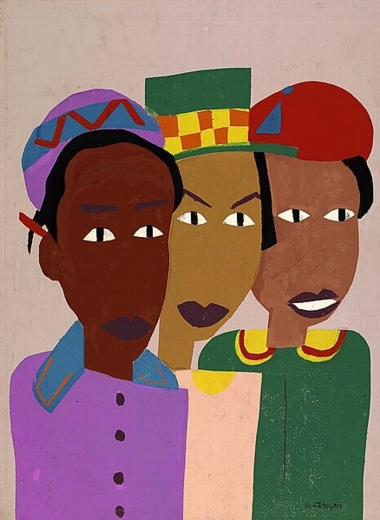
(above: William H. Johnson, Three Friends, c. 1944-45, screenprint on paper, 15 7/8 x 11 5/8 inches, Smithsonian American Art Museum. Public domain, via Wikimedia Commons*)
While Johnson forged his modernism abroad, a flicker of it was already present in Charleston. Edward I.R. Jennings (1898-1929) was a tragic figure who stood apart from his Renaissance contemporaries. In his short career, he defied "conventional styles of realism," creating imaginative and fanciful landscapes that verged on Surrealism and experimenting with Cubism. His bold forays into abstraction before his suicide in 1929 represent a pioneering local modernism that was largely overshadowed by the dominant representational style of the era.
The radicalism of European modernism was also seen in the state through traveling exhibitions. Alfred Maurer: The First American Modern, shown at the Greenville County Museum of Art, told the story of Alfred Maurer (1868-1932), an artist who made a dramatic shift from an award-winning Tonalist style to the brilliant, explosive color of Fauvism after his time in Paris. Maurer's embrace of painting with "brilliant color applied straight from the tube to create an emotional response" exemplified the revolutionary spirit that was challenging artistic traditions across the world. South Carolina's engagement with Modernism was thus a complex dialogue between a powerful local culture of preservation and the arrival of radical new ideas from both its own artists returning from abroad and from the wider art world.

(above: Alfred Henry Maurer, Flowers
in a Vase, 1932, oil on wood panel,, Phoenix Art Museum.
Public domain, via Wikimedia Commons*)
A Lasting Legacy
The century of artistic expression in South Carolina from 1845 to 1945 reveals a profound and dynamic evolution. It was a period in which the state's singular landscape and deeply rooted cultural identity served as a constant wellspring of inspiration, continuously reinterpreted through the successive and often overlapping lenses of America's major artistic movements.
The journey began with the idealized portraits and sublime landscapes of Romanticism, which sought to capture a genteel and divinely ordered world. It then moved inward with the atmospheric, memory-laden canvases of Tonalism, a style that seemed perfectly matched to the ethereal light of the Lowcountry and offered a poetic response to the upheavals of the post-Civil War era.
With the arrival of Impressionism, the focus shifted outward, as artists applied a modern, scientific approach to capturing the fleeting effects of Southern light, integrating the state into a vibrant national art scene. This engagement with the wider world culminated in the Charleston Renaissance, a powerful expression of American Regionalism that skillfully blended artistic preservation with economic renewal. Finally, the disruptive force of Modernism challenged these traditions, introducing new, abstract languages that pushed the boundaries of expression.
Throughout this transformative century, a tension between preservation and progress, between a fierce attachment to a regional identity and the embrace of national and international innovation, defined South Carolina's artistic character. The state was never an isolated cultural backwater but an active participant -- both as a subject and as a stage -- in the great dialogues that shaped American art. The artists who worked there, whether native-born or drawn by the allure of its light and history, created a body of work that stands as a testament to the enduring power of place, leaving an indelible mark on the American creative spirit.
Note: Tables within AI reports formatted
in a manner incompatible with functionality of our page editing software
have been deleted. Please don't
rely on this AI-generated text for accuracy. It has been lightly edited,
yet may be laden with inaccurate information. Consider it a base for further
inquiry
 Return to South
Carolina Art History
Return to South
Carolina Art History
Return to Individual States Art History Project
*Tag for expired US copyright of object image:

Links to sources of information outside of our web site are provided only as referrals for your further consideration. Please use due diligence in judging the quality of information contained in these and all other web sites. Information from linked sources may be inaccurate or out of date. TFAO neither recommends or endorses these referenced organizations. Although TFAO includes links to other web sites, it takes no responsibility for the content or information contained on those other sites, nor exerts any editorial or other control over them. For more information on evaluating web pages see TFAO's General Resources section in Online Resources for Collectors and Students of Art History.
 Search Resource Library
Copyright 2025 Traditional Fine Arts Organization, Inc., an Arizona nonprofit corporation. All rights reserved.