
Connecticut's 19th-Century Art
by Gemeni 2.5 Pro
In the half-century between 1850 and 1900, the artistic landscape of Connecticut underwent a profound transformation, moving from traditional portraiture and commemorative sculpture to a more expressive and personal engagement with the natural world. This evolution was not merely a matter of style but a conscious turn towards art that celebrated beauty, championed positive virtues, and aimed to lift the human spirit. As the nation grappled with the immense trauma of the Civil War and the disorienting pace of industrialization, artists in Connecticut sought solace and inspiration in the state's rolling hills, serene coastlines, and the quiet dignity of its rural life. This period saw the rise of art colonies and a flourishing of styles that, while influenced by European trends, were distinctly American in their optimistic and heartfelt portrayal of the everyday.
The earlier part of this era was characterized by a more formal approach to art. Sculpture, in particular, served a public and commemorative purpose, often honoring civic leaders and memorializing the sacrifices of the Civil War. These works, executed in bronze and stone, were designed to instill a sense of civic pride and remembrance, focusing on themes of heroism, duty, and patriotism. As the century progressed, however, a more intimate and personal form of artistic expression began to take root in Connecticut's fertile creative soil.
A significant shift occurred with the emergence of Tonalism in the 1880s. This movement, a precursor to the brighter palette of Impressionism, emphasized mood, atmosphere, and a spiritual connection to the landscape. Tonalist painters favored evocative scenes of dawn, dusk, and moonlit nights, using a limited palette of muted colors to create a sense of tranquility and introspection. Their work was a gentle rebellion against the stark realism of the preceding decades, offering viewers a space for quiet contemplation and an appreciation for the subtle beauties of the natural world.
This introspective mood paved the way for the arrival of Impressionism in Connecticut, most notably with the founding of the Lyme Art Colony at the turn of the century. Drawn by the state's picturesque landscapes and the camaraderie of fellow artists, painters flocked to Old Lyme, transforming the town into a vibrant center of creativity. Here, they adopted the Impressionist emphasis on light and color, but with a uniquely American sensibility. Their canvases were filled with sun-drenched fields, dappled light on water, and the idyllic charm of colonial architecture. The art that emerged from this colony was overwhelmingly positive in its outlook, celebrating the simple pleasures of country life and the enduring beauty of the American landscape. It was an art intended to soothe the soul and remind viewers of the inherent goodness of the world.
Key artists
Willard Metcalf (1858-1925) A leading figure in the Lyme Art Colony, Metcalf's work is synonymous with the beauty of the New England landscape. After studying in Paris, he developed a vibrant Impressionist style that he applied to the Connecticut countryside. His paintings are characterized by their brilliant light, clear colors, and a profound sense of peace. Metcalf was inspired by the changing seasons and the subtle nuances of the natural world, and his work consistently conveys a feeling of joy and reverence for the land. His paintings of the Connecticut hills and streams are not just faithful representations of a place, but heartfelt odes to the restorative power of nature.
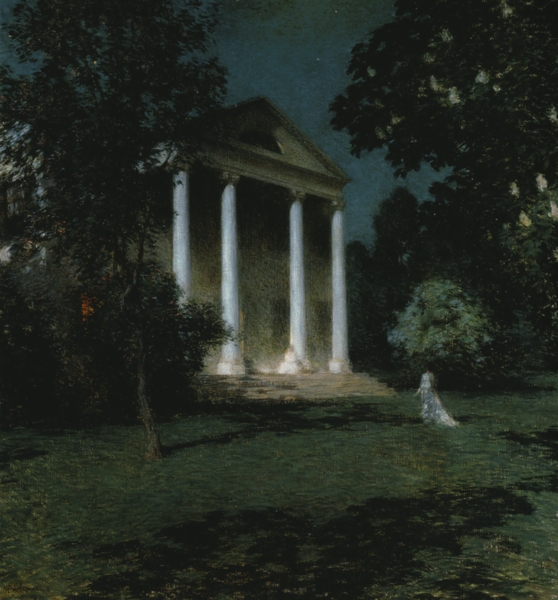
(above: Willard Metcalf, May Night (Florence Griswold House in Old Lyme, Connecticut.), 1906, oil on canvas, 99.5 ? 36.1 inches, National Gallery of Art. Public domain, via Wikimedia Commons*)
Henry Ward Ranger (1858-1916) Often called the "father" of the Lyme Art Colony, Ranger was a pivotal figure in the transition from Tonalism to Impressionism in Connecticut. His earlier works are characterized by their dark, moody Tonalist style, inspired by the French Barbizon school. However, he was also a passionate advocate for painting outdoors, and his later work embraced the brighter palette and loose brushwork of Impressionism. Ranger was deeply inspired by the spiritual qualities he perceived in nature, and his paintings often have a mystical, transcendent quality, inviting the viewer to look beyond the surface and connect with the soul of the landscape.

(above: Henry Ward Ranger (1858-1916), Entrance to the Harbor, 1890, 18.2 x 25.6 in. Smithsonian American Art Museum. Public domain via Wikimedia Commons*)
Larkin Goldsmith Meade, Jr. (1835-1910) A prominent sculptor of the mid-19th century, Meade's work exemplifies the commemorative tradition in American sculpture. While he spent much of his career in Italy, his sculptures are found throughout the United States, including in Connecticut. His work, often on a grand scale, celebrates American heroes and historical events. His sculptures are characterized by their classical elegance and their powerful emotional impact, designed to inspire feelings of patriotism and respect for those who came before.
Chauncey Bradley Ives (1810-1894) A native of Hamden, Connecticut, Ives was a successful Neoclassical sculptor who, like Meade, worked primarily in Italy. His sculptures are known for their idealized beauty and their graceful, flowing lines. He created numerous portrait busts and allegorical figures, often drawing on themes from mythology and literature. Ives's work reflects the 19th-century fascination with classical antiquity, and his sculptures were intended to elevate the viewer's mind to a realm of timeless beauty and noble ideals.
John Henry Twachtman (1853-1902) Though his time in Connecticut was relatively brief, Twachtman's influence on the state's artistic development was significant. A master of Tonalism and Impressionism, he was known for his highly personal and poetic interpretations of the landscape. His paintings of the countryside around his Greenwich home are exquisitely subtle, rendered in a delicate palette of whites, grays, and pale greens. Twachtman was inspired by the quiet, intimate corners of the natural world -- a frozen brook, a snow-covered field, a blossoming apple tree. His work is a testament to the profound beauty that can be found in the most unassuming of subjects, and it invites a deep and meditative engagement with the landscape.

(above: John Henry Twachtman, Old Holley House, Cos Cob, c.1890-1900, oil on canvas, 25.06 x 25.13 inches, courtesy of The Athenaeum. Public domain, via Wikimedia Commons*)
In conclusion, the period from 1850 to 1900 was a time of remarkable artistic growth in Connecticut. From the stately public monuments of the mid-century to the sunlit canvases of the Lyme Art Colony, the state's artists consistently sought to create works that were not only aesthetically pleasing but also morally and spiritually uplifting. In a rapidly changing world, the art of Connecticut offered a vision of enduring beauty, simple virtues, and the timeless solace of the natural world.
Note: Tables within AI reports formatted
in a manner incompatible with functionality of our page editing software
have been deleted. Please don't
rely on this AI-generated text for accuracy. It has been lightly edited,
yet may be laden with inaccurate information. Consider it a base for further
inquiry
 Return to Georgia
Art History
Return to Georgia
Art History
Return to Individual States Art History Project
*Tag for expired US copyright of object image:

Links to sources of information outside of our web site are provided only as referrals for your further consideration. Please use due diligence in judging the quality of information contained in these and all other web sites. Information from linked sources may be inaccurate or out of date. TFAO neither recommends or endorses these referenced organizations. Although TFAO includes links to other web sites, it takes no responsibility for the content or information contained on those other sites, nor exerts any editorial or other control over them. For more information on evaluating web pages see TFAO's General Resources section in Online Resources for Collectors and Students of Art History.
 Search Resource Library
Copyright 2025 Traditional Fine Arts Organization, Inc., an Arizona nonprofit corporation. All rights reserved.