
American impressionist and Fauvism: Evolution
By ChatGPT
April 23, 2025
In the spring of 1906, two very different art worlds were rippling with the same electric question: once Impressionism had shattered the academy's grip on paint and palette, where might artists go next? On Manhattan's Upper East Side, painters fresh from study in Paris swapped stories of fiery exhibitions at the Salon d'Automne. Across the continent in Laguna Beach and Carmel, young Californians gathered in sun-bathed canyons, their eyes dazzled by desert glare and Pacific haze. And in both places, the answer soon took shape in a style that sent Impressionism's vivid color into a new direction: Fauvism.
From Dappled Light to Pure Chromatic Pulse
Impressionism's gift to American artists was the realization that color itself could carry the essence of a scene. Gone were the smooth modeling and hidden brushstrokes of Academic painting; in their place appeared patches of unblended pigment, dancing side by side to trick the eye into shimmering atmospheres. Yet by the turn of the century some painters began to wonder: if broken brushwork could capture light, why not use color to capture feeling? Why not flense color entirely from its descriptive duties and let it roar on its own terms?
In Paris, a small band of rebels answered that challenge. At the 1905 Salon d'Automne, Henri Matisse and his circle upended viewers with canvases daubed in scarlet, emerald, and mustard yellow, their forms outlined in flat, confident strokes. Critics sneered, calling them "Fauves" (wild beasts), but American students took notice. Alfred Maurer -- already versed in Impressionist skies -- returned to New York bristling with new possibilities: cushions turned vermilion, faces suffused with cadmium green. Across town, Marsden Hartley's Matisse-inspired still lifes pulsed like jazz.
New York's Modernist Crossroads
In 1908 Stieglitz's 291 Gallery became the Patton of this modernist revolution: daring, and impossible to ignore. Visitors came expecting pretty pictures; they found Matisse originals side by side with work by young Americans who'd absorbed his lessons. The effect was contagious. John Marin, long a watercolor Impressionist, began to outline roofs and hills in bold strokes of cobalt and carmine. Arthur Davies, back from Paris, mounted paintings where deep violet shadows met fuchsia light. What had begun as an optical experiment in Monet's garden now crackled with emotional urgency.
Critics were divided. Traditionalists sniffed that color had "run amok," a sin against nature itself. But for a growing vanguard, Fauve color offered a direct route to the artist's inner life -- unfiltered, unapologetic, and unmoored from local topography. Landscapes no longer wanted only to look like France or New England; they spoke of mood, memory, and the pure joy of pigment set free.
California's Sun-Charged Experiment
Out west, Impressionism had arrived via the same Paris studios -- Monet's plein-air workshops translated into pastel fogs over Monterey Bay and lavender hills above Pasadena. By 1909 a handful of adventurous Californians were following the same trail to Fauvism. Morgan Russell and Stanton MacDonald-Wright -- fresh from Matisse's classes -- returned to Los Angeles to found the Synchromist group, painting rhythmic bands of color that sang under the relentless sun.
Meanwhile, at the 1915 PanamaPacific International Exposition in San Francisco, visitors flocked to see European modernism exhibited alongside California landscapes. Matisse's riotous canvases hung near Albert Bender's portrait of San Francisco Bay in bulbous strokes of magenta and chartreuse, and by the time the fair closed, local artists were convinced: the West Coast's blazing light demanded a palette unafraid of intensity.
Why Fauvism Grew From Impressionism
Across both coasts, the evolution from Impressionism to Fauvism followed a shared logic. First, Impressionism loosened the grip of naturalism, proving that sunsets needn't be painted with ochre and sienna if the eye perceived them in a flurry of orange and violet. Second, the Impressionist emphasis on direct observation encouraged traveling artists to study in Paris, where they encountered not only Monet's water-lilies but also Matisse's inaccessible color experiments. Third, modern exhibition spaces -- Stieglitz's 291 Gallery in New York and the grand pavilions of the Panama-Pacific fair in San Francisco -- created platforms where those experiments could land on American soil and spark imitation.
But perhaps most importantly, both regions shared a hunger to affirm regional identity through color. On the East Coast, the damp greys of New England could be transfigured into surging aquamarines; in California, the Mediterranean light could be rendered in blazing chartreuse. Fauvism's unblushing palette spoke to painters who no longer wanted to imitate nature so much as to distill its sensation, its heat, its pulse, into pure, vibrant paint.
An Ongoing Dialogue
By 1920, Fauvism's "wild beast" phase had subsided,
giving way to Cubism and Expressionism. Yet the audacious freedom it bequeathed
lived on. On both shores, painters retained the conviction that color need
not be shackled to fact, but could instead ignite emotion, signal mood,
or even dance across the canvas in joyous rebellion. In that way, Fauvism
was not a repudiation of Impressionism but its most daring heir -- carrying
forward the belief that painting's true power lies not in mimicry, but in
the artist's capacity to transform light, landscape, and feeling into pure
chromatic song.

(above: Alfred Henry Maurer, Flowers in a Vase, 1932, oil on wood panel,, Phoenix Art Museum. Public domain, via Wikimedia Commons*)
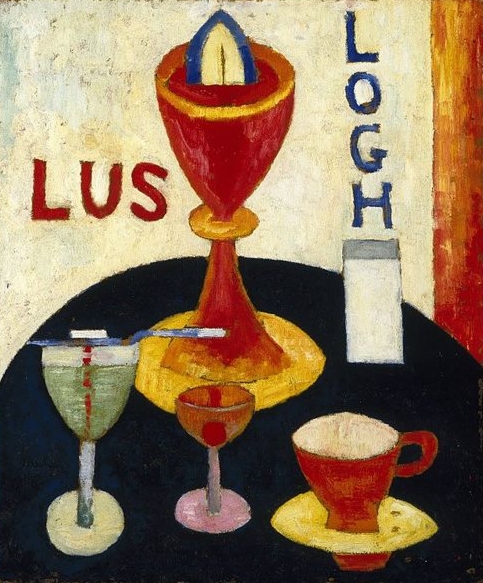
(above: Marsden Hartley, Handsome Drink, c. 1916, oil on composition board, 24 x 20 inches, Brooklyn Museum, gift of Mr. and Mrs. Milton Lowenthal, 72.31. Public domain, via Wikimedia Commons*)
Additional paintings by Marsden Hartley
 Return to Impressionism
Return to Topics in American Representational Art
Links to sources of information outside of our web site are provided only as referrals for your further consideration. Please use due diligence in judging the quality of information contained in these and all other web sites. Information from linked sources may be inaccurate or out of date. TFAO neither recommends or endorses these referenced organizations. Although TFAO includes links to other web sites, it takes no responsibility for the content or information contained on those other sites, nor exerts any editorial or other control over them. For more information on evaluating web pages see TFAO's General Resources section in Online Resources for Collectors and Students of Art History.
*Tag for expired US copyright of object image:

 Search Resource Library
Copyright 2025 Traditional Fine Arts Organization, Inc., an Arizona nonprofit corporation. All rights reserved.