
American Impressionist Versus Post-Impressionist Style of Painting
By ChatGPT
April 21, 2025
In the spring of 1880, a handful of young American painters -- among them John Leslie Breck and the already Paris-based Mary Cassatt -- boarded steamships bound for Le Havre, eager to witness firsthand the revolutionary canvases Monet and Renoir were producing along the Seine. These travelers brought back more than souvenirs: they returned with a palette of broken brushstrokes, unmixed pigments laid side by side, and a new conviction that art could capture the very breath of a moment. By the early 1880s, this "Impressionist" vocabulary had begun to ripple through ateliers in Boston, New York, and beyond, where it was adapted to autumnal New England landscapes and idle city promenades.
By the dawn of the 1890s, American Impressionism had found firm footing. In Connecticut's Cos Cob art colony -- where John Henry Twachtman and J. Alden Weir taught summer classes from about 1890 to 1920 -- the gentle clapboard houses and salt-marsh vistas were rendered in high horizons and dappled light, testifying to the style's popularity among collectors who prized its decorative effects . Along the California coast, artists like Benjamin Chambers Brown and Granville Redmond, freshly returned from study at Paris's Julian Academy, translated Monet's techniques to the sun-washed hills of Pasadena and Laguna Beach, establishing regional variants of Impressionism before the turn of the century.
Yet as the French phase of Impressionism gave way to the bolder experiments of Cézanne, van Gogh, and Gauguin in the late 1880s and 1890s, a new question arose among American painters: could pigment and form convey not just light but the artist's inner vision? Post-Impressionism -- broadly defined as a turn "beyond Impressionism's dissolution of form," toward "substance and meaning" through heightened color contrasts, outline, and psychological brushwork -- began to seep into American art discourse through magazine reproductions and the sporadic import of French exhibitions.
The defining moment arrived in March 1913, when the Armory Show in New York unveiled Cézanne's constructive brushwork, Seurat's scientific pointillism, and van Gogh's electric impastos to an American audience unaccustomed to such visual shocks. As Robert Henri later recalled, it was "a style you had to adopt in order to be modern," even as many American Scene painters recoiled at the seeming disintegration of form. The show's shockwaves prompted vigorous debates in art clubs from Boston to San Francisco: should an American painter cling to the decorative harmony of Impressionism, or embrace Post-Impressionism's promise of emotional and structural depth?
Although Post-Impressionism's intellectual rigor and sometimes "negative or esoteric subject matter" appealed to forward-thinking artists, it proved a tough sell to many patrons and students -- especially in regions like Southern California, where local collectors favored "sun-drenched" landscapes rendered with ease and atmosphere. Nancy Dustin Wall Moure observed that, unlike Impressionism's bright palette and leisurely subjects, Post-Impressionism "did not elicit the patronage of Southern California's collectors, and its subjectivity and experimental nature seems to have been too challenging for local artists just trying to paint a realistic landscape."
Nevertheless, a determined few wove Post-Impressionist principles into American art. In New York, Ernest Lawson -- having encountered Cézanne's solidity in Europe -- subtly reintroduced structure into his urban landscapes, trading pastel haze for emphatic form. On the Left Coast, Clarence Hinkle's bold color planes and Stanton MacDonald Wright's early cityscapes foreshadowed the modernism of the 1920s. By mid-century, the legacy of Post-Impressionism had permeated American painting, not as a mass movement, but as a vital undercurrent guiding artists toward abstraction, expressive color, and a deeper synthesis of emotion and form.
In sum, American artists embraced Impressionism first -- around 1880 in European ateliers, and by 1890 in colonies from Connecticut to California -- because it offered a fresh lens on light and contemporary life. A generation later, those restless for structural coherence, symbolic weight, or heightened emotion turned to Post-Impressionism after glimpsing European innovations in exhibitions and publications. Though the new style never supplanted Impressionism's popularity among collectors, its influence proved indispensable in the unfolding narrative of modern American art.
Also see from our website:
International Exhibitions held in US and Abroad

(above: Mary Stevenson Cassatt, Self Portrait, c. 1878, guache on paper, 23.6 x 16.1 inches, Metropolitan Museum of Art. Public domain, via Wikimedia Commons*)
Additional paintings by Mary Cassatt
Artwork by John Henry Twachtman
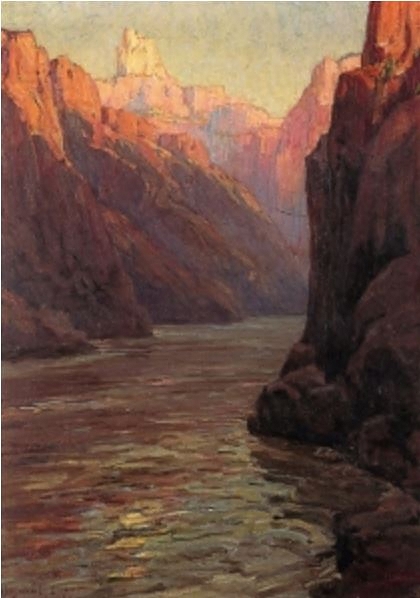
(above: Benjamin Chambers Brown, Grand Canyon, before 1942, 30 x 22 inches, Private collection. Source: The Athenaeum. Public domain, via Wikimedia Commons*)

(above: Granville Richard Seymor Redmond, Talk On the Beach, 1931, Laguna Art Museum. Public domain, via Wikimedia Commons*)
Additional paintings by Granville Redmond and brief remarks

(above: Robert Henri, Mary Fanton Roberts, 1917, oil on canvas, 32 x 26 inches, The Metropolitan Museum of Art. Bequest of Mary Fanton Roberts, 1956. Public domain, via Wikimedia Commons*)
Additional paintings by Robert Henri
 Return to Impressionism
Return to Topics in American Representational Art
Links to sources of information outside of our web site are provided only as referrals for your further consideration. Please use due diligence in judging the quality of information contained in these and all other web sites. Information from linked sources may be inaccurate or out of date. TFAO neither recommends or endorses these referenced organizations. Although TFAO includes links to other web sites, it takes no responsibility for the content or information contained on those other sites, nor exerts any editorial or other control over them. For more information on evaluating web pages see TFAO's General Resources section in Online Resources for Collectors and Students of Art History.
*Tag for expired US copyright of object image:

 Search Resource Library
Copyright 2025 Traditional Fine Arts Organization, Inc., an Arizona nonprofit corporation. All rights reserved.