America's Distinguished Artists
a national registry of historic artists
A B C D E F G H I J K L M N O P Q R S T U V W X Y Z
Deceased American artists and artisans of note who created representational art are indexed in this catalogue by last name in alphabetical order. There are references to Resource Library texts and those from other sites. Click on letters below to access the alphabetical index.
Additional paintings by Albert Bierstadt
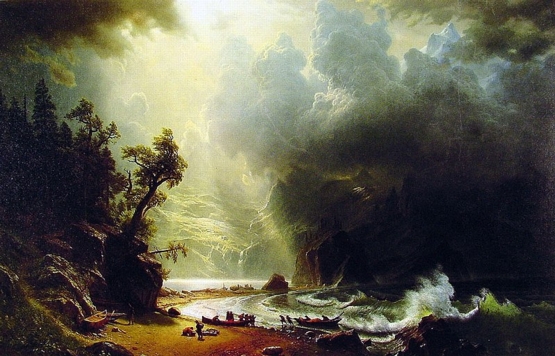
(above: Albert Bierstadt, Puget Sound on the Pacific Coast, 1870, oil on canvas, 52.5 x 82 inches, Seattle Art Museum, Gift of the Friends of American Art at the Seattle Art Museum, with additional funds from the General Acquisition Fund, 2000.70. Public domain, via Wikimedia Commons*)

(above: Albert Bierstadt, Snow in the Rockies, oil on paper mounted on board. Public domain, via Wikimedia Commons**)
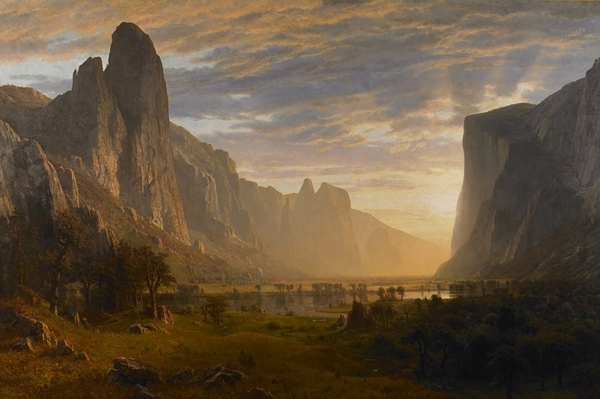
(above: Albert Bierstadt, Looking Down Yosemite Valley, California, 1865, oil on canvas, 64 x 96.2 inches, Birmingham Museum of Art, Gift of the Birmingham Public Library, 1991.879. Public domain, via Wikimedia Commons*)

(above: Albert Bierstadt, Mount Baker, Washington, from the Frazier River, c. 1890, oil on paper mounted on canvas, 14.2 x 19.6 inches, Brooklyn Museum, Dick S. Ramsay Fund, 47.196. Public domain, via Wikimedia Commons*)
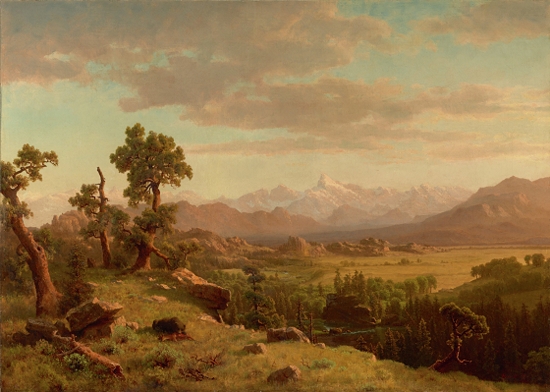
(above: Albert Bierstadt, Wind River Country, 1860, oil on canvas; 29 5/8 x 43 3/4 inches, Denver Art Museum, The Charles H. Bayly Collection, 1987.47)
Albert Bierstadt (1830-1902) was a German-American painter renowned for his grandiose and majestic landscapes of the American West. His paintings are celebrated for their detailed realism, dramatic use of light, and expansive compositions that capture the awe-inspiring beauty of nature. Bierstadt's work was driven by his deep fascination with the American wilderness, his desire to document the landscapes of the expanding frontier, and his ambition to convey the sublime power of nature.
Born in Solingen, Prussia (now Germany), Bierstadt moved with his family to New Bedford, Massachusetts, when he was two years old. He showed an early interest in art and traveled to Düsseldorf, Germany, in 1853 to study painting. The Düsseldorf School of painting, known for its meticulous detail and romantic approach to landscape, significantly influenced Bierstadt's style. After returning to the United States, he became captivated by the possibilities of the American landscape.
In the mid-19th century, the American West was largely uncharted territory for many Americans. Bierstadt joined several expeditions to the West, including a notable journey in 1859 with Frederick W. Lander's survey party. These expeditions provided him with firsthand experiences of the vast and varied landscapes of the region, from the Rocky Mountains to Yosemite Valley. His sketches and studies from these trips formed the basis for many of his large-scale studio paintings.
Bierstadt's landscapes are characterized by their dramatic compositions and luminous light effects, often referred to as "luminism." He masterfully used light to create a sense of depth and atmosphere, imbuing his scenes with a transcendent quality. His works often depict sweeping vistas, towering mountains, serene lakes, and cascading waterfalls, capturing the raw and untamed beauty of the American wilderness. Paintings like "The Rocky Mountains, Lander's Peak" (1863) and "Among the Sierra Nevada, California" (1868) exemplify his ability to convey the grandeur and majesty of these natural landscapes.
One of Bierstadt's primary motivations was to capture the sublime power of nature. He was part of the Hudson River School, a group of artists who believed that nature was a manifestation of the divine. Through his paintings, Bierstadt sought to evoke a sense of awe and reverence in viewers, highlighting the beauty and spirituality of the natural world. His works often included dramatic contrasts between light and shadow, emphasizing the vastness and power of the landscapes he depicted.
Another motivation for Bierstadt was to document the American frontier during a period of westward expansion. His paintings provided East Coast audiences with a glimpse of the remote and unexplored territories of the West. These works played a significant role in shaping public perceptions of the American wilderness, promoting the idea of Manifest Destiny, and encouraging exploration and settlement. Bierstadt's paintings served as visual records of the landscape at a time when photography was still in its infancy.
Bierstadt's work also reflected his ambition to achieve recognition and success. His large-scale paintings were often exhibited to great acclaim and commanded high prices. He utilized his skills as a showman, staging elaborate exhibitions with special lighting effects to enhance the impact of his work. Despite criticism from some quarters for his sometimes-exaggerated portrayals of nature, Bierstadt remained a popular and influential artist throughout his career.
In conclusion, Albert Bierstadt's paintings are a testament to his deep appreciation for the American wilderness and his skill in capturing its sublime beauty. His dramatic landscapes, characterized by their meticulous detail and luminous light, convey a sense of awe and reverence for nature. Motivated by a desire to document the expanding frontier and to celebrate the power of the natural world, Bierstadt's work continues to inspire and captivate viewers, offering a window into the breathtaking landscapes of the American West.
The above brief essay was generated by AI and edited in July, 2024.
See page 2 of more paintings by Albert Bierstadt
Links to sources of information outside of our web site are provided only as referrals for your further consideration. Please use due diligence in judging the quality of information contained in these and all other web sites. Information from linked sources may be inaccurate or out of date. TFAO neither recommends or endorses these referenced organizations. Although TFAO includes links to other web sites, it takes no responsibility for the content or information contained on those other sites, nor exerts any editorial or other control over them. For more information on evaluating web pages see TFAO's General Resources section in Online Resources for Collectors and Students of Art History.
*Tag for expired US copyright of object image:

**Tag for some rights reserved:

 Search Resource Library
Copyright 2023 Traditional Fine Arts Organization, Inc., an Arizona nonprofit corporation. All rights reserved.