
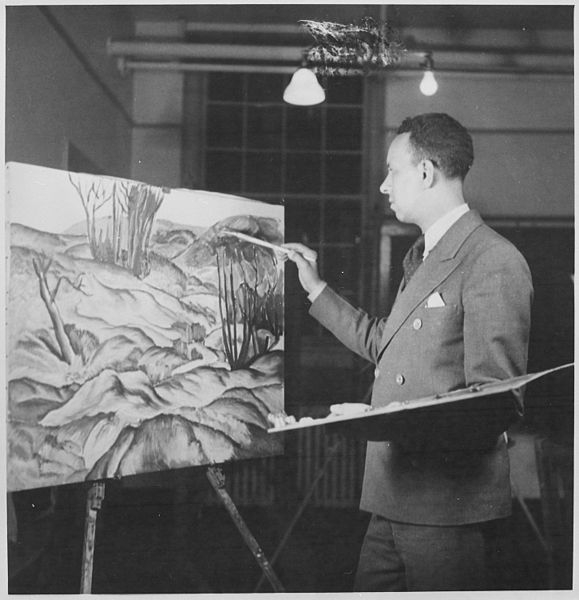
(above: Hale Woodruff, Artist and Teacher, photograph, The Harmon Foundation Collection: Kenneth Space Photographs of the Activities of Southern Black Americans, compiled 1936-1937, National Archives at College Park. Public domain, via Wikimedia Commons*)
Our articles and essays published in year 2008 are listed
below. Clicking on titles takes readers directly to them. The date at the
end of each title is our publication date.
Whitfield Lovell: All Things in Time; essay by Bartholomew F. Bland (10/2/08) Bland's essay accompanied an exhibition of the same name. The artist is internationally recognized for his large-scale tableaux and room-sized installations that combine reclaimed historical objects with life-sized charcoal portraits, often based on historic photographs. Many of the photographs that inspire Lovell's art are of anonymous individuals, the biographical details of their lives lost to time. We posted a brief narrative about the exhibition, two images and information about every artwork in the exhibit alongside the essay. 11/26
Kara Walker: My Complement, My Enemy, My Oppressor, My Love (7/23/08)) This 2008 exhibition at the Modern Art Museum of Fort Worth https://www.themodern.org featured works ranging from Walker's signature black cut-paper silhouettes to film animations to more than 100 works on paper. Over the years the artist has used drawing, painting, light projections, writing, shadow puppetry and film animation to narrate her tales of romance and oppression, power and liberation. Her work leads viewers through an aesthetic experience that evokes a critical and emotional understanding of the past and proposes an examination of contemporary racial and gender stereotypes. Our article includes three images. We published two prior articles about the artist. The Walker Art Center organized the exhibition which was curated by Philippe Vergne and Yasmil Raymond. 11/26
Bare Witness: Photographs by Gordon Parks (5/27/08) In 2008, the Saint Louis Art Museum presented this exhibition, a retrospective of more than 50 photographs representing the finest works of the artist's prolific career. Our article includes wall texts, expanded artwork labels and six images. 11/26
The Paintings of William Edouard Scott; text by Rachel Berenson Perry (5/16/08) This essay was written to accompany the exhibition Our Own Artist: The Paintings of William Edouard Scott. A quote from the author: "William Edouard Scott painted the black experience and helped African Americans to recognize and celebrate the wealth of material in their immediate world. The retrospective exhibition at the Indiana State Museum re-introduces an exceptional man and artist to today's audiences. He is not only "our own artist" as he was to the African Americans of his day but to all of us who appreciate the strength of his art and its messages." 11/26
Jacob Lawrence: Three Series of Prints (2/7/08) An exhibition of 35 silk-screen prints brought together three important series of limited edition prints called Genesis, Hiroshima and Toussaint L'Ouverture created during the last few decades of Lawrence's life. Lawrence drew from his baptism in the Abyssinian Baptist Church in 1932 to create the works in the Genesis series which focuses on man's creation. The Hiroshima series illustrates the series of everyday events and struggles surrounding the dropping of the atomic bomb in August 1945 in Japan. The Toussaint L'Ouverture series tells the visual story of the Haitian revolution leader's life. Our article includes three images and the exhibition checklist. There's also links to nine other articles we published about the artist. 11/26
"The Highwaymen" and "Highwaymen Paintings" (2/6/08) In 2008, we published a brief article about The Highwaymen, a group of 26 African-American self-taught artists who lived and painted in Fort Pierce and Brevard County, Florida. Most notably the group included Alfred Hair, the artist who developed the fast method of oil painting that came to define the style of the Highwaymen, and Harold Newton, an artist who specialized in painting landscapes. A.E. (Beanie) Backus, a southern white and well-known Florida landscape artist, is credited with teaching and encouraging Hair and Newton to paint. The other 24 Highwaymen, including Mary Ann Carroll, the only female in the group, were apprentices to either Newton or Hair and each developed their own distinctive style, brush strokes and trademarks. One image accompanies our article. 11/26
Aaron Douglas: African American Modernist (1/25/08) This 2008 exhibit featured the art of Aaron Douglas, a highly regarded illustrator, muralist and painter.During his long and illustrious career, Douglas vividly captured the spirit of his time and established a new black aesthetic and utopian vision. Working from a politicized concept of personal identity, he combined cubist rhythms and Art-Deco dynamism with traditional African and African American imagery to develop a new visual vocabulary. Douglas' imaginative and forceful ideas, and his distinctive artistic form, combined to produce the most powerful visual legacy of the Harlem Renaissance and made a lasting impact on the history of art and the cultural heritage of the nation. One image accompanies our article along with links to two prior articles about the artist. 11/26
Street Sense: Celebrating 20 Years of The Heidelberg Project (1/16/08) This exhibition commemorated the 20-year history of the internationally recognized neighborhood art project known as The Heidelberg Project, created by Detroit artist Tyree Guyton. Included in the show were his preliminary sketches for Heidelberg installations, historical and contemporary photographs of the project, works of art by Guyton which reflect the free-spirited energy of The Heidelberg Project, and sculptural works from the Project itself -- a colorful and energetic environmental art project meant to transform the deteriorated neighborhood where he grew up into a place with an atmosphere of hope and possibility. With its brightly colored sculptures in vacant lots, painted abandoned houses adorned with discarded objects from the inner city, Guyton's vision centered on using art to transform an environment by stemming urban decay, displacing crime, and rebuilding the dignity and hope of a community. Our article includes two images and a link to the project website. 11/26
Contents For Our African American Art Topic
This topic contains over 100 articles and essays published by us. There's also links to scores of other high-value materials. They are listed below by year of publication.
More Online Texts
We've found scores of online texts beyond what we have published. Also click here to view information about online videos.
Offline Materials
We've also found numerous offline materials. Click here to review suggested books, here to review DVD and VHS videos and here to hear online audio
Searching Our Website
Find contents in our site by entering into a search engine site:tfaoi.org followed by a space and then keywords for your search.
This topic was updated and enhanced November 2026
 Return to African-American Art
*Tag for expired US copyright of object image:

Links to sources of information outside of our web site are provided only as referrals for your further consideration. Please use due diligence in judging the quality of information contained in these and all other web sites. Information from linked sources may be inaccurate or out of date. TFAO neither recommends or endorses these referenced organizations. Although TFAO includes links to other web sites, it takes no responsibility for the content or information contained on those other sites, nor exerts any editorial or other control over them. For more information on evaluating web pages see TFAO's General Resources section in Online Resources for Collectors and Students of Art History.
 Search Resource Library
Copyright 2024 Traditional Fine Arts Organization, Inc., an Arizona nonprofit corporation. All rights reserved.