
Leigh Yawkey Woodson Art Museum
Wausau, WI
(715) 845-7010
Quilt National '97: Contemporary Designs in Fabric
Essentially Beads
This holiday season
the Leigh Yawkey Woodson Art Museum invites you to come in out of the cold
and enjoy two new exhibitions--Quilt National '97: Contemporary Designs
in Fabric and Essentially Beads which will be on view from November
7 through January 3, 1999.
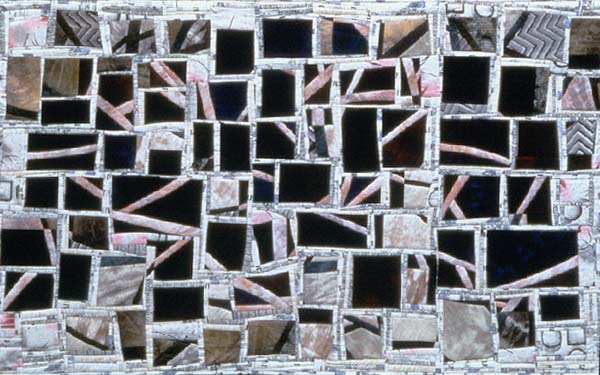
The Quilt National presents the diversity, quality, and creativity of artists who prefer to express themselves in this medium of layered, stuffed, and stitched fabric. In looking at the 31 art quilts that comprise the exhibition, ask yourself: Why would I expect a quilt made at the dawn of the 21st century to be like quilts made fifty or a hundred years ago? Would I want my car to be like those driven fifty or a hundred years ago? Would I want my household plumbing to be like that of several generations ago?
Just as rotary cutters and sewing machines have transformed
the art of quilt making, so too have the computers, color photocopiers,
and contemporary global issues--such as AIDS, women's rights, and global
warming--that modern quilt makers use and react to in creating their two-dimensional
 statements.
While the quilts being made today have their roots in the
rich history of quilting in the United States, today's quilt makers add
a few new wrinkles--such as creating three-diniensional illusions, using
hand-dyed and painted fabrics as well as transfer methods, and altering
surfaces by adding objects. Yet among the experimentation with bold colors,
innovative designs, and masterful construction techniques, there is still
room for calm but attention-getting quilts and those that gain strength
from their use of repetitive patterns.
The video "Unraveling the Stories: Quilts as a Reflection of our Lives" will be shown continuously in the galleries.
Essentially Beads brings together
26 objects created by an international roster of beadsmiths. Historically,
beads from practically every material known have been used to ornament both
the human form and its surroundings. In the 20th century, the use of beads
fell out of favor until the "anything goes" art movements of the
1970s, when artists again looked to beads as a material relevant for creating
art. They see in beads an exciting medium that offers a broad spectrum of
colors and textures, and surfaces that range from somber to highly light
reflective.
From top to bottom: Tim Harding, Koi Diptych; Cynthia
Corbin, Bare Root; Niki Bonnett, American in Asia; Clare Smith,
Mozzies: Don't You Just Hate "Em
rev. 11/22/10
Search Resource Library for thousands of articles and essays on American art.
Copyright 2010 Traditional Fine Arts Organization, Inc., an Arizona nonprofit corporation. All rights reserved.