de Saisset Museum
Santa Clara University
Santa Clara, CA
408.554.4528
We Live in the Bizarro World: Assemblages
by David Gilhooly
Artist David Gilhooly returns to the
Bay Area for the first museum exhibition of his latest work - the "Shadow
Boxes" - a divergence from the ceramics and Plexiglas pieces with which
he made his artistic reputation.
This show, "We Live in the Bizarro World: Assemblages
by David Gilhooly," exhibited through Mar. 28, 1999, will focus on
his work in assemblages from 1995 to the present.
Gilhooly received his BA and MA from the University of
California at Davis, where he studied with and was influenced by Robert
Arneson, whom he later worked for as a studio assistant.
Gilhooly's work grows out of attitudes of the Beat 1950s
in which the exploration of alternative world views and the legacy of Dada
art gave artists permission to be themselves and use any and all materials
and subjects.
Gilhooly's new "sculptural paintings" or "Assemblages
Noirs," as he calls them, are made up of found  objects, often feature puzzles as backdrops with groupings
of toys, action figures, bendable characters, and other found objects, and
are completed by the addition of cheap plastic frames gleaned from thrift
shops. Gilhooly's subject matter and inspiration for these humorous and
satirical concoctions come from life, history, and the social sciences.
objects, often feature puzzles as backdrops with groupings
of toys, action figures, bendable characters, and other found objects, and
are completed by the addition of cheap plastic frames gleaned from thrift
shops. Gilhooly's subject matter and inspiration for these humorous and
satirical concoctions come from life, history, and the social sciences.
Along with the assemblages featured in the main galleries,
Gilhooly will also take over the auditorium gallery with an exhibition of
his prints. "Prints by David Gilhooly from the Permanent Collection,"
exhibited Jan. 26 to Mar. 28 and April 15 to May 2, 1999, will focus on
Gilhooly's print production and features a number of works drawn from the
permanent collection, also including works which the artist has lent to
the museum.
The exhibitions allow visitors to compare Gilhooly's work
in three-dimensional assemblages with that of his earlier work in two-dimensional
prints.
About the artist...
David Gilhooly's work grows out of the attitudes and experimentation's
following the formative years of the Beat and Funk movements of the 1950s
and the 1960s. Under the continuing influence of Dada, artists of this era
broke with tradition and began to accept the use any and all materials,
objects, or subjects in their art.
Gilhooly attended the University of California - Davis
as an undergraduate in the early 1960s. His initial artistic inspiration
came from the work of California ceramic artist and UC Davis instructor
Robert Arneson, under whom he studied and later worked as a studio assistant.
While at Davis he was also under the guidance of teachers such as Wayne
Thiebaud, William T. Riley, Roy Deforest, Manuel Neri, and Ruth Horsting.
As his mentors, they supported and encouraged the exploration of alternative
world views. They urged him to experiment and discover media through which,
eventually, his own unique style would emerge.
For the next several years, the TB-9 (Temporary Building
9) studio at U C Davis provided a crucible in which Gilhooly, along with
his fellow students and peers, would study, imitate, incorporate and/or
reject the work of older contemporary artists. They explored a variety of
tangents that emerged when they used fresh and eccentric materials in their
work. It was within this artistic milieu that Gilhooly's presence emerged.

Well known for his sculptures in clay and Plexiglas, Gilhooly
has also worked with various print techniques on paper, a selection of which
is displayed in the Auditorium.
Most recently he has turned to mixed-media assemblages
which are being publicly displayed at the de Saisset Museum for the first
time.
de Saisset Museum is open Tuesday through Sunday 11 a.m.
to 4 p.m. except March 29 to April 14. Founded in 1955, the de Saisset Museum
is a member-supported, privately funded institution operated by SCU. It
is located in the center of campus adjacent to the Mission church. Address:
de Saisset Museum, Santa Clara University, 500 El Camino Real, Santa Clara,
CA 95053-0550
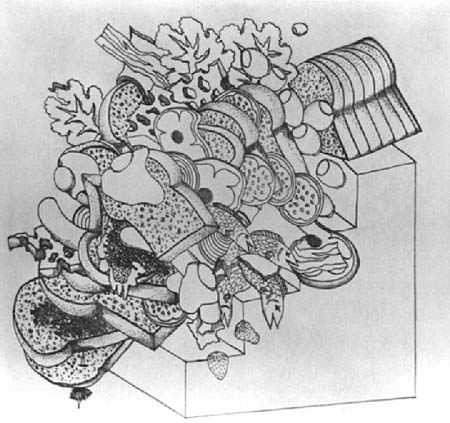
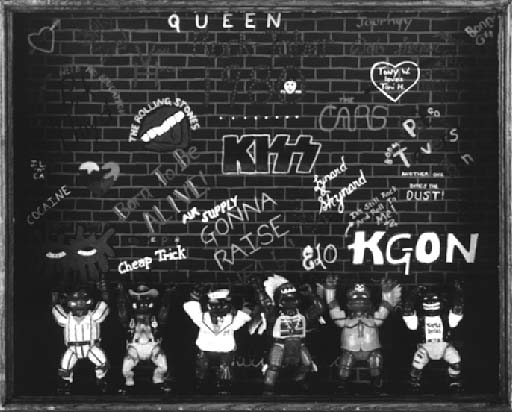
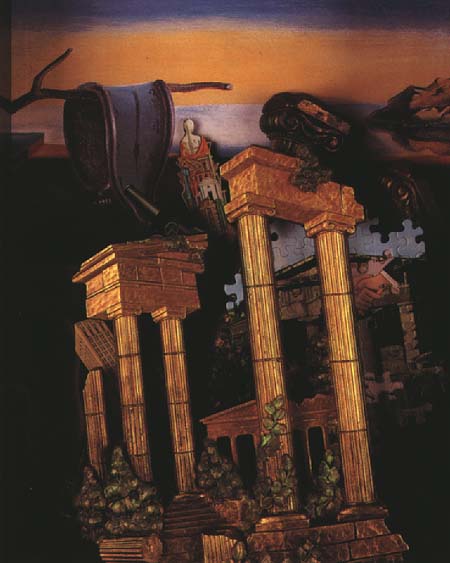
From top to bottom: David Gilhooly, My Dream! All Those
Surrealists Were Just One Guy, 1997, assembladge, 24 x 20 x 6 inches,
courtesy of the artist; David Gilhooly, Food Descending a Staircase,
1983, drypoint etching, 36 x 37 inches; David Gilhooly, The Village
Turtles Perform "YMCA" in Front of the Rock'n Roll Wall of Fame,
June, 1996, assemblage, 23.75 x 19.75 x 4 inches.
Read more about the de Saisset Museum.
rev. 9/20/10
Search Resource
Library for thousands of articles and essays on American art.
Copyright 2010 Traditional Fine Arts Organization, Inc., an Arizona nonprofit corporation. All rights
reserved.
 objects, often feature puzzles as backdrops with groupings
of toys, action figures, bendable characters, and other found objects, and
are completed by the addition of cheap plastic frames gleaned from thrift
shops. Gilhooly's subject matter and inspiration for these humorous and
satirical concoctions come from life, history, and the social sciences.
objects, often feature puzzles as backdrops with groupings
of toys, action figures, bendable characters, and other found objects, and
are completed by the addition of cheap plastic frames gleaned from thrift
shops. Gilhooly's subject matter and inspiration for these humorous and
satirical concoctions come from life, history, and the social sciences.