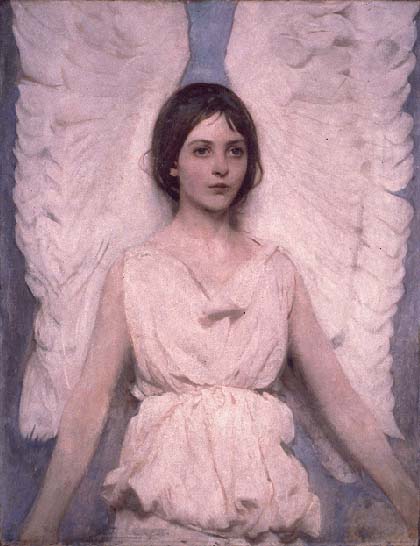
Angels and Ideal Figures
Thayer's angels are his best-known paintings.
As one art critic mused: "They come near to us, there is a lovely hint
of the human and intimate in them, yet they are not of the earth."
Thayer made no attempt to explain these enigmatic figures, saying only that the wings were meant to lift the figure out of the commonplace. Yet for him these winged figures had personal meaning. The first angel was a portrait of his daughter Mary, painted in 1887 at the time of his wife's illness. His later angels appear as protective figures hovering over the landscape that Thayer worked so hard to safeguard.
During the same period, Thayer painted some of America's most alluring images of women. Some evoke classical mythology; others seem to step out of the Renaissance. These ideal figures represent a golden age, uncontaminated by the materialist world.
Landscapes and Mount Monadnock
Thayer's earliest landscapes were traditional
-- cattle grazing on gently rolling, sunlit hills. At the turn of the 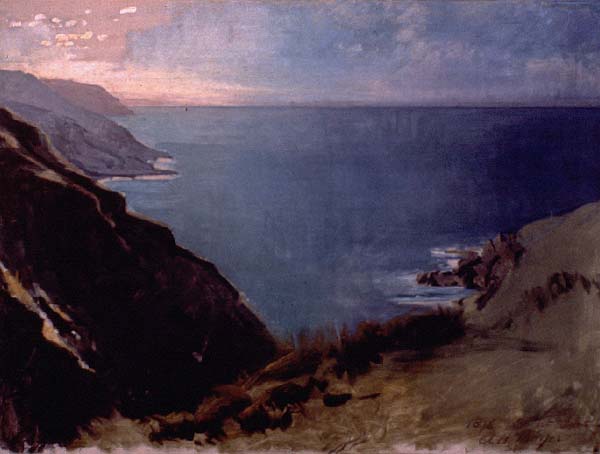 century, he developed a broader style of fresh, brisk brushstrokes
and thin washes that create the illusion of great distances.
century, he developed a broader style of fresh, brisk brushstrokes
and thin washes that create the illusion of great distances.
Thayer focused after 1900 on Mount Monadnock, the great formation rising behind his home and studio in Dublin, New Hampshire. Thayer's innate appreciation of this majestic mountain was enhanced by the transcendental vision of the site expressed by Ralph Waldo Emerson and Henry David Thoreau. Following Chinese and Japanese models, Thayer portrayed the mountain in each of its seasonal "personalities." He finally settled, however, on one preferred view, that of the dawning winter sun striking the peak.
Portraits and Self-Portraits
Thayer's early portraits show the influence
of nineteenth-century French artists and of the American William Morris
Hunt. During the 1880s, when he was most sought-after, his portraits refer
stylistically to early 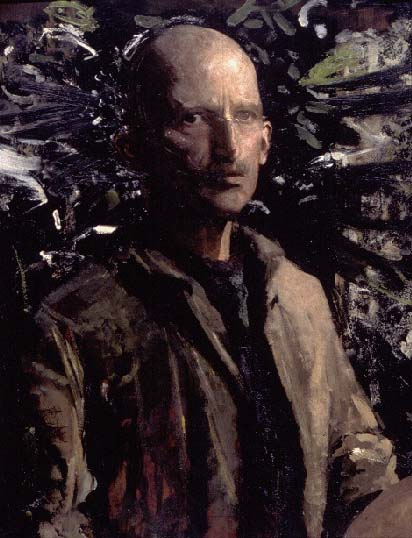 American portraitists, such as the eighteenth-century Boston painter
John Singleton Copley. In this period, Thayer posed young women in luminous
gowns against dramatic, dark backgrounds. Later, his portraits evolved into
character studies, which were usually exhibited without the name of the
sitter in their titles.
American portraitists, such as the eighteenth-century Boston painter
John Singleton Copley. In this period, Thayer posed young women in luminous
gowns against dramatic, dark backgrounds. Later, his portraits evolved into
character studies, which were usually exhibited without the name of the
sitter in their titles.
Thayer also painted self-portraits. Early examples depict him as elegant and self-confident. After the death of his first wife in 1891, the self-portraits became more stark, and the balding, often haggard artist meets our gaze full-face, without the distraction of surrounding objects.
Still~Life and Concealing Coloration
 The few surviving examples of Abbott Thayer's still lifes display
a thorough knowledge of French impressionism, as well as a remarkable ability
to describe the essentials of a flower. The still lifes are quickly and
easily painted, unlike the figure paintings that took years to complete
The few surviving examples of Abbott Thayer's still lifes display
a thorough knowledge of French impressionism, as well as a remarkable ability
to describe the essentials of a flower. The still lifes are quickly and
easily painted, unlike the figure paintings that took years to complete
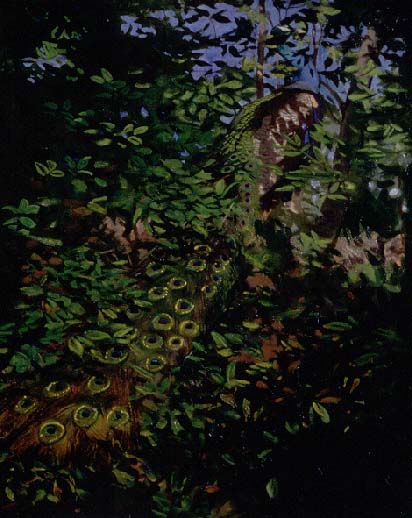
Thayer was drawn to a careful study of
nature, and in particular the depiction of animals. 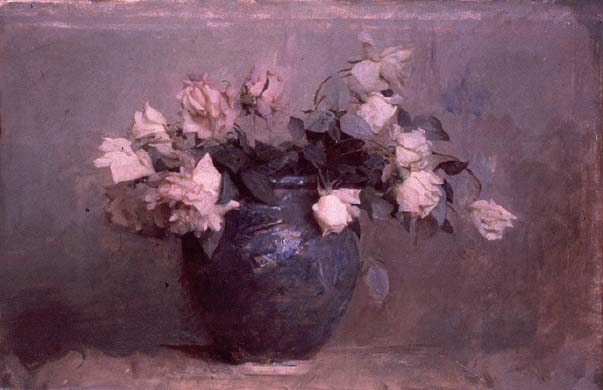 Through academic training in the optical
laws of color, Thayer, with his son Gerald, published a book on the natural
coloration animals display to conceal and protect themselves. Although these
ideas were rejected by many, including another amateur naturalist, President
Theodore Roosevelt, they were adapted during World War I to camouflage ships
and soldiers.
Through academic training in the optical
laws of color, Thayer, with his son Gerald, published a book on the natural
coloration animals display to conceal and protect themselves. Although these
ideas were rejected by many, including another amateur naturalist, President
Theodore Roosevelt, they were adapted during World War I to camouflage ships
and soldiers.
All paintings are by Abbott Handerson Thayer unless otherwise indicated. Images from top to bottom (click on thumbnail images to enlarge them): Angel, 1887, oil, 25 x 36 inches, private collection; Cornish Headlands, 1898, oil, 30 1/8 x 40 1/8 inches, National Museum of American Art, Smithsonian Institution, gift of John Gellatly; Self-Portrait, 1920, oil, 28 3/5 x 21 3/4 inches, National Portrait Gallery, Smithsonian Institution; Peacock in the Woods, 1907, oil, 45 1/4 x 36 3/8 inches, National Museum of American Art, Smithsonian Institution, gift of the heirs of Abbott H. Thayer; Roses, c. 1896, oil, 22 3/8 x 31 3/8 inches, National Museum of American Art, Smithsonian Institution, gift of John Gellatly
For art lovers who cannot travel to Washington, D.C., this summer, a virtual exhibition is available through the Museum of American Art' s Web site.
The exhibition is supported by the Pearson Art Foundation - Gerald L. and Beverly Pearson; the Homeland Foundation; the artist's great-grandchildren Margaret Hyland, John Plunket, Kathy Versluys and Elizabeth Riviera; David Hudgens; the Rosse Family Charitable Foundation; Mr. and Mrs. Willard G. Clark; the Dublin Historical Society; numerous individual contributors; and the Smithsonian's Special Exhibition Program.
Go back to first page of article.
Resource Library editor's note:
RL suggests from Google Books:
Memorial Exhibition of the Work of Abbott Handerson Thayer, by Abbott Handerson Thayer, Bruce Rogers, Royal Cortissoz, Metropolitan Museum of Art (New York, N.Y.), Pforzheimer Bruce Rogers Collection (Library of Congress, N.Y. Metropolitan Museum of Art (New York, Pforzheimer Bruce Rogers Collection (Library of Congress). Published 1922 by Metropolitan Museum of Art, 14 pages. Original from Harvard University. Digitized Jun 28, 2007. Google Books says:
Note: Google Books offers a Full View of this book. For more information on this and other digitizing initiatives from publishers please click here and here.
 As of May 2008 Google Books lists 69 Full
View books citing Abbott Handerson Thayer. Most contain illustrations by
the artist.
As of May 2008 Google Books lists 69 Full
View books citing Abbott Handerson Thayer. Most contain illustrations by
the artist.
Links to sources of information outside of our web site are provided only as referrals for your further consideration. Please use due diligence in judging the quality of information contained in these and all other web sites. Information from linked sources may be inaccurate or out of date. TFAO neither recommends or endorses these referenced organizations. Although TFAO includes links to other web sites, it takes no responsibility for the content or information contained on those other sites, nor exerts any editorial or other control over them. For more information on evaluating web pages see TFAO's General Resources section in Online Resources for Collectors and Students of Art History.
Read more articles and essays concerning this institutional source by visiting the sub-index page for the Smithsonian American Art Museum in Resource Library.
For further biographical information on selected artists cited above please see America's Distinguished Artists, a national registry of historic artists.
rev. 10/18/10
Search Resource Library for thousands of articles and essays on American art.
Copyright 2010 Traditional Fine Arts Organization, Inc., an Arizona nonprofit corporation. All rights reserved.