Distinguished Artist Series
Sam Hyde Harris
1889-1977
Harris' early paintings date from about 1920 until the
early 1940's. The primary influence on Harris at this time was his long
standing friendship with Hanson 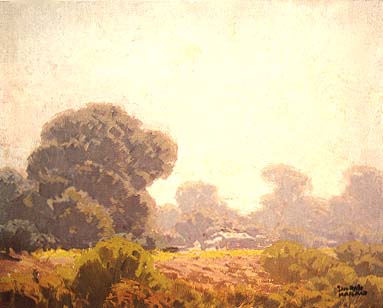 D.
Puthuff (1875-1972), a noted California painter whose works often show a
deep interest in light and atmospheric effects. During the early 1920's,
Harris studied under Puthuff and the similarity of styles between the two
men are obvious. Puthuff's influence and guidance at the beginning of Harris'
career afforded Harris the technique and style to produce his best work.
D.
Puthuff (1875-1972), a noted California painter whose works often show a
deep interest in light and atmospheric effects. During the early 1920's,
Harris studied under Puthuff and the similarity of styles between the two
men are obvious. Puthuff's influence and guidance at the beginning of Harris'
career afforded Harris the technique and style to produce his best work.
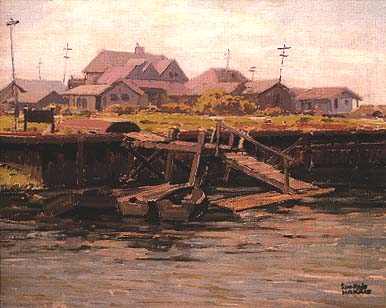
Paintings from Harris' early period are relatively rare.
He had always been a commercial artist and was continually employed by various
clients. His spare time was limited, and thus his paintings were produced
during short periods: weekends, holidays and vacations. The Newport area
paintings were painted on vacations and while he lived there from 1931-37.
His outside exhibitions were few. To fa cilitate handling
and 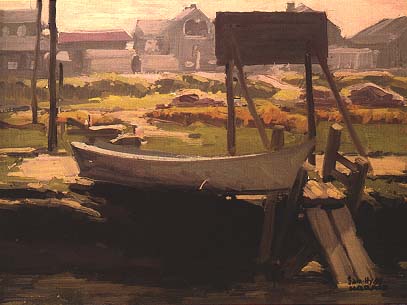 storage, most of Harris'
paintings are on canvas mounted on thick board. A few of his special works
that he sent to exhibitions are on stretched canvas. In general, one might
characterize the early period as that of an extremely good "Sunday
Painter", although the implied limits of this characterization are
grossly unfair to Harris.
storage, most of Harris'
paintings are on canvas mounted on thick board. A few of his special works
that he sent to exhibitions are on stretched canvas. In general, one might
characterize the early period as that of an extremely good "Sunday
Painter", although the implied limits of this characterization are
grossly unfair to Harris.
During World War II, Harris enters a period of transition,
in both his life and his art. He continues to work as a commercial artist,
but he begins to take frequent trips to the desert. He no longer summers
near Newport Beach, instead he goes to Svenska and Cathedral City, near
Palm Springs. He still paints with Puthuff, but he makes friends with several
desert painters and in 1943, he meets the painter who will be the greatest
influence in his late period, James Swinnerton (1875-1974). Harris' personal
life changed in 1945, when he divorced his first wife and married Marion
 Dodge.
Harris' late paintings exhibit a marked difference from
his early paintings. The late ones are almost exclusively desert scenes.
The influence of James Swinnerton is clear: the paintings are of bright
stretches of sand with occassional smoke trees; the colors are simple and
bold, reds, yellows and greens; the compositions are simplified and direct;
the paint is applied thinly and broadly. There is no trace of the earlier
 preoccupations with
Constable and Turner.
preoccupations with
Constable and Turner.
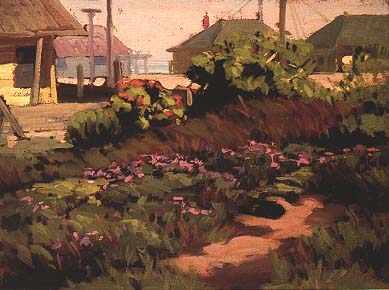
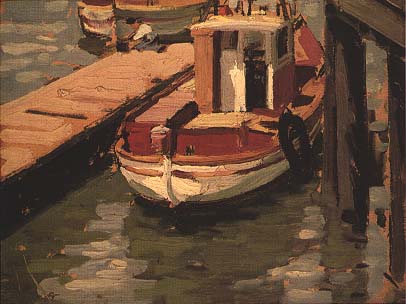
From top to bottom: Backwash, oil on canvas on board, 16 x 20 inches; Sunday Sky, oil on masonite, 16 x 20 inches; At Rest, oil on canvas on board, 16 x 20 inches; Beach Flora, oil on board, 12 x 16 inches; Docked, oil on board,12 x 16 inches.
Resource Library editor's note:
The above texts and images were reprinted in 1997 in Resource Library with permission of the authors. If you have questions or comments regarding the materials published here please contact them.
As of 2007 The estate of Sam Hyde Harris is being marketed by Maurine St. Gaudens, administrator of the estate. Tel is 626-792-0865 and email is harrispaintings@samhydeharrisestatepaintings.com.
Please click on thumbnail images bordered by a red line to see enlargements.
For further biographical information please see America's Distinguished Artists, a national registry of historic artists.
See these essays by Jean Stern in Resource Library:
Art in California: 1880 to 1930 by Jean Stern
Artists in Santa Catalina Island Before 1945 by Jean Stern
The California Missions in Art: 1890 to 1930 by Jean Stern
The Development of Southern California Impressionism by Jean Stern
Franz A. Bischoff, 1864-1929 essay by Jean Stern
Impressionist Style in Perspective by Jean Stern
Impressionism in California, 1890-1930 by Jean Stern
The Irvine Museum in Perspective by Jean Stern
Landscape of Light: Impressionism in California by Jean Stern
Landscape Painting in California by Jean Stern
Marion Kavanagh Wachtel, 1870-1954 by Jean Stern
Masters of Light by Jean Stern
"The Outsiders" -- Modernism in California, 1920-1940 by Jean Stern
The Paintings of Sam Hyde Harris by Jean Stern (2001)
Robert Henri and the 1915 San Diego Exposition by Jean Stern
This page was originally published in Resource Library Magazine. Please see Resource Library's Overview section for more information. rev. 10/28/11
Search Resource Library for thousands of articles and essays on American art.
Copyright 2023 Traditional Fine Arts Organization, Inc., an Arizona nonprofit corporation. All rights reserved.
