Continuity and Change:
Southern California's Evolving Landscape
by Sarah Vure
"The romance of the present is the magical metamorphosis
of Southern California. Enterprises and towns are springing up on all sides.
Great accomplishments are swiftly succeeded by greater ones."
Howard S. Nichols, 1925 -- Los Angeles County Chamber of
Commerce
From the late nineteenth through the
early twentieth century, Southern California's scenic beauty, 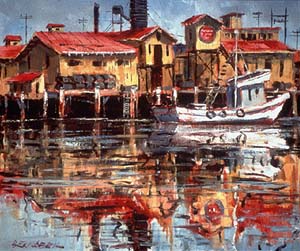 ideal climate, and
abundant agricultural opportunities enticed both tourists and newcomers
from all over the United States. In the promotional literature of the day,
the region's appeal was based on the confluence of continuity and change;
its perpetual sunshine and spectacular physical geography were enhanced
by the capacity for economic growth and development. Captivated by the West's
romantic aura, many artists flocked to California. Their landscape paintings,
created between 1890 and 1950, explore the picturesque qualities, historical
significance, and dramatic evolution of specific Southern California locations
from the hills of Pasadena's Arroyo Seco to the shores of San Diego's Mission
Beach. (left: Ben Abril (1923-1995), The Cannery, n.d., oil
on canvas, 25 x 30 inches, Collection of Dr. and Mrs. Edward H. Boseker)
ideal climate, and
abundant agricultural opportunities enticed both tourists and newcomers
from all over the United States. In the promotional literature of the day,
the region's appeal was based on the confluence of continuity and change;
its perpetual sunshine and spectacular physical geography were enhanced
by the capacity for economic growth and development. Captivated by the West's
romantic aura, many artists flocked to California. Their landscape paintings,
created between 1890 and 1950, explore the picturesque qualities, historical
significance, and dramatic evolution of specific Southern California locations
from the hills of Pasadena's Arroyo Seco to the shores of San Diego's Mission
Beach. (left: Ben Abril (1923-1995), The Cannery, n.d., oil
on canvas, 25 x 30 inches, Collection of Dr. and Mrs. Edward H. Boseker)
In the early years, most Southern California painters,
who came originally from Europe, the East, or the Midwest, worked en plein-air
or outdoors, capturing the effects of brilliant sunlight with Impressionism's
characteristic qualities of bright color and broken brushwork. Throughout
the 1920s plein air landscapes of fertile flowering valleys and soaring
mountain peaks expressed the period's booming economy and exuberant optimism.
By 1929, when the stock market crash ushered in the economic hardships of
the Great Depression, California artists were participating in a nationwide
movement to capture the American scene by depicting their local environment
in a more realist-based style. In contrast to these historical works, contemporary
photographs represent continued development and elicit community pride.
For artists seeking to record Southern 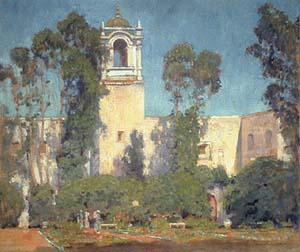 California's magnificence, subjects were everywhere
-- the heroic grandeur of the Spanish missions, the luminous splendor of
the coastline and beach towns, the agricultural bounty of Orange County,
and the urban vistas of Los Angeles and San Diego.(right: Alson Skinner
Clark (1876-1949), Court of Montezuma -- 1922, 1922, oil on canvas
on board, 20 x 24 inches, Collection of Herb and Earlene Seymour)
California's magnificence, subjects were everywhere
-- the heroic grandeur of the Spanish missions, the luminous splendor of
the coastline and beach towns, the agricultural bounty of Orange County,
and the urban vistas of Los Angeles and San Diego.(right: Alson Skinner
Clark (1876-1949), Court of Montezuma -- 1922, 1922, oil on canvas
on board, 20 x 24 inches, Collection of Herb and Earlene Seymour)
Prior to the planting of the first orange groves, real
estate promoters were encouraging immigration to the land south of Los Angeles
known as the Santa Ana Valley. Officially named Orange County in 1889, it
was the area's agricultural potential that most attracted new migrants.
Although touted as "A Nature's Wonderland" and "Spring Eternal,"
the county's eastern edge still encompassed desert terrain. John Frost's
Santa Ana Wash, 1921, is a hauntingly beautiful view of this arid
landscape with the smoky blue peaks in the distance. While in certain seasons
the rocky riverbed is dry, today environmental engineers monitor the river
to control pollution and flooding. From its source in the San Bernardino
Mountains, the Santa Ana River runs through Riverside and Orange counties
to terminate at the Pacific Ocean in Huntington Beach.
 The dramatic
natural beauty of the Pacific coast drew artists to Laguna Beach where steep
mountains plunge into the sea along the many sandy coves and inlets. John
Baumgarten and Anna Hills captured these spectacular rock formations and
the crashing surf at Abalone Point and Laguna Beach. Because the eucalyptus
trees that characterize the area and frequently appear in landscape paintings
did not yield wood suitable for building, many early Laguna Beach structures
were reused. In fact, Joseph Kleitsch's studio, as seen in Evening Light,
Laguna, 1922, was originally a Mormon schoolhouse that was moved from
Laguna Canyon to Legion and Through Streets where it served as a church
prior to Kleitsch's ownership. Known for his efforts to record the idyllic
village character of Laguna Beach before it was altered during the real
estate boom of the 1920s, Kleitsch painted scenes such as El Paseo,
n.d., showing the small street that runs along main beach near the Hotel
Laguna. From a striking hilltop vantage, the hotel and surrounding houses
were painted with cubist-inspired angularity by Modernist Helen Rousseau.
Even with contemporary shops and parked cars, Laguna's charming streets
with their cool ocean breezes are a tourist
The dramatic
natural beauty of the Pacific coast drew artists to Laguna Beach where steep
mountains plunge into the sea along the many sandy coves and inlets. John
Baumgarten and Anna Hills captured these spectacular rock formations and
the crashing surf at Abalone Point and Laguna Beach. Because the eucalyptus
trees that characterize the area and frequently appear in landscape paintings
did not yield wood suitable for building, many early Laguna Beach structures
were reused. In fact, Joseph Kleitsch's studio, as seen in Evening Light,
Laguna, 1922, was originally a Mormon schoolhouse that was moved from
Laguna Canyon to Legion and Through Streets where it served as a church
prior to Kleitsch's ownership. Known for his efforts to record the idyllic
village character of Laguna Beach before it was altered during the real
estate boom of the 1920s, Kleitsch painted scenes such as El Paseo,
n.d., showing the small street that runs along main beach near the Hotel
Laguna. From a striking hilltop vantage, the hotel and surrounding houses
were painted with cubist-inspired angularity by Modernist Helen Rousseau.
Even with contemporary shops and parked cars, Laguna's charming streets
with their cool ocean breezes are a tourist  mecca.(left: John Frost (1890-1937),
Santa Ana Wash, 1921, oil on canvas, 26 x 32 inches, Collection of
Marcel Vinh and Daniel Hansman)
mecca.(left: John Frost (1890-1937),
Santa Ana Wash, 1921, oil on canvas, 26 x 32 inches, Collection of
Marcel Vinh and Daniel Hansman)
Beginning in the nineteenth century, tourists came to California
for seaside vacations. Among the earliest works in this exhibition, William
Lees Judson's Avalon, Catalina Island, c. 1896-1904, depicts the
sailboats, tent camps, and Banning brothers' steamer ferry that brought
people from the mainland. For millions of tourists who visited the state,
the missions were an important stop on the itinerary. The romantic image
of Spanish California was largely based on pictures of the weathered adobe
missions with their red tile roofs and splendid gardens. Considered the
"Jewel of the Missions," and the only one located in Orange County,
San Juan Capistrano was portrayed by George Gardner Symons, Carl Oscar Borg,
and Colin Campbell Cooper, among others.(right: Anna Althea Hills
(1882-1930), High Tide, Laguna Beach, n.d., oil on canvas, 20 x 30
inches, Collection of Diane Nesley)
A major promotional event for westbound tourists was the
1915-16 Panama California Exposition that celebrated the opening of the
Panama Canal. The exposition was held in Balboa Park, named after Vaco Nunez
de Balboa, the first European to view the Pacific Ocean. Under the direction
of Bertram Gosvenor Goodhue, the exposition's building designs were based
on an ornate Spanish and Mexican style that recalled San Diego's colonial
heritage and emphasized its Mediterranean climate. This Spanish Revival
architecture can be seen in Alson Clark's painting Court of 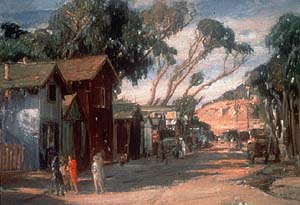 Montezuma -- 1922, 1922, noted for its garden and Puebla tower. Originally intended
only as temporary structures, Balboa Park's decorative buildings have become
permanent and popular symbols of San Diego. Still another tourist site developed
in the late 1920s was the colorful Mexican market on Olvera Street in Los
Angeles. Frank Coburn, who depicted the converted historic adobes, was one
of the few plein air painters who sought to capture the burgeoning city.(left:
Joseph Kleitsch (1881-1931), Evening Light, Laguna, 1922, oil on
canvas, 24 x 30 inches, Collection of Robert D. Ehrlich)
Montezuma -- 1922, 1922, noted for its garden and Puebla tower. Originally intended
only as temporary structures, Balboa Park's decorative buildings have become
permanent and popular symbols of San Diego. Still another tourist site developed
in the late 1920s was the colorful Mexican market on Olvera Street in Los
Angeles. Frank Coburn, who depicted the converted historic adobes, was one
of the few plein air painters who sought to capture the burgeoning city.(left:
Joseph Kleitsch (1881-1931), Evening Light, Laguna, 1922, oil on
canvas, 24 x 30 inches, Collection of Robert D. Ehrlich)
Unlike their predecessors, the Regionalist painters of
the 1930s chose increasingly to portray aspects of the urban scene, such
as downtown skylines, industrial sites, and recreational pleasures, often
including images of people involved in daily activities. Based on its aspirations
of grandeur and growth, and symbolizing its power and wealth, Los Angeles
built a new City Hall in 1926-28 that combined monumental classical architecture
with the simple planes and volumes of the moderne style. As seen on the
horizon in Emil Kosa's Over the Rooftops, c. early 1940s, the building's
452-foot white tower far surpassed the 150-foot height limit that was imposed
on other city buildings at the time. Dominating the urban skyline, Kosa's
City Hall is dramatically composed with bold contrasts of light and dark,
exemplifying the nationally recognized California watercolor style. While
Kosa's rooftops were probably painted from across the river in Boyle Heights,
recent years have seen a renewed interest in residential redevelopment downtown.
Although the discovery of oil and the growth of the Hollywood
movie industry fueled the expansion of Los Angeles, agriculture remained
one of Orange County's primary industries. 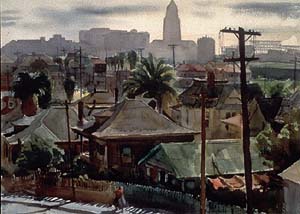 William Griffith's painting of the bean harvest
on the Irvine Ranch embodies this rich agrarian heritage. The Irvine Ranch
once totaled 125,000 acres and comprised almost a quarter of Orange County.
James Irvine, Jr. was among those who transposed the land from cattle and
sheep ranches to prized farms where oranges, lima beans, and other crops
were grown. Yet, to avoid the encroachment of industry, William Wendt, known
as the "dean" of Southern California landscape painters, looked
back to the natural landscape as a source of spiritual solace. The verdant
hills and rocky cliffs of Laguna Canyon appeared in the pious artist's Sermons
in Stone, 1934. A decade later, Emil Kosa's view of the canyon in I'll
Take the High Road, 1944, may imply moral overtones, but his inclusion
of telephone poles betrays the area's prevailing human presence.(left:
Emil Jean Kosa, Jr. (1903-1968), Over the Rooftops, n.d., c. early
1940s, watercolor on paper, 22 x 30 inches, The Buck Collection. Laguna
Hills, California)
William Griffith's painting of the bean harvest
on the Irvine Ranch embodies this rich agrarian heritage. The Irvine Ranch
once totaled 125,000 acres and comprised almost a quarter of Orange County.
James Irvine, Jr. was among those who transposed the land from cattle and
sheep ranches to prized farms where oranges, lima beans, and other crops
were grown. Yet, to avoid the encroachment of industry, William Wendt, known
as the "dean" of Southern California landscape painters, looked
back to the natural landscape as a source of spiritual solace. The verdant
hills and rocky cliffs of Laguna Canyon appeared in the pious artist's Sermons
in Stone, 1934. A decade later, Emil Kosa's view of the canyon in I'll
Take the High Road, 1944, may imply moral overtones, but his inclusion
of telephone poles betrays the area's prevailing human presence.(left:
Emil Jean Kosa, Jr. (1903-1968), Over the Rooftops, n.d., c. early
1940s, watercolor on paper, 22 x 30 inches, The Buck Collection. Laguna
Hills, California)
This presence carries over into the expansion of industry
in Orange County, which included commercial mackerel fishing. During its
peak period, there were three fish canneries operating in Newport Beach.
Ben Abril's colorfully energetic rendering The Cannery, n.d., depicts
the 30th Street plant, warehouse, and dock. Eventually the supply of fish
diminished and the cannery became a popular restaurant. Although Newport
in the nineteenth century had briefly been a shipping center, by the 1930s,
San Pedro, as seen in Paul Sample's view of Fish Harbor, was the second
largest port in the United States.
Even during the Depression Era, California was recognized
for its future potential and superb natural advantages. WPA guidebooks to
the Golden State emphasized opportunities for outdoor recreation and Regionalist
paintings seem to ignore the era's financial disasters in favor of positive
views of the nation's playground. During the 1930s, scenes of weekend merriment
-- sailing, fishing, and picnicking -- exist within landscape depictions.
Even in urban Los Angeles, thousands of acres were designated for recreation
in Elysian Park and Griffith Park, the latter being the largest municipal
park in the country. Artists did occasionally evoke the Depression's turbulent
times. In Balboa Island Ferry Storm, 1934, Mary Blair portrayed Newport
Beach's pavilion and fun zone ferris wheel at a distance from the tiny vessel
that tosses amidst the swelling waves and blustery sky. Whatever challenges
and changes Southern Californians have had to face, the title of Rex Brandt's
painting of Newport Harbor, Promise of Sunshine, n.d., signifies
the region's eternal reward.
As contemporary residents, we maintain diverse relationships
to the landscape and its development -- whether nostalgic yearning for bygone
eras or future-oriented visions of new growth. From all perspectives, Southern
California remains a remarkable landscape that continues to afford infinite
opportunities for appreciation.
Resource Library editor's note:
Please click on thumbnail images to
see enlargements.
Above is an essay written by Sarah Vure,
Curator at the Orange County Museum of Art, in connection with an exhibit
of the same title showing at the Museum July 7 through September 30, 2001.
Essay reprinted with permission of the author and the Orange County Museum
of Art. Images courtesy of Orange County Museum of Art.
Read more about the Orange County Museum of Art in Resource
Library Magazine
For further biographical information on
selected artists cited above please see America's
Distinguished Artists, a national
registry of historic artists.
Also see these articles and essays: California
Art History, California Artists: 19th-21st Century, California
Impressionism and California Regionalism and California School
of Painters.
This page was originally published in Resource
Library Magazine. Please see Resource Library's Overview section for more information. rev. 6/7/11
Search Resource Library for thousands of articles and essays on
American art.
Copyright 2011-2021 Traditional Fine Arts Organization, Inc., an Arizona nonprofit corporation. All rights
reserved.