
Early Anglo-American Artists Who Painted the Navajo
a 2026 article by TFAO and Gemini AI
The Diné, known universally as the Navajo people, have inhabited the sweeping deserts, towering red-rock mesas, and deep, echoing canyons of the American Southwest for centuries. Their culture is deeply intertwined with the harsh but stunning rhythms of the earth, possessing a rich heritage of weaving, silversmithing and complex spiritual ceremonies.
Following a tragic forced exile by the United States military to the Bosque Redondo internment camp in the 1860s, the Navajo were finally allowed to return to their ancestral homelands in 1868. In the decades that followed, they faced the monumental task of rebuilding their lives, their flocks, and their local economy. During this era of reconstruction, a new kind of explorer began arriving on the reservation. Armed not with cavalry rifles or government treaties, but with sketchpads, canvases, and oil paints, Anglo artists journeyed into the desert. They were drawn by the stark beauty of the landscape and a fervent desire to document a culture they believed was rapidly vanishing in the face of encroaching industrial modernity.
Profiles in Paint
Four notable American painters emerged as pioneers in this artistic migration, each bringing a unique background to the desert. Elbridge Ayer Burbank , born in Illinois in 1858, became one of the most prolific portraitists of Native Americans in the nation's history. Burbank studied art at the Chicago Academy of Design before traveling to Munich, Germany, for advanced training. He was a deeply sensitive individual who struggled throughout his life with manic depression, eventually spending his final years in mental health facilities before dying from injuries sustained in a San Francisco cable car accident. Despite these personal battles, Burbank possessed an unparalleled dedication to ethnographic accuracy, ultimately painting figures from more than one hundred and twenty-five different tribes.
Maynard Dixon, a California native born in 1875, took a decidedly different artistic approach. Raised as a sickly child in Fresno, Dixon spent his early years sketching to pass the time, eventually receiving encouragement from the legendary Western artist Frederic Remington. Dixon became highly successful in the commercial illustration industry of New York and San Francisco, but he grew profoundly disillusioned, complaining that he was being paid to lie about the realities of the West. Seeking authentic experiences, he abandoned commercial illustration for fine art. Dixon focused on Modernism, employing simplified lines, vibrant colors, and dramatic clouds to convey the vast isolation and primitive purity of the region.
William R. Leigh, born in West Virginia in 1866, brought a deep appreciation for the dramatic interplay of light and nature to his canvases. Reputedly a direct descendant of Pocahontas, Leigh also received formal artistic training in Munich, studying alongside Burbank. Leigh worked as a field artist for the American Museum of Natural History, a role that took him as far as East Africa, but he found his greatest inspiration in the sweeping vistas of the American Southwest. Finally, Joseph Henry Sharp, another Munich alumnus born in 1859, brought a profound empathy to his subjects. While Sharp is most famous today as a founding member of the Taos Society of Artists in New Mexico, his travels frequently took him deep into Navajo country, where he painted highly observant, respectful portraits of the people he encountered.
Introductions in the Desert
The sheer vastness of the Navajo Nation and the understandable wariness of its inhabitants meant that these artists could not simply wander into a remote camp and expect to be welcomed. Introductions required a trusted cultural broker, a role perfectly filled by the legendary trader John Lorenzo Hubbell. Born to an American father and a Mexican mother, Hubbell did not learn English until he was twelve, but he spoke the Navajo language fluently. Having established a sprawling trading post at Ganado, Arizona, in 1878, Hubbell was affectionately known to the local people as "Old Mexican" or "Double Glasses". He built a profound trust with the Navajo population based on decades of fair dealings, honest counsel, and mutual respect.
Hubbell graciously opened his home to visiting artists, transforming his trading post into an informal artist colony and a safe haven. Burbank spent ten months at Ganado in 1905, finding the environment so welcoming that he considered it a true home, writing to his family that he was happier there than anywhere else on earth. Dixon even chose to spend his honeymoon with his wife, the artist Lillian West Tobey, at Hubbell's trading post in 1905, exploring the surrounding reservation under Hubbell's protective guidance. By leveraging his deep community ties, Hubbell served as the vital intermediary. He arranged the crucial first meetings, vouching for the artists and assuring tribal members that these strange men with their brushes and palettes meant no harm.
Mutton, Coffee, and the Building of Trust
The initial meetings between these formally trained Anglo painters and the Navajo tribal members were brokered with simple, universal gestures of hospitality. Upon arriving at a Navajo encampment, visitors were frequently greeted with the offering of warm coffee and broiled mutton ribs, cooked over an open fire and passed sociably among guests. On the artists' side, gestures of goodwill often involved reciprocal gifts procured from the trading post shelves. The Hubbell Trading Post itself served as the ultimate neutral ground where cultures mingled freely. The dimly lit "bullpen" of the trading post was a place of warmth, conversation, and commerce, where the squeak of wooden floors announced the arrival of both weavers and wandering painters.
Trust, however, did not form overnight; it was cultivated through immense patience and prolonged exposure. Artists like Burbank did not merely breeze through the reservation for a weekend; they stayed for months, immersing themselves in the daily rhythms of the community and allowing their presence to become familiar. The Navajo observed the artists at work, slowly realizing that their intent was to observe and record rather than to exploit. Burbank's integration into the community is beautifully illustrated by his 1911 painting, "Navajo Poker Game." The artwork depicted an intimate, candid scene of Navajo men gambling in the old Leonard building at the trading post, a space where men played cards for days while their wives wove rugs nearby. By existing quietly in these communal spaces, the artists transitioned from intrusive outsiders to accepted, if curious, guests.
Taboos and Tensions
Despite the warm hospitality, tensions inevitably arose, rooted deeply in cultural misunderstandings and spiritual taboos. Many traditional Navajo held profound reservations about having their likenesses captured on canvas, fearing the spiritual implications of such permanence. Furthermore, Anglo artists were often eager to depict sacred ceremonies and rituals, which were strictly forbidden to the eyes of uninitiated outsiders. The creation of Navajo sandpaintings, for instance, was a deeply sacred healing ritual. These intricate, beautiful designs were meant to be temporary, traditionally destroyed by sunset as part of the healing process; permanently reproducing these images in paint or textiles was considered a dangerous taboo that could provoke illness or cosmic imbalance.
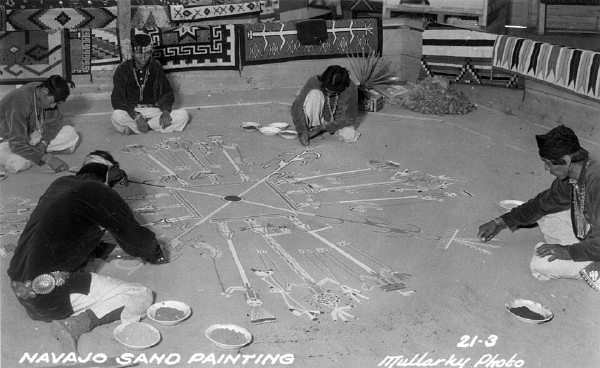
(above: Navajo men work on a sand painting probably in Arizona. Woven blankets and rugs are displayed nearby, c. 1890-1910, Mullarky Photo. Public domain, via Wikimedia Commons*)
Tensions also flared over the staging of portraits. Some artists, driven by an ethnographic desire to capture a specific aesthetic, pressured sitters to wear historical regalia or pose in ways that felt unnatural to the native subjects. These cultural frictions were ultimately resolved through careful negotiation, compromise, and the slow evolution of mutual understanding. Artists learned to respect spiritual boundaries, often settling for painting scenes of daily life rather than demanding access to sacred rites. Interestingly, some cultural evolution came from within the tribe itself to bridge this gap. The revered Navajo medicine man Hosteen Klah, recognizing the intense outside interest in his culture, made the highly controversial decision to weave sacred sandpainting designs into permanent textiles. Though this caused an uproar on the reservation, Klah boldly modified traditional strictures for a new era, sharing the culture with the outside world on his own terms. For individual portraits, artists learned that allowing models a degree of agency in how they were depicted was the most effective way to soothe anxieties and forge a collaborative relationship.
The Canvas of the Southwest
When it came to choosing settings, the artists possessed distinct favorites that highlighted both the drama of the Southwestern environment and the enduring resilience of the Navajo people. Dixon was captivated by the towering red rocks and expansive, cloud-filled horizons, frequently placing his subjects against the sweeping backdrop of Canyon de Chelly or the high, dusty mesas. This choice of setting emphasized a profound sense of isolation, grandeur, and harmony with the earth. Leigh favored the atmospheric interplay of light and shadow, often depicting Canyon de Chelly at night, its massive stone walls illuminated by the flickering, warm glow of a campfire. Burbank, heavily focused on ethnography and the intricate details of human character, preferred the intimate, dimly lit interiors of the trading post or a simple, stark wall. This minimalist background allowed the viewer to focus entirely on the subject's weathered face, heavy silver jewelry, and traditional clothing.

(above: Spider Rock, Canyon de Chelly, in Morning #2, 2011. Photo by John Hazeltine)
The models chosen by these artists represented a broad cross-section of Navajo society, ranging from revered historical leaders to everyday artisans. Burbank famously painted a poignant portrait of Chief Manuelito, the last great chief of the Navajo, capturing the gravity, exhaustion, and immense history etched into the leader's features. Other frequent subjects included silversmiths, shepherds, and the masterful weavers who were bringing the Ganado Red rugs to national prominence. The favored poses were often dignified, static, and highly respectful. Subjects were frequently depicted seated, wrapped tightly in vibrantly colored traditional blankets, shown in a classical profile or offering a direct, full-face gaze. These poses were deliberately designed to convey a sense of stoic nobility, a reflection of the Anglo artists' desire to document a timeless purity that they feared was rapidly slipping away into history.
Silver Dollars and Railroad Tickets
Compensation for this collaborative work took several forms, perfectly reflecting the complex, transitional economy of the frontier. Navajo models were rarely expected to pose for free, as their time and image held distinct value. They were frequently compensated with vital trade goods directly from Hubbell's post, such as coffee, flour, canned goods, and cloth. Just as often, they were paid in hard currency, particularly the heavy silver dollars that were highly prized both as a medium of exchange and as the raw material for Navajo silversmiths to melt down and pound into exquisite jewelry. The artists themselves were compensated through a burgeoning, hungry market for Western art. Some sold their small canvases directly to wealthy tourists passing through the trading posts, while others shipped their finished work back to eager galleries and private collectors in Chicago, Munich, or San Francisco.
The most lucrative compensation for the artists, however, came from powerful corporate and institutional sponsors who saw the commercial potential in these striking images. The Atchison, Topeka, and Santa Fe Railway, along with its hospitality partner, the Fred Harvey Company, became the greatest patrons of Southwestern art. Men like Herman Schweizer, who managed the Fred Harvey Indian Department, bought Native crafts in immense bulk and routinely commissioned Anglo artists to paint the region to drive tourism along the rail lines. Other vital sponsors included wealthy private individuals like Edward E. Ayer, Burbank's uncle and the first president of the Field Museum in Chicago, who commissioned exhaustive ethnographic portrait series for institutional preservation. The federal government also stepped into a sponsoring role, commissioning sweeping murals depicting Navajo life for public buildings and post offices.
Marketing the Mystique
These corporate sponsors harbored very specific, highly curated visions of the scenes they wanted depicted on canvas. Because the railroads and the Fred Harvey Company were fundamentally in the business of selling train tickets and hotel rooms to affluent, comfort-seeking tourists, they demanded art that portrayed the Southwest as a peaceful, exotic, and sun-drenched paradise. Sponsors eagerly commissioned romanticized images of Navajo weavers working contentedly at their looms under the shade of a cottonwood tree, or solitary, blanket-draped riders dwarfed by majestic mesas. They actively discouraged depictions of poverty, hardship, or the often-harsh realities of reservation life, preferring an idyllic, pastoral narrative that would entice Eastern urbanites to board a westbound train for a safe, colorful adventure.
The artworks generated by these sponsored expeditions were deployed as brilliant, ubiquitous marketing tools. Paintings by Leigh, Dixon, and others were endlessly reproduced on railway calendars, dining car menus, and promotional brochures that flooded the East Coast. Original canvases were proudly hung in the opulent lobbies of Fred Harvey hotels, such as the El Tovar at the Grand Canyon or the Alvarado in Albuquerque, immediately immersing arriving tourists in the curated romance of the West. The sponsors even went a step further, hiring famous Navajo artisans, such as the master weaver Elle of Ganado and her silversmith husband Tom, to sit as living models and demonstrators in hotel lobbies and at international expositions in Chicago and San Diego. In these settings, the line between fine art, ethnographic display, and commercial tourist attraction was intentionally blurred.
A Digital Gallery of the West
Ultimately, the meeting of Anglo artists and the Navajo people at the turn of the twentieth century produced a highly complex legacy. The resulting artworks are undoubtedly romanticized, shaped heavily by the commercial demands of railroad executives and the nostalgic yearnings of the artists themselves. Yet, beneath the commercial polish and the staging, these canvases contain genuine, undeniable moments of cross-cultural connection. Through shared cups of coffee, long afternoons spent in the shadow of the trading post, and the slow, deliberate building of trust, artists like Burbank, Dixon, Leigh, and Sharp left behind a vivid, enduring record. They captured the faces and the landscapes of a resilient people who maintained a fierce and beautiful grip on their identity.
For readers interested in viewing artworks discussed in this narrative, several non-commercial educational and government websites provide high-resolution digital archives of these historical pieces. Elbridge Ayer Burbank's historic "Painted portrait of Chief Manuelito," depicting the bare-chested leader seated against a wall with a staff and quiver, can be viewed here. Maynard Dixon's striking 1902 piece, "Blanket-Wrapped Navajo," showcasing his use of simplified lines and vibrant colors, is available in the digital collections of the National Gallery of Art here. William R. Leigh's atmospheric 1917 painting, "Sitting Indian," which portrays a figure at a campsite against a dramatic sunset landscape, is hosted by the Smithsonian American Art Museum here. Finally, Joseph Henry Sharp's 1910 portrait, "Typical Navajo," detailing a subject adorned in a coral and turquoise necklace, can be explored via the Buffalo Bill Center of the West's online catalogue here.
Other Early Artists

(above: James Swinnerton, Mittens at Sunrise, 1936. From the collection of Doreen and David Picerne. Courtesy of the Blue Coyote Gallery from our article Shadows on the Mesa - Artists of the Painted Desert and Beyond (2/8/12)
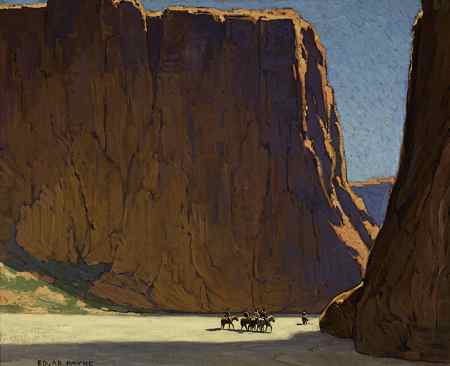
(above:: Edgar Payne, Sunset, Canyon de Chelly, 1916. Oil on canvas, 28 x 34 inches. Mark C. Pigott Collection) from our article Edgar Payne: The Scenic Journey (2/26/12)
Note: We added content for enrichment and deleted some text from this Gemini narrative. It may contain inaccurate information because of how AI gathers and processes content. Sources are footnoted in the raw AI report but deleted here for a general audience.
Also see our articles listed below:
Beneath A Turquoise Sky: Navajo Painters and Their World
History of Navajo Sand Paintings
Navajo Silversmithing: 1855-1955
Navajo Weavings from the Getzwiller Collection
Shadows on the Mesa - Artists of the Painted Desert and Beyond
Stories Woven In: the Navajo Way of Seeing
Trees in a Circle: Navajo Weavings of Teec Nos Pos
Walk in Beauty: Hózhó and Navajo Basketry
Prompt:
 Return to Arizona Art History
Links to sources of information outside of our web site are provided only as referrals for your further consideration. Please use due diligence in judging the quality of information contained in these and all other web sites. Information from linked sources may be inaccurate or out of date. TFAO neither recommends or endorses these referenced organizations. Although TFAO includes links to other web sites, it takes no responsibility for the content or information contained on those other sites, nor exerts any editorial or other control over them. For more information on evaluating web pages see TFAO's General Resources section in Online Resources for Collectors and Students of Art History. Individual pages in this catalogue will be amended as TFAO adds content, corrects errors and reorganizes sections for improved readability. Refreshing or reloading pages enables readers to view the latest updates.
 Search Resource Library for everything about American
art.
Search Resource Library for everything about American
art.
Copyright 2026 Traditional Fine Arts Organization, Inc., an Arizona nonprofit corporation. All rights reserved.