
`
Paintings by American Artists
of Fatherly Affection for Children: 1860-1960
a 2026 Gemini 3.1 Extended Report
The century spanning 1860 to 1960 witnessed a dramatic evolution in the portrayal of fatherhood in American art. Moving away from the stiff, formal patriarchs of early colonial and federalist portraiture, American painters began to explore the nuanced, emotional depths of the father-child bond. This report examines well-known American painters who created poignant, affectionate depictions of fathers and their children during this transformative era, reflecting the shifting structure of the American family.
Eastman Johnson (1824-1906)
Eastman Johnson was one of the foremost genre painters of the 19th century, frequently capturing the everyday realities and intimate domestic spaces of American families. In his 1871 masterpiece, The Hatch Family, Johnson illustrated a sprawling, multi-generational family in their lavish New York parlor. While group portraits historically relegated the patriarch to a stiff, authoritative stance overlooking his dependents, Johnson depicted Alfreth Hatch in a deeply relaxed and engaged manner. Sitting intimately alongside his family, Hatch is shown as an approachable and affectionate figure rather than an emotionally distant provider. The painting reflects the broader Victorian shift toward the "cult of domesticity," where the home became an emotional sanctuary and fathers began to be depicted as active, loving participants in the daily lives of their children. Another painting, The Brown Family, exhibits the same affection.
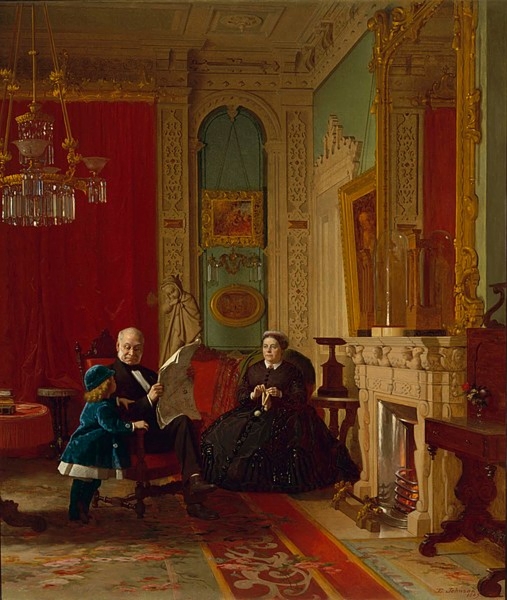
(above: Eastman Johnson, The Brown Family, [grandson William Adams Brown (1865-1943), James Brown (1791-1877), wife Eliza Brown (1803-1890)] 1869, oil on canvas, 38.5 x 32.3 inches, M. H. de Young Memorial Museum, Gift of Mr. and Mrs. John D. Rockefeller 3rd. Public domain, via Wikimedia Commons*)
Mary Cassatt (1844-1926)
While Mary Cassatt is internationally celebrated for her tender, revolutionary depictions of mothers and children, she occasionally directed her Impressionist lens toward fathers. A prominent American expatriate in Paris, Cassatt frequently used her own family members as models. In her 1884 painting Alexander J. Cassatt and His Son Robert Kelso, she captured her brother with his young son. The painting is a masterclass in relaxed body language and psychological intimacy. Alexander sits in an armchair, resting his arm casually, while his son leans comfortably against his father's knee. By eliminating the formal rigidity typical of 19th-century male portraiture, Cassatt emphasized physical closeness and protective tenderness. The shared gaze and the complete ease of the boy's posture against his father communicate a profound, unstated affection that transcends the traditional boundaries of Victorian masculinity.
Henry Ossawa Tanner (1859-1937)
Henry Ossawa Tanner brought a profound spiritual and emotional depth to American realism. According to Wilson (2018), Tanner's 1893 oil painting The Banjo Lesson is widely recognized as "a turning point in African American art history." Tanner studied under Thomas Eakins and absorbed a meticulous realist technique, which he applied to an intimate domestic scene of an older man-often interpreted as a grandfather or father figure-patiently teaching a young boy how to pluck the strings of a banjo. Instead of falling into the caricatured stereotypes common in the era's depictions of Black Americans, Tanner elevated the scene with warm, luminous lighting and a palpable sense of dignity. The man's gentle guidance and the boy's focused attention illustrate the tender transfer of cultural heritage. It is a powerful portrait of patriarchal affection, demonstrating the vital role of the father figure as a loving educator and protector. Another painting, The Thoughful Poor, depicts a grandfather and his grandson prayine in gratitude for God's blessings.

(above: Henry Ossawa Tanner, The Thankful Poor, 1894, oil on canvas, 35.5 x 44.2 inches, Private collection. Public domain, via Wikimedia Commons*)
N.C. Wyeth (1882-1945)
Newell Convers Wyeth was one of America's most celebrated illustrators, known for his dynamic compositions and deep emotional resonance. As Lamouliatte (2016) notes, Wyeth's unique artistic approach was essential because it "helped emphasize the depiction of action." While famous for swashbuckling adventures, Wyeth frequently illustrated stories that centered on the bond between father and son. One of his most moving contributions was his series of paintings for Marjorie Kinnan Rawlings's Pulitzer Prize-winning novel The Yearling (many images via Google Image Search) published with Wyeth's illustrations in 1939. Wyeth beautifully captured the relationship between the rugged Florida pioneer, Penny Baxter, and his young son, Jody. Wyeth's paintings depict Penny not merely as a survivalist, but as a deeply loving and empathetic father who guides his son through the harsh realities of nature and the heartbreak of growing up. Wyeth's use of dramatic lighting and sweeping landscapes highlights the father's role as a gentle anchor in an unforgiving world, making his illustrations a definitive representation of rural American fatherhood.
Norman Rockwell (1894-1978)
Few artists have shaped the visual narrative of the American family as extensively as Norman Rockwell. Working well into the mid-20th century, Rockwell's illustrations for The Saturday Evening Post provided a mirror to the nation's evolving identity. His 1954 painting Breaking Home Ties remains one of his most deeply emotional works, masterfully capturing a father's profound, unspoken affection. The scene depicts a rancher and his son sitting on the running board of a farm truck, waiting for the train that will take the boy away to college. The son looks eagerly down the tracks toward his future, while the father stares in the opposite direction, his posture slumped and his weathered face betraying a bittersweet mixture of pride and sorrow. Rockwell conveys immense paternal love not through a hug or a smile, but through physical proximity and the heavy, emotional sacrifice of letting a child go.
The depiction of fathers showing affection to their children
evolved significantly in American art from 1860 to 1960. Artists like Eastman
Johnson and Mary Cassatt broke away from the rigid portraiture of the past
to reveal fathers as relaxed, tender participants in the home. Henry Ossawa
Tanner and N.C. Wyeth highlighted the role of the father figure as a loving
mentor and guide, passing down both knowledge and survival skills. Meanwhile,
20th-century painter Norman Rockwell stripped away Victorian idealism to
explore the raw, protective, and sometimes sorrowful depths of paternal
devotion. Together, these artists captured the quiet, enduring power of
a father's love, cementing it as a vital theme in American art.
We lightly edited this report, added images and provided
links to other materials to enhance it. AI is rapidly improving in
accuracy, however, the report may contain inaccurate information. This presentation doesn't meet scholarly standards, yet Gemini
3 AI researched and checked it for accuracy. Sources are footnoted in the
raw AI report, yet deleted here for a general audience. Please
see An Evaluation Of Gemini 3 Deep Research
In Replication Of Academic Peer Review, an April, 2026 Gemini 3 Deep Research
Report.
Prompt:
Write a report up to 2,500 words, about well known American artists who painted scenes depicting fathers showing affection towards children. Discuss paintings of such scenes created between 1860 and 1960. Research only .org and .edu websites. Do not use tables in your report.
 Return to Figurative and Portrait
Art:19-20th
Century
Return to Figurative and Portrait
Art:19-20th
Century
*Tag for expired US copyright of object image:

and
**Tag for some rights reserved:

Links to sources of information outside of our web site are provided only as referrals for your further consideration. Please use due diligence in judging the quality of information contained in these and all other web sites. Information from linked sources may be inaccurate or out of date. TFAO neither recommends or endorses these referenced organizations. Although TFAO includes links to other web sites, it takes no responsibility for the content or information contained on those other sites, nor exerts any editorial or other control over them. For more information on evaluating web pages see TFAO's General Resources section in Online Resources for Collectors and Students of Art History.
Copyright 2026 Traditional Fine Arts Organization, Inc. an Arizona nonprofit corporation. All rights reserved.