
History of Tohono O'odham (formerly Papago) Basket Weaving: 1880-1980
a Gemini 3 Deep Research Report
.
The history of Tohono O'odham basketry between 1880 and 1980 serves as a profound case study in cultural endurance, demonstrating how an Indigenous community successfully navigated the transition from a localized subsistence economy to a globalized art market without forfeiting its spiritual core. Known historically to outsiders as the Papago, a term derived from a Spanish misunderstanding of the O'odham phrase for "tepary bean eaters," the Tohono O'odham or "Desert People" have occupied the arid reaches of the Sonoran Desert for millennia. Their basketry, once purely utilitarian vessels for gathering, parching, and storage, underwent a radical transformation during this century-long period, catalyzed by shifting environmental conditions, the encroachment of Anglo-American trade networks, and federal Indian policy reforms. This evolution was not a simple abandonment of tradition for the sake of commerce but rather a sophisticated adaptation -- a way of life.
Materials Transition
The period beginning in 1880 was marked by significant ecological shifts in the American Southwest that directly impacted the materiality of O'odham weaving. For generations, the Piman-speaking peoples had utilized willow (Salix) and cattail (Typha) for their baskets, materials that required the consistent presence of riparian corridors. However, as Anglo-American settlement increased following the 1854 Gadsden Purchase, the diversion of river water for large-scale agriculture and the general drying of the regional water table led to the decline of these traditional materials. This environmental pressure forced a distinction between the Akimel O'odham (River People), who maintained access to some willow, and the Tohono O'odham, who were increasingly restricted to the resources of the open desert.
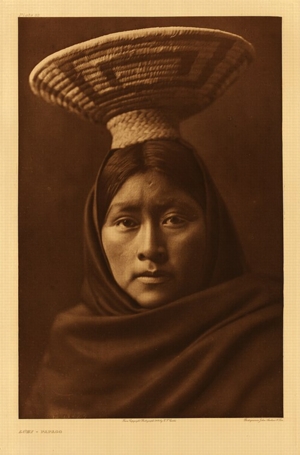
(above: Edward S. Curtis, Luzi - Papago (The North American Indian; v.02, c. 1907, photogravure, brown ink, 45 x 30 cm. Description by Edward S. Curtis: "The Papago women always carry their burdens on, or supported from, their heads. When the burden - be it a basket, pottery, or a box - has a flat or a rounded bottom, the ring of the woven yucca is placed on the head in order to give the load a firm position for carrying, and to relieve the bearer of pressure." Public domain, via Wikimedia Commons*)
By the early 1900s, the Tohono O'odham began to systematically replace willow with soaptree yucca (Yucca elata) and bear grass (Nolina microcarpa). This shift was not merely an aesthetic choice but an ingenious response to the scarcity of riparian plants. Yucca offered a flexible, durable stitching element (weft) that could be harvested in the vast grasslands and mesas of the reservation, while bear grass provided a sturdy, abundant material for the inner foundation (warp) of the coils. This transition was essentially complete by the mid-twentieth century, establishing the "Papago" style -- characterized by creamy white yucca backgrounds and stark black devil's claw designs -- as a distinct category in the ethnographic art market.
The processing of these materials remained a labor-intensive ritual deeply embedded in O'odham life. Yucca leaves were typically harvested between May and July, with weavers strictly avoiding rainy days to prevent the leaves from turning black. The harvested leaves were cleaned and bleached in the sun to achieve a light cream color, or stored in darkness to maintain a natural pale green. Devil's claw, prized for its natural deep black pigment and structural resilience, required even more strenuous preparation.
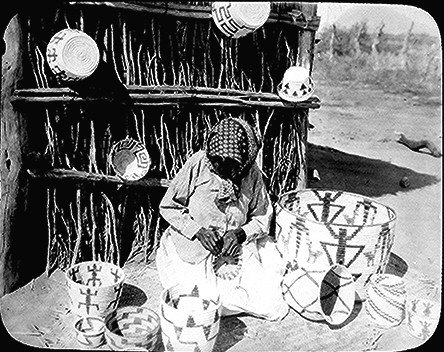
(above: Papago basketmaker at work, Arizona. Photographed by H. T. Cory, 1916. Public domain, via Wikimedia Commons*)
After harvesting in late spring, weavers would bury the fibers in wood ash or store them in dark spaces to prevent mold, subsequently soaking them in hot water for months to "tame" the fibers for splitting into narrow splints. The persistence of these harvesting traditions throughout the 1880-1980 period ensured that while the materials changed, the spiritual and physical connection to the desert landscape remained unbroken.
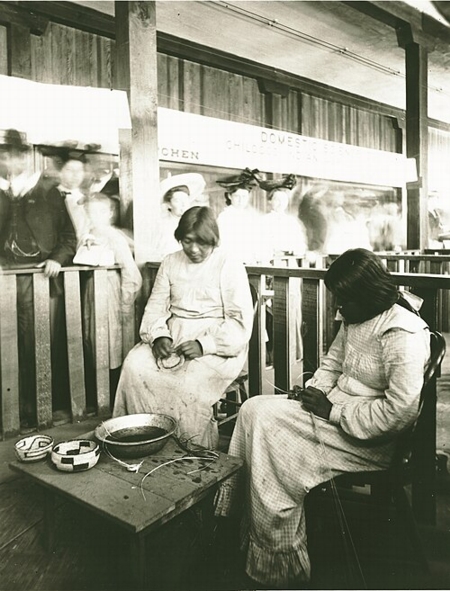
(above: Effa Rhodes and Amy Enos, of the O'odham (Pima tribe), weave baskets in the Domestic Science exhibit at the Model Indian School. Department of Anthropology, 1904 World's Fair, 1904, Missouri History Museum. Public domain, via Wikimedia Commons*)
Trading Post Era
As the O'odham transitioned toward a cash economy in the early twentieth century, basketry became a vital source of supplemental income. The period between 1910 and 1930 saw the decline of the large, utilitarian burden baskets (giho) and storage jars in favor of smaller, more decorative forms that appealed to tourists and collectors. This shift was facilitated by the expansion of the railroad and the subsequent rise of Indian trading posts. These commercial hubs acted as critical intermediaries, transforming a local craft into a globally recognized art form.
One of the most influential figures in this commercial expansion was Goldie Tracy Richmond. In 1932, during the height of the Great Depression, Goldie and her husband opened Tracy's Trading Post at San Simon on the Tohono O'odham Reservation. Goldie's role was far more complex than that of a simple merchant; she became a fluent speaker of the O'odham language and a respected member of the community, often described as running her own "New Deal program". At the peak of her operations in the 1930s, she bought and sold upwards of 20,000 O'odham baskets annually, distributing them to department stores and curio shops from coast to coast. Her efforts provided a critical financial lifeline for weavers during an era of extreme economic hardship. Simultaneously, she encouraged the development of finer techniques and more complex pictorial designs to satisfy the demands of the high-end art market.
Anglo-American Influence
The professionalization of the trade during this era led to a clearer differentiation between "tourist" baskets and "collector" pieces. While mass-produced, smaller items provided steady income, the most skilled weavers began to experiment with elaborate motifs, including desert fauna like Gila monsters, rattlesnakes, and eagles. This era also saw the increased popularity of lidded jars and flat trays, shapes that were more suited to Anglo-American home décor than traditional O'odham households. This commercial pressure, however, did not result in a loss of cultural meaning; rather, it allowed weavers to project O'odham identity into a broader public sphere.
Papago Arts and Crafts Board
The 1930s brought a significant shift in federal policy toward Native American arts. Under the leadership of Indian Commissioner John Collier, the Bureau of Indian Affairs (BIA) moved away from forced assimilation and toward the preservation of Indigenous cultures. This shift was codified by the creation of the Indian Arts and Crafts Board (IACB) in 1935, which aimed to revitalize tribal economies by promoting authentic Native products. For the Tohono O'odham, this institutional support arrived in the form of Gwyneth Harrington, a New England anthropologist hired by the IACB in 1938. Harrington worked closely with the newly established Tohono O'odham Tribal Council to create the Papago Arts and Crafts Board in 1937. Operating out of a new tribal complex in Sells, Arizona-which included an auditorium, tribal offices, and a dedicated museum - the Board provided a centralized system for marketing and quality control. Harrington traveled the reservation, purchasing baskets from remote villages and ensuring that weavers received fair prices for their labor. The Board's success culminated in the inclusion of O'odham basketry in a landmark exhibition of Indian Art at New York's Museum of Modern Art in 1940, a move that helped redefine Native crafts as "fine art" in the eyes of the American public. However, the momentum of the Papago Arts and Crafts Board was curtailed by the onset of World War II. The labor demands of the war and the subsequent shift in federal funding led to the closure of the tribal museum and the Board's formal marketing operations in 1942. Despite this setback, the foundation laid by the Board remained influential. The O'odham people continued to seek ways to manage their own artistic output, maintaining a "dream of having their own museum" that would eventually be realized decades later.
Technical Innovation
As the mid-twentieth century approached, O'odham weavers pushed the technical boundaries of their craft, developing specialized styles that showcased their virtuosity. Among the most notable of these developments were the "Wheat Stitch" and "Lace Coiling" techniques, which emerged as distinctive markers of modern O'odham artistry. The Wheat Stitch is a decorative, textured stitch that creates a raised pattern on the surface of the basket, often resembling the head of a wheat stalk. This technique was frequently applied to the "ollas" (jars) and lidded bowls of the mid-to-late century, providing a three-dimensional quality that contrasted with the smooth surface of traditional coiling.
Lace coiling, or the "lace" technique, represented a further evolution toward purely decorative and artistic forms. Unlike traditional coiling, which sought to create a solid, light-blocking surface, lace coiling utilized an open-work stitch that resulted in a delicate, semi-transparent fabric reminiscent of European lace. This technique required extreme precision and tension control, as the structural integrity of the basket depended on the careful interlocking of thin splints without the support of a solid warp. The development of lace coiling illustrates the O'odham weaver's ability to borrow and adapt external aesthetic concepts while remaining firmly rooted in traditional desert materials.
The rise of "miniature" baskets also became a hallmark of the twentieth-century O'odham repertoire. Starting in the 1930s, some weavers began specializing in tiny baskets, sometimes no larger than a thimble, using traditional yucca or increasingly, horsehair. Horsehair was a particularly challenging material, as its fine diameter required the use of bandages to protect the weaver's thumbs and immense hand strength to maintain tension. These miniatures were not merely "souvenirs" for the tourist trade; they represented a pinnacle of technical achievement, forcing the viewer to appreciate the skill required to translate complex geometric designs and pictorial scenes into a microscopic scale.
Legend of I'itoi
Throughout the 1880-1980 period, the "Man in the Maze" emerged as the quintessential O'odham design, transitioning from a sacred mythological symbol to a globally recognized icon of tribal identity. This motif depicts the figure of I'itoi, or Elder Brother, standing at the entrance to a complex circular labyrinth. According to O'odham oral history, I'itoi is the creator who resides in a cave beneath Baboquivari Mountain, the most sacred site in O'odham territory. The legend tells of how I'itoi, fearing retribution from his own creations after a period of conflict, turned his home into a maze to confuse and defeat his enemies.
Over time, the interpretation of the maze shifted toward a more philosophical representation of the human experience. By the mid-twentieth century, O'odham weavers and elders frequently described the maze as a "map of life," where every turn represents a moment of joy, sorrow, or a difficult choice. The goal of the maze is the center - a place of wisdom, dreams, and ultimate home reached at the end of life's journey. The persistence of this design in basketry served as a constant reminder of the Himdag, ensuring that even as the baskets were sold to outsiders, they carried the fundamental values of the O'odham people.
The technical execution of the Man in the Maze motif required mastery of the devil's claw material. Because the O'odham traditionally avoided dyes, the stark black lines of the labyrinth were created solely through the skillful integration of devil's claw into the yucca background. Interestingly, every basket was intentionally finished with a "dau" or door - a small break or "mistake" in the pattern. This feature was not a sign of poor craftsmanship but a spiritual necessity, designed to allow the spirit of the basket to be released so that the weaver's own soul would not be trapped within the complexity of the design. This practice highlights the fact that for O'odham weavers, a basket was never just a commodity; it was a living entity with its own spiritual trajectory.
Mid-Century Transition and the 1960s-1980s Revitalization
The post-World War II era was a time of significant social and economic upheaval for the Tohono O'odham. The return of veterans and the increasing influence of the "cash economy" led to fears among some scholars that traditional crafts would soon vanish. In the 1950s and early 1960s, a decline in the number of active weavers was noted, as younger generations sought employment in urban centers like Tucson or Phoenix.Anthropologists like Clara Lee Tanner observed that the adoption of modern technology was "wreaking havoc" on traditional beliefs, suggesting that the intricate knowledge required for harvesting and weaving might be lost. However, these predictions of cultural decline proved premature. By the late 1960s and early 1970s, a "revival" of Native American arts was underway, driven by the broader "Indian Chic" movement in American pop culture and a renewed sense of tribal activism. Consumers responded enthusiastically to Native-inspired home goods, and O'odham basketry found a new, appreciative audience. During this period, the O'odham emerged as the most prolific basket makers in the United States, producing more pieces than any other tribe. This vitality was supported by individual and group efforts within the community, including the formation of basketry organizations that organized gathering trips and workshops to teach the craft to younger members.
The 1970s also saw the professionalization of basketry conservation and the recognition of baskets as historical documents. High-profile collectors and institutions, such as the Arizona State Museum, began to systematically document and preserve O'odham work. A notable example occurred in 1974 when a collection of fire-damaged Tohono O'odham baskets was restored using advanced air-abrasive techniques with ground walnut shells, demonstrating the high value now placed on these objects as irreplaceable cultural treasures.By 1980, the O'odham basketry tradition had not only survived the pressures of the previous century but had transformed into a resilient, self-sustaining industry that provided both economic support and a powerful sense of cultural continuity for the Desert People.
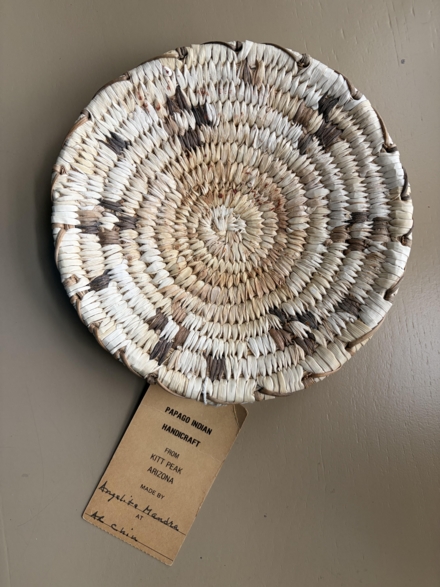
(above: Papago Indian Handicraft
with sales tag, n.d., Tohono O'odham basket. Harry and Dorothy Hazeltine
Collection. Photo: John Hazeltine)
Weaving the Future from the Roots of the Past
The century of Tohono O'odham basket making between 1880 and 1980 is a narrative of strategic resilience. By adapting their materials from the riparian willow to the desert yucca, and their techniques from the utilitarian giho to the artistic lace coil and the complex Man in the Maze pictorial, the O'odham successfully navigated the most disruptive century in their history. The influence of traders like Goldie Richmond and institutional agents like Gwyneth Harrington provided the necessary economic bridge to the outside world, but the "soul" of the craft remained firmly in the hands of the weavers who gathered their materials according to the cycles of the sun and the desert seasons.
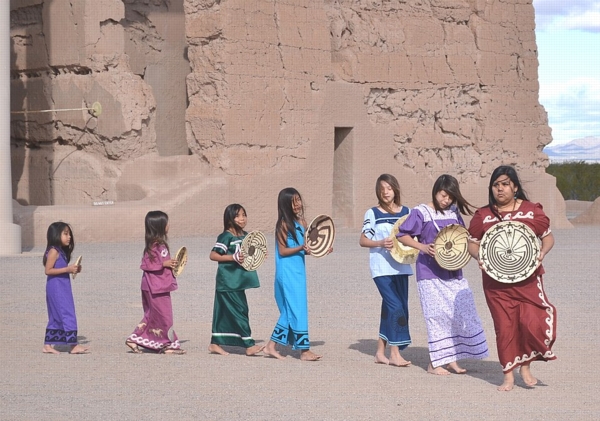
(above: Traditional welcome dances, including the O'odham basket dance. This group is the River People Basket Dancers. U.S. National Park Service. Public domain, via Wikimedia Commons*)
By 1980, O'odham basketry had transcended its origins as a survival tool to become a sophisticated medium for cultural expression and political identity. The tradition survived because it was flexible - like the yucca fibers themselves - allowing it to absorb new economic realities without snapping its connection to the Himdag. This period of evolution serves as a testament to the fact that for the Tohono O'odham, tradition is not a static relic of the past but a dynamic tool for building a future in which the Desert People remain the masters of their own artistic and cultural narrative.
We lightly edited this report, added images and provided
links to other materials to enhance it. AI is rapidly improving in
accuracy, however, the report may contain inaccurate information.
This presentation doesn't meet scholarly standards, yet
Gemini 3 AI researched and checked it for accuracy. Sources are footnoted
in the raw AI report, yet deleted here for a general audience. Please
see An Evaluation Of Gemini 3 Deep Research In
Replication Of Academic Peer Review, an April, 2026 Gemini 3 Deep Research
Report.
Prompt:
Research Plan:
(1) Search .edu and .org domains for a comprehensive timeline and history of Tohono O'odham (formerly Papago) basket weaving between 1880 and 1980. (2) Research the early period (1880-1910), focusing on the transition from traditional utilitarian baskets to pieces influenced by the burgeoning tourist trade and the arrival of the railroad. (3) Investigate the shift in materials during the early 20th century, specifically the transition from willow and devil's claw to the widespread use of yucca and bear grass. (4) Look for information on the impact of the Indian Arts and Crafts Board and various cooperatives or traders on the production and design of Papago baskets during the 1930s to 1950s. (5) Explore the evolution of design motifs and shapes, including the origin and popularization of the 'Man in the Maze' design and the development of 'wheat stitch' or 'lace' techniques. (6) Examine the economic and social role of basket weaving for O'odham women and their families throughout the mid-20th century, especially during the 1960s and 1970s. (7) Find details on the Papago Arts and Crafts Board's establishment and its efforts to preserve and market traditional crafts toward the end of the 1980 period. (8) Gather descriptive details about the gathering and preparation of desert plants to include vivid, informal narrative elements about the weavers' lives.
 Return to Arizona Art History
Return to Basketry
Return to Native American Art
Return to Topics in American Representational
Art
*Tag for expired US copyright of object image:

TFAO Museum of American Art is proudly sponsored by Traditional Fine Arts Organization, Inc., an Arizona nonprofit corporation. All rights reserved. © 2024
Links to sources of information outside of this website are provided only as referrals for your further consideration. Please use due diligence in judging the quality of information contained in these and all other web sites. Information from linked sources may be inaccurate or out of date. TFAO neither recommends or endorses these referenced organizations. Although TFAO includes links to other web sites, it takes no responsibility for the content or information contained on those other sites, nor exerts any editorial or other control over them. For more information on evaluating web pages see TFAO's General Resources section in Online Resources for Collectors and Students of Art History.
 Search Resource Library
Copyright 2026 Traditional Fine Arts Organization, Inc., an Arizona nonprofit corporation. All rights reserved.