
Hopi Silversmithing: 1850-1945
a Gemini 3 Deep Research Report
The evolution of Hopi jewelry between the mid-nineteenth century and the conclusion of World War II represents a profound narrative of cultural survival, artistic re-invention, and the strategic navigation of global economic forces. For the Hopi people, whose ancestral lands in northern Arizona comprise some of the most geologically and spiritually significant terrain in the American Southwest, the journey from traditional lapidary work to the world-renowned "silver overlay" technique was not an inevitable progression but a deliberate response to the pressures of tourism, colonial intervention, and the material scarcities of total war. While the neighboring Navajo and Zuni established their silversmithing traditions earlier and with greater commercial visibility, the Hopi path was characterized by a prolonged period of stylistic experimentation that eventually culminated in a unique aesthetic identity mirroring the intricate cosmology of the Hopi mesas.
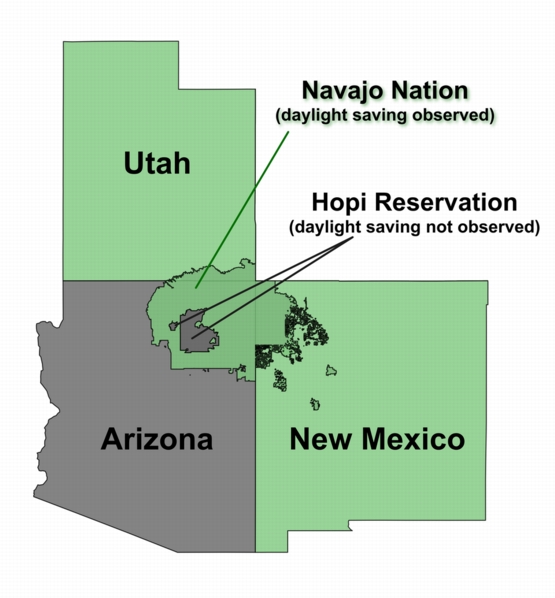
(above: Hopi Reservation, Photo: MadeYourReadThis, Public domain, via Wikimedia Commons**)
Lapidary Tradition
Before the first Hopi artisan ever struck a silver ingot, the people of the mesas possessed a sophisticated and ancient tradition of personal adornment. Throughout the nineteenth century and for centuries prior, Hopi jewelry was primarily a lapidary art, utilizing materials sourced through extensive trade networks or harvested from the local environment. This era was defined by the use of stone, shell, bone, and wood, crafted into beads and pendants that served both aesthetic and spiritual functions.
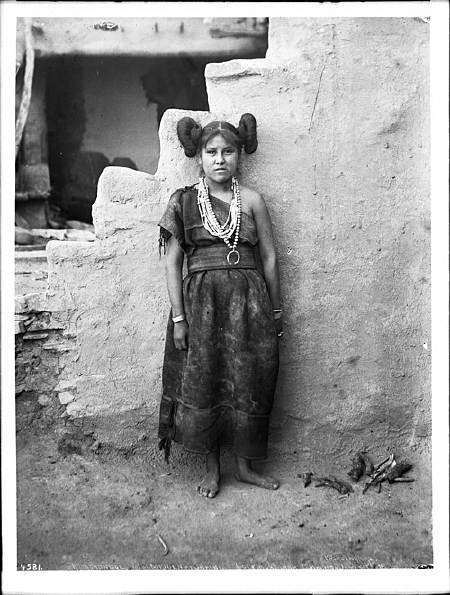
(above: George Wharton James, Mashonga, a Hopi maiden wearing rich silver ornaments made by Navajo Indians, Oraibi, Arizona, c. 1898, USC Libraries Special Collections. Public domain, via Wikimedia Commons*)
The spiritual significance of these materials cannot be overstated. Turquoise, frequently referred to as the "stone of life," was valued not merely for its rarity or color but for its association with moisture, the sky, and the life-giving properties of rain -- essential concepts for a dry-farming agricultural society. During this period, jewelry was deeply integrated into the ceremonial cycle. Mosaic earrings, which featured bits of turquoise, shell, or bone set onto a backing of wood or stone, were common among the Zuni and Hopi. These earrings were often symbolic; for example, certain mosaic patterns were said to represent "blue corn stacked up," a direct link between the wearer's adornment and the agricultural sustenance of the community.
As the nineteenth century progressed, the introduction of metal through contact with Spanish, Mexican, and later Anglo-American settlers began to shift the landscape of adornment. However, silversmithing did not initially take hold among the Hopi at the same scale as it did with the Navajo (Diné) and Zuni (A:shiwi). The Navajo were the first to learn the craft, with smiths like Atsidi Sani observing Mexican ironworkers and silversmiths as early as the 1850s. The Zuni followed suit in the 1870s.
The Hopi, by contrast, maintained a robust economy based on textiles, basketry, and agriculture. They often traded their high-quality mantas, sashes, and produce -- including corn, peaches, and melons -- for the silver jewelry produced by their neighbors. This trade relationship meant that for decades, the Hopi were consumers of silver rather than producers. It was not until the 1890s that the first recorded Hopi silversmith, Sikyatala of the First Mesa village of Sichomovi, learned the craft. Sikyatala's apprenticeship was a direct result of intercultural contact; he was taught by the Zuni smith Lanyade, who had stayed at First Mesa for four months in 1898 to trade and work. This genealogical link meant that early Hopi silverwork was stylistically indistinguishable from the heavy, stamped silver and large-stone settings characteristic of early Navajo and Zuni jewelry.
Fred Harvey Era and the Commodification of the Southwest (1900-1930)
The turn of the twentieth century brought a seismic shift to the Southwest through the expansion of the Atchison, Topeka & Santa Fe Railway and the commercial genius of the Fred Harvey Company. Fred Harvey, a pioneer of cultural tourism, established a network of restaurants, hotels, and curio shops along the rail line, fundamentally changing how Native American art was produced and perceived.
In 1926, the Fred Harvey Company introduced the "Indian Detours," which utilized "Harveycars" -- high-end automobiles like Cadillacs and Studebakers -- to transport tourists from the train stations into the heart of the Hopi and Navajo reservations. These tours were facilitated by "couriers," well-educated women who served as guides and cultural interpreters. The Harveycars acted as mobile mechanisms of observation, turning the Hopi villages into what some scholars describe as "ethnographic exhibits on a grand scale". (See Z.S. Liang, Pueblo Street Market in the 1920s, 2006, oil on canvas. The Hilbert Museum of California Art, gift of John Heckenlively, M.D.)
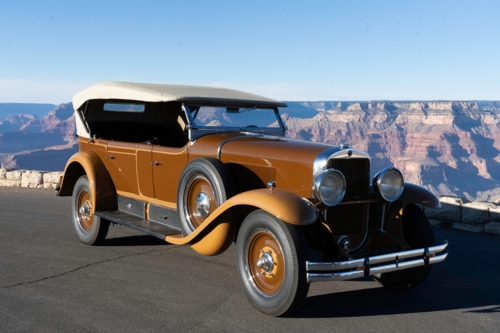
(above: 1929 Cadillac 341-B, the last remaining Harvey Car, on display at the New Mexico History Museum, 2025. Image: Courtesy of the NMHM Photo Archives)
This level of exposure created an unprecedented demand for souvenirs. However, the traditional jewelry favored by Native people -- heavy, thick-gauge silver cast in sand or tufa molds -- was often too expensive and physically heavy for the average tourist. Fred Harvey recognized this market gap and began to incentivize the production of lighter, more affordable jewelry.
Differentiation through Marketing and Symbols
During this era, the Fred Harvey Company exerted significant influence over the aesthetic direction of Southwestern jewelry. To make the pieces more "descriptive" of the Western experience for tourists, Harvey introduced specific stamps and symbols for smiths to use, such as the thunderbird (the AT&SF trademark), crossed arrows, and lightning bolts. These symbols often had little to no traditional meaning for the Hopi or Navajo artists, yet they became the hallmark of "authentic" Indian jewelry in the eyes of the traveling public.
This period exacerbated a "differentiation crisis." Because Hopi silversmiths were working within the same commercial framework as the Navajo and Zuni, and because they had learned their techniques from these neighbors, their work lacked a unique tribal signature. To the casual tourist, a silver cuff with a thunderbird stamp was simply "Indian," regardless of whether it was made in the Hopi village of Shungopavi or on the Navajo reservation.
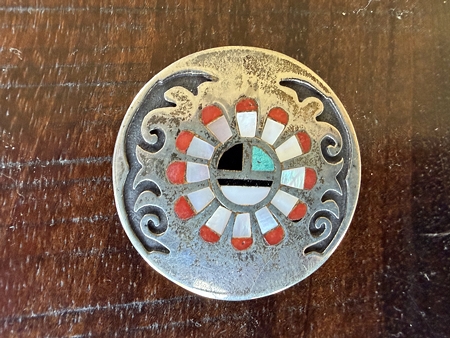
(above: Brooche, "Sunface" (Tawa), n.d., silver overlay, turquroise , coral, mother of pearl and obsidian, Harry and Dorothy Hazeltine Collection)
Museum of Northern Arizona and the Stylistic Revolution (1930-1940)
The lack of a distinct Hopi style in silverwork became a point of concern for Mary Russell Ferrell Colton and Harold S. Colton, who founded the Museum of Northern Arizona (MNA) in 1928. Mary Russell Ferrell Colton, an artist trained at the Philadelphia School of Design for Women, recognized that while Hopi pottery, weaving, and basketry were highly sophisticated and unique, their silverwork was derivative. Starting in 1930 with the inaugural Hopi Craftsman Show, Colton began a long-term project to revitalize Hopi arts. She observed that only a few Hopis were working in silver, and their designs were largely indistinguishable from the Navajo styles that dominated the market. Colton's solution was to encourage Hopi silversmiths to look toward their own heritage -- specifically the intricate patterns found in ancient pottery, textiles, and basketry as a source of design inspiration.
This was a radical departure from the Fred Harvey model. Instead of imposing external "tourist" symbols, Colton advocated for the use of indigenous motifs. She collaborated with the MNA's fine arts curator, Virgil Hubert, who sketched design concepts based on Hopi imagery and provided them to silversmiths. Two Hopi artists, Fred Kabotie and Paul Saufkie, were instrumental in translating these ideas into reality.
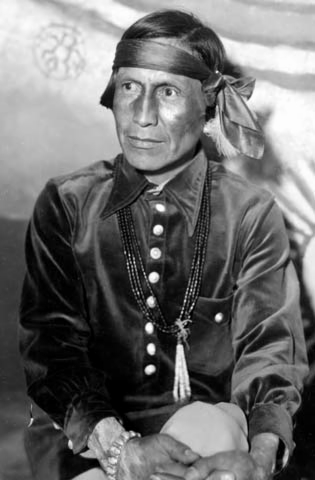
(above: Fred Kabotie, Hopi artist, c.1932, Fred Harvey photo, Grand Canyon National Park. Public domain, via Wikimedia Commons**)
Innovation of Silver Overlay
The technique that emerged from this collaboration was "silver overlay," a method that would eventually become the signature of Hopi silversmithing. Overlay is technically demanding and requires a high level of precision with a jeweler's saw.
This technique allowed Hopi smiths to render the complex geometric and representational designs of their culture-such as the rain clouds (omaw), the wave patterns of the Colorado River, and the figures of the Katsinam-with a clarity and graphic power that was previously impossible in metalwork.
World War II: Scarcity, Substitution, and Resilience (1941-1945)
The entry of the United States into World War II in December 1941 placed an immediate strain on the burgeoning Hopi jewelry industry. For the Hopi, who were already living in a remote and economically disadvantaged region, the shortage of materials was acute. The Interruption of the Silver Supply During the war years, refined silver became nearly impossible for individual artisans to obtain. For the Hopi, who were already living in a remote and economically disadvantaged region, the shortage of materials was acute.
Interruption of the Silver Supply
During the war years, refined silver became nearly impossible for individual artisans to obtain. Those who remained were forced to find alternative sources for their craft. The scarcity of silver led to the innovative use of scrap materials. Those who remained were forced to find alternative sources for their craft.
The scarcity of silver led to the innovative use of scrap materials. One of the most documented substitutions was the use of battery casings and lead-based scraps. While silver remained the "metal of choice" for those who could afford it, the broader rationing of metals like brass and copper actually made silver appear even more precious, though less accessible. In some instances, Hopi smiths experimented with copper and brass scraps to continue practicing the overlay technique. While silver remained the "metal of choice" for those who could afford it, the broader rationing of metals like brass and copper actually made silver appear even more precious, though less accessible.
In some instances, Hopi smiths experimented with copper and brass scraps to continue practicing the overlay technique. This period was a crucible for the craft; it forced a focus on design and technique over the inherent value of the material. The Return of the Veterans and the GI Bill The end of the war in 1945 did not just mean a return to normalcy; it signaled a renaissance for Hopi silversmithing. This period was a crucible for the craft; it forced a focus on design and technique over the inherent value of the material.
Return of the Veterans and the GI Bill
The end of the war in 1945 did not just mean a return to normalcy; it signaled a renaissance for Hopi silversmithing. In 1947, utilizing funding from the GI Bill, a training program was established at the Hopi High School at Oraibi to teach silversmithing to these veterans. This program was headed by the same duo who had collaborated with the MNA in the 1930s: Fred Kabotie and Paul Saufkie. In 1947, utilizing funding from the GI Bill, a training program was established at the Hopi High School at Oraibi to teach silversmithing to these veterans.
This program was headed by the same duo who had collaborated with the MNA in the 1930s: Fred Kabotie and Paul Saufkie. This training program was the foundational step toward the creation of the Hopi Silvercraft Cooperative Guild, which would formalize the Hopi style and provide a central marketing outlet for the artists.
By 1945, the differentiation between the "Big Three" Southwestern jewelry traditions -- Navajo, Zuni, and Hopi -- was fully realized. Each tribe had developed a specialization that spoke to their unique cultural values and economic adaptations. This training program was the foundational step toward the creation of the Hopi Silvercraft Cooperative Guild, which would formalize the Hopi style and provide a central marketing outlet for the artists.
What Makes Hopi Jewelry Unique?
The uniqueness of Hopi jewelry, as it stood at the end of 1945, lay in its graphic "negative space." While Navajo jewelry was additive (stamping designs onto a surface) and Zuni jewelry was additive (setting stones into a surface), Hopi overlay was subtractive. The beauty of the piece was defined by what the artist chose to cut away.
Furthermore, the integration of hallmarks became a point of tribal pride and individual identification. This shift represented the transition of the silversmith from an anonymous craftsman to a recognized artist, a change that was heavily supported by the Museum of Northern Arizona's focus on individual excellence. Artistic Evolution: From Mimesis to Modernism The trajectory of Hopi artistic style between 1850 and 1945 can be viewed as a movement from mimesis (copying the styles of others) to a form of indigenous modernism. Artistic Evolution: From Mimesis to Modernism
The result was a body of work that was simultaneously ancient and avant-garde. The bold, black-and-white (or black-and-silver) contrast of the overlay resonated with mid-century modern aesthetic sensibilities, making Hopi jewelry highly sought after by collectors who appreciated the intersection of traditional symbolism and modern design.
Legacy of 1945
The year 1945 serves as a bridge between the historical struggles of the Hopi people and the modern success of their artistic traditions. The decade that preceded it had been one of near-collapse for the craft due to the Great Depression and World War II, yet the resilience of the Hopi silversmiths, supported by the vision of the Museum of Northern Arizona and the leadership of Fred Kabotie and Paul Saufkie, ensured that the craft would not only survive but flourish.
By the end of this period, Hopi jewelry was no longer merely
a "souvenir" of the Harveycars' Indian Detours. It had become
a primary vehicle for the lean years of the war stands as a testament to
the resourcefulness of an artist population that refused to let their cultural
voice be silenced. Today, the overlay technique remains the definitive marker
of Hopi silversmithing, a craft that successfully navigated the complex
waters of the early twentieth century to emerge as a cornerstone of Global
Indigenous art. Today, the overlay technique remains the definitive marker
of Hopi silversmithing, a craft that successfully navigated the complex
waters of the early twentieth century to emerge as a cornerstone of Global
Indigenous art.
We lightly edited this report, added images and provided links to other materials to enhance it. AI is rapidly improving in accuracy, however, the report may contain inaccurate information. This presentation doesn't meet scholarly standards, yet Gemini 3 AI researched and checked it for accuracy. Sources are footnoted in the raw AI report, yet deleted here for a general audience. Please see An Evaluation Of Gemini 3 Deep Research In Replication Of Academic Peer Review, an April, 2026 Gemini 3 Deep Research Report.
Prompt:
Research Plan:
(1) Research the broad history of Hopi silversmithing from 1850 to 1945 on .edu and .org websites, focusing on the introduction of the craft and early techniques such as hand-forging and sand casting. (2) Investigate the influence of the Fred Harvey Company and the Harveycars tours on .edu and .org sites, specifically looking for how the commercial demand for lightweight, souvenir-style jewelry shaped production. (3) Find scholarly comparisons on .edu and .org domains that detail the stylistic differences between Hopi, Navajo, and Zuni jewelry during the early 20th century to identify what made Hopi work distinct. (4) Search for historical documentation on .edu and .org sites regarding the impact of World War II on Southwest jewelry making, focusing on silver shortages and the documented use of alternative materials like melted battery casings or copper. (5) Research the evolution of the unique Hopi aesthetic on .edu and .org sites, tracking the transition from Navajo-style designs to the development of the silver overlay technique spearheaded by the Museum of Northern Arizona in the late 1930s and early 1940s. (6) Gather details about key figures, trading posts, and cultural shifts on .edu and .org websites that influenced Hopi jewelry trends and artisan guilds prior to 1945. (7) Look for anecdotal or cultural narratives on .edu and .org sites about the life of Hopi silversmiths during this era to provide descriptive depth for a long-form narrative.
 Return to Jewelry Art
Return to Native American Art
Return to Arizona Art History
*Tag for expired US copyright of object image:

and
**Tag for some rights reserved:

Links to sources of information outside of our web site are provided only as referrals for your further consideration. Please use due diligence in judging the quality of information contained in these and all other web sites. Information from linked sources may be inaccurate or out of date. TFAO neither recommends or endorses these referenced organizations. Although TFAO includes links to other web sites, it takes no responsibility for the content or information contained on those other sites, nor exerts any editorial or other control over them. For more information on evaluating web pages see TFAO's General Resources section in Online Resources for Collectors and Students of Art History.
Copyright 2026 Traditional Fine Arts Organization, Inc. an Arizona nonprofit corporation. All rights reserved.