
Washington State Art History: 1850-1945
a Gemini 3 Deep Research Report
April, 2026
The trajectory of artistic expression in Washington State between 1850 and 1945 is a profound chronicle of adaptation, cross-cultural synthesis, and environmental immersion. During this formative century, the region transitioned from a remote western frontier to a recognized epicenter of Modernism. The visual arts produced in Washington were distinctly differentiated from the academic and Eurocentric traditions dominant on the East Coast of the United States. Several factors influenced this deviation, chief among them being geography. The Pacific Northwest's specific climate -- noted for its soft, diffuse light, overcast skies, and the dramatic natural topography of the Cascade Range, the Puget Sound, and the Skagit Valley -- instilled a unique visual sensibility. Washington artists became fascinated by this "silver light," developing atmospheric styles characterized by earthy tonal ranges, soft pastel colors, and the elimination of stark shadows.
Furthermore, Washington's physical orientation toward the Pacific Rim encouraged cultural interaction with Asian aesthetics and philosophies, particularly Zen Buddhism and traditional calligraphy. This stood in sharp contrast to East Coast institutions that continued to rely heavily on European conventions. The local presence of rich Indigenous traditions, specifically those of the Coast Salish and other coastal tribes, provided another layer of distinct regional iconography that white artists frequently adopted and synthesized with modernist techniques.
The Great Depression of the 1930s served as a critical event that paradoxically accelerated creative freedom. The collapse of the commercial art market and lack of private patronage prompted Washington artists to form highly independent, self-contained communities. Unbound by the demands of commercial sales or conservative curators, they established a radical, spiritually centered aesthetic that would eventually capture national attention.
Early Painting and the Aesthetics of Frontier Documentation
The earliest formal European-style imagery generated in the Washington territory was produced by itinerant artist-explorers attached to governmental, scientific, and military surveys. At the center of this period was the presumption that Native American populations were fated for extinction, fueling a drive among artists to document what was perceived as a "vanishing race."
JJohn Mix Stanley stands as one of the premier painters to engage with the Washington region in the mid-nineteenth century. Stanley was orphaned in 1828 and apprenticed to a coach maker before moving to Detroit to paint houses and signs. He became fascinated by frontier life and joined the northern railway survey commanded by Isaac I. Stevens in 1853, where he produced the first widely disseminated views of the northern west stretching to the Puget Sound.

(above: John Mix Stanley, The Abduction, 1847, oil on board, 12 58 x 17 58 inches. Public domain, via Wikimedia Commons*)
Aditional paintings by John Mix Stanley
Stanley's primary motivation was to give Native Americans a face as subjects of fine art, rather than reducing them to mere scientific specimens. He documented early missions and councils, famously capturing scenes like the Chemakane Mission. Unfortunately, Stanley's legacy was severely impacted by a massive fire at the Smithsonian Institution in 1865, which destroyed over 200 of his paintings, leaving only seven saved and resulting in a long-term decline in his artistic reputation.
By the 1880s and 1890s, artists like James Everett Stuart arrived in the Pacific Northwest to capitalize on the growing market for monumental landscapes. Stuart, the grandson of portraitist Gilbert Stuart, produced more than 5,000 paintings and drawings over a six-decade career, meticulously numbering and dating each one. Stuart spent considerable time in Tacoma and made multiple painting excursions to Alaska. His work was characterized by a traditional realism that captured the pristine qualities of glaciers, mountains, and Native settlements, directly framing the visual expansion of the American West within the cultural ideals of Manifest Destiny.

(above: James Everett Stuart, Crater Lake, Looking West from the Surface of the Water, 1882, oil on canvas, 14 x 22 inches, Spanierman Gallery. Public domain, via Wikimedia Commons*) DAS
Monumental Sculpture and Public Commemoration
Sculptural expression in Washington underwent a parallel transformation at the turn of the twentieth century, largely driven by the work of Alonzo Victor Lewis. Lewis initially studied under the western painter Edgar S. Paxson in Montana before attending the Chicago Art Academy, where he won a gold medal in life drawing in 1906. Arriving in Spokane in 1911 and later settling in Tacoma and Seattle, Lewis established a reputation as the state's foremost sculptor of public monuments.
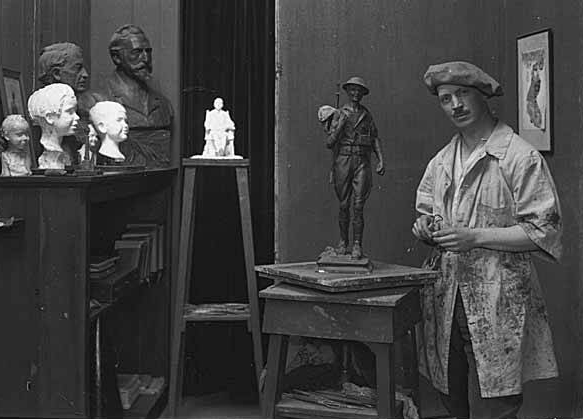
(above: Sculptor Alonzo Victor Lewis, Seattle, ca. 1923, photo, University of Washington. Public domain, via Wikimedia Commons*)
Lewis preferred to work on a monumental scale, utilizing a highly classical and realistic approach. His process was meticulous: he modeled his subjects first in clay, produced casting molds in plaster of paris, and shipped the molds to the Roman Bronze Works in Brooklyn, New York, to produce the final bronze statues through the lost-wax casting method. Lewis strongly preferred to use live models for his projects. For his 10-foot-tall Lincoln statue dedicated in Tacoma in 1918, he paid a model named William Neilson three dollars a day for 26 consecutive days.
Lewis's career was marked by severe financial difficulties and legal disputes. He frequently struggled to collect payments from city councils and community committees, and had to file lawsuits or rely on pennies collected by local schoolchildren to fund the completion of his Lincoln statues in both Tacoma and Spokane. His masterwork, a 14-foot-tall bronze Doughboy statue completed in 1922 for the 91st Division, used three tons of clay and relied on three soldiers from the local Fort Lawton army base as live models. The resulting sculpture, featuring a smiling soldier carrying German helmets as souvenirs, highlighted Lewis's ability to combine classical realism with the gritty, personal memories of local participants.
Indigenous Textiles and the Evolution of Weaving
Long before the arrival of European explorers, the Coast Salish First Nations of the Puget Sound and surrounding waterways possessed highly complex traditions of material culture. Coast Salish women turned mountain goat wool, dog hair, and native plant fibers into woven blankets of immense value. In Salish cosmology, these blankets were considered living objects that mediated between the human world and the spirit realm. Ownership of these masterpieces dictated the wealth and status of families and clans. Blankets were central to the potlatch ceremony and were widely traded along the inland waterways of the Pacific Northwest.
The introduction of European settlers and trade goods caused a distinct acculturative shift in these textile practices. Around 1860, Coast Salish women in the Cowichan Valley were introduced to European two-needle and multiple-needle knitting. By combining ancient fiber processing and spinning techniques with this new craft, they began to produce the heavy, durable, and weatherproof Cowichan sweater. This iconic garment allowed Native families to generate earnings and weather periods of severe land loss and economic uncertainty during the transition to a wage-driven economy. Spinning the wool originally relied on the large-diameter "Salish spindle," a hand spindle unique to Coast Salish culture and not found elsewhere in North America.
Rise of the Northwest School and Regional Modernism
The most significant and internationally acclaimed development in Washington's art history was the rise of the Northwest School, which flourished in the 1930s and 1940s. This movement was spearheaded by a loose collective of artists centered in the Seattle area and the rural Skagit Valley. They combined symbols of Western Washington's natural environment with the diffuse lighting of the region and traditional Asian aesthetics. The movement's defining artists became known as the "Big Four": Mark Tobey, Morris Graves, Kenneth Callahan, and Guy Anderson.
Mark Tobey
Mark Tobey was born in Wisconsin and studied briefly at the Art Institute of Chicago before working as a fashion illustrator for McCall's in New York City. He arrived in Seattle in 1921 to head the art department at the Cornish School. Tobey's style underwent a profound evolution after his conversion to the Bahá?í Faith in 1918, which led him to explore spiritual representation in visual art. In 1922, Tobey met Teng Kuei, a Chinese painter and student at the University of Washington who introduced him to Eastern penmanship.
Tobey's travels through Europe and his time studying Haiku poetry and calligraphy at a Zen monastery outside Kyoto in 1934 solidified his aesthetic direction. In 1935, while working at Dartington Hall in England, Tobey painted a series of works that established his famous "white writing" style. This technique featured a dense web of white or light-colored calligraphic brushstrokes overlaid on an abstract field of muted color. His work was distinct from Surrealist automatic writing in that it was studied, controlled, and intensely deliberate. This style captured the frenetic light and energy of environments like Seattle's Pike Place Market, effectively inventing the "all-over" painting style that would later be made famous by abstract expressionist Jackson Pollock.
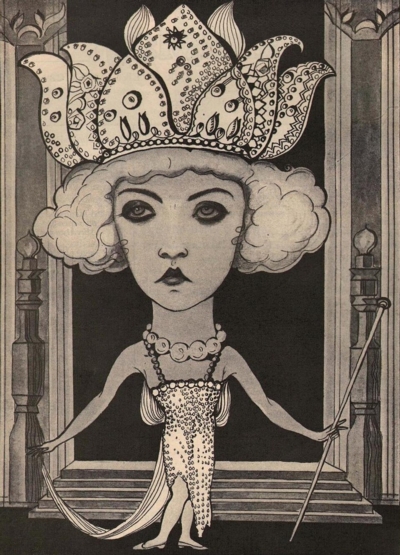
(above: Marion Davies in Beauty's Worth, caricature by Mark Tobey. Filmplay June 1922. Public domain, via Wikimedia Commons*)
Morris Graves
Morris Graves was a self-taught artist with a natural understanding of color and line. Born in Oregon and moving to Edmonds, Washington, as an infant, Graves was a moody child who spent his recuperation from pneumonia watching birds and designing mental gardens. He dropped out of high school and worked as a steamship hand, visiting major Asian ports between 1928 and 1931, where he first absorbed an affinity for Japanese acceptance of nature.
Graves shared a studio in La Conner with Guy Anderson and focused heavily on oil paintings of birds touched with strangeness. He achieved national recognition when his painting Moor Swan won an award at the Seattle Art Museum in 1933. Graves's style evolved to favor thin paper, ink, and gouache applied in thick impasto on coarse feed sacks. His paintings frequently featured birds trapped in restrictive webs or barbs of white line, a motif representing his fears for the survival of man and nature in the face of modern warfare and industry. Heavily drawn to isolation, Graves built a legendary home called "The Rock" on Fidalgo Island, retreating there to paint and meditate. He later moved to Ireland to escape the noise and technological encroachments of post-war America.

(above: Morris Graves, Church at Index, 1934, oil on canvas, Seattle Art Museum, Gift of the Marshall and Helen Hatch Foundation, in honor of the 75th anniversary of the Seattle Art Museum..Photographed by Joe Mabel in an exhibit at the Tacoma Art Museum. Public domain, via Wikimedia Commons*)
Kenneth Callahan
Kenneth Callahan served as a major catalyst for Northwest artists in the mid-twentieth century. Born in Spokane, Callahan worked as the assistant director and curator at the Seattle Art Museum for twenty years, alongside writing weekly arts columns for The Seattle Times.
Callahan's early paintings were executed in a realist style inspired by Thomas Hart Benton and the Ashcan School. However, his style transformed dramatically after he began spending his summers working as a fire lookout for the U.S. Forest Service in the North Cascades. His work became firm expressions of the relationship between man and nature, developing into highly complex swirling patterns filled with men, horses, and insects. By the early 1960s, figurative elements vanished from his work entirely in favor of pure abstraction. Callahan forcefully denied the "mystic" label placed on the group by journalists, stating in interviews that his art was firmly rooted in nature and art history rather than abstract symbolism.
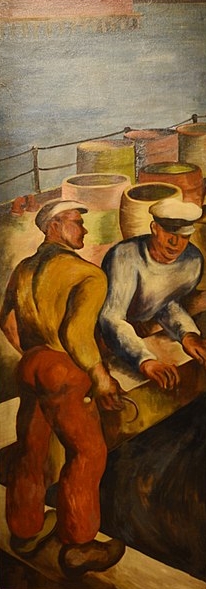
(above: Kenneth Callahan, assisted by Hovey Rich and Julius Twohy, Unloading, from the mural cycle 'Men Who Work the Ships,' c. 1935-36, oil on canvas mounted on masonite. Originally commissioned for the Seattle Marine Hospital (later Public Health Hospital, then outpatient clinic Pacific Medical Center, headquarters of Amazon.com c. 1999-2011, now Pacific Tower), the mural cycle was discovered in basement storage in 1982 in the Pacific Medical Center era, and donated to the Museum of History and Industry. Photographed by Joe Mabel in an exhibit at the Tacoma Art Museum, February 2020. Public domain, via Wikimedia Commons*)
Guy Anderson
Guy Anderson grew up in semi-rural Edmonds and was heavily influenced by the woodcarvings of Northern Coastal Native tribes and Japanese prints. After winning a Tiffany Foundation scholarship and studying masters like Rembrandt and Goya in Manhattan, Anderson returned to Washington to set up a studio. In 1959, Anderson left Seattle permanently and settled on the edge of La Conner. His style evolved from densely worked, tightly composed figurative images to massive paintings executed on long rolls of brown roofing paper. Anderson preferred a limited palette of muted earthy tones and often used the male nude as his central subject. He combined these figures with recurring symbols like circles, eggs, seeds, and waves drawn from Greek mythology and Native American iconography. His grand, sweeping brushstrokes were designed to express a universal harmony between human existence and the surrounding environment.
Helmi Juvonen
Helmi Juvonen was a contemporary of the Northwest School mystics and stands historically as one of the few prominent female artists associated with that community. Born in Butte, Montana, her family moved to Seattle when she was 15 years old. Juvonen was highly motivated and talented, taking illustration and life drawing classes while supporting herself with department store window displays and selling handmade rag dolls.
Juvonen's style was defined by a lifelong obsession with Native American art and culture. She was often invited to attend and participate in the sacred ceremonies of the Lummi, Swinomish, Makah, and Yakima tribes. During these ceremonies, she would rely on memory to draw paintings of masks, costumes, and dances later in her studio. Juvonen also produced hundreds of drawings of Native artifacts housed at the Burke Museum. Her style successfully merged aboriginal Northwest culture with modern art. Her larger works from the late 1940s through the 1960s were characterized by shallow indeterminate space and an "all-overness" akin to the white writing of Tobey and Graves.
Juvonen's life was plagued by severe trials. She suffered from manic depression and lived on the edge of poverty, selling prints at Pike Place Market for 50 cents apiece. Her eccentricities, which included living in a shack overrun with dozens of cats and a public obsession with Mark Tobey, alarmed her neighbors and family. In 1959, she was committed against her will to Northern State Hospital and was later moved to Oakhurst Convalescent Center in Elma, where she spent the final 26 years of her life.
Relative Importance of Regional Artists
To determine the relative historical and cultural importance of the specific artists mentioned above, it is necessary to consider the depth of their representation in museum exhibits, monographs, books, articles, and moving-image archives.
Mark Tobey and Morris Graves sit at the absolute pinnacle of recognition for this era. Both received intense national acclaim during World War II and the post-war years. Their works were quickly acquired by major national institutions, including the Museum of Modern Art and the Whitney Museum of American Art. Innumerable books have been written analyzing their specific styles, including Sounds of the Inner Eye: John Cage, Mark Tobey and Morris Graves and Northwest Mythologies. Furthermore, Tobey and Graves are the most heavily documented of the group on video. Rare documentaries filmed between the 1960s and 1970s, such as Mark Tobey: A Tour of Pike Place Market (1969) and Mark Tobey Abroad (1973), capture him reflecting on cubism and Picasso while exploring iconic Seattle spaces.
Guy Anderson and Kenneth Callahan occupy a second tier of substantial regional fame. While they did not achieve the same degree of international notoriety as Tobey or Graves, they are consistently included in major retrospectives exploring regional modernism at the Seattle Art Museum and the Museum of Northwest Art in La Conner. They are also featured in documentaries like Northwest Visionaries (1979), where they were interviewed in their studios discussing the forces that drove their unique aesthetic choices.
Helmi Juvonen and Alonzo Victor Lewis represent figures whose reputations were largely regional or suppressed due to personal hardships and changing taste. Juvonen worked in quasi-obscurity for decades while institutionalized. However, she has received extensive recent recognition through retrospectives at the Whatcom Museum and the Frye Art Museum, both of which actively collect her drawings, letters, and market prints. Alonzo Victor Lewis, despite sculpting some of the most recognizable public monuments in Washington's major cities, received lower long-term mention in modern books and exhibits due to the mid-century academic pivot away from classical realism toward pure abstraction.
The history of artistic expression in Washington State
between 1850 and 1945 illustrates a dynamic transition from early frontier
documentation to a highly independent school of regional modernism. The
visual arts generated during this century were fundamentally differentiated
from those of other states by the region's geographical isolation, its unique
atmospheric lighting, and its willingness to absorb Asian and Indigenous
traditions. By examining the evolution of figures like Mark Tobey, Morris
Graves, and Helmi Juvonen, it becomes clear that Washington's isolation
did not result in a cultural vacuum. Instead, it provided the vital environmental
and spiritual space necessary to forge a unique visual language that still
serves as a cornerstone of the state's cultural identity today.
We lightly edited the article, added
images and provided links to other materials to enhance it. AI is
rapidly improving in accuracy, yet the article may have inaccurate information.
Prompt:
Research plan:
(1) Search .org and .edu websites for a comprehensive historical
overview of South Dakota art between 1850 and 1945, focusing on how the
state's unique geography and the transition from frontier to settled territory
influenced artistic styles. (2) Research the specific development of various
art forms in the region, including paintings (frontier and landscape), sculpture
(monumental and local), pottery (indigenous traditions and commercial ventures
like Rushmore Pottery), and textiles (Lakota beadwork and star quilts).
(3) Identify four to six prominent artists who were active in South Dakota
during this timeframe, such as Harvey Dunn, Oscar Howe, Gutzon Borglum,
Ada Caldwell, or Nicholas Black Elk, and gather details on their life, style
evolution, and specific contributions to the state's identity. (4) Investigate
any established art colonies or artist communities that operated in South
Dakota between 1850 and 1945, particularly those located in the Black Hills
or affiliated with regional universities. (5) Analyze the cultural intersections
between Native American artistic traditions and Western settler art styles
during this period, looking for unique hybridizations or distinct parallel
developments found on .edu archival sites. (6) Assess the historical and
cultural significance of the chosen artists by searching for their presence
in museum digital collections, university archives, and scholarly articles
hosted on .org or .edu domains. (7) Examine the impact of major historical
events, such as the Homestead Act, the Wounded Knee Massacre, and the Great
Depression, on the themes and subjects of South Dakota art during the late
19th and early 20th centuries. (8) Gather descriptive details and specific
examples of artworks from this era to support a long-form narrative that
explores why South Dakota's artistic output was distinct from neighboring
Midwestern or Western states.
 Return to Washington State Art History
*Tag for expired US copyright of object image:

and
**Tag for some rights reserved:

Links to sources of information outside of our web site are provided only as referrals for your further consideration. Please use due diligence in judging the quality of information contained in these and all other web sites. Information from linked sources may be inaccurate or out of date. TFAO neither recommends or endorses these referenced organizations. Although TFAO includes links to other web sites, it takes no responsibility for the content or information contained on those other sites, nor exerts any editorial or other control over them. For more information on evaluating web pages see TFAO's General Resources section in Online Resources for Collectors and Students of Art History.
Copyright 2026 Traditional Fine Arts Organization, Inc. an Arizona nonprofit corporation. All rights reserved.