
Kansas "Pioneer Baroque" Furniture
a Gemini 3 Conversational Deep Research Report
December, 2025
If you've ever wandered through an old stone house in the Flint Hills or stepped into one of those grand Victorian manors that still dot the Kansas landscape, you might have felt a strange sense of weight -- not a heavy, depressing kind of weight, but a solidness that feels like it's anchoring you to the earth. That's the first thing people usually notice about what critics and historians love to call "pioneer baroque" furniture. It's a bit of a fancy name for something that was born out of a very gritty, practical reality. Back in the late 1800s, as settlers were pushing into the Great Plains, they weren't just bringing along plows and hopes for a good harvest; they were bringing an entire European aesthetic that they had to somehow reconcile with the raw, untamed nature of the American West. The result was this unique style of cabinetry that's got all the flourishes of the Old World but is built with the "19th-century solidity" that defined life on the frontier.
You might wonder why anyone would bother making a massive, thirteen-foot-tall buffet in a place where people were still living in sod houses just a few years earlier, but that's exactly what makes it so fascinating. To the viewers and critics of today, this furniture is admired because it feels "honest." While the later industrial age started churning out pieces covered in thin veneers to hide cheap wood, these Kansas makers were all about the "natural color" and the inherent grain of the wood itself. There's a resilience in the design that matches the people who owned it. Historians often link this aesthetic to a sense of self-reliance and thrift, a feeling that if you're going to build something, you build it to last forever and you make it a "tours de force" of what you're capable of doing with your own two hands. It wasn't just furniture; it was a competitive statement of technical innovation and artistic ambition.
Now, if you want to understand the heart of this style, you really have to look at someone like Herman Richter. He was a German immigrant who showed up in America in 1879 and eventually found his way to Alma, Kansas, right in the heart of Wabaunsee County . Richter is the quintessential example of the "cabinet-maker-undertaker" combo that was so common back then. It sounds a little macabre to us today, but it made perfect sense in the 1800s -- the same skills you needed to build a fine dresser or a sturdy table were exactly what you needed to build a coffin . You can almost see that influence in the sobriety and the structural integrity of his work. His pieces weren't just "stuff" for a room; they were built with the same gravity you'd expect from someone whose craft touched the most serious moments of life.
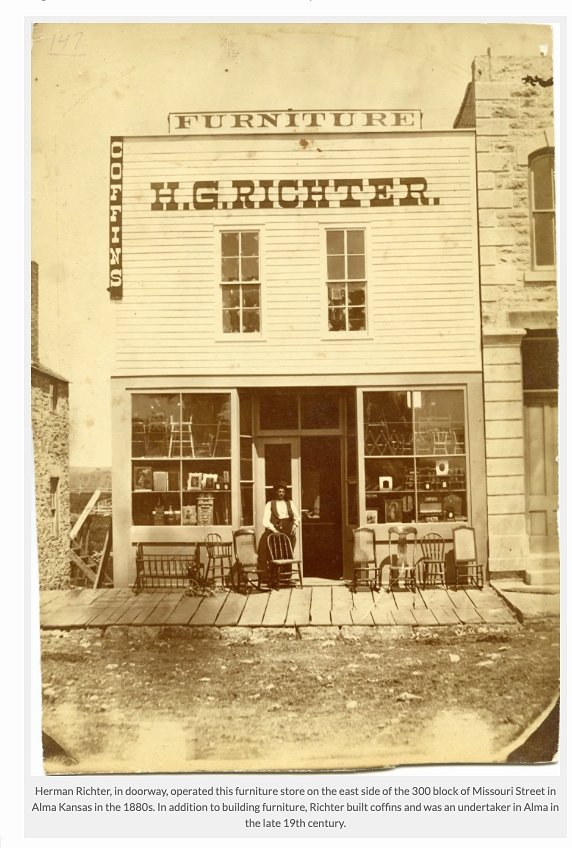
(above: Herman Richter furniture store. Photo courtesy of Wabaunsee County Historical Society and Museum)
Richter's style was heavily influenced by his German roots, leaning into that "pioneer baroque" look with deep relief carvings and massive proportions. He loved using the local hardwoods that Kansas was famous for, especially the solid black walnut that grew so abundantly in the area . If you look at pieces from that era, you'll see these incredibly detailed lion's heads on the arms of chairs or "claw feet" that look like they're ready to walk right off the rug . This wasn't just decoration for decoration's sake. Critics argue that this kind of sculptural treatment was actually pretty uncharacteristic for most American furniture of the time; it was much more ambitious, almost biomorphic in its shapes. Richter would take solid blocks of wood and mold them into organic forms, a technique that actually predates the modern sculptural methods we see today.
Life in Alma during the 1880s wasn't all just quiet woodcarving, though. Richter was a prominent businessman, but he also got caught up in the cultural tensions of the time. Kansas was going through a major temperance movement, and in 1884, Richter actually found himself on the wrong side of the law. He was one of five local businessmen arrested and convicted for selling "intoxicating liquors" right as the state was trying to shut down the saloons . It's a funny little detail that adds some human color to the story of these makers -- they were craftsmen and pillars of the community, but they were also immigrants bringing their own traditions into a place that was rapidly changing its rules. Even through those legal scrapes, Richter's legacy stayed rooted in the town. He built a stone house in Alma that still stands today, a permanent reminder of that era's commitment to building things that could withstand the passage of time .
The materials these makers had to work with really dictated the vibe of the furniture. Kansas sat near a "great hardwood area," so they had access to walnut, white oak, ash, and poplar . Walnut was the king of the parlor. If you go into the Warkentin House in Newton, which was built in the late 1880s, you can see exactly how these woods were used to signal status. They had walnut pocket doors that were actually "crafted of two woods" so that each side would match the specific theme of the room it faced . They even used birdseye maple for the master suites and intricate parquet flooring made of several different types of wood. It shows that the "pioneer" part of pioneer baroque didn't mean they were making do with scraps; they were creating high-end, sophisticated art using the best of what the land offered.
As the century started to wind down, the world of the independent cabinet maker like Richter started to feel the squeeze of the industrial revolution. It's a bit of a sad chapter, but by the early 1900s, local makers were having a hard time competing with "prison labor." Companies were using convicts to make low-priced chairs for about half the cost of what a master craftsman had to charge for labor . This economic pressure pushed makers like Richter out of the everyday furniture business and into the "better field" of high-quality cabinets, chiffoniers, and specialized cases . They had to specialize because the machines and the cheap labor couldn't replicate the soul of a hand-carved piece. Around the same time, you started seeing the rise of things like the "Wooton desk," which became a huge status symbol for the wealthy in Kansas . These were "flexible" and "adaptable" desks with all sorts of secret compartments, reflecting that high Victorian love for complexity .
People today still look back at those 1880s pieces and see an "erasure of the lines between art, craft and design" . Critics love the way a piece from that era manages to be both a functional object and a "competitive tours de force" . When you look at the "striking lion's heads" on an old walnut chair native to Leavenworth or the "massive oak sideboards" of a turn-of-the-century dining room, you're seeing the result of a very specific moment in history . It was a time when the "hardships and vicissitudes of pioneer days" didn't stop people from wanting to surround themselves with beauty that had some real weight to it .
In the end, what makes Kansas pioneer baroque so special is that it's a physical map of a cultural collision. It's got the DNA of German artisans, the raw materials of the American plains, and the "dazzle" of international exhibitions all wrapped into one solid black walnut package . Herman Richter might have spent his later years on a farm in the Beman community, but the work he and his contemporaries left behind -- those huge, ornate, indestructible pieces of furniture -- still tells the story of a frontier that was determined to be more than just a wild wilderness They carved their history right into the heart of the wood, and that's why, whether you're a critic or just someone who appreciates a good chair, you can't help but admire the honesty and the sheer ambition of what they built.
Prompt:
In about 1,200 words, using a conversational, informal, style of writing, write a narrative about unique styles of furniture made in Kansas in the 1800s, sometimes called "pioneer baroque" furniture. Do not make the narrative look like a report that has section headings, bullet points, or tables. Explain why this furniture is admired by both viewers and critics. Include information about the artistic style of Kansas furniture maker Herman Richter. Do not make the narrative look like a report that has section headings, bullet points, or tables. Research only .edu and .org sites.
We lightly edited this article, added images and provided
links to other materials to enhance it. AI is rapidly improving in
accuracy, yet the article may have inaccurate information.
 Return to Kansas Art History
Return to Quilts and Quilting
*Tag for expired US copyright of object image:

Links to sources of information outside of our web site are provided only as referrals for your further consideration. Please use due diligence in judging the quality of information contained in these and all other web sites. Information from linked sources may be inaccurate or out of date. TFAO neither recommends or endorses these referenced organizations. Although TFAO includes links to other web sites, it takes no responsibility for the content or information contained on those other sites, nor exerts any editorial or other control over them. For more information on evaluating web pages see TFAO's General Resources section in Online Resources for Collectors and Students of Art History.
Copyright 2025 Traditional Fine Arts Organization, Inc. an Arizona nonprofit corporation. All rights reserved.