
Colorado Modernism
by Grok
If you're picturing the art world in the early 20th century, Modernism often conjures up those chaotic urban scenes from Paris or New York -- think jagged cubist angles or dreamlike surrealist swirls. But let's zoom in on Colorado from 1925 to 1945, a time when the state's artists took that same restless energy and poured it into something utterly their own. Colorado modernism in painting wasn't about rejecting tradition outright; it was a bold remix, blending European avant-garde techniques with the raw, sprawling beauty of the Rockies.
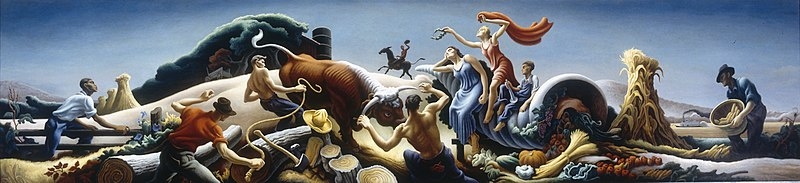
(above: Thomas Hart Benton, Achelous and Hercules, 1947, tempera and oil on canvas mounted on plywood, 62.8 x 264.1 inches, Smithsonian American Art Museum. Public domain, via Wikimedia Commons*)
Painters here grappled with high-altitude light that could make shadows dance like they're alive, endless horizons that demanded new ways of seeing space, and a frontier spirit that refused to stay sentimental. This wasn't the gritty social realism dominating the Midwest or the sun-baked adobe romanticism of New Mexico's Taos crowd -- Colorado's version felt more architectural, more tied to the land's vertical drama, and deeply infused with the era's economic upheavals. The Great Depression hit hard in the mining towns and ranchlands, sparking New Deal programs that turned empty walls into canvases, while World War II loomed, adding a layer of urgency to capturing the American West before it vanished under progress. And at the heart of it all? The Colorado Springs Fine Arts Center (CSFAC), a gleaming beacon of poured concrete and Pueblo-inspired terraces that opened in 1936, pulling in artists like a mountain magnet.
What set Colorado modernism apart was how geography wasn't just backdrop -- it was the pulse. Imagine hiking up Pikes Peak, where the air thins and colors sharpen into something almost hallucinatory; artists here translated that into paintings where forms twist and overlap, echoing cubism but grounded in boulder-strewn valleys or thundering herds against snow-capped peaks. Unlike the flat, folksy regionalism of Grant Wood's Iowa cornfields, Colorado painters leaned into the verticality of the Front Range, using modernist fragmentation to mimic fractured rock faces or wind-whipped aspens. Events played their part too -- the Dust Bowl's echoes reached the plains, fueling WPA mural projects that plastered post offices with visions of hardy miners and cowboys, but with a modernist edge: flattened perspectives, vibrant palettes borrowed from Matisse, and a subtle critique of industrialization creeping into the wilds.
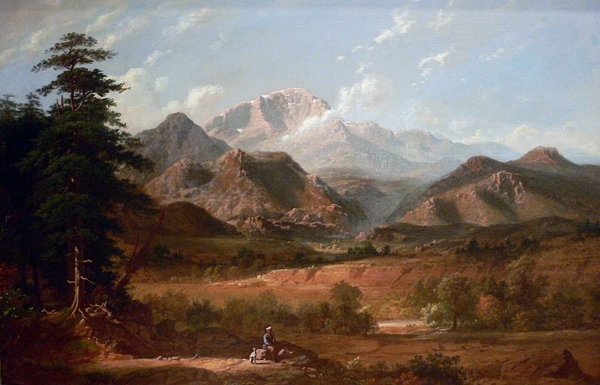
(above: George Caleb Bingham, View of Pike's Peak, 1872, oil on canvas, 28.1 x 42.2 inches, Amon Carter Museum of American Art,1967.27. Public domain, via Wikimedia Commons)
Sure, horses and landscapes dominated, but not as postcard pretties. These were modern Wests -- dynamic in their energy, celebrating resilience amid hardship. The Colorado Springs Fine Arts Center itself embodied this fusion: architect John Gaw Meem's design married sleek modernist concrete (smooth as a machine age dream) with stepped Pueblo forms, creating a building that felt like a painted mural come to life, its flat roofs and aluminum accents nodding to international style while rooting deep in Southwestern soil. No wonder it drew 5,000 visitors in its first week; it was a cultural lifeline during the Depression, hosting exhibitions that bridged local ranch hands with East Coast sophisticates.
If there's one figure who orchestrated this Colorado renaissance, it's Boardman Robinson. Born in 1876 in Nova Scotia but drawn to the U.S. like a moth to flame, Robinson landed in Colorado in the 1920s after stints in New York and Paris, where he'd soaked up the modernist ferment from Picasso's deconstructions to the Ashcan School's urban grit. By 1935, he was the driving force behind the Broadmoor Art Academy's evolution into the Colorado Springs Fine Arts Center, serving as its first director until 1947. What made him indispensable? Robinson wasn't just painting; he was building an ecosystem. As a leader in the national mural movement, he championed public art as democracy in action -- walls for the people, not just galleries for the elite. In Colorado, he differentiated the scene by insisting on a "Western internationalism," pulling European techniques into local narratives, far from the isolationist bent of other states' regionalists. His teaching emphasized draftsmanship with a modernist twist: figure-ground relationships that made bodies and landscapes interlock like puzzle pieces, influencing a generation to see the Rockies not as static scenery but as living abstractions.
Robinson's most important works from this era are his Colorado Springs Fine Arts Center frescoes, unveiled in 1936 above the main entry doors -- five spandrels depicting the arts of music, drama, dance, poetry, and painting. Take the "Music" panel: a sinewy figure strums a harp amid swirling notes that morph into mountain silhouettes, the colors -- ochres and indigos -- echoing twilight over Garden of the Gods. These weren't decorative fluff; they were manifestos. Painted in true fresco (pigments sinking into wet plaster, a nod to Renaissance masters like Giotto but updated with flattened planes and asymmetrical compositions), they integrated seamlessly with Meem's architecture, turning the building into a total artwork -- a Gesamtkunstwerk for the Dust Bowl generation.

(above: Colorado Springs Fine Arts Center, 2017. Photo by John Hazeltine, © John Hazeltine)
Unlike Diego Rivera's politicized Detroit murals, Robinson's infused quiet optimism, celebrating creativity as Colorado's salvation amid jobless lines and bank runs. Another standout: his 1934 WPA mural "The Arkansas Traveler" for the Little Rock post office, but its Colorado echo came in local commissions like the 1938 "Prometheus" series sketches, where mythic fire-stealers grapple with industrial smokestacks against alpine backdrops. These elevated Colorado modernism by proving regional subjects could carry universal weight, bridging folk tales with avant-garde form. Robinson's legacy? He made the FAC a WPA hotspot, commissioning over 20 murals and drawing talents from coast to coast, ensuring Colorado's art pulsed with national relevance while staying fiercely local.
Then there's Frank Mechau, the wild heart of this movement -- picture a cowboy who'd rather wrestle a canvas than a steer. Born in 1904 in Glenwood Springs, Colorado, Mechau grew up roping horses in the high country, but his path veered artistic after stints at the Art Institute of Chicago and Vienna's Academy of Fine Arts, where he devoured modernism's feasts: Cézanne's structural apples, Braque's splintered guitars. Back in Colorado by the late 1920s, he taught at the Broadmoor Academy in 1934, then the FAC from 1937 to 1938, molding students in a style that fused gritty Western realism with elegant abstraction.
Mechau embodied the era's contradictions -- Depression-era toughness meets aristocratic refinement -- and he was the first Coloradan to snag a Guggenheim Fellowship in 1935, using it to roam the West, sketching mustangs at dawn. His work differentiated Colorado by humanizing the frontier: horses weren't symbols of conquest but kinetic forces, painted with a sensual line that evoked both ranch dust and Parisian salons, setting it apart from California's sunnier precisionism or Texas's bolder folk vibes.
Mechau's masterpiece? That 60-foot Wild Horses fresco on the Colorado Springs Fine Arts Center's east wall, completed in 1935 and unveiled with the building's opening. Imagine a stampede frozen in mid-leap: muscular flanks twist in cubist overlaps, manes flare like abstract flames, all against a minimalist Pikes Peak horizon in earthy reds and golds. Why crucial? It was a technical triumph -- buon fresco, the ancient Italian method where colors bind eternally to plaster -- and a thematic gut-punch, capturing the untamed West as modernist poetry amid 1930s mechanization fears. Commissioned under early WPA auspices, it turned a cultural center's facade into public theater, drawing crowds who saw their landscapes reborn through fractured light and shadow, much like how Georgia O'Keeffe abstracted New Mexico's bones but with Mechau's equine vitality. Another gem: Stallion and Mares. Here, a dominant stallion rears amid mares in a teal-skied mountain nook, their forms a hybrid of bold outlines and delicate detailing -- hooves like etched crystals, manes flowing in soft neutrals. Visible grid lines beneath the translucent paint reveal his process, a modernist confession of construction over illusion. Important because it marks his evolution: from the frenzied, featureless herds of Horses at Night (1934), all thick impasto and nocturnal blues evoking urban alienation, to this intimate naturalism, reversing the era's abstraction tide. It championed the West for modern art, earning spots in MoMA and the Met, and whispered of personal joys -- family hikes in the Roaring Fork Valley -- amid global turmoil. Finally, Tom Kenney Comes Home (1944), a tender return scene with a soldier reintegrating into ranch life, its warmer tones and fluid lines reflecting wartime longing. These pieces cemented Mechau's status: dead at 42 from a car crash, he left a corpus that proved Colorado could export modernism without losing its soul.
Don't sleep on Archie Musick, though -- the unsung glue holding it all together. Born in 1902 in Kansas, Musick washed up in Colorado Springs by the 1920s, studying at the Broadmoor Art Academy (BAA) in Colorado Springs under Robinson and Mechau, then teaching there himself. A quintessential local, he embodied Colorado modernism's grassroots side: WPA foot soldier by day, studio dreamer by night, his output a bridge between elite frescoes and everyday walls. What elevated him? In a state of transient miners and artists chasing grants, Musick stayed put, painting the Pikes Peak region's pulse -- its miners, dancers, everyday heroes -- with a modernist lens that flattened space for emotional punch, distinct from Wyoming's sparse minimalism or Utah's pioneer piety. His subjects zeroed in on labor's dignity, infused with the FAC's interdisciplinary buzz: think murals nodding to Martha Graham's 1937 performances there, where modern dance met painted motion.
Musick's standout: the 1936 Hardrock Miners and The Dipper and the Plunger murals at Colorado Springs City Auditorium, twin frescoes wrapping the walls in heroic scale. Miners swing picks in rhythmic, semi-abstract poses -- bodies as interlocking geometries, faces etched with stoic grit against ochre veins of ore -- while the companion evokes hydraulic mining's raw power, water jets arcing like modernist arcs. Why vital? Born of WPA relief, they transformed a civic space into social commentary, celebrating Colorado's extractive heart without romantic gloss, their bold contours and limited palette echoing Diego Rivera but localized to Cripple Creek's boom-bust scars. These drew national eyes, listed on the National Register for their era-defining blend of regionalism and form. Another key: his 1939 Cheyenne Mountain Zoo mural in the Cheyenne Building lobby, a vibrant menagerie where animals prowl in flattened, colorful planes -- zebras striped like Mondrian grids, lions with cubist jaws -- framing the space with playful energy. Important for injecting whimsy into Depression art, it humanized modernism for families filing through during tough times, differentiating Colorado's scene with its accessible joy. And Pioneers (c. 1940), an oil capturing settlers fording streams in dynamic thrusts, its swirling blues and earth tones capturing flood-season peril with empathetic abstraction. Musick's oeuvre, scattered in post offices from Manitou Springs to Red Cloud, Nebraska, showed how Colorado artists democratized modernism-public, place-based, pulsing with the land's rhythms.
Looking back, Colorado modernism from 1925 to 1945 feels like a high-country campfire tale: intimate yet expansive, forged in adversity but lit with possibility. While other states chased urban angst or pastoral nostalgia, Colorado's painters -- led by visionaries like Robinson, Mechau, and Music -- wove the Rockies' grandeur into a tapestry of fractured light and bold narrative. The FAC stood as their forge, its walls alive with murals that whispered, "This land is modern too." Geography gifted the drama, events the urgency, subjects the soul. Even as war clouds gathered, these canvases endured, reminding us that art, like a mountain stream, carves its own defiant path. If you're ever in Colorado Springs, stand before Wild Horses at dusk-the peaks glow just like Mechau dreamed. It's not just paint; it's the West, reimagined.
We lightly edited this article, added images and provided links to other materials to enhance it. AI is rapidly improving in accuracy, yet the article may have inaccurate information.
 Return to Colorado Art History
*Tag for expired US copyright of object image:

Links to sources of information outside of our web site are provided only as referrals for your further consideration. Please use due diligence in judging the quality of information contained in these and all other web sites. Information from linked sources may be inaccurate or out of date. TFAO neither recommends or endorses these referenced organizations. Although TFAO includes links to other web sites, it takes no responsibility for the content or information contained on those other sites, nor exerts any editorial or other control over them. For more information on evaluating web pages see TFAO's General Resources section in Online Resources for Collectors and Students of Art History.
Copyright 2025 Traditional Fine Arts Organization, Inc. an Arizona nonprofit corporation. All rights reserved.