
AI Curiosities
New Hampshire Art After WWII
by Grok 4
Let's dive into the fascinating world of representational art in New Hampshire from 1945 right up to today. You know, New Hampshire has always had this quiet, rugged charm that sets its art apart -- think towering White Mountains, craggy coastlines, serene lakes, and those dramatic four seasons that turn everything from fiery autumn foliage to snow-blanketed farms into ready-made canvases. Representational art here, which focuses on depicting the real world in recognizable ways rather than abstract forms, has evolved from its roots in romantic landscapes to more intimate, realistic portrayals of everyday life and nature. But to really appreciate where it's gone since World War II, we have to glance back at the early art colonies that laid the groundwork, even though they peaked earlier. These colonies weren't just hangouts; they were creative hubs that drew artists to the state's unique geography and fostered a tradition of capturing New Hampshire's untamed beauty in a way that felt distinctly American, different from the more urban or exotic subjects in states like New York or California.
The story starts with those early art colonies, which developed in the 19th and early 20th centuries largely because of New Hampshire's stunning natural features and improving access. The White Mountain art movement kicked off around the 1820s, sparked by a tragic event -- the 1826 Willey family mudslide in Crawford Notch -- that captured national imagination and symbolized nature's awesome power. Artists flocked to the area as roads and railroads made it easier to reach from cities like Boston, turning the White Mountains into a tourist magnet. Innkeepers even invited painters to stay for free, hoping their works would advertise the region.
North Conway became the first formal artist colony in the U.S., where folks painted en plein air, emphasizing the sublime Hudson River School style with dramatic peaks, valleys, and forests. It was important because it not only boosted tourism -- hotels popped up everywhere -- but also defined New Hampshire art as grounded in landscape realism, setting it apart from the more industrialized scenes in other states.
Then there's the Cornish Colony, starting in 1885 when sculptor Augustus Saint-Gaudens sought a peaceful rural spot for his work. Drawn by the Connecticut River Valley's Italian-like vistas across to Mount Ascutney, it attracted painters, writers, and designers who built homes and studios, creating a Gilded Age social scene with pageants and gatherings. It faded by the 1930s, but its emphasis on naturalistic representation influenced later artists. The Dublin Colony, blooming around the turn of the century in the Monadnock region, developed similarly for its highland scenery, pulling in painters like Abbott Thayer and Rockwell Kent who valued the isolation for focused work.

(above: Abbott Handerson Thayer, Sketch of Monadnock Mountain, 1897, oil on canvas, Detroit Institute of Arts. Public domain, via Wikimedia Commons*)
These colonies were crucial because they established New Hampshire as an artistic haven, away from big-city distractions, and their legacy of celebrating local geography -- mountains, rivers, rural life -- differentiated the state's art from, say, the desert motifs of the Southwest or the urban grit of New York. Events like conservation efforts in the White Mountains preserved these subjects, ensuring they remained central even after 1945.
As we move into the post-1945 era, representational art in New Hampshire evolved while staying true to those roots. After World War II, the state saw a shift toward more personal and contemporary realism, influenced by returning veterans and a growing appreciation for everyday Americana. Styles moved from the impressionistic touches of earlier landscapes to sharper, more detailed depictions, often incorporating modern techniques like better color theory or photography references, but always keeping subjects recognizable.
Geography played a huge role here -- New Hampshire's compact size means artists can capture coastal scenes in Portsmouth one day and mountain vistas in Conway the next, something not as easy in sprawling states like Texas. Subject matter often highlighted rural resilience, seasonal changes, and quiet human stories, setting it apart from the abstract trends dominating places like New York. For instance, the rise of environmental awareness in the 1960s and '70s led to paintings emphasizing conservation, while tourism booms kept landscapes popular.
The New Hampshire Art Association, founded in 1940 as the state's oldest statewide group, became a key player, promoting exhibitions and supporting representational work through galleries and community shows. It helped bridge old traditions with new voices, focusing on realism amid national shifts to abstraction. Overall, NH art stayed representational because the state's identity is so tied to its land -- harsh winters, blooming springs, and that independent spirit -- making abstract detachment feel out of place compared to more cosmopolitan areas.
One of the most important artists bridging the pre- and post-1945 periods is Maxfield Parrish, who lived in Plainfield, New Hampshire, until his death in 1966. Parrish was a beloved figure, known as "America's first truly public artist" for his vibrant, dreamlike illustrations and paintings that made him a household name. His importance lies in how he popularized representational art through mass reproductions, influencing generations with his luminous colors and idealized scenes drawn from New Hampshire's landscapes. Even after 1945, as he slowed down due to age, his work embodied the state's romantic view of nature. A key artwork is "Moonlight Night, Winter" from 1942, which captures a serene, snow-covered New Hampshire scene with glowing blues and subtle light effects that highlight the quiet magic of winter isolation -- it's important because it shows Parrish's mastery of atmosphere, making everyday rural views feel enchanting and timeless. Another is "Daybreak" from 1922, though created earlier, it remained influential post-1945 as one of the most reproduced paintings ever, appearing in countless homes; its classical figures in a golden landscape underscored Parrish's role in keeping representational idealism alive amid modern changes.
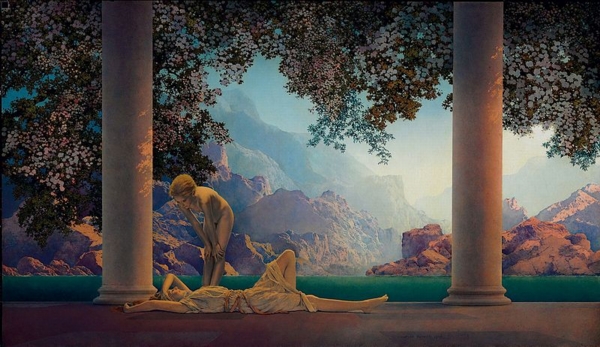
(above: Maxfield Parrish, Daybreak, c. 1922, oil on board, 26? x 45 inches, Christie's. Public domain, via Wikimedia Commons*)
Moving to more contemporary figures, Richard Whitney stands out as a giant in New Hampshire's representational scene since the 1970s. Born in 1946 in Vermont but a long-time resident of Stoddard, New Hampshire, Whitney graduated from the University of New Hampshire and trained in the Boston School tradition, focusing on portraits and landscapes. He's important for reviving classical realism in a time when abstraction dominated, earning acclaim as one of America's top portrait painters from magazines like Town & Country. His works hang in over 750 collections, including major museums and universities, and his books like "Painting the Visual Impression" have educated thousands on representational principles. One significant artwork is his portrait of former U.S. Secretary of State Henry Kissinger, which captures the subject's intellect and gravitas with meticulous detail and lighting -- it's important because it demonstrates Whitney's skill in psychological depth, making portraits more than likenesses but windows into character. Another is a landscape like "Crescent Pond in Autumn," reflecting his New Hampshire home; its vibrant colors and realistic foliage celebrate the state's seasonal beauty, emphasizing conservation themes that differentiate NH art.
Another key artist is Tomie dePaola, who settled in New Lebanon, New Hampshire, in 1973 and worked there until his death in 2020. DePaola was a prolific children's book illustrator and author, creating over 260 books with charming, representational styles that drew from folk art and his Italian-Irish heritage. His importance comes from making representational art accessible to young audiences, earning Caldecott and Newbery honors while basing many stories in New Hampshire's rural settings, which helped preserve the state's cultural narratives amid national homogenization. A standout work is "Strega Nona" from 1975, a folktale illustration series depicting an Italian grandmother in a village-like setting with warm, detailed figures and landscapes -- it's important for blending whimsy with realism, teaching moral lessons through recognizable scenes that echoed New Hampshire's small-town life. Another is "The Clown of God" from 1978, showing a juggler in medieval Italy but with universal themes; its expressive characters and vivid backgrounds highlighted dePaola's ability to make representational art emotionally resonant, influencing education and art in the state.
In the Monadnock and Lake Sunapee regions, Kevin Whitfield emerges as an important contemporary representational painter. Born and raised in New Hampshire, he graduated from Plymouth State University and has worked in a realistic style since the 1980s, focusing on landscapes and figures. Whitfield's significance lies in his commitment to capturing the state's changing environments, often addressing themes like urbanization's impact on rural areas, which sets NH art apart with its environmental focus. One important artwork is a landscape of Mount Monadnock at dawn, with precise light and shadow rendering the peak's iconic silhouette -- it's key because it continues the White Mountain tradition, symbolizing endurance in a modern context. Another is a portrait of a local farmer, emphasizing weathered features and tools; this piece is vital for portraying New Hampshire's agricultural heritage, differentiating it from more abstract rural depictions elsewhere.
Dale Tremblay, based in Portsmouth, is another standout since the 1990s, known for her representational portraits and pastels that capture emotional essence. As a member of the New Hampshire Art Association, she's important for her role in promoting female artists in a traditionally male-dominated field, with works that explore human connections amid the state's coastal and urban-rural blend. A notable work is her portrait of a young girl by the sea, using soft lighting to convey innocence and the ocean's vastness -- it's significant for blending figure and landscape, highlighting NH's coastal uniqueness. Another is a still life of local flowers, realistic yet evocative; this underscores her skill in everyday subjects, making representational art relatable in contemporary times.
Finally, Karen Haskell, working in the Lake Sunapee area since the 2000s, represents the evolution toward luminous, impression-tinged realism in landscapes. After a career change, she focused on New England's beauty, making her important for inspiring mid-life artists and emphasizing light's play on water and foliage, a hallmark of NH's variable weather. One artwork is "Sunapee Harbor in Spring," with vibrant greens and reflections -- it's important for capturing seasonal renewal, a theme central to the state's identity. Another is a winter farm scene, detailed with snow textures; this differentiates NH art by celebrating harsh yet beautiful winters, unlike milder climates elsewhere.
Today, representational art in New Hampshire thrives through associations, galleries, and residencies like the still-active MacDowell Colony, which continues to host visual artists. The evolution from colony-driven landscapes to personal, contemporary realism reflects the state's enduring bond with its geography -- mountains that inspire awe, coasts that evoke introspection, and events like annual art fairs that keep traditions alive. What makes it special is that intimacy; in a world of digital abstraction, New Hampshire artists remind us of the tangible, grounding us in the real. It's a legacy that's not just preserved but evolving, inviting new generations to paint the Granite State's story.
We added images and links to other materials
to this Gemini article to make it more interesting and educational
for your benefit. Although AI is rapidly improving its accuracy,
the article may have inaccurate information. It's safest to consider
it a base for further inquiry.
Our prompt to Gemini 2.5 Pro:
 Return to New Hampshire Art History
Return to AI Curiosities
*Tag for expired US copyright of object image:

Links to sources of information outside of our web site are provided only as referrals for your further consideration. Please use due diligence in judging the quality of information contained in these and all other web sites. Information from linked sources may be inaccurate or out of date. TFAO neither recommends or endorses these referenced organizations. Although TFAO includes links to other web sites, it takes no responsibility for the content or information contained on those other sites, nor exerts any editorial or other control over them. For more information on evaluating web pages see TFAO's General Resources section in Online Resources for Collectors and Students of Art History.
Copyright 2025 Traditional Fine Arts Organization, Inc. an Arizona nonprofit corporation. All rights reserved.